Animals in the Gaza Strip have also been dragged into the conflict between Hamas and Israel, as many have died or are dying from bombing attacks, forced abandonment, or hunger.
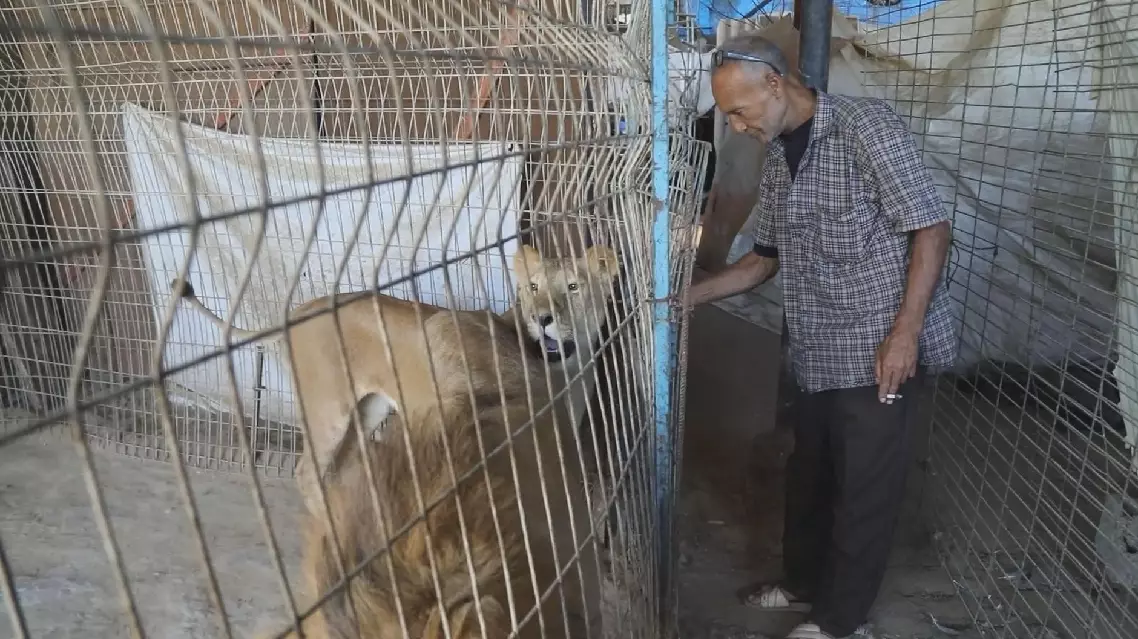
In Rafah, southern Gaza, the Jumaa family used to run the local zoo. When the war escalated, they were forced to flee their home. But they refused to leave their animals behind. Together, they evacuated with lions, monkeys, and other zoo animals to the city of Khan Younis.
But displacement was only the beginning of the hardship. Hunger became a shared reality, for both humans and the zoo animals. With food supplies nearly nonexistent, many animals died from starvation. Others died under the rubble from bombings. The survivors are now severely malnourished.
"During the war, the majority of animals in Gaza's zoos were wiped out. I managed to save some and flee with them. When the ceasefire began, I returned to the zoo. All I found were skeletons," said Fathi Jumaa, owner of the zoo.
Maryam Baz, a young woman in Gaza City, had turned her home into a shelter for dozens of cats. But heavy shelling in her neighborhood forced her to flee, leaving most of the animals behind, with no food or water.
"I had around 40 cats. Under bombing and explosions, I could only take six. I had to leave the rest, 35 cats," she said.
Moatasem Qadura, a veterinarian in Gaza City, chose to stay behind in his clinic despite the risks. He's using the limited resources available to treat injured animals.
"Most cases we receive during the war are animals pulled from under the rubble. Many suffer burns and fractures. Some die because we lack the tools and medications to save them," he said.
Animals also suffer from war, hunger in Gaza
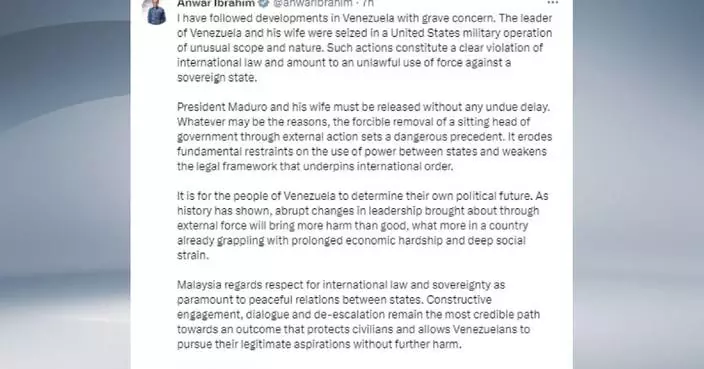
The United States cannot legitimize an operation that attacked Venezuela and captured its president, a Chinese scholar said Sunday.
On Saturday, the United States launched a large-scale strike on Venezuela, during which Venezuelan President Nicolas Maduro and his wife were 'captured and flown out of Venezuela' according to a post by U.S. President Donald Trump on his Truth Social account.
Teng Jianqun, director of the Center for Diplomatic Studies at Hunan Normal University, said in an interview with China Global Television Network (CGTN) that the aim of this operation is to take full control of Venezuela’s natural resources.
"I don't think the United States can legitimize this operation to take custody of the president of Venezuela. And also I don't think the United States can legitimize its any action in taking the oil reserves of that country. This is actually a very dangerous game played by the Trump administration. And of course, the United States would like to take full control of that country and to take full control of the natural resources, especially the large reserve of oil in Venezuela," said Teng.
Teng said Venezuela is not an isolated case but a common practice by the United States. The United States launched an invasion of Panama on Dec. 20, 1989, which continued until January 1990, with the stated objective of capturing Panamanian strongman Manuel Noriega on charges of drug trafficking and organized crime.
"We still remember the so-called sentence of the former president of Panama in the late 1980s. And this time, the president of Venezuela will be under some judicial condition (judicial proceedings) for the so-called drug trafficking and some other crimes. So I think this is not a single case for the Venezuela country, but also this is actually a practice by the United States -- to use force, to use so-called justice under law against any leaders in Latin America and the Caribbean waters," he said.

US cannot legitimize operation against Venezuela: Chinese scholar