NEW YORK--(BUSINESS WIRE)--Jul 23, 2025--
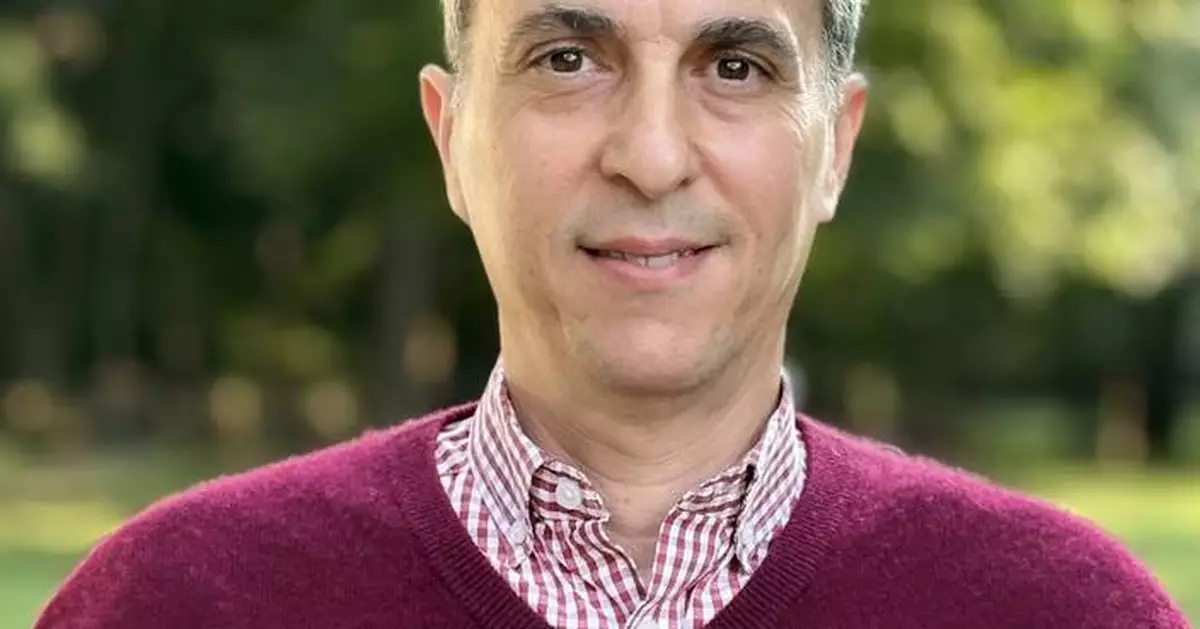
Glassbox, a leading provider of digital experience analytics for web and mobile applications, announced Ido Ophir as its Chief Customer Officer. In this newly created executive role, Ophir will work with the company’s leadership team to scale global success programs, strengthen executive partnerships, provide upscaled service for larger enterprises and deliver measurable outcomes for clients.
This press release features multimedia. View the full release here: https://www.businesswire.com/news/home/20250723800428/en/
Ophir brings more than 20 years of experience in enterprise software, with deep expertise across customer success, product and professional services sectors. Prior to joining Glassbox, Ophir spent more than a decade at Personetics, where he built and scaled its global customer success and professional services organizations. Ophir has also held key roles at NICE Actimize and helped establish the company as a market leader in financial crime and compliance.
“Glassbox is built on the idea that better data leads to better experiences,” said Alex Assim, Chairman of Glassbox. “Our clients, particularly in the financial services space, expect not just insights, but a strategic partner who understands their priorities and helps them realize long-term value. Ido’s experience scaling global customer organizations in highly regulated industries makes him the ideal leader to help us deliver on that promise.”
Last month, Glassbox was named a 2025 TrustRadius Top Rated Award Winner, recognized by customer reviews as a top player in the marketing software category. Ophir joining as CCO helps further Glassbox’s commitment to its customers and their satisfaction.
“Glassbox is uniquely positioned to help financial institutions and other enterprises turn customer behavior into meaningful business outcomes,” said Ophir. “My focus is on ensuring every client receives the strategic partnership, executive engagement, and measurable results they expect from a mission-critical platform. We have the opportunity to redefine what best-in-class customer experience looks like in regulated industries, and I’m excited to join a team that’s making that a reality.”
About Glassbox:
Glassbox is a leading AI-driven platform that captures, analyzes and optimizes user interactions across all digital channels, including web and mobile. Trusted by the world’s top enterprises in highly regulated industries, Glassbox helps organizations enhance digital experiences, improve brand loyalty and drive revenue growth. By providing 100% user session capture, real-time alerts and AI-powered insights, Glassbox empowers businesses to identify and resolve customer challenges, ensure accessibility and prevent fraud attacks. Industry leaders such as Citi Bank, SoFi and Credit.com rely on Glassbox to transform data into actionable decisions. To learn more, visit www.glassbox.com.
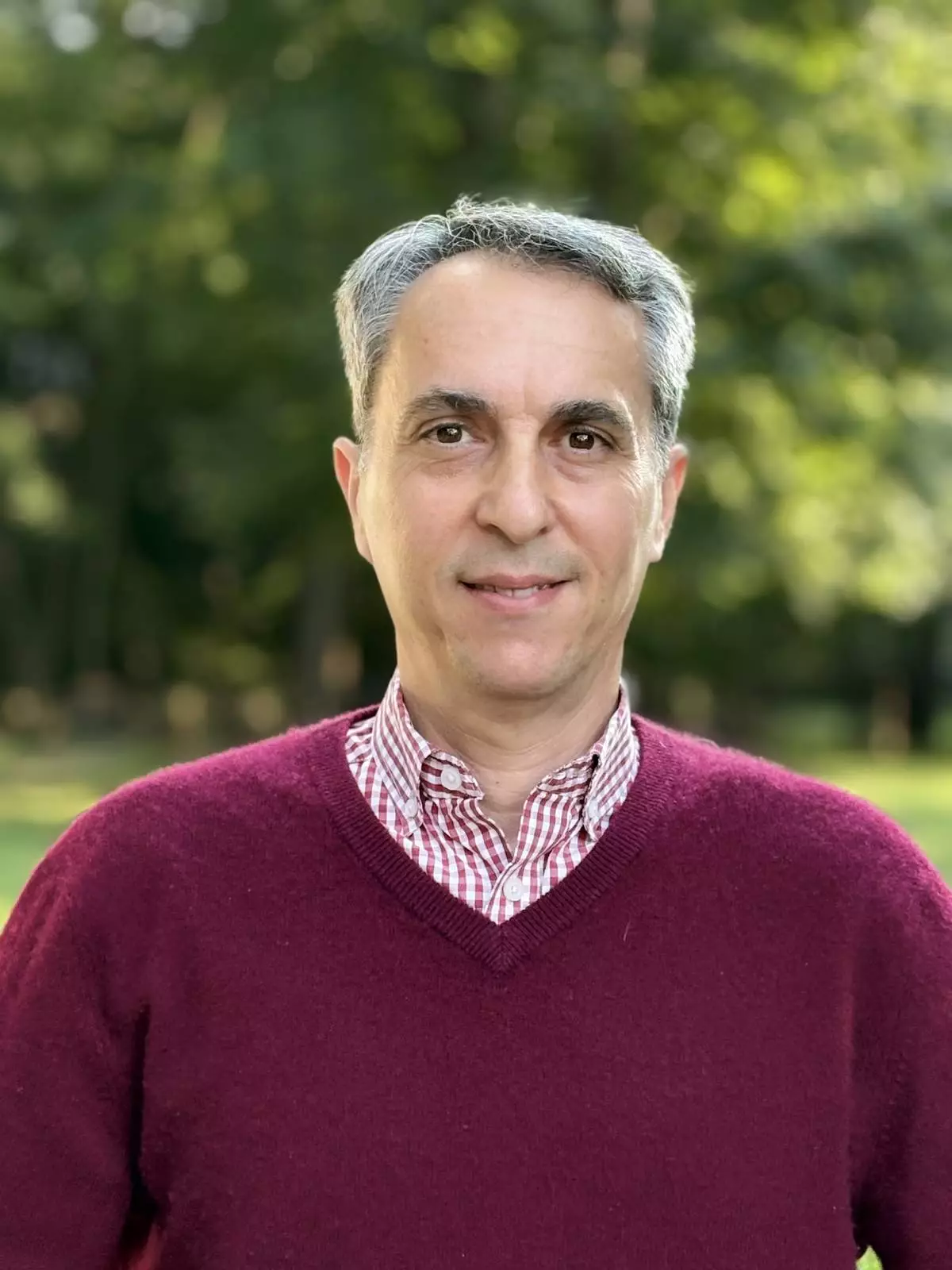
Glassbox Appoints Ido Ophir as Chief Customer Officer
JDEIDEH, Lebanon (AP) — It was not how the Rev. Maroun Ghafari had envisioned this Holy Week — for years, he had held Easter sermons in his predominantly Christian village of Alma al-Shaab in southern Lebanon, near the border with Israel.
This year, he is preaching from a Beirut suburb, beside a cardboard cutout depicting his church in Alma al-Shaab, now caught in the crossfire between Israeli forces and Hezbollah fighters.
Since hostilities erupted last month between Israel and Lebanon's Iran-backed Hezbollah militant group — in the shadow of the wider, U.S.-Israeli war on Iran — over 1,400 people have been killed in Lebanon, and more than 1 million have been forced to flee their homes.
Among those displaced from the war-torn south are thousands of Christians. They now find themselves far from their ancestral churches in Lebanon, where Christians have maintained a strong presence through centuries of Byzantine, Arab and Ottoman conquest and plenty of modern-day crises.
Christians are estimated to make up around a third of Lebanon's population of roughly 5.5 million people. With 12 Christian sects, the country is home to the largest proportion of Christians of any nation in the Arab world.
Christian villagers who stayed behind in southern Lebanon, ignoring Israel’s blanket evacuation warnings for the area, have increasingly hardened into enclaves surrounded by fierce clashes.
And though villagers in Alma al-Shaab had been uprooted before, in the 2024 Israel-Hezbollah war, this time around, they were adamant they wouldn't leave, even as airstrikes came closer and closer.
The villagers huddled in their church for protection as Israeli warplanes pounded large swaths of southern and eastern Lebanon while Israeli troops stepped up a ground invasion and Hezbollah kept firing rockets at Israel.
In his annual Easter homily, Patriarch Beshara al-Rai of Lebanon’s Maronite Church blamed both Hezbollah and Israel for the suffering wrought by the war.
“The country is going through a critical situation due to Iranian interference through Hezbollah and Israeli aggression,” he said. “Our hearts bleed for the victims of the conflict imposed on Lebanon.”
Ghafari’s brother, 70-year-old Sami Ghafari, was among the villagers who sought refuge at the church in Alma al-Shaab.
But he dashed out briefly on March 8 to tend to his garden, and was killed by an Israeli drone strike. His killing prompted the remaining villagers — including his brother — to pack up their belongings.
The U.N. peacekeepers in the area — a force known as UNIFIL that has monitored the region for nearly five decades — evacuated them to the northern suburbs of Beirut.
“We wanted to stay, but it was always possible that one of us could be targeted or killed at any moment,” the Rev. Maroun Ghafari told The Associated Press from St. Anthony Church in the northern Beirut suburb of Jdeideh, where the displaced from Alma al-Shaab came to worship on Saturday.
“Everyone is tired, and we see that war brings nothing but destruction, death and displacement.”
For many Lebanese Christians, it's a tradition on Holy Saturday — the day between Good Friday, which commemorates the crucifixion and death of Jesus, and Easter Sunday, which marks his resurrection according to the Gospels — to visit the graves of their loved ones.
This year, displaced Christians could only reflect from afar.
Nabila Farah, dressed in black for the Saturday service at St. Anthony Church, was among the last to leave Alma al-Shaab. She still feels heartbroken, a month later.
“You miss the smell of home, the lovely traditions and customs, the sounds of the bells of three churches ringing,” she said, reminiscing about her village. “As much as we experience the Easter atmosphere here, it will never be as it is over there.”
Those who remain face other challenges.
Marius Khairallah, a priest in the southern Lebanese city of Tyre, where much of the Christian community has hunkered down, says that he and his congregants are staying put "not out of stubbornness, but out of a sense of mission, to remain alongside their fellow faithful, as witnesses.”
“A significant number of parishioners have been displaced or are absent,” he said. "Yet churches still open their doors. Prayers are still raised — even with fewer voices."
Worries are mounting among Christians in the area as the Lebanese army — which seeks to stay neutral in the Israel-Hezbollah war — pulls out from parts of southern Lebanon, leaving them exposed to Israeli forces pushing deeper into the territory.
St. Antony's main priest, the Rev. Dori Fayyad, used his Good Friday sermon to take solemn note of the war’s widening toll on the southern Lebanese Christians, as the faithful recited prayers in Arabic and Syriac, a dialect of the Aramaic language spoken by Jesus.
“Today, you understand what the cross means, not as an idea, not as a concept, but because you are going through it,” he told the fully packed pews, the crowd so thick that dozens had to stand or crouch on the back stairs.
Some wiped away tears as Fayyad named one by one the southern churches, illustrated in the cardboard cutouts next to the pulpit.
“These churches in these villages are not only places of worship,” he said. “They are silent witnesses to suffering and to faith.”
Associated Press video journalist Ali Sharafeddine in Jdeideh, Lebanon, contributed to this report.
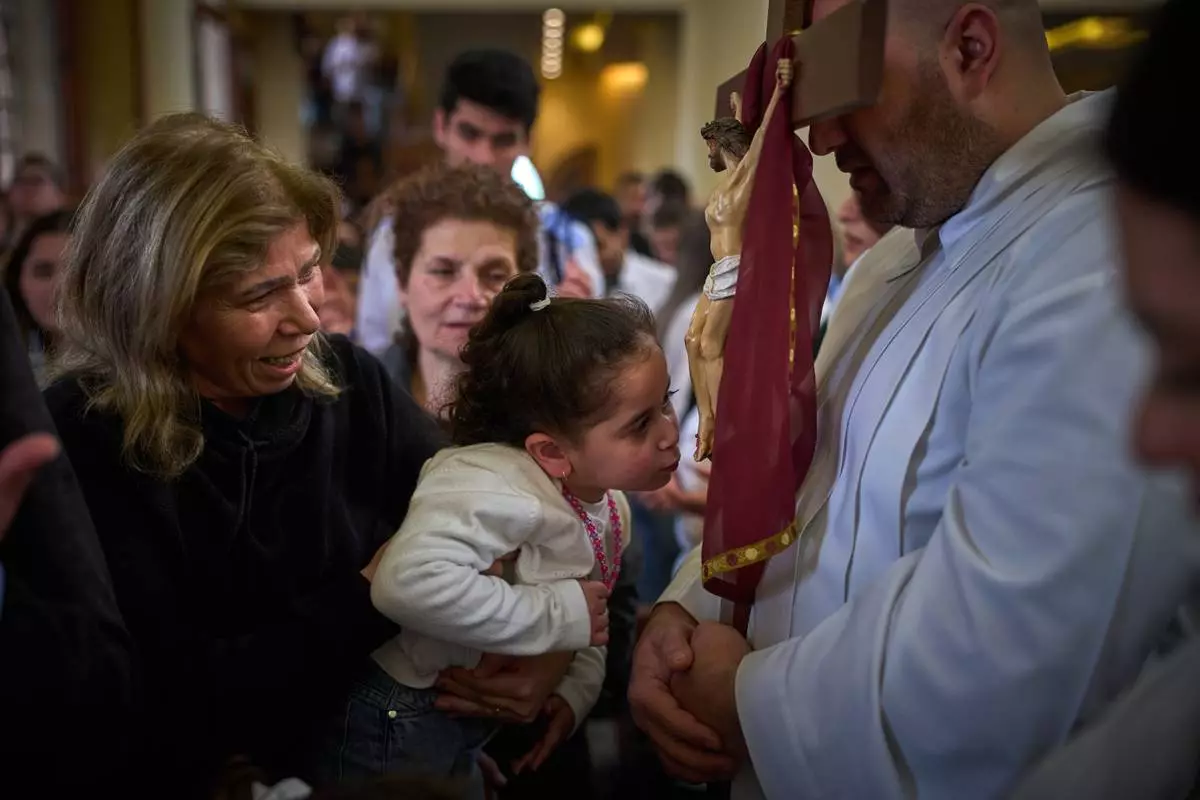
A girl kisses a cross held by a priest during Good Friday Mass at St. Anthony Church, which was devoted to expressing solidarity with Christian villagers in southern Lebanon displaced by the war in Jdeideh, a suburb of Beirut, Lebanon, Friday, April 3, 2026. (AP Photo/Emilio Morenatti)
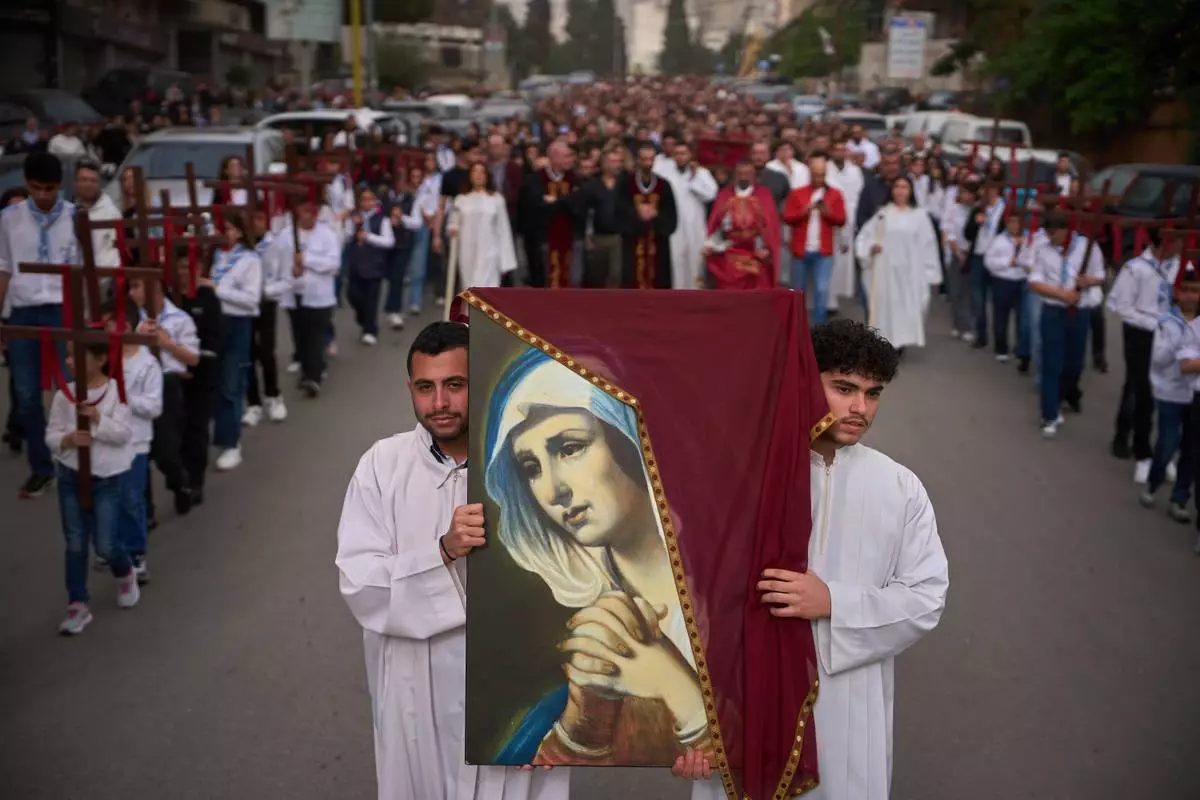
Parishioners walk in a procession after a Good Friday Mass at St. Anthony Church, which was devoted to expressing solidarity with Christian villagers in southern Lebanon displaced by the war in Jdeideh, a suburb of Beirut, Lebanon, Friday, April 3, 2026. (AP Photo/Emilio Morenatti)
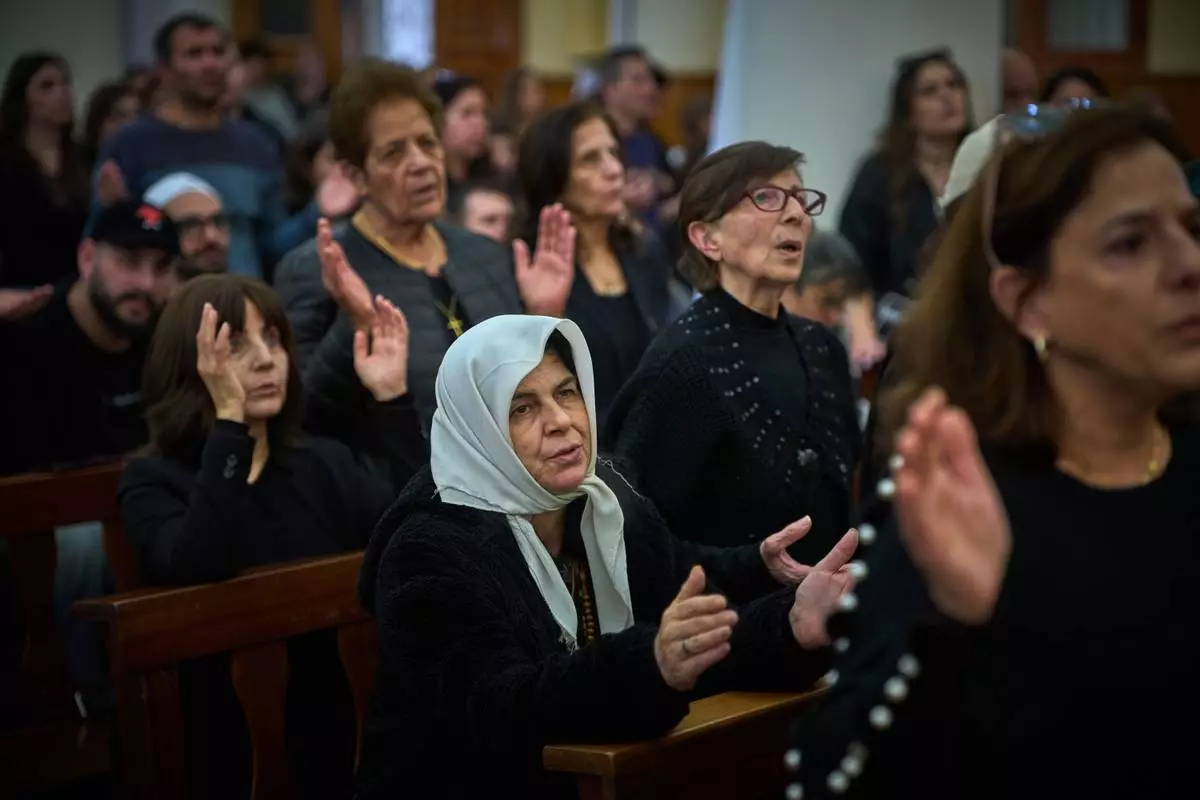
Worshipers pray during Good Friday Mass at St. Anthony Church, which was devoted to expressing solidarity with Christian villagers in southern Lebanon displaced by the war in Jdeideh, a suburb of Beirut, Lebanon, Friday, April 3, 2026. (AP Photo/Emilio Morenatti)
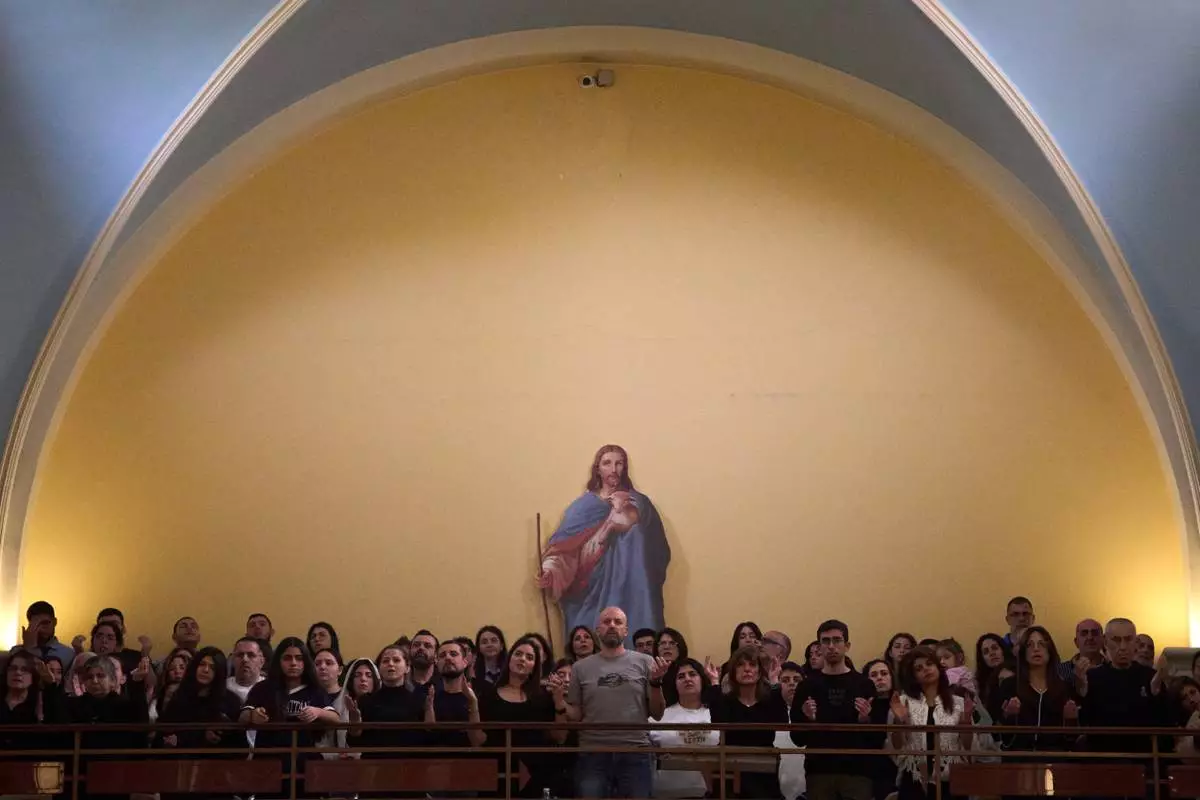
Worshipers pray during Good Friday Mass at St. Anthony Church, which was devoted to expressing solidarity with Christian villagers in southern Lebanon displaced by the war in Jdeideh, a suburb of Beirut, Lebanon, Friday, April 3, 2026. (AP Photo/Emilio Morenatti)
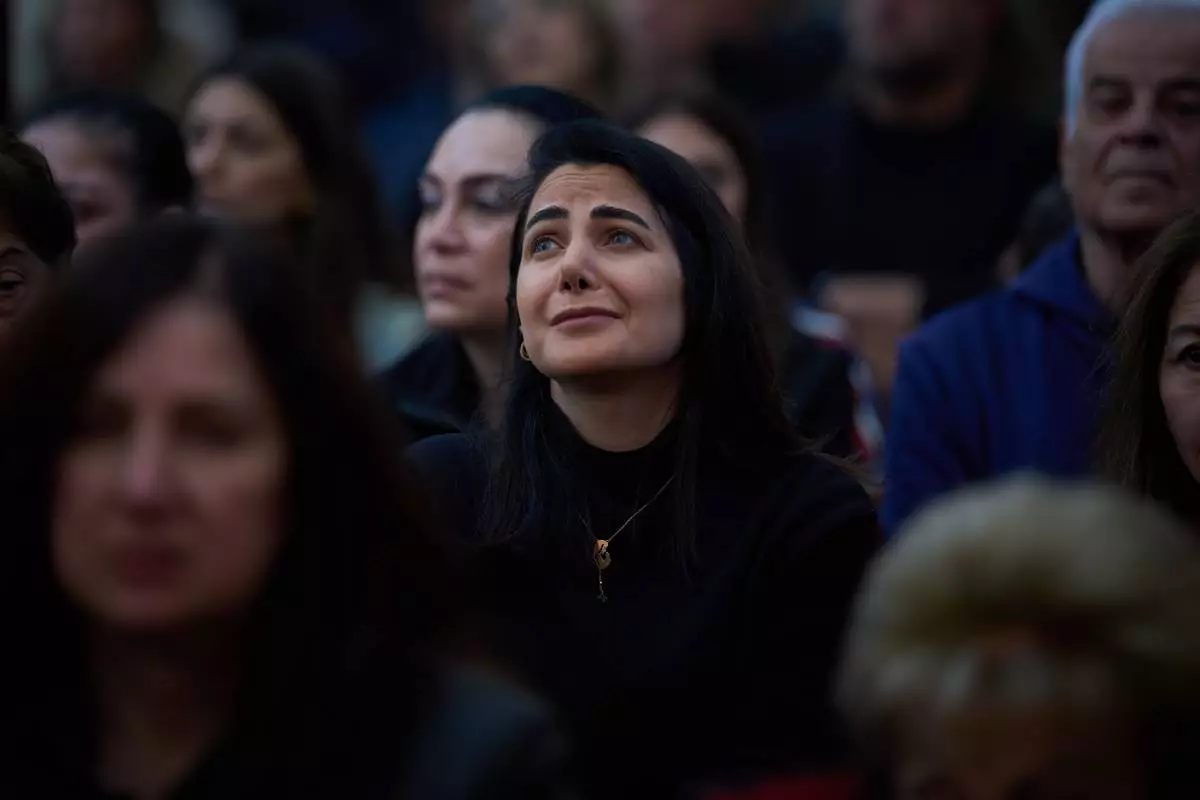
Worshipers pray during Good Friday Mass at St. Anthony Church, which was devoted to expressing solidarity with Christian villagers in southern Lebanon displaced by the war in Jdeideh, a suburb of Beirut, Lebanon, Friday, April 3, 2026. (AP Photo/Emilio Morenatti)