A judge on Wednesday rejected a Trump administration request to unseal transcripts from grand jury investigations of Jeffrey Epstein years ago in Florida, though a similar request for the work of a different grand jury is pending in New York.
U.S. District Judge Robin Rosenberg in West Palm Beach said the request to release grand jury documents from 2005 and 2007 did not meet any of the extraordinary exceptions under federal law that could make them public.
The Justice Department last week asked the judge to release records to quell a storm among supporters of President Donald Trump who believe there was a conspiracy to protect Epstein’s clients, conceal videos of crimes being committed and other evidence.
In 2008, Epstein cut a deal with federal prosecutors in Florida that allowed him to escape more severe federal charges and instead plead guilty to state charges of procuring a person under 18 for prostitution and solicitation of prostitution.
Deputy Attorney General Todd Blanche had asked judges in Florida and New York to unseal transcripts from grand jury proceedings that resulted in indictments against Epstein and former girlfriend Ghislaine Maxwell, saying “transparency to the American public is of the utmost importance to this Administration.”
Federal grand juries hear evidence in secret and then decide whether there is enough for an indictment. Experts say the transcripts likely would not reveal much because prosecutors typically are trying only to present enough material to get charges and don't introduce the entire investigation.
Epstein, a wealthy financier, years later was arrested in 2019 on federal sex trafficking charges, while Maxwell was charged with helping him abuse teenage girls.
Epstein was found dead in his cell at a federal jail in New York City about a month after he was arrested. Investigators concluded he killed himself. Maxwell later was convicted at trial and sentenced to 20 years in prison.
The case attracted attention because of Epstein and Maxwell’s links to famous people, including royals, presidents and billionaires. It also led to some of the biggest conspiracy theories animating Trump’s base.
The furor over records has been stoked by the Justice Department. In February, far-right influencers were invited to the White House and provided with binders marked “The Epstein Files: Phase 1” and “Declassified.” The binders contained documents that had largely already been in the public domain.
The department on July 7 acknowledged that Epstein did not have a list of clients. It also said no more files related to his case would be made public.
A two-page memo that bore the logos of the FBI and Justice Department, but that was not signed by any individual, said the department determined that no “further disclosure would be appropriate or warranted.”
Meanwhile, a House Oversight subcommittee voted Wednesday to subpoena the Justice Department for files. The full committee issued a subpoena for Maxwell to testify before committee officials in August. And Sen. Adam Schiff, D-Calif., called on Attorney General Pam Bondi and FBI Director Kash Patel to appear before the Senate Judiciary Committee.
CARACAS, Venezuela (AP) — President Donald Trump is set to meet Thursday at the White House with Venezuelan opposition leader María Corina Machado, whose political party is widely considered to have won 2024 elections rejected by then-President Nicolás Maduro before the United States captured him in an audacious military raid this month.
Less than two weeks after U.S. forces seized Maduro and his wife at a heavily guarded compound in Caracas and brought them to New York to stand trial on drug trafficking charges, Trump will host the Nobel Peace Prize laureate Machado, having already dismissed her credibility to run Venezuela and raised doubts about his stated commitment to backing democratic rule in the country.
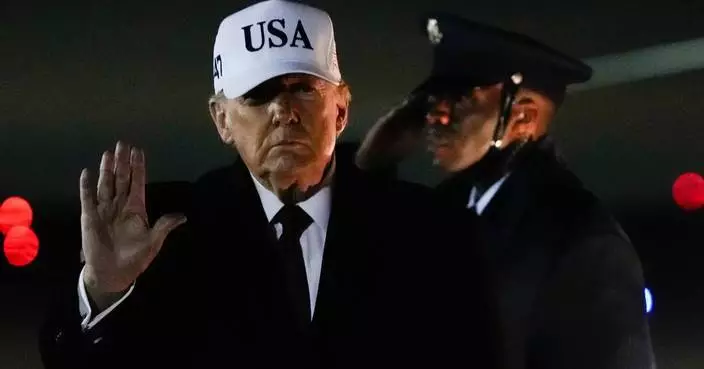
“She’s a very nice woman,” Trump told Reuters in an interview about Machado. “I’ve seen her on television. I think we’re just going to talk basics.”
The meeting comes as Trump and his top advisers have signaled their willingness to work with acting President Delcy Rodríguez, who was Maduro’s vice president and along with others in the deposed leader's inner circle remain in charge of day-to-day governmental operations.
Rodríguez herself has adopted a less strident position toward Trump and his “America First” policies toward the Western Hemisphere, saying she plans to continue releasing prisoners detained under Maduro — a move reportedly made at the behest of the Trump administration. Venezuela released several Americans this week.
Trump, a Republican, said Wednesday that he had a “great conversation” with Rodríguez, their first since Maduro was ousted.
“We had a call, a long call. We discussed a lot of things,” Trump told reporters. “And I think we’re getting along very well with Venezuela.”
In endorsing Rodríguez, Trump has sidelined Machado, who has long been a face of resistance in Venezuela. She had sought to cultivate relationships with Trump and key advisers like Secretary of State Marco Rubio among the American right wing in a political gamble to ally herself with the U.S. government. She also intends to have a meeting in the Senate on Thursday afternoon.
Despite her alliance with Republicans, Trump was quick to snub her following Maduro’s capture. Just hours afterward, Trump said of Machado that “it would be very tough for her to be the leader. She doesn’t have the support within or the respect within the country. She’s a very nice woman, but she doesn’t have the respect.”
Machado has steered a careful course to avoid offending Trump, notably after winning last year’s Nobel Peace Prize, which Trump coveted. She has since thanked Trump and offered to share the prize with him, a move that has been rejected by the Nobel Institute.
Machado’s whereabouts have been largely unknown since she went into hiding early last year after being briefly detained in Caracas. She briefly reappeared in Oslo, Norway, in December after her daughter received the Nobel Peace Prize on her behalf.
The industrial engineer and daughter of a steel magnate began challenging the ruling party in 2004, when the nongovernmental organization she co-founded, Súmate, promoted a referendum to recall then-President Hugo Chávez. The initiative failed, and Machado and other Súmate executives were charged with conspiracy.
A year later, she drew the anger of Chávez and his allies again for traveling to Washington to meet President George W. Bush. A photo showing her shaking hands with Bush in the Oval Office lives in the collective memory. Chávez considered Bush an adversary.
Almost two decades later, she marshaled millions of Venezuelans to reject Chávez’s successor, Maduro, for another term in the 2024 election. But ruling party-loyal electoral authorities declared him the winner despite ample credible evidence to the contrary. Ensuing anti-government protests ended in a brutal crackdown by state security forces.
Janetsky reported from Mexico City. AP Diplomatic Writer Matthew Lee in Washington contributed to this report.
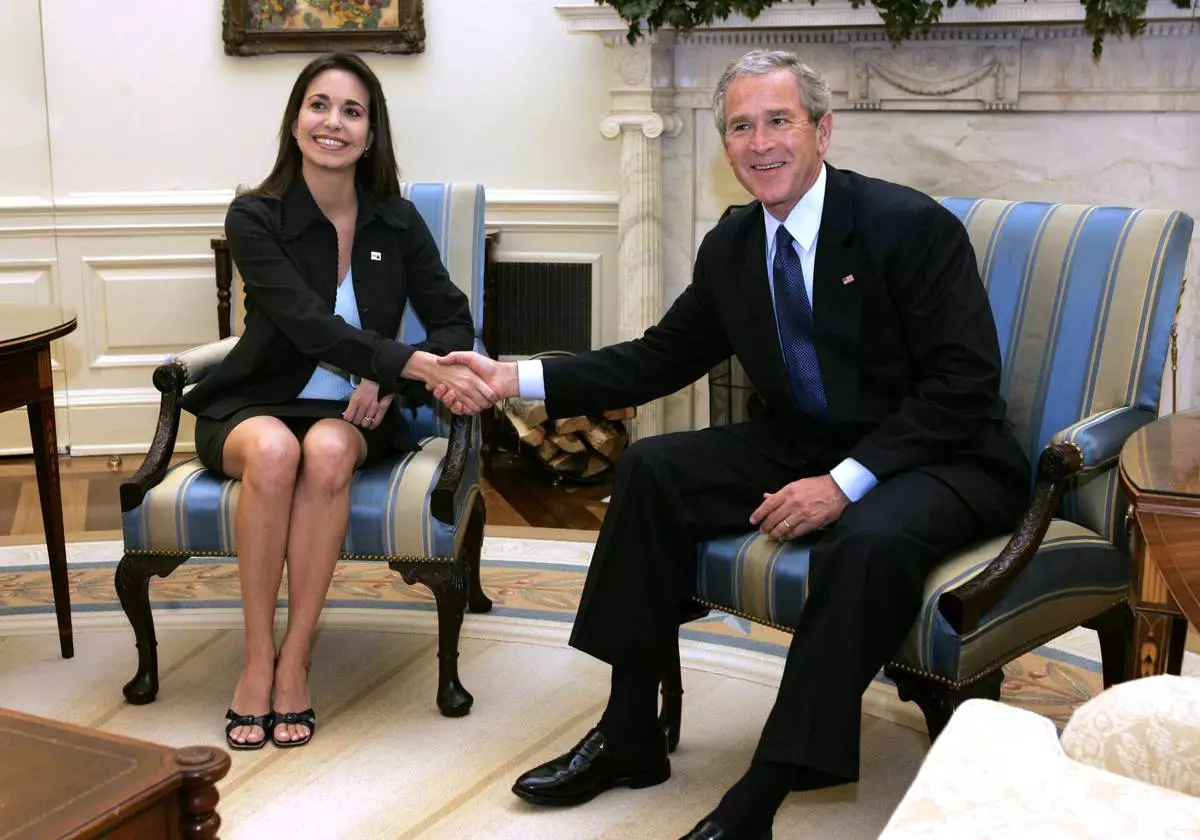
FILE - U.S. President George Bush, right, meets with Maria Corina Machado, executive director of Sumate, a non-governmental organization that defends Venezuelan citizens' political rights, in the Oval Office of the White House, Washington, May 31, 2005. (AP Photo/Charles Dharapak, File)
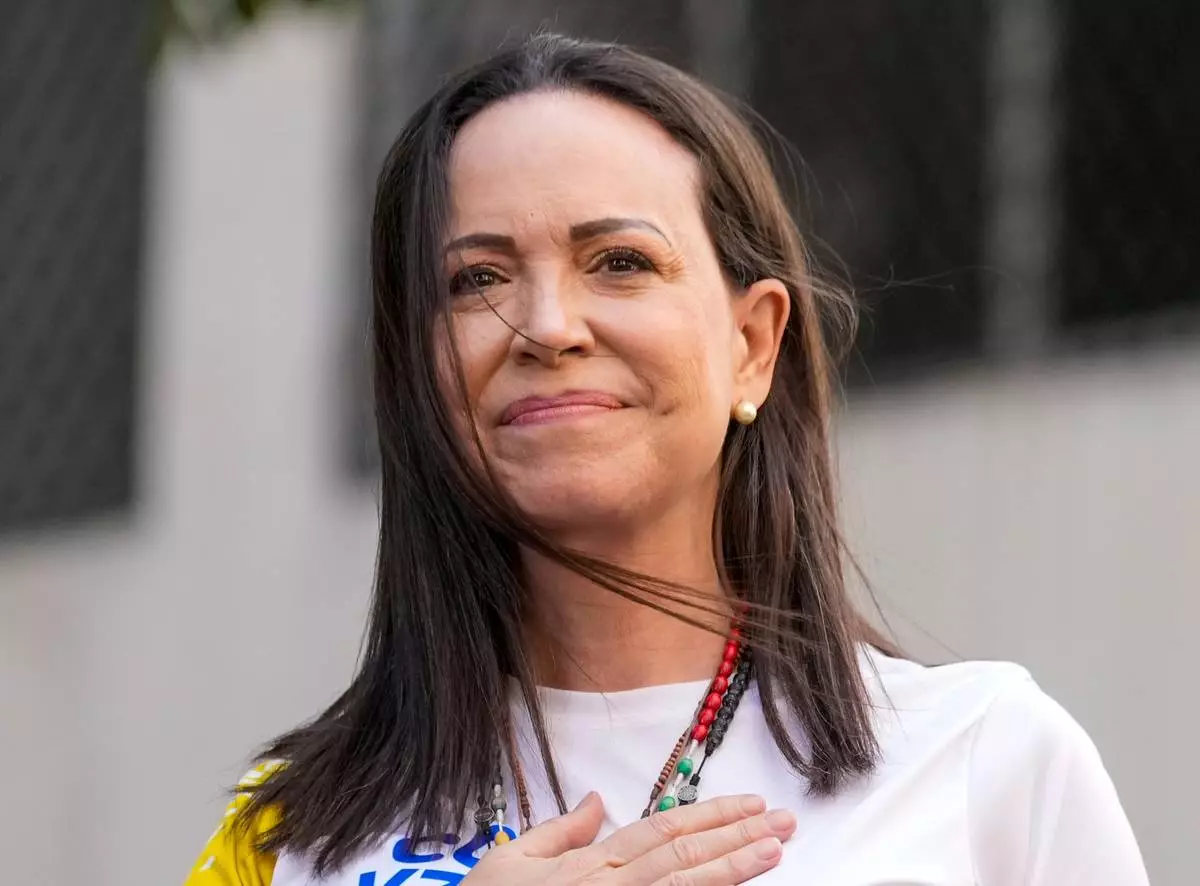
FILE - Opposition leader Maria Corina Machado gestures to supporters during a protest against President Nicolas Maduro the day before his inauguration for a third term, in Caracas, Venezuela, Thursday, Jan. 9, 2025. (AP Photo/Ariana Cubillos, file)