Donald Trump is determined to maintain Republicans' threadbare House majority this fall and avoid a repeat of his first presidency, when Democrats won control of the chamber in midterm elections and went on to impeach him twice.
This time, Trump is involved in candidate recruiting, dispensing strategic advice and promising he will not let history repeat. But a number of moving pieces and unanswered questions remain.
Democrats, buoyed by the results of several 2025 elections, are more than eager for the president to be the GOP front man, though they also must improve their stock with voters and attract growing numbers of independents. Ongoing redistricting battles, spurred on by Trump, could affect the eventual outcome. As Trump tries not to repeat 2018, he also is fighting midterm trends that have gone against a president’s party for generations.
While House control is at the center of the midterms, which party holds the majority will be settled by a small share of the chamber's 435 seats. Democrats are targeting nearly 40 Republican-held districts, while Republicans are aiming for a few dozen seats held by Democrats.
Here are some key questions and data to explain the fight ahead.
The party in the White House rarely gains seats or even holds ground in the midterms. Sometimes the losses are steep, especially in the first midterms of a presidency. Second-term presidents struggle, too.
“It’s an amazing phenomenon,” Trump acknowledged at a recent House Republican retreat.
The 2026 dynamics do not compare perfectly with the past: Trump is neither a traditional new president nor a traditional second-term president because he is in a second but nonconsecutive term.
Regardless, since 1932, the sitting president’s party has lost an average of 26 House seats, and only three times has the president’s party gained seats. The last time it happened was 2002: Republicans picked up seats in the first national elections after the 9/11 attacks that made George W. Bush a wartime president at the time of the midterms.
Every other president since 1992, including Trump in 2018, has seen House control shift to the opposition in the first midterm after flipping control of the Oval Office.
Another dynamic may be a factor this year: Dozens of House members have announced they are not running for reelection, putting a record number of seats up for grabs at this point in the midterm election cycle.
Democrats romped in November, winning elections across the country. In House special elections last year, Democrats outperformed their 2024 presidential election results, often by double digits. They also flipped Republican-held legislative seats nationwide.
Off-year elections are not perfect predictors of midterm results. But it is notable that Democrats saw the same trends in 2017 before their 2018 midterm victories during Trump’s first term. Republicans had similar strong performances in 2009, the first year of Barack Obama’s presidency, before the GOP wave of 2010.
Trump and House Republicans are going all-in together, regardless of his job approval ratings.
Georgia Rep. Brian Jack, the Republicans’ chief candidate recruiter, said many GOP recruits got into their races because they are “very inspired by President Trump” and that voters will see nominees “talking about the president’s successes.”
Jack said Republicans cannot afford to distance themselves from the president. Yet Trump's approval was just 40% in January, according to recent Associated Press-NORC Center for Public Affairs Research polling, a number that has remained consistently low throughout his second term. That could make it harder to excite core Republicans and reach independents at the same time.
Past presidents’ approval rating in the lead-up to midterms has largely correlated with their party’s performance, according to Gallup polling. For example, Bill Clinton’s approval rating was on the decline heading into the “Republican Revolution” of 1994. He rebounded substantially four years later when House Democrats gained seats.
Another dynamic that could be good news for Democrats this fall: A new Gallup survey found that 45% of U.S. adults now identify as independents. Those adults appear, increasingly, to be driven by their unhappiness with the party in power, according to Gallup’s analysis.
Pocketbook issues promise to be at the forefront of this fall's campaigns.
In a December AP-NORC poll that asked adults an open-ended question about what issues they want the government to focus on this year, 4 in 10 people mentioned health care costs. That put the issue about even with immigration. About one-third cited cost-of-living in general. About 2 in 10 U.S. adults wanted the federal government to focus on housing costs.
Democrats are hammering affordability on everything from groceries to health care. They argue that Trump won in 2024 because of inflation but that he has not fixed the problem. Trump has referred to the affordability “hoax” but also nodded to political and economic realities: He has urged Republicans to reach a deal on health insurance premium subsidies and he is promising populist action on housing costs.
Trump wants Republicans to sell the sweeping domestic policy law passed last summer as a tax cut for working-class voters. Democrats note that tax advantages in the law, which passed with only GOP support, are tilted to wealthier Americans while the law cuts health care and other programs.
Despite national narratives, Republicans and Democrats insist candidates still matter, especially in swing districts.
“It’s really district-by-district,” said Illinois Rep. Lauren Underwood, a chief candidate recruiter for Democrats. “It’s not just going to be a narrative of ‘the suburbs reject Trump’ or something like that.”
Certainly, national mood matters, Underwood said. If voters’ broad opinions shift back in Trump’s favor on the economy, for example, Republicans stand to do better. But a party with the broad trends in its favor still must have a credible candidate that voters in a competitive district see as plausibly representing them.
That’s why Democrats were especially sorry to see Rep. Jared Golden, a moderate who represents most of small-town and rural Maine, forgo reelection, while Republicans expect to nominate former two-term Gov. Paul LePage. Golden represents one of 13 Democratic-held districts that Trump won in 2024.
Democrats are excited about candidates such as Elaine Luria, a military veteran and former congresswoman. She is trying to reclaim a Virginia swing district that has not changed substantially since she won it in 2018.
Republicans began this Congress with a 220-215 advantage. But Trump pushed GOP-led states to draw new maps that would increase the number of congressional districts where Republicans have an advantage. Democratic-led states responded with their own plans. Notably, the redistricting back-and-forth was led by the two largest states, GOP-run Texas and Democratic-led California.
Altogether, Republicans appear to have increased their odds by a handful of districts. But several states are either still considering new maps or their revisions are being challenged in court.
If the Supreme Court guts a key provision of the Voting Rights Act, some states controlled by Republicans could theoretically move quickly to eliminate Democratic advantages in districts where nonwhite voters have sway.
In short, the national map is up in the air.
The final version could help Republicans keep a majority. Or Republicans could succeed in increasing the number of GOP-friendly districts yet still lose House control because voter discontent flips enough districts anyway. In that case, the gerrymandering would simply mean a smaller new majority for Democrats.
AP Polling Editor Amelia Thomson-DeVeaux in Washington contributed to this report.

President Donald Trump listens to a question from a reporter after signing a bill that returns whole milk to school cafeterias across the country, in the Oval Office of the White House, Wednesday, Jan. 14, 2026, in Washington. (AP Photo/Alex Brandon)
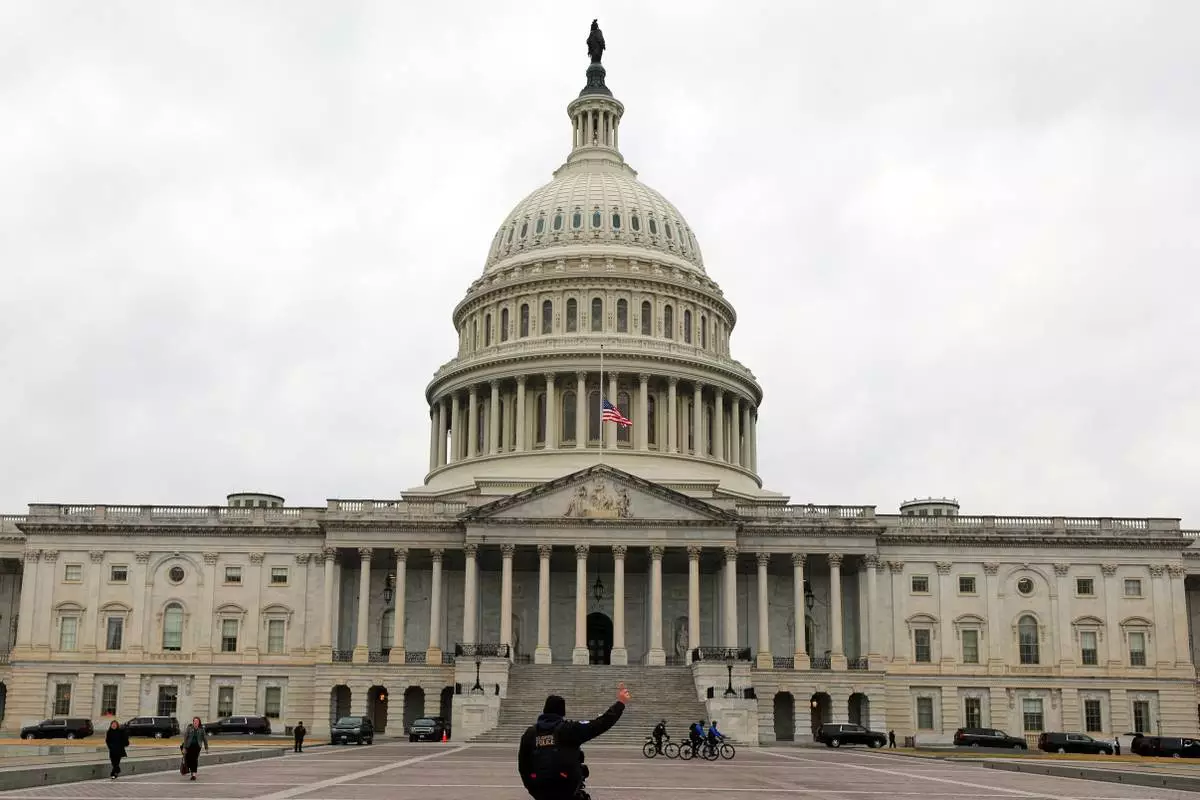
A U.S. Capitol Police officer patrols on the East Front of the U.S. Capitol, Wednesday, Jan. 14, 2026, in Washington. (AP Photo/Rahmat Gul)