The conflict in southern Syria's Sweida province has displaced more than 145,000 people, with some of them fleeing to the neighboring Daraa province and Rural Damascus governorates and most remained in the province, the United Nations Office for the Coordination of Humanitarian Affairs (OCHA) said on Wednesday.
According to the OCHA, the violence between July 20 and 22, including mortar attacks, drone strikes, aerial surveillance, and sporadic clashes, has caused civilian casualties while leaving tens of thousands to flee despite a declared truce.
The U.N. reported widespread outages in electricity, water, fuel, and telecommunications services, while food insecurity is worsening due to market disruptions and the closure of bakeries.
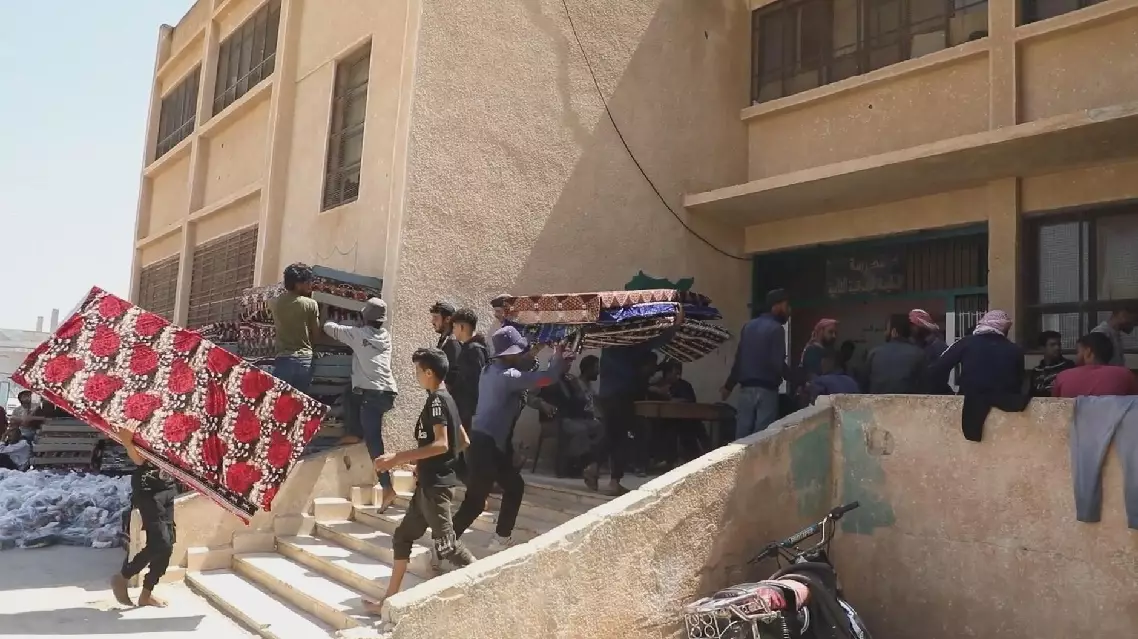
A China Global Television Network (CGTN) stringer visited a shelter in Daraa Governorate where various supplies were urgently needed and the people who fled were still in shock.
"We used to live in peace, happiness and comfort. We never killed anyone, stole, robbed or harmed any life. We lived with the Druzes of Shahba and we were safe. We were like brothers and never differentiated between Druzes and Bedouins. One of our young men contacted the Druzes and asked if we should leave. They said, 'Yes, you have two hours to leave.' He asked if we could take our belongings with us. They said no, we had to leave empty-handed. Before I even hung up the phone, a group of them rushed in and started attacking. They killed children, women and young girls without mercy. My daughters and two other girls were hiding on the north side of the house. One of them died and another was injured. I lost everything and could never go back to my home. We left Sweida and as you can see, we had nothing," said Omaima, a displaced person.
Local officials and charity operators said the number of displaced people is huge and that despite the local community's efforts to provide supplies, asylum seekers are still in urgent need of basic necessities.
"In this difficult situation, we received instructions from the governor to set up a shelter. We found an available facility at the Nahtah town school and accommodated as many people as possible. The number of displaced people is huge. About 120 families arrived here today, a total of about 700 people. We had difficulty collecting blankets and sleeping mats, but the local community came to our aid and provided supplies. However, the shelter does not have electricity at the moment. We are working with volunteers. May Allah bless us and the problem will be solved soon," said Nahtah mayor Farid Fallani.
"We have secured the shelter for now, but we urgently need toilets, bathrooms and water tanks. We also need medical teams and first aid kits because there are pregnant or breastfeeding mothers. An hour later, we received another 42 displaced families from the Bedouin community in Shahba. Today we opened a fourth shelter for them in eastern Al-Malihah. We are currently preparing it. We still need furniture, lighting, water tanks and basic medical kits to help all our displaced brothers and sisters. There are sick people, including the elderly and those with chronic diseases such as hypertension and diabetes," said Mohamed Hassan Al-Amari, vice president of the local charity.
Syria's clashes cause massive displacement, serious humanitarian crisis
Syria's clashes cause massive displacement, serious humanitarian crisis
Syria's clashes cause massive displacement, serious humanitarian crisis