NEW YORK (AP) — The fertility rate in the U.S. dropped to an all-time low in 2024 with less than 1.6 kids per woman, new federal data released Thursday shows.
The U.S. was once among only a few developed countries with a rate that ensured each generation had enough children to replace itself — about 2.1 kids per woman. But it has been sliding in America for close to two decades as more women are waiting longer to have children or never taking that step at all.
The new statistic is on par with fertility rates in western European countries, according to World Bank data.
Alarmed by recent drops, the Trump administration has taken steps to increase falling birth rates, like issuing an executive order meant to expand access to and reduce costs of in vitro fertilization and backing the idea of “baby bonuses” that might encourage more couples to have kids.
But there's no reason to be alarmed, according to Leslie Root, a University of Colorado Boulder researcher focused on fertility and population policy.
“We’re seeing this as part of an ongoing process of fertility delay. We know that the U.S. population is still growing, and we still have a natural increase — more births than deaths,” she said.
The U.S. Centers for Disease Control and Prevention released the statistic for the total fertility rate with updated birth data for 2024.
In the early 1960s, the U.S. total fertility rate was around 3.5, but plummeted to 1.7 by 1976 after the Baby Boom ended. It gradually rose to 2.1 in 2007 before falling again, aside from a 2014 uptick. The rate in 2023 was 1.621, and inched down in 2024 to 1.599, according to the CDC's National Center for Health Statistics.
Birth rates are generally declining for women in most age groups — and that doesn’t seem likely to change in the near future, said Karen Guzzo, director of the Carolina Population Center at the University of North Carolina.
People are marrying later and also worried about their ability to have the money, health insurance and other resources needed to raise children in a stable environment.
“Worry is not a good moment to have kids,” and that’s why birth rates in most age groups are not improving, she said.
Asked about birth-promoting measures outlined by the Trump administration, Guzzo said they don’t tackle larger needs like parental leave and affordable child care.
“The things that they are doing are really symbolic and not likely to budge things for real Americans,” she said.
The CDC's new report, which is based on a more complete review of birth certificates than provisional data released earlier this year, also showed a 1% increase in births — about 33,000 more — last year compared to the prior year.
That brought the yearly national total to just over 3.6 million babies born.
But this is different: The provisional data indicated birth rate increases last year for women in their late 20s and 30s. However, the new report found birth rate declines for women in their 20s and early 30s, and no change for women in their late 30s.
What happened? CDC officials said it was due to recalculations stemming from a change in the U.S. Census population estimates used to compute the birth rate.
That's plausible, Root said. As the total population of women of childbearing age grew due to immigration, it offset small increases in births to women in those age groups, she said.
The Associated Press Health and Science Department receives support from the Howard Hughes Medical Institute’s Department of Science Education and the Robert Wood Johnson Foundation. The AP is solely responsible for all content.
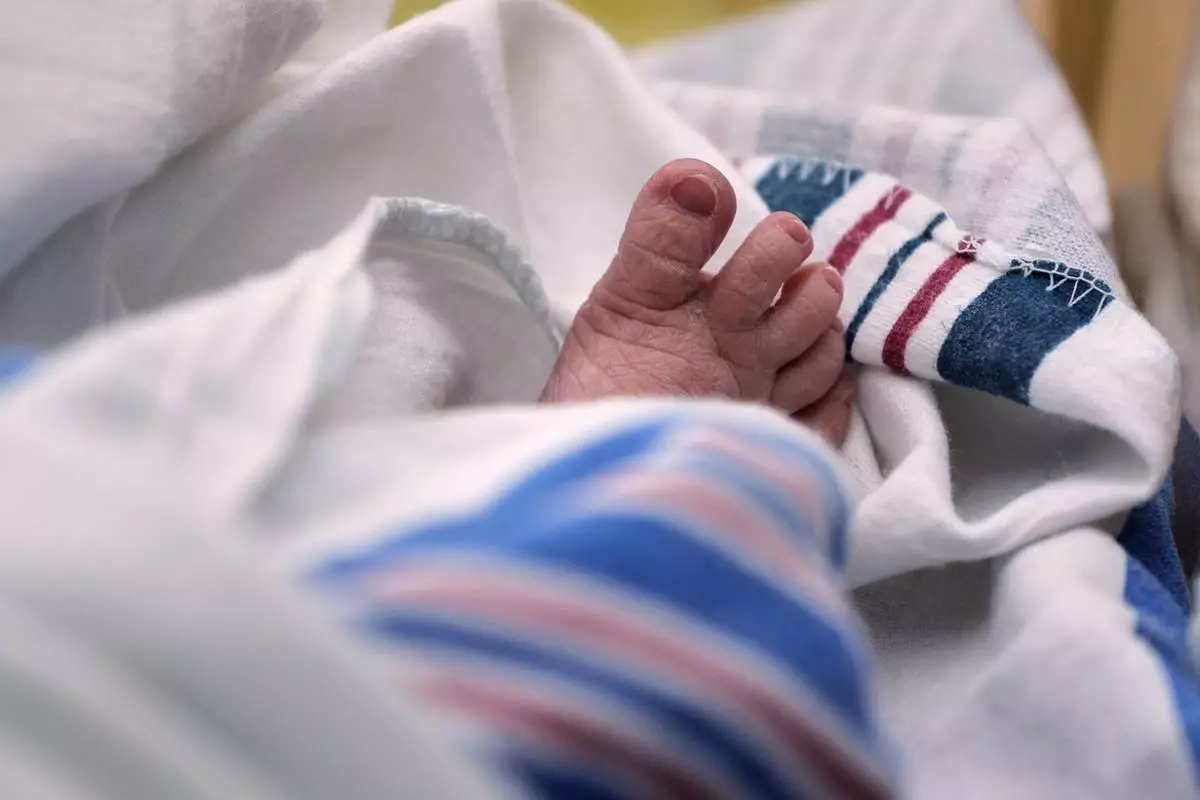
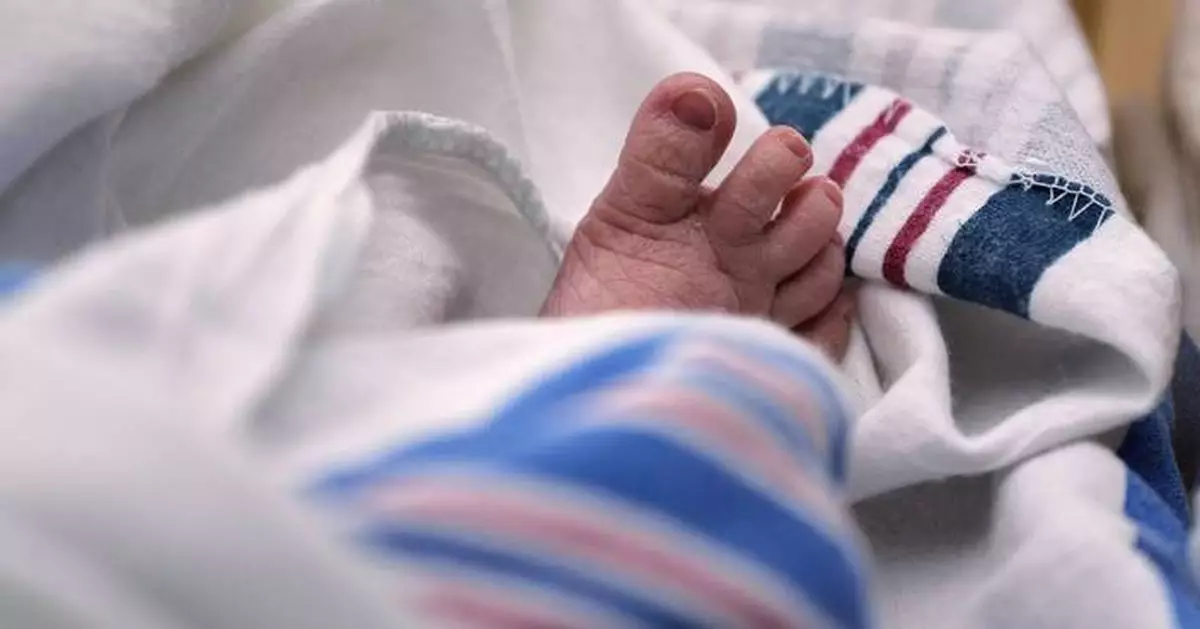
FILE - The toes of a baby are seen at a hospital in McAllen, Texas, on Wednesday, July 29, 2020. (AP Photo/Eric Gay, File)
SYDNEY (AP) — A father and son are suspected by officials to have killed 15 people on a popular Australian beach, shocking a country where gun violence is rare. The government on Monday, a day after the shootings, proposed tougher new gun laws amid criticism that officials didn't take seriously enough a string of antisemitic attacks.
Here's a look at what to know from the attack at Bondi Beach:
Little is known about the suspects in the attack on Sydney's famous Bondi Beach, but there was widespread shock when officials said that the two men pictured firing weapons in social media videos were related.
The 50-year-old father, who was killed, arrived in Australia in 1998 on a student visa, authorities said, and was an Australian resident when he died. Officials wouldn’t confirm what country he had migrated from.
His 24-year-old Australian-born son, who was shot and wounded, is being treated at a hospital
The target was a Hanukkah celebration where hundreds had gathered to celebrate the first day of the eight-day Jewish holiday. Prime Minister Anthony Albanese called it an act of antisemitic terrorism.
Albanese said that Australia’s main domestic spy agency, the Australian Security Intelligence Agency, had investigated the son for six months in 2019. The Australian Broadcasting Corp. reported that the agency had examined the son’s ties to a Sydney-based Islamic State group cell. Albanese did not describe the associates, but said the spy agency was interested in them rather than the son.
The dead included a 10-year-old girl, a rabbi and a Holocaust survivor. Dozens of others were injured, some seriously.
Police said the father held a firearms license and that he was a member of a gun club, which suggests he was a target shooter.
One dramatic clip broadcast on Australian television showed a man appearing to tackle and disarm one of the gunmen, before pointing the man’s weapon at him, then setting the gun on the ground.
The man was identified by Home Affairs Minister Tony Burke as Ahmed al Ahmed. The 42-year-old fruit shop owner and father of two was shot in the shoulder by the other gunman and survived.
A wave of antisemitic attacks have shocked and angered many in Australia over the last year.
Australia has 28 million people and about 117,000 Jews.
Antisemitic incidents, including assaults, vandalism, threats and intimidation, surged more than threefold in the country during the year after Hamas attacked Israel on Oct. 7, 2023, and Israel launched a war on Hamas in Gaza in response, the government’s Special Envoy to Combat Antisemitism Jillian Segal reported in July.
Last year, there were antisemitic attacks in Sydney and Melbourne. Synagogues and cars have been torched, businesses and homes vandalized with graffiti, and Jews attacked in cities where 85% of the nation’s Jewish population lives.
Albanese in August blamed Iran for two of the attacks and cut diplomatic ties to Tehran.
Israel urged Australia’s government to address crimes targeting Jews. Prime Minister Benjamin Netanyahu said he warned Australia’s leaders months ago about the dangers of failing to take action against antisemitism. He claimed Australia’s decision — in line with scores of other countries — to recognize a Palestinian state “pours fuel on the antisemitic fire.”
Australia has strict gun control laws.
Mass shootings are extremely rare. A 1996 massacre in the Tasmanian town of Port Arthur, where a lone gunman killed 35 people, prompted the government to drastically tighten gun laws, making it much more difficult to acquire firearms.
Significant mass shootings this century included two murder-suicides with death tolls of five people in 2014 and seven in 2018, in which gunmen killed their own families and themselves.
In 2022, six people were killed in a shootout between police and Christian extremists at a rural property in Queensland state.
The prime minister said he was pushing for tougher gun laws.
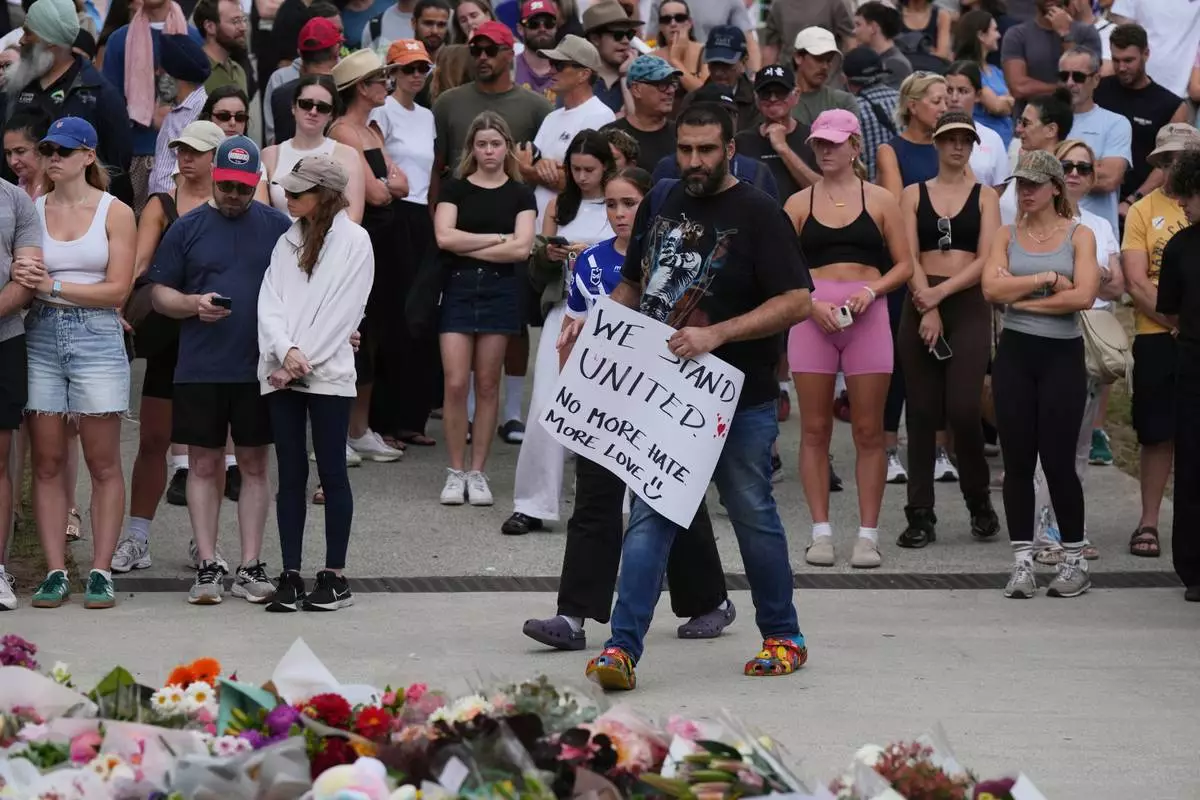
People leave notes at a flower tribute for shooting victims outside the Bondi Pavilion at Sydney's Bondi Beach, Monday, Dec. 15, 2025, a day after a shooting. (AP Photo/Mark Baker)
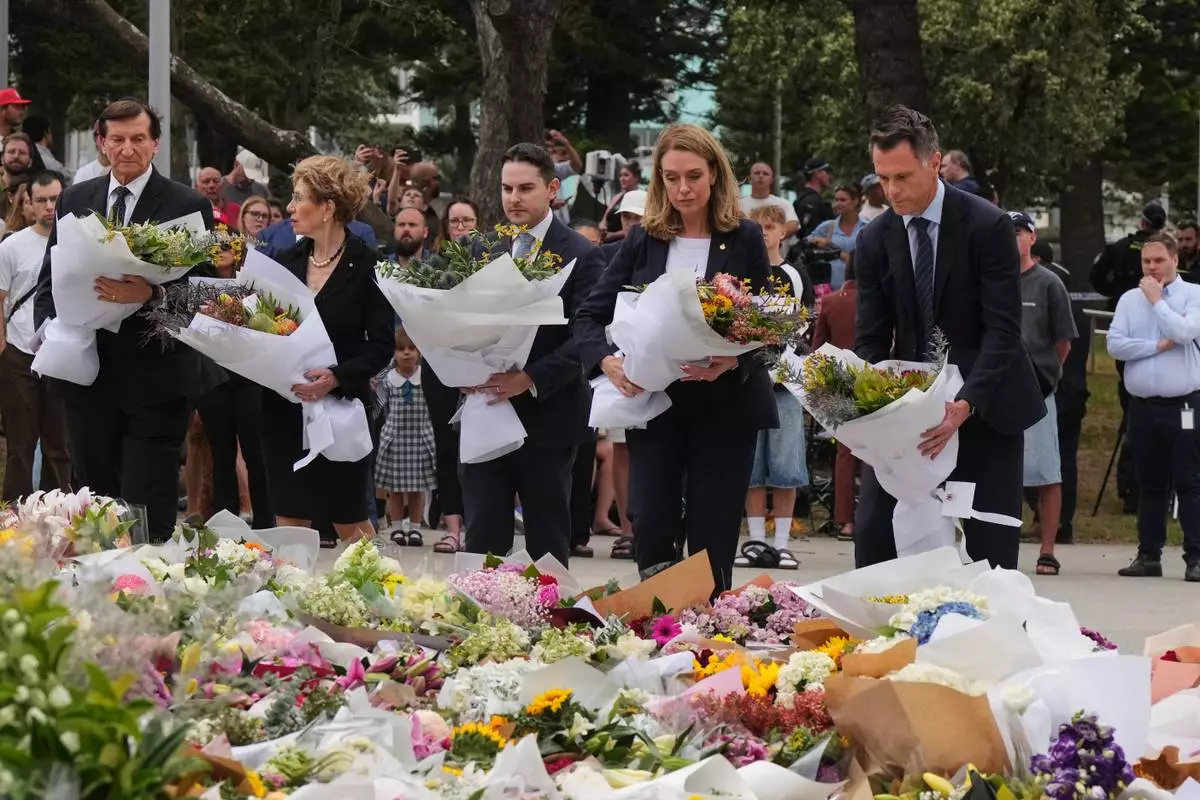
New South Wales Premier Chris Minns, right, and Kellie Sloane, leader of the opposition, the New South Wales Liberal Party, lay wreaths at a tribute for shooting victims outside the Bondi Pavilion at Sydney's Bondi Beach, Monday, Dec. 15, 2025, a day after a shooting. (AP Photo/Mark Baker)