 |
BEIJING, July 25, 2025 /PRNewswire/ -- The Hubei Humanoid Robotics Industry Chain Matchmaking Conference was held during the 3rd China International Supply Chain Expo (CISCE) in Beijing, with the theme Synergizing Cutting-Edge Innovations, Empowering New Quality Productive Forces.
The event brought together over 400 participants, including ambassadors, experts, industry leaders, and financial executives. Featuring speeches, project promotions, and cooperation signings, it highlighted Hubei's strengths in humanoid robotics and fostered global collaboration across the industry.
Yu Jianlong, Vice Chairman of China Council for the Promotion of International Trade (CCPIT), highlighted Hubei's strategic location, rich sci-tech resources, innovation ecosystem, and openness. He noted the province's rapid progress in humanoid robotics, spanning smart manufacturing, core component R&D, application scenarios, and ecosystem development.
"At this year's CISCE, Hubei launched a humanoid robotics exhibition zone with 22 enterprises showcasing over 80 exhibits, including 20 fully-integrated humanoid robots, highlighting the province's complete robotics industry ecosystem," Yu noted.
He stated that CCPIT will enhance its service network and global partnerships, supporting Hubei in building platforms for international cooperation and establishing its humanoid robotics industry as a leading brand.
Hu Zhonghai, Director of CCPIT Hubei, called humanoid robotics a key driver of tech innovation and industrial upgrading. He noted Hubei's advantages in geography, industry, and policies, with 325 Fortune Global 500 firms present, and outlined its robotics roadmap for milestones in one, three, and five years.
Zhao Xingwei, JCBot's legal representative and professor at HUST, shared that JCBot has industrialized its technologies with support from HUST academicians. Its products serve over 10 fields, including industrial production, tourism, firefighting, and warehousing. He pledged to enhance R&D for higher-value applications and industrial upgrades.
At the product launch, Lou Kaiqi, Deputy General M anager of Hubei Optics Valley Dongzhi Embodied Intelligence Technology Co. Ltd., introduced the company's new humanoid robot. Already used in roles like exhibition guidance, retail, reception, and performances, the robot is set to expand into government services, industrial operations, elderly care, and more.
At the matchmaking conference, the Hubei Humanoid Robotics Industry Alliance signed strategic agreements with three partners—the Zhejiang Robot Industry Association, the Humanoid Robotics Innovation Center, and the Zhongguancun Rongzhi Specialized Robotics Alliance. The collaboration will focus on R&D, market expansion, and talent exchange, aiming to build a stronger robotics ecosystem through resource sharing and complementary strengths.
Please visit https://en.cisce.org.cn/ for more details.
BEIJING, July 25, 2025 /PRNewswire/ -- The Hubei Humanoid Robotics Industry Chain Matchmaking Conference was held during the 3rd China International Supply Chain Expo (CISCE) in Beijing, with the theme Synergizing Cutting-Edge Innovations, Empowering New Quality Productive Forces.
The event brought together over 400 participants, including ambassadors, experts, industry leaders, and financial executives. Featuring speeches, project promotions, and cooperation signings, it highlighted Hubei's strengths in humanoid robotics and fostered global collaboration across the industry.
Yu Jianlong, Vice Chairman of China Council for the Promotion of International Trade (CCPIT), highlighted Hubei's strategic location, rich sci-tech resources, innovation ecosystem, and openness. He noted the province's rapid progress in humanoid robotics, spanning smart manufacturing, core component R&D, application scenarios, and ecosystem development.
"At this year's CISCE, Hubei launched a humanoid robotics exhibition zone with 22 enterprises showcasing over 80 exhibits, including 20 fully-integrated humanoid robots, highlighting the province's complete robotics industry ecosystem," Yu noted.
He stated that CCPIT will enhance its service network and global partnerships, supporting Hubei in building platforms for international cooperation and establishing its humanoid robotics industry as a leading brand.
Hu Zhonghai, Director of CCPIT Hubei, called humanoid robotics a key driver of tech innovation and industrial upgrading. He noted Hubei's advantages in geography, industry, and policies, with 325 Fortune Global 500 firms present, and outlined its robotics roadmap for milestones in one, three, and five years.
Zhao Xingwei, JCBot's legal representative and professor at HUST, shared that JCBot has industrialized its technologies with support from HUST academicians. Its products serve over 10 fields, including industrial production, tourism, firefighting, and warehousing. He pledged to enhance R&D for higher-value applications and industrial upgrades.
At the product launch, Lou Kaiqi, Deputy General M anager of Hubei Optics Valley Dongzhi Embodied Intelligence Technology Co. Ltd., introduced the company's new humanoid robot. Already used in roles like exhibition guidance, retail, reception, and performances, the robot is set to expand into government services, industrial operations, elderly care, and more.
At the matchmaking conference, the Hubei Humanoid Robotics Industry Alliance signed strategic agreements with three partners—the Zhejiang Robot Industry Association, the Humanoid Robotics Innovation Center, and the Zhongguancun Rongzhi Specialized Robotics Alliance. The collaboration will focus on R&D, market expansion, and talent exchange, aiming to build a stronger robotics ecosystem through resource sharing and complementary strengths.
Please visit https://en.cisce.org.cn/ for more details.
** The press release content is from PR Newswire. Bastille Post is not involved in its creation. **

Humanoid Robot Industry Chain Matchmaking Event Held at 3rd CISCE
The new Beyond Borders report identifies five major trends shaping payments in emerging markets: UPI driving local schemes in India, cards growing through installments and debit across LatAm and Africa, Pix leading e-commerce in Brazil, crypto adoption via stablecoins, and AI advancing toward autonomous buying
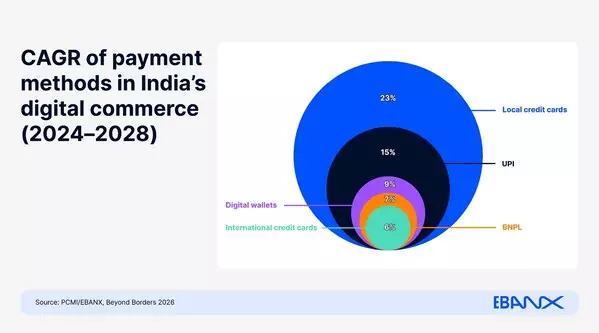
CURITIBA, Brazil, Feb. 12, 2026 /PRNewswire/ -- In the home of UPI, the world's most-used instant payment system and the backbone of how Indians shop online, the fastest-growing e-commerce payment method is credit cards. Led by domestic networks like RuPay, local cards are expected to expand at a CAGR of 23% through 2028, outpacing UPI itself (15%) and international cards (6%).
The projections are featured in the new edition of Beyond Borders, EBANX's annual comprehensive study on digital market and payment trends in emerging economies, published today, and are based on Payments and Commerce Market Intelligence (PCMI) data. The business intelligence report offers an in-depth analysis of payment trends in India, Southeast Asia, Latin America, and Africa, with data and expert perspectives on Alternative Payment Methods (APMs), cards, shopping behaviors, B2B e-commerce, and the rise of stablecoins and AI agents as personal buyers.
Click here to access the full Beyond Borders 2026 report for free.
"Our report shows that the global payments industry is undergoing a structural shift, led by emerging markets," said Eduardo de Abreu, Chief Product Officer (CPO) at EBANX. "To meet the demands of the world's fastest-growing digital customers, these regions have turned complex local challenges into a blueprint for the future, creating faster and more inclusive ways to pay and shifting the competitive dynamics worldwide."
The growth of credit cards in India directly reflects this trend. In a country where APMs like UPI account for 75% of e-commerce volume, local providers found new opportunities by embedding themselves into the same rails that consumers already use daily. Under this hybrid model, domestic card schemes are linked to the UPI system, allowing real-time transactions to draw directly on credit limits. As a result, RuPay holds 33% of the Indian card market, ahead of Mastercard (20%) and American Express (4%), trailing only Visa at 43%.
"This is less about displacement and more about convergence," Abreu emphasized. "As APMs raise the bar by reducing checkout friction and streamlining payment flows, local card schemes are responding by combining card-based credit with instant payments, wallets, and domestic infrastructure—leveraging their deeper understanding of local consumer behavior to scale faster than global rails."
Cards' winning moves in LatAm and Africa: installments and debit
Beyond India, this shift is turning cards into more specialised tools within broader, multi-rail payment ecosystems focused on higher-value purchases. In Latin America, they have sustained growth by leveraging the region's longstanding installment payment culture. EBANX data shows this approach boosts average order values up to 2.7x, allowing cards to remain the backbone of e-commerce in countries like Mexico, Chile, and Peru, accounting for more than 60% of online transactions, per PCMI.
In Nigeria and Egypt, card expansion is being driven by debit, with ownership rising over 10 percentage points from 2021 to 2024, according to Global Findex. As in India, this growth is fueled by the rise of local schemes that leverage their deep understanding of domestic markets to offer tailored solutions, such as reliable processing of very low-value transactions and support for multiple refund paths. Nigeria's leading scheme, Verve, has issued 100 million cards in a country of 232 million people.
"What determines success for payment methods in emerging markets is how well each system understands local reality," said Abreu. "Local schemes succeed because they are built around domestic spending habits, regulatory frameworks, and technical constraints. Whether it is an instant payment system, a digital wallet, or a card, scale comes from local intelligence, not global standardisation."
Pix overtakes cards in Brazil
Unlike UPI in India, Pix remains the fastest-growing payment method among digital consumers in Brazil. The system became the most-used option for online shopping in 2025, ending cards' long-standing dominance. Last year, 42% of the total value of purchases in the country were paid with Pix, edging out cards at 41%. The new leader will continue to accelerate at a CAGR of 18% through 2028, when it will account for 50% of transactions compared to 36% for cards—a 14 percentage-point gap.
This sustained growth stems not only from volume but from Pix's rapid evolution beyond one-off payments to support more complex commerce models. Last year, the system introduced recurring transactions with Pix Automático. In operation since June 2025, the feature has been growing at a rate of 41% per month, according to EBANX internal data, driven by the roughly 60 million Brazilians without credit cards who can now access services such as video and audio streaming.
"This growth reinforces that high adoption does not mean saturation. Pix is used by 95% of Brazil's adult population, yet new demand is unlocked with each additional functionality introduced," Abreu explained. "That momentum is now extending to businesses, particularly small and medium-sized enterprises, which are increasingly adopting Pix and reducing their reliance on corporate credit cards for their B2B purchases."
EBANX data shows that eight out of ten companies in Brazil using Pix through EBANX are micro-businesses, with 84% of them relying on it to purchase software, opening a previously inaccessible market for global providers.
A similar dynamic is unfolding across other emerging economies. In India, a major global software-as-a-service (SaaS) company that enabled UPI Autopay via EBANX attracted more than 4,000 new customers daily during the first three months. APMs like GCash (Philippines), Mercado Pago (Latin America), Nequi (Colombia), Yape (Peru), OPay (Nigeria), and Capitec Pay (South Africa) are also expanding their ecosystems and seeing growing adoption.
Stablecoins and AI agentic buyers as the next evolution of digital payments
Beyond Borders also highlights how emerging markets are exploring crypto's value for real-world commerce through stablecoins. They're used to preserve value, move money efficiently, and enable cross-border transactions in economies facing inflation, currency controls, or high banking costs.
Data from Triple A analysed in EBANX's study shows that more than 15% of the population in Brazil, Argentina, Thailand, and Vietnam already owns digital currencies, rising to 20% in Turkey. In Argentina, nearly 90% of crypto purchases are made up of dollar-pegged stablecoins.
Another trend explored in Beyond Borders is agentic commerce, where artificial intelligence evolves from a discovery tool to an autonomous buyer. In this model, AI compares prices, selects merchants, and executes transactions end-to-end—often without users visiting websites—making prompt quality and consumer context more decisive than sophisticated storefronts or visual design. Competition shifts towards pricing, availability, reliability, and trust.
McKinsey reports that 20% of consumers would be comfortable having agents complete purchases on their behalf, while Deloitte projects that up to 30% of global e-commerce value could be influenced by this technology by 2030.
"Stablecoins and agentic commerce may seem like separate trends, but they point in the same direction: payments are becoming more programmable, more automated, and less dependent on legacy assumptions. Like APMs before them, these technologies are solving problems traditional rails can't address—and once again, emerging markets are positioned to lead adoption and shape how they evolve," Eduardo de Abreu stated.
ABOUT EBANX
EBANX is the leading payments platform connecting global businesses to the world's fastest-growing digital markets. Founded in 2012 in Brazil, EBANX was built with a mission to expand access to international digital commerce. Leveraging proprietary technology, deep market expertise, and robust infrastructure, EBANX enables global companies to offer hundreds of local payment methods across Latin America, Africa, and Asia. More than just payments, EBANX drives growth, enhances sales, and delivers seamless purchase experiences for businesses and end-users alike.
For further information, please visit:
Website: https://www.ebanx.com/en/
LinkedIn: https://www.linkedin.com/company/ebanx
Media Contact:
Shan Huang
shan.huang@ahgstrategies.com
** The press release content is from PR Newswire. Bastille Post is not involved in its creation. **
E-commerce: UPI sparks a credit card boom in India while Pix overtakes card dominance in Brazil, EBANX finds