The Yemeni rial has continued its steep decline in government-controlled areas, plummeting to an all-time low of approximately 2,900 per US dollar in recent trading sessions. The sharp drop underscores the worsening economic crisis, deepening the suffering of Yemeni households struggling to meet basic needs.
As the exchange rate plummets, prices for essential goods have soared, crippling purchasing power. Yemenis are finding daily life increasingly unaffordable.
Amid the severe currency crisis, Yemen's oil export revenues have sharply declined, and foreign exchange reserves are critically low, while the government has yet to propose a viable solution. With falling confidence in the national currency, public anxiety is at an all-time high.
"In the past three months, exchange rate fluctuations have been highly volatile and unpredictable. Immediate measures must be taken. If the government doesn't intervene urgently, the devaluation will keep pushing food prices up and severely impact people's lives," said Mohammed Saleh Al Safi, director of Al Haddad Exchange Company.
As national foreign currency revenues have dwindled and international humanitarian aid has also seen a sharp decline, prices have soared across the country. The cost of essential goods such as wheat, flour, and cooking oil has risen by over 40 percent in just a few months, making necessities unaffordable for many families.
Shrinking wages and declining purchasing power have made daily life increasingly difficult for the population.
"The situation is terrible. One U.S. dollar is now worth 2,900 rials, but a regular government employee earns only 50,000 rials a month. When a bag of rice costs 60,000 rials, what choices does he have? Yemen is torn by internal conflict, yet no one is thinking about what ordinary people are going through," said Karim Hussein Adel, a resident of Aden, capital of the war-torn country.

Yemen currency collapse worsens economic crisis, deepening suffering of ordinary people
The three astronauts of China's recently-returned Shenzhou-20 mission on Friday shared the experiences of their dramatic 204-day space mission, including detailing the emergency procedures which were implemented to bring them safely home after their return capsule was struck by space debris.
The trio -- Chen Dong, Chen Zhongrui, and Wang Jie -- met with the press in Beijing on Friday afternoon, marking their first public appearance since returning to Earth in November.
When detailing the emergency response mechanisms which were enacted prior to their scheduled return, the astronauts explained that upon discovering a triangular crack on the spacecraft's viewport window, they immediately took photos for documentation and transmitted them to the ground team, who swiftly activated an emergency plan to get the trio home safely.
Experienced mission commander Chen Dong explained how the crew had complete faith in their colleagues on the ground to find a solution to these unforeseen circumstances which led to their return being delayed.
"First, we must trust the ground team, who would anticipate everything and develop the safest return plan for us. Second, we must believe in ourselves; as well-trained astronauts, we have the ability to manage various unexpected failures. I believe that with the collaboration of astronauts and researchers on the ground, our space home will surely go farther, more steadily, and for a longer time," he said.
Following their extended stay in space as a result of the debris incident, the Shenzhou-20 crew spent a total 204 days in orbit, setting a new record for the longest duration by a single group of Chinese astronauts.
During their mission, they completed multiple payload operations, conducted extensive scientific experiments, and carried out four extravehicular activities.
"Our crew worked together with the ground team in unity and coordination, completing four extravehicular activities, several payload entry and exit tasks, and a large number of scientific experiments. It was a fulfilling yet challenging mission. The path to exploring the heavens is long and arduous, but I firmly believe that China's space missions will succeed," said Chen Zhongrui, a former air force pilot who was making his first spaceflight during the mission.
"From the ground to space, from learning to application, I have deeply felt the solid progress of Chinese space endeavors and the quiet dedication of countless personnel behind the scenes. In the future, I will accomplish each mission with full commitment, living up to the trust of the motherland and the people," said fellow astronaut Wang Jie, who was also making his debut spaceflight.
After returning to Earth on Nov 14, the trio successfully completed their isolation recovery and rehabilitation and will now resume normal training following health assessments.
The crew's return, originally scheduled for Nov 5, was postponed due to safety concerns, with the astronauts later using the return capsule belonging to their successor crew of the Shenzhou-21 mission to get back to Earth. China later launched the unmanned Shenzhou-22 spacecraft which will serve the future return of the crew now aboard the Tiangong Space Station.
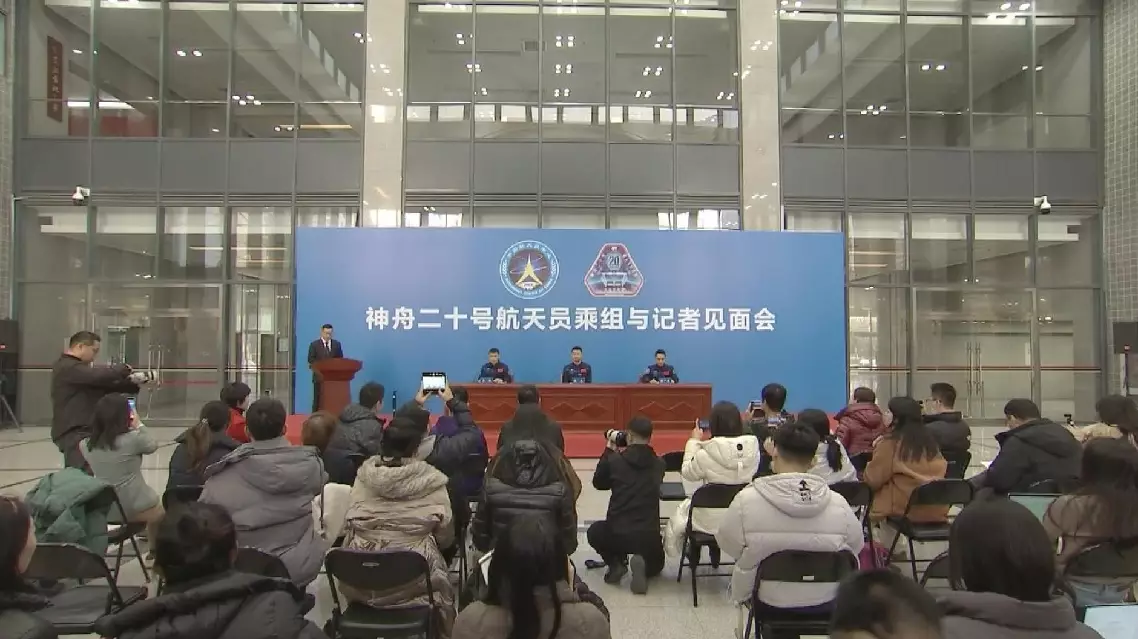
Shenzhou-20 astronauts share experiences after safely returning from debris incident