A state judge has stayed an upcoming execution in Alabama to evaluate whether the man is too mentally ill to be put to death.
The judge temporarily stayed the Aug. 21 execution of David Lee Roberts until it can be established whether he has a “rational understanding” of what is to happen to him.
“Or similarly put, the issue is whether the petitioner's concept of reality is so impaired that he cannot grasp the execution’s meaning and the purpose or the link between his crime and its punishment,” Marion County Circuit Judge Talmage Lee Carter wrote in the July 10 order.
Carter said the execution will be on hold until a report from the Alabama Department of Mental Health is finished. It is not immediately clear how long that will take.
Roberts was convicted of killing Annetra Jones in 1992 by shooting her in the head. His execution was scheduled to be carried out by nitrogen gas, a method Alabama began using last year.
Attorneys representing Roberts argue that his death sentence should be suspended due to severe illness. Roberts has been diagnosed with paranoid schizophrenia diagnosis, hears voices and is delusional, they said in a court filing. He also recently attempted to burn tattoos off his arm and leg because he believed they “are trying to control his thoughts,” his lawyers said.
“This evidence demonstrates Mr. Roberts is incompetent to be executed because his delusions prevent him from having a factual or rational understanding of the reason,” they said.
The Alabama attorney general’s office is not appealing the stay. The state asked that the competency evaluation by expedited.
The U.S. Supreme Court ruled that states cannot execute prisoners who are insane and do not understand their impending execution and the reasons for it. However state law does not provide a clear standard on what courts must find in determining someone's competency to be executed.
In 1992, Roberts, now 59, was a houseguest at Jones’ boyfriend’s home in Marion County. Prosecutors said that on the afternoon of April 22, he came to the home, packed his belongings, stole money and shot Jones three times in the head with a .22 caliber rifle while she slept on the couch. He then set the house on fire after dousing Jones’ body and the floor with a flammable liquid, prosecutors said.
Jurors convicted Roberts of capital murder and voted 7-5 to recommend that he receive life in prison without parole. A judge overrode that and sentenced him to death. Alabama no longer allows judges to override jury sentences in capital cases.

FILE In this undated image provided by the Alabama Department of Corrections, shows David Lee Roberts, who was convicted of capital murder for the 1992 shooting death of Annetra Jones. (Alabama Department of Corrections via AP, File)
When Indiana adopted new U.S. House districts four years ago, Republican legislative leaders lauded them as “fair maps” that reflected the state's communities.
But when Gov. Mike Braun recently tried to redraw the lines to help Republicans gain more power, he implored lawmakers to "vote for fair maps.”
What changed? The definition of “fair.”
As states undertake mid-decade redistricting instigated by President Donald Trump, Republicans and Democrats are using a tit-for-tat definition of fairness to justify districts that split communities in an attempt to send politically lopsided delegations to Congress. It is fair, they argue, because other states have done the same. And it is necessary, they claim, to maintain a partisan balance in the House of Representatives that resembles the national political divide.
This new vision for drawing congressional maps is creating a winner-take-all scenario that treats the House, traditionally a more diverse patchwork of politicians, like the Senate, where members reflect a state's majority party. The result could be reduced power for minority communities, less attention to certain issues and fewer distinct voices heard in Washington.
Although Indiana state senators rejected a new map backed by Trump and Braun that could have helped Republicans win all nine of the state’s congressional seats, districts have already been redrawn in Texas, California, Missouri, North Carolina and Ohio. Other states could consider changes before the 2026 midterms that will determine control of Congress.
“It’s a fundamental undermining of a key democratic condition,” said Wayne Fields, a retired English professor from Washington University in St. Louis who is an expert on political rhetoric.
“The House is supposed to represent the people,” Fields added. “We gain an awful lot by having particular parts of the population heard.”
Under the Constitution, the Senate has two members from each state. The House has 435 seats divided among states based on population, with each state guaranteed at least one representative. In the current Congress, California has the most at 52, followed by Texas with 38.
Because senators are elected statewide, they are almost always political pairs of one party or another. Pennsylvania and Wisconsin are the only states now with both a Democrat and Republican in the Senate. Maine and Vermont each have one independent and one senator affiliated with a political party.
By contrast, most states elect a mixture of Democrats and Republicans to the House. That is because House districts, with an average of 761,000 residents, based on the 2020 census, are more likely to reflect the varying partisan preferences of urban or rural voters, as well as different racial, ethnic and economic groups.
This year's redistricting is diminishing those locally unique districts.
In California, voters in several rural counties that backed Trump were separated from similar rural areas and attached to a reshaped congressional district containing liberal coastal communities. In Missouri, Democratic-leaning voters in Kansas City were split from one main congressional district into three, with each revised district stretching deep into rural Republican areas.
Some residents complained their voices are getting drowned out. But Govs. Gavin Newsom, D-Calif., and Mike Kehoe, R-Mo., defended the gerrymandering as a means of countering other states and amplifying the voices of those aligned with the state's majority.
Indiana's delegation in the U.S. House consists of seven Republicans and two Democrats — one representing Indianapolis and the other a suburban Chicago district in the state's northwestern corner.
Dueling definitions of fairness were on display at the Indiana Capitol as lawmakers considered a Trump-backed redistricting plan that would have split Indianapolis among four Republican-leaning districts and merged the Chicago suburbs with rural Republican areas. Opponents walked the halls in protest, carrying signs such as “I stand for fair maps!”
Ethan Hatcher, a talk radio host who said he votes for Republicans and Libertarians, denounced the redistricting plan as “a blatant power grab" that "compromises the principles of our Founding Fathers" by fracturing Democratic strongholds to dilute the voices of urban voters.
“It’s a calculated assault on fair representation," Hatcher told a state Senate committee.
But others asserted it would be fair for Indiana Republicans to hold all of those House seats, because Trump won the “solidly Republican state” by nearly three-fifths of the vote.
“Our current 7-2 congressional delegation doesn’t fully capture that strength,” resident Tracy Kissel said at a committee hearing. "We can create fairer, more competitive districts that align with how Hoosiers vote.”
When senators defeated a map designed to deliver a 9-0 congressional delegation for Republicans, Braun bemoaned that they had missed an “opportunity to protect Hoosiers with fair maps.”
By some national measurements, the U.S. House already is politically fair. The 220-215 majority that Republicans won over Democrats in the 2024 elections almost perfectly aligns with the share of the vote the two parties received in districts across the country, according to an Associated Press analysis.
But that overall balance belies an imbalance that exists in many states. Even before this year's redistricting, the number of states with congressional districts tilted toward one party or another was higher than at any point in at least a decade, the AP analysis found.
The partisan divisions have contributed to a “cutthroat political environment” that “drives the parties to extreme measures," said Kent Syler, a political science professor at Middle Tennessee State University. He noted that Republicans hold 88% of congressional seats in Tennessee, and Democrats have an equivalent in Maryland.
“Fairer redistricting would give people more of a feeling that they have a voice," Syler said.
Rebekah Caruthers, who leads the Fair Elections Center, a nonprofit voting rights group, said there should be compact districts that allow communities of interest to elect the representatives of their choice, regardless of how that affects the national political balance. Gerrymandering districts to be dominated by a single party results in “an unfair disenfranchisement" of some voters, she said.
“Ultimately, this isn’t going to be good for democracy," Caruthers said. "We need some type of détente.”
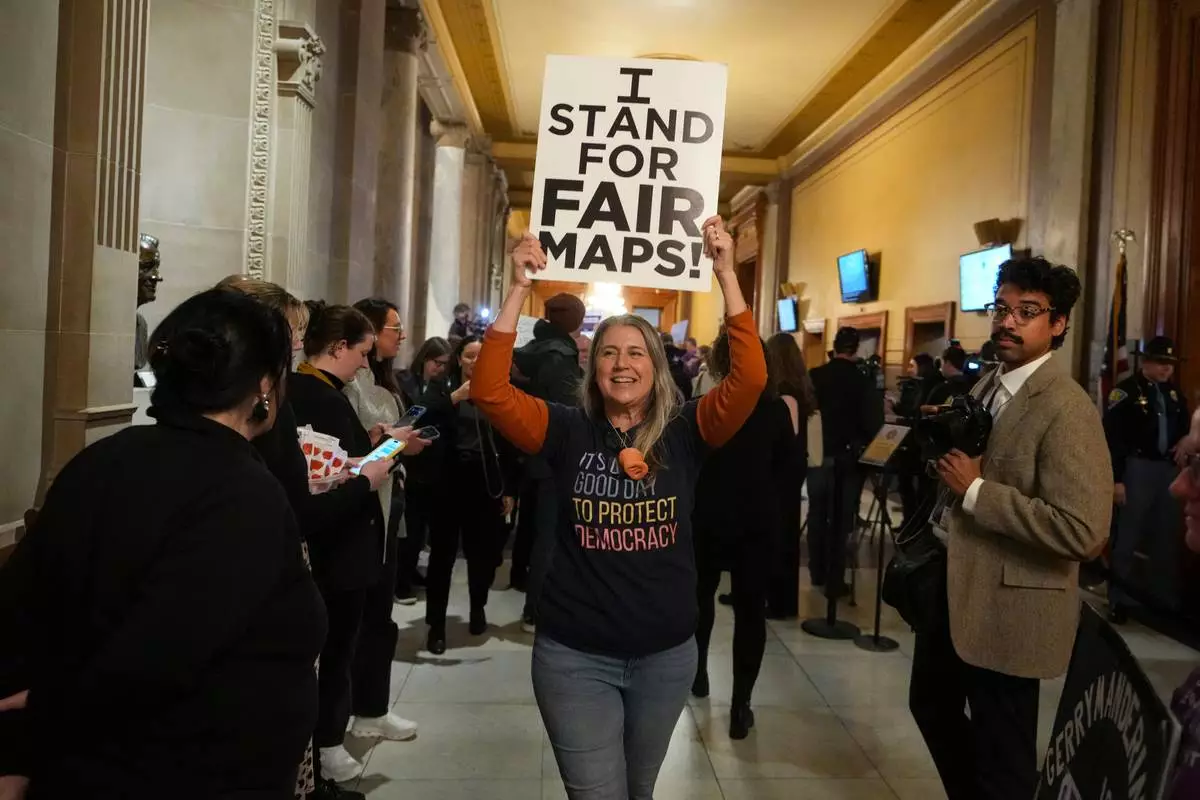
A protester celebrates as they walk outside the Indiana Senate Chamber after a bill to redistrict the state's congressional map was defeated, Thursday, Dec. 11, 2025, at the Statehouse in Indianapolis. (AP Photo/Michael Conroy)
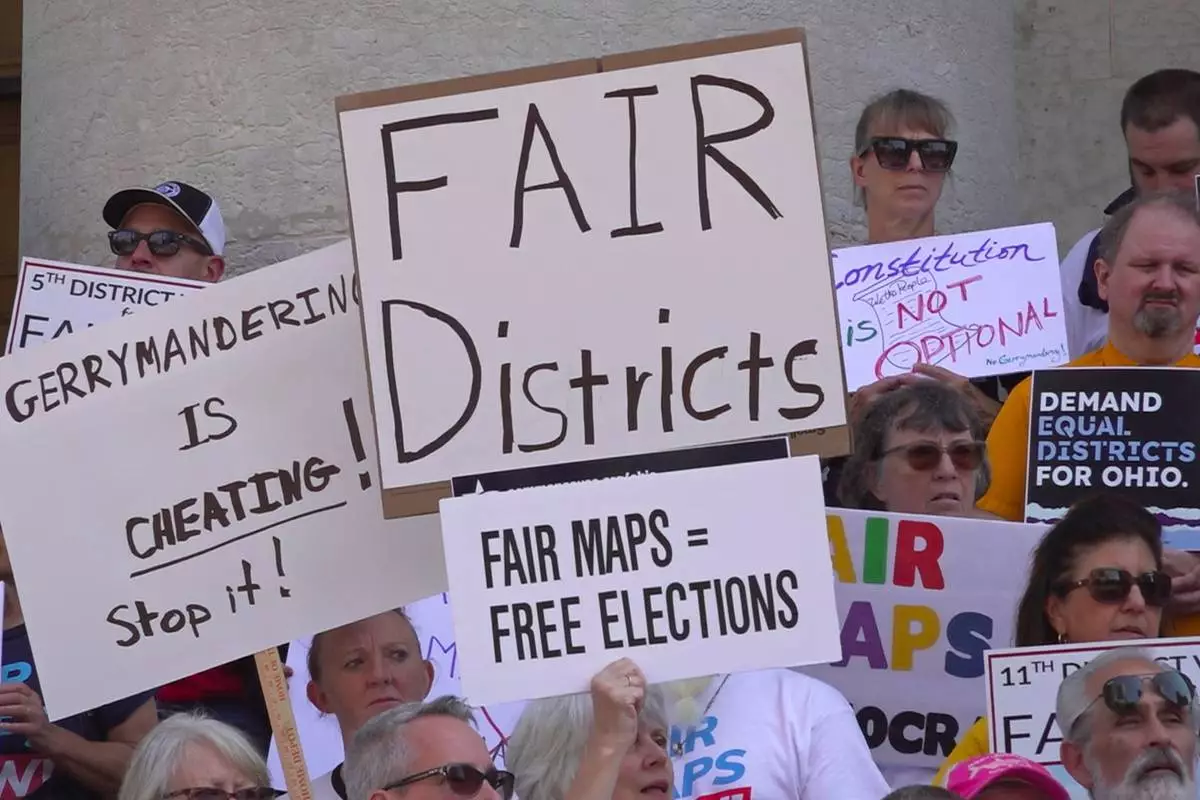
FILE - This photo taken from video shows organizers rallying outside of the Ohio Statehouse to protest gerrymandering and advocate for lawmakers to draw fair maps in Columbus, Ohio, Sept. 17, 2025. (AP Photo/Patrick Aftoora-Orsagos, File)
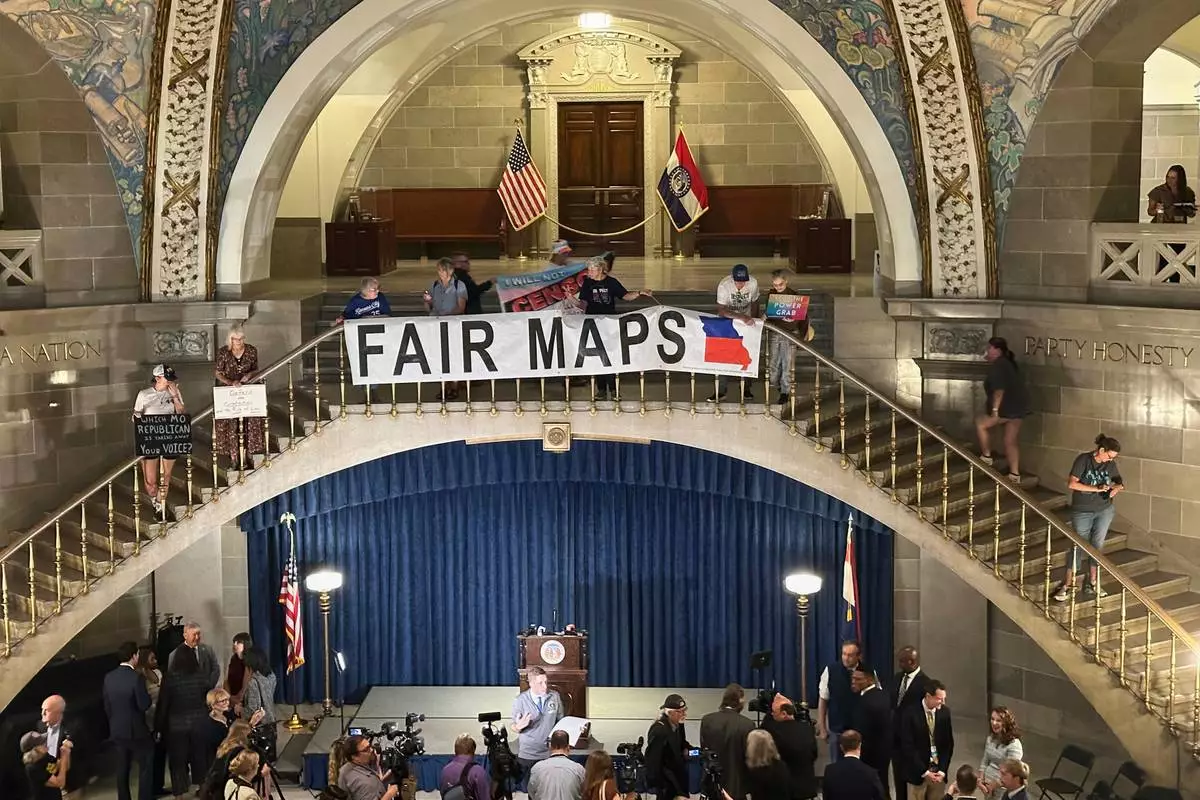
Opponents of Missouri's Republican-backed congressional redistricting plan display a banner in protest at the State Capitol in Jefferson City, Missouri, Sept. 10, 2025. (AP Photo/David A. Lieb)