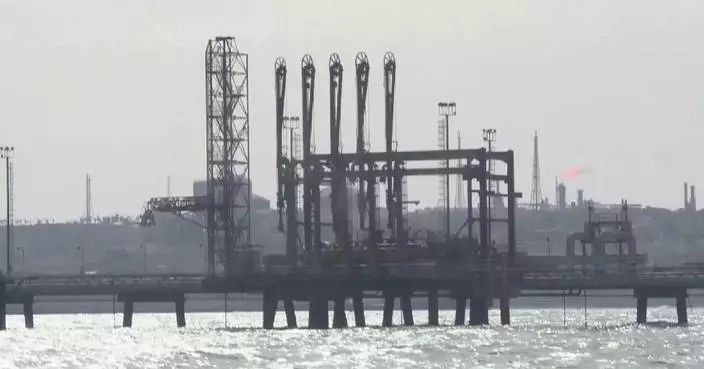
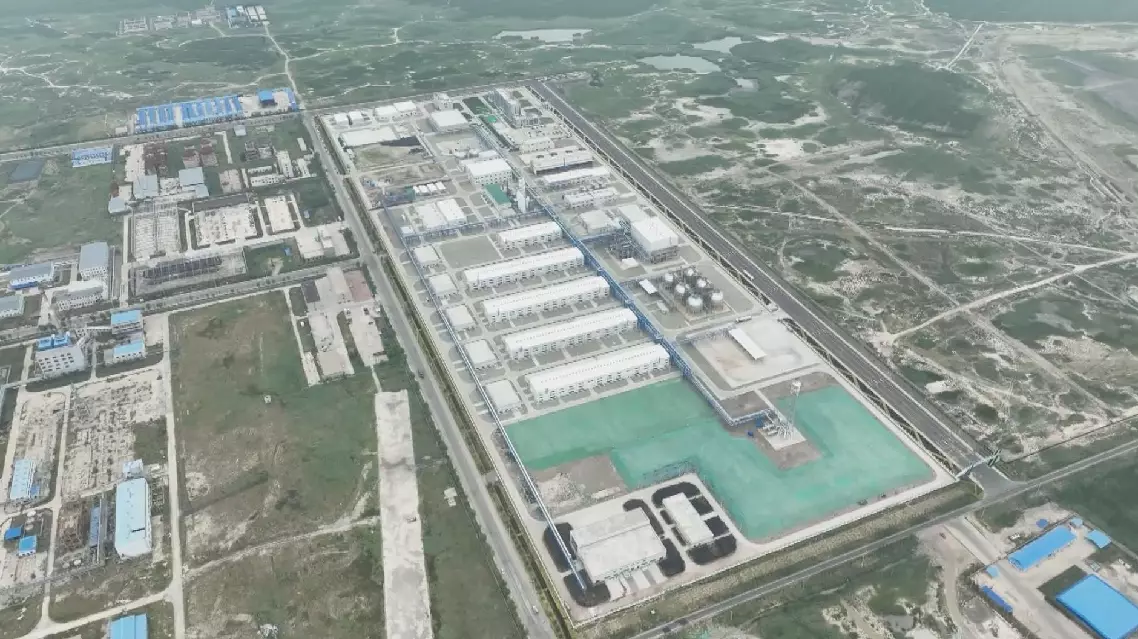
The world's largest single-unit green ammonia project was put into operation in Da'an City of northeast China's Jilin Province on Saturday.
State Power Investment Corporation's Da'an Project first utilizes the abundant wind and solar resources in Jilin Province to generate "green electricity," which is used in water electrolysis to produce "green hydrogen." And then, green hydrogen will be combined with nitrogen from the air to synthesize "green ammonia" under the action of a catalyst.
This process integrates the entire industrial chain from new energy consumption to the utilization of green ammonia. The "green ammonia" can be widely applied in the chemical, transportation, and power sectors.
"After putting into operation, it will achieve an annual production capacity of 32,000 tons of green hydrogen and 180,000 tons of green ammonia, reducing carbon emissions by about 650,000 tons each year, which is equivalent to the carbon emissions from the daily electricity consumption of nearly 500,000 ordinary households in a year," said Song Shulin, chief director of the project.
The installed capacity of the new energy part of the project reaches 800 megawatts, including 700 megawatts of wind power and 100 megawatts of photovoltaic power. "We have creatively applied our independent intellectual property rights to develop a full-process flexible control system of 'power-hydrogen-chemical', addressing the challenge of matching the instability of wind and solar power generation with the stability of synthetic ammonia production. This has paved the way for a replicable industrial model for the on-site transformation of new energy sources," said Song.
World's largest single-unit green ammonia project put into operation
More than three weeks after U.S. strikes on military sites in Venezuela, many Caracas residents said the psychological scars remain deep, even as people push forward with everyday routines.
The strikes on January 3 focused on military targets in Caracas, including Fort Tiuna, a major military installation in southwestern Caracas, which includes command centers, and civilian neighborhoods built by the government for low-income families.
The strikes left parts of the complex in ruins, with civilians living nearby experiencing intense fear and disruption.
Yesenia Acevedo, who runs a small convenience store in the residential area of Fort Tiuna, described how business has declined after the attack. Her shop, which had enjoyed steady customers for three years, was forced to close for a week due to safety concerns.
"After the bombing, this area was designated as a war zone. Everyone was forced to evacuate. After the airstrikes on January 3, the number of customers dropped sharply. Some of them were regulars. I think they're afraid and won't come back. If they personally experienced the bombing that day, it must have been a nightmare," said Acevedo.
Emma Chavez, owner of a bakery in the neighborhood, was out of the city when the strikes occurred. Family and employees called to alert her to the chaos.
"When I returned, I felt the vibe here was very strange, full of uncertainty. Everyone was talking about it [the bombing]. Many people came back because they had nowhere else to go, they had to return. Their hearts are filled with fear, even now. But everyone has to look forward and continue with normal life," said Chavez.
Both Acevedo and Chavez condemned the U.S. strikes as illegal and inhumane, while emphasizing the resilience of Venezuelans in the face of adversity.
"It's not so much about believing we can get through the hard times; it's that we have to keep living normally. We have no other choice. Venezuelans are very resilient, we can endure any adversity. Of course, we're afraid, because we don't know what the future holds. Everyone knows the United States is a warlike country, and war is a business for the U.S. But we Latin Americans love peace. For us, war is something from games or movies. I think it's inhumane, I can't imagine anyone thinking it's justified," said Chavez.
"I think all of America's actions toward Venezuela are illegal. The raid has become a turning point in our lives. It's hard to say our lives can return to normal right away, because the psychological trauma is still there. But Venezuelans are tough and unyielding; we always keep moving forward," said Acevedo.
Caracas residents struggle to rebuild life amid lingering trauma from US strikes