Fuzhou City, the capital of east China's Fujian Province, has balanced efforts for promoting urban development and the conservation of ancient banyan trees over the past decades, providing good living environment for local residents while advancing economic and social development.
Fuzhou is nicknamed Rongcheng, literally translated as "The City of Banyan Trees."
The origin of this nickname dates back about 900 years to the Northern Song Dynasty (960 - 1127). At that time, the city frequently suffered from flooding and summer heat.
In order to provide a better environment for the citizens, the local governor, Zhang Boyu, advocated that "the city should be green, and no parasols should be needed in summer." He made policies encouraging each family in the city to plant banyan trees, hence the city's nickname.
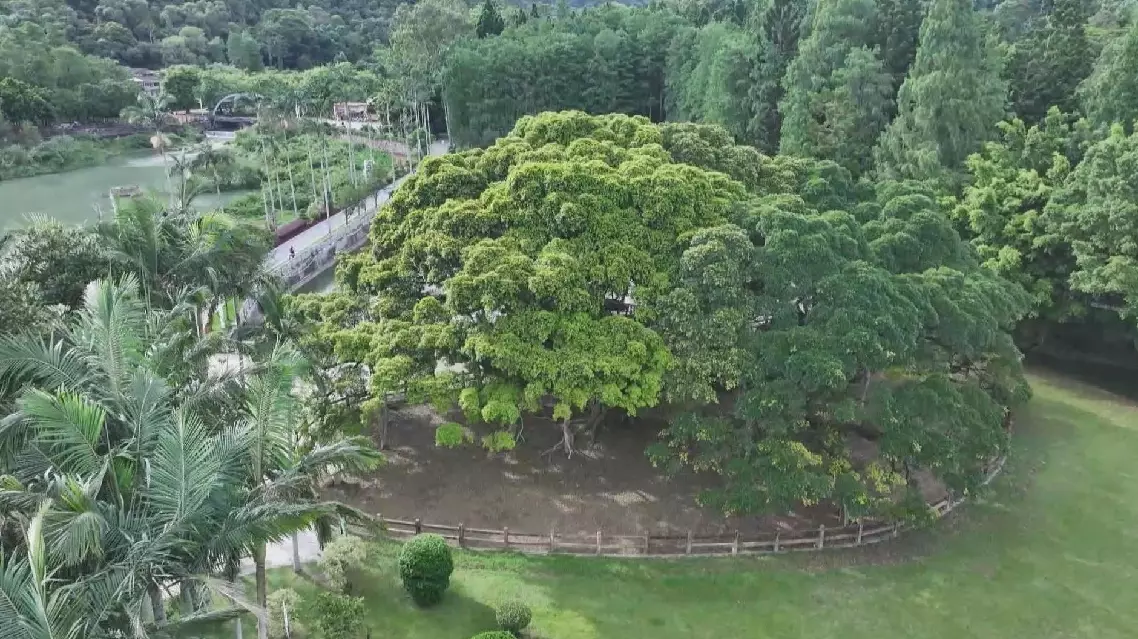
Today, the city's largest banyan tree is in the Fuzhou National Forest Park. It is said that the tree was planted during Zhang Boyu's rule, which makes it about 960 years old.
The giant banyan tree has a height of approximately 20 meters and a trunk diameter of about 10 meters, while the ground projection area of its canopy reaches 1,330 square meters, which is bigger than the combined area of three standard basketball courts, allowing it to accommodate a thousand people seeking shade underneath.
The park has taken several measures to protect the ancient tree, such as installing concrete supportive columns to support the giant tree's massive branches, and adopting a dynamic tree health monitoring system.
Fuzhou now has over 130,000 trees flanking its main roads, of which more than 30,000 are banyan trees. To preserve this greenery, the city's priority for urban renovation and development has been given to the protection of banyan trees.
Another iconic ancient banyan tree is located at a position on a major traffic route in the center of Fuzhou, where there is a transfer station for two subway lines. In order to protect this banyan tree, local authorities optimized the construction plan of the station so as to prevent damage caused by relocating it.
This approach has reflected Fuzhou's principle in urban development, which prioritizes protection -- avoiding tree felling and minimizing relocation. With all these efforts, the city has preserved its greenery to the greatest extent possible.
In addition to providing comfortable living environment, Fuzhou's banyan trees have also injected new vitality into the city's cultural and tourism sector.
At the city’s Sanfang Qixiang neighborhood, a cluster of ancient residential buildings dating from the late Jin Dynasty (265 - 420), there is an ancient banyan tree whose crown resembles a heart. It has become quite popular among tourists over the past few years, because of the heart-like shape of the crown.
Local tourism authorities have designed a plush keychain in the image of this banyan tree, and in just over a year since its launch, the sales have exceeded 270,000 pieces.
Fuzhou is continuously expanding its urban green spaces. According to the latest statistics, the city has established a 1,395-kilometer urban greenway network across its administrative region, with over 1,500 parks scattering throughout the city. The per capita area of park greenery reaches approximately 16 square meters.
China's 'banyan tree city' balances urban development, conservation