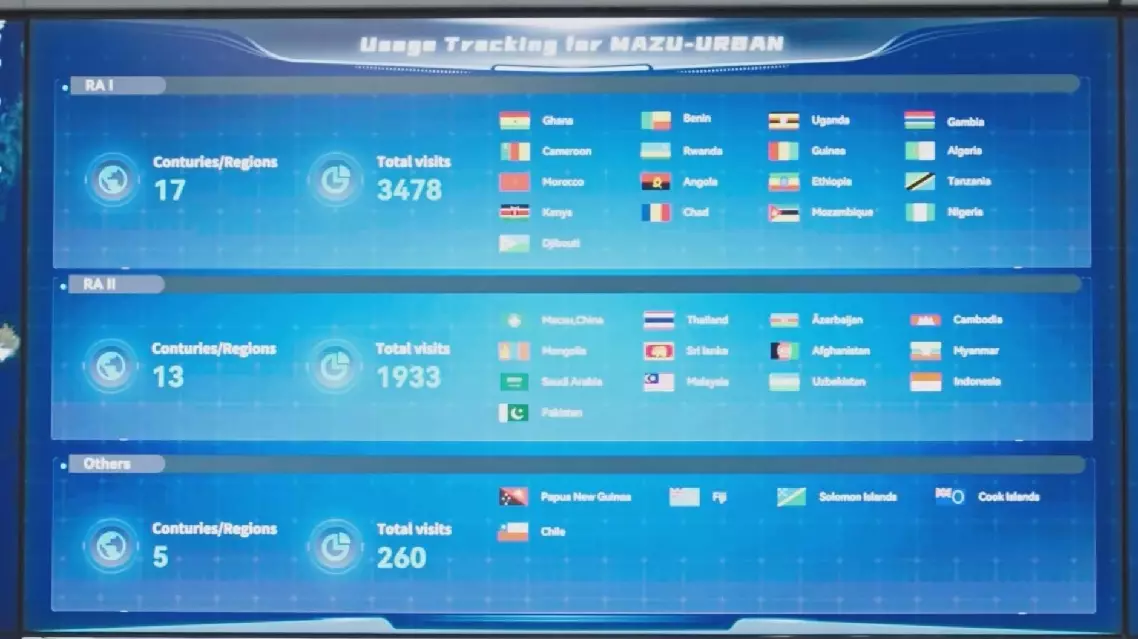
The MAZU-Urban, an artificial intelligence (AI) agent for multi-hazard early warning launched by the China Meteorological Administration (CMA) on Saturday in Shanghai, has already been used on a trial basis in 35 countries and regions, with its functions constantly upgrading, exemplifying the extensive application of Chinese AI in global disaster prevention and mitigation.
The CMA launched MAZU, a joint initiative for "early warnings for all," and donated MAZU-Urban to Djibouti and Mongolia during the opening ceremony of the 2025 World Artificial Intelligence Conference (WAIC) on Saturday in Shanghai.
Within the scope of MAZU, MAZU-Urban was collaboratively developed by the Shanghai Meteorological Service (SMS), the National Meteorological Center of CMA, China United Network Communications Company Shanghai Branch, the Shanghai Institute of Science and Intelligence, and the Shanghai Artificial Intelligence Laboratory.
As the urban user-end component of the CMA's early warning support operational system, MAZU-Urban is powered by AI technology and integrates advanced algorithms with multi-source data. It is equipped with cloud-based early warning system products, meteorological open-source models, and the African regional model developed by the SMS. According to its developers, the intelligent agent has been upgraded from a purely software-based system to one that also includes hardware components during trial use in various countries.
In Pakistan, the AI agent has significantly improved the forecast efficiency of local weather authorities, enabling near real-time updates of meteorological forecasts and disaster early warnings by incorporating local alerts.
Last month, an international training course on AI-empowered early warnings for all was launched in Shanghai, bringing together trainees from 21 countries and regions, including Jordan, Chad, and Mauritius.
China's newly launched AI agent for multi-hazard early warning already piloted in countries around the world