DH announces latest situation of Legionnaires' disease cases
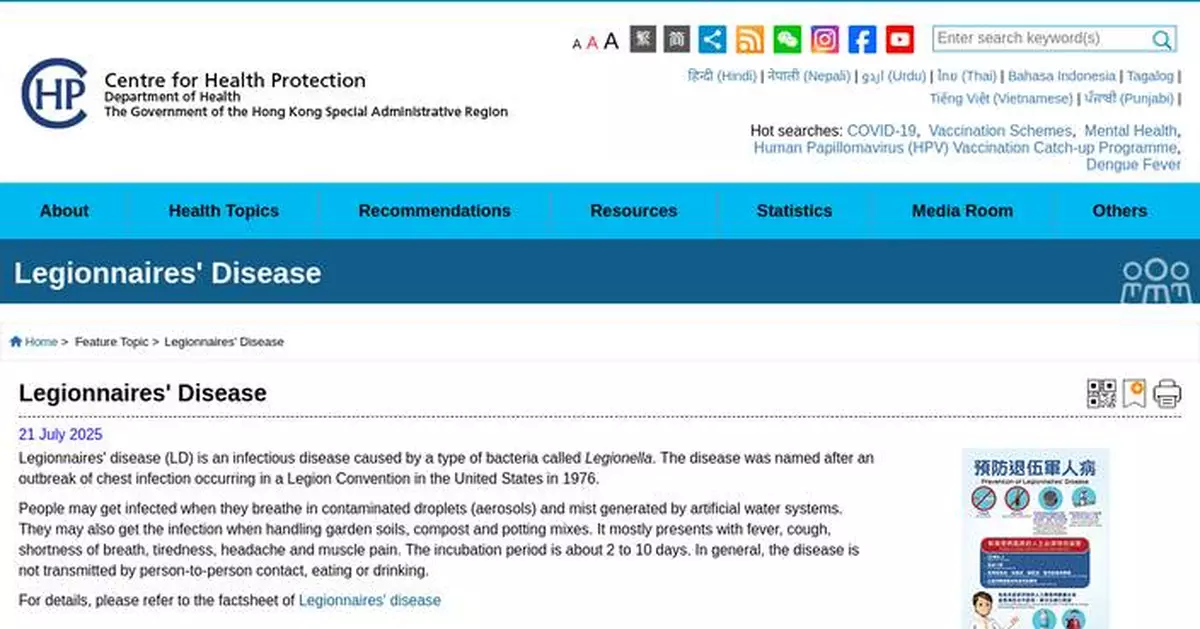
The Centre for Health Protection (CHP) of the Department of Health today (July 28) reported the latest number of cases of Legionnaires' disease (LD), and reminded the public of the importance of using and maintaining properly designed man-made water systems, adding that susceptible groups should strictly observe relevant precautions.
From July 20 to 26, the CHP recorded five community-acquired LD cases. The details of the cases are as follows:
An 88-year-old female patient with underlying illnesses living in Kwai Tsing District;
A 61-year-old male patient with underlying illnesses living in Sha Tin District;
A 60-year-old male patient with underlying illnesses living in Sha Tin District;
A 68-year-old male patient with good past health living in Kwai Tsing District; and
An 81-year-old male patient with underlying illnesses living in Yau Tsim Mong District.
The CHP is conducting epidemiological investigations to identify potential sources of infection and high-risk exposure. Initial investigation revealed that all five cases are sporadic cases. No epidemiological linkages have been established between these cases and other confirmed cases previously recorded in Hong Kong.
As of July 26, 90 LD cases had been recorded this year. In 2024 and 2023, there were 135 and 121 LD cases respectively.
Men, people aged over 50, smokers, alcoholics and persons with weakened immunity are more susceptible to LD. Some situations may also increase the risk of infection, including poor maintenance of water systems; living in areas with old water systems, cooling towers or fountains; using electric water heaters, whirlpools and spas or hot water spring spas; and recent stays in hotels or vessels.
Legionellae are found in various environmental settings and grow well in warm water (20 to 45 degrees Celsius). They can be found in aqueous environments such as water tanks, hot and cold water systems, cooling towers, whirlpools and spas, water fountains and home apparatus that support breathing. People may become infected when they breathe in contaminated droplets (aerosols) and mist generated by artificial water systems, or when handling garden soil, compost and potting mixes.
Immunocompromised persons should:
 Use sterile or boiled water for drinking, tooth brushing and mouth rinsing;
Avoid using humidifiers, or other mist- or aerosol-generating devices; and
If using humidifiers, or other mist- or aerosol-generating devices, fill the water tank with only sterile or cooled freshly boiled water, and not water directly from the tap. Also, clean and maintain humidifiers/devices regularly according to manufacturers' instructions. Never leave stagnant water in a humidifier/device. Empty the water tank, wipe all surfaces dry, and change the water daily.
Use sterile or boiled water for drinking, tooth brushing and mouth rinsing;
Avoid using humidifiers, or other mist- or aerosol-generating devices; and
If using humidifiers, or other mist- or aerosol-generating devices, fill the water tank with only sterile or cooled freshly boiled water, and not water directly from the tap. Also, clean and maintain humidifiers/devices regularly according to manufacturers' instructions. Never leave stagnant water in a humidifier/device. Empty the water tank, wipe all surfaces dry, and change the water daily.
The public should observe the health advice below:
Observe personal hygiene;
Do not smoke and avoid alcohol consumption;
Strainers in water taps and shower heads should be inspected, cleaned, descaled and disinfected regularly or at a frequency recommended by the manufacturer;
If a fresh-water plumbing system is properly maintained, it is not necessary to install domestic water filters. Use of water filters is not encouraged as clogging occurs easily, which can promote growth of micro-organisms. In case water filters are used, the pore size should be 0.2 micrometres (µm) and the filter needs to be changed periodically according to the manufacturer's recommendations;
Drain and clean water tanks of buildings at least quarterly;
Drain or purge for at least one minute infrequently used water outlets (e.g. water taps, shower heads and hot water outlets) and stagnant points of the pipework weekly or before use;
Seek and follow doctors' professional advice regarding the use and maintenance of home respiratory devices and use only sterile water (not distilled or tap water) to clean and fill the reservoir. Clean and maintain the device regularly according to the manufacturer's instructions. After cleaning/disinfection, rinse the device with sterile water, cooled freshly boiled water or water filtered with 0.2 µm filters. Never leave stagnant water in the device. Empty the water tank, keep all surfaces dry, and change the water daily; and
When handling garden soil, compost and potting mixes:
Wear gloves and a face mask;
Water gardens and compost gently using low pressure;
Open composted potting mixes slowly and make sure the opening is directed away from the face;
Wet the soil to reduce dust when potting plants; and
Avoid working in poorly ventilated places such as enclosed greenhouses.
The public may visit the CHP'sLD page, theCode of Practice for Prevention of LDand theHousekeeping Guidelines for Cold and Hot Water Systems for Building Managementof the Prevention of LD Committee, and the CHP'srisk-based strategyfor prevention and control of LD.
Source: AI-found images
EPD highly concerned over industrial accident at yard waste recycling centre
The Environmental Protection Department (EPD) is highly concerned over an industrial accident that occurred yesterday (January 16) at the yard waste recycling centre, Y·PARK in Tuen Mun, and extends its sympathies to the injured worker and his family members.
At around 2pm yesterday, a worker sustained injury when his left palm was severed while attempting to clear stuck debris at an operating wood chipping machine. He remained conscious and was sent to Tuen Mun Hospital for treatment. The EPD immediately deployed staff to the hospital after the incident to understand the condition of the injured and provide his family members with appropriate assistance.
The EPD notified the Labour Department and the Police in the first instance. Staff from the Labour Department conducted on-site inspection and issued a suspension notice to the contractor, requiring suspension of operation of the concerned machinery until all improvement measures have been implemented. The EPD requested the contractor to fully co-operate with the Labour Department in its investigation, and demanded an incident report from the contractor within three days.
The safety of its facilities remains the top priority of the EPD, with close monitoring of contractors' operation in place. On the contractor's front, daily regular on-site inspections on occupational safety conditions and safety training for employees and its subcontractors are part of their requirements.
The Environmental Protection Department (EPD), Photo source: HKSAR Government Press Releases