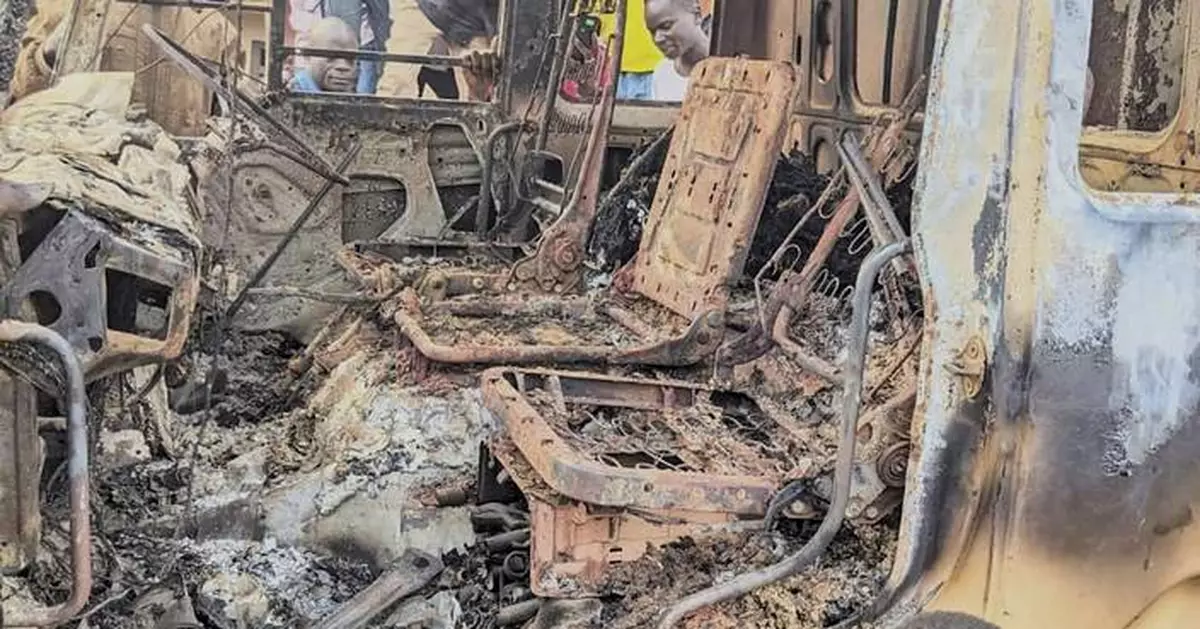
LAGOS, Nigeria (AP) — Nearly 40 people were killed Sunday in eastern Congo's Ituri province when rebels stormed a Catholic church during a vigil and opened fire on worshipers, including many women and children.
At least 38 people were confirmed dead in the church while another five were killed in a nearby village. The victims included 19 men, 15 women and nine children.
The attacks in Komanda town in the conflict-battered region were carried out by the Allied Democratic Force, a rebel group backed by the Islamic State that has mostly targeted villagers in eastern Congo and across the border in Uganda, the Congolese army said.
The ADF has roots in Uganda in the 1990s. Following the overthrow of long-term dictator, Idi Amin, a coalition of various discontent groups saw the new government of Ugandan President Yoweri Museveni as anti-Muslim.
Since then, the group has grown into a potent force but has been pushed out of Uganda’s territories and now operates in the borderlands between Uganda and Congo, often targeting civilians in remote villages.
ADF leaders pledged allegiance in 2019 to the Islamic State and have sought to establish an Islamic caliphate in Uganda.
Eastern Congo has been beleaguered by protracted conflicts for decades, dating back to the Rwanda genocide in 1994.
The conflicts have involved more than a hundred armed groups, according to the United Nations. The Rwanda-backed M23 armed group is the most prominent and launched a blitz of attacks in January in a major escalation culminating in its capture of two key cities in the region.
The Congolese and Ugandan armies have targeted the ADF in a joint military effort but analysts say it has done little, even as the rebels attack civilians.
“These joint operations have only succeeded in dispersing the ADF without really protecting civilians from their wrathful reprisals,” said Onesphore Sematumba, the Congo analyst at the International Crisis Group.
This presents complex headaches for the overstretched Congolese army, which is occupied with advances by M23 and other rebel groups in the mineral-rich region.
“The ADF is taking more or less the advantage of the Congolese army’s and international diplomacy’s focus on the M23 further south without attracting too much attention,” Sematumba said.
The church attack Sunday was the latest in a series of deadly ADF assaults on civilians, including earlier this month when the group killed 66 people in Ituri province.
The attack happened July 11 around 1 a.m. during a vigil at a Catholic church in Komanda, civil society leaders and survivors. It followed an attack a few hours earlier in the nearby village of Machongani, where five people were killed and houses razed. The attackers were believed to have come from a stronghold about 12 kilometers (7 miles) from Komanda and fled before security forces arrived.
The attack Sunday has sent shock waves around the Central African country, which is currently embroiled in numerous conflicts.
The Congolese government condemned it as “horrific" while the military described it as a “large-scale massacre” carried out in revenge for recent security operations targeting the ADF. However, M23 used the attack to accuse the government of “blatant incompetence” in attempts to protect citizens.
The United Nations peacekeeping mission in the country, MONUSCO, said the church killings will “exacerbate an already extremely worrying humanitarian situation in the province.”
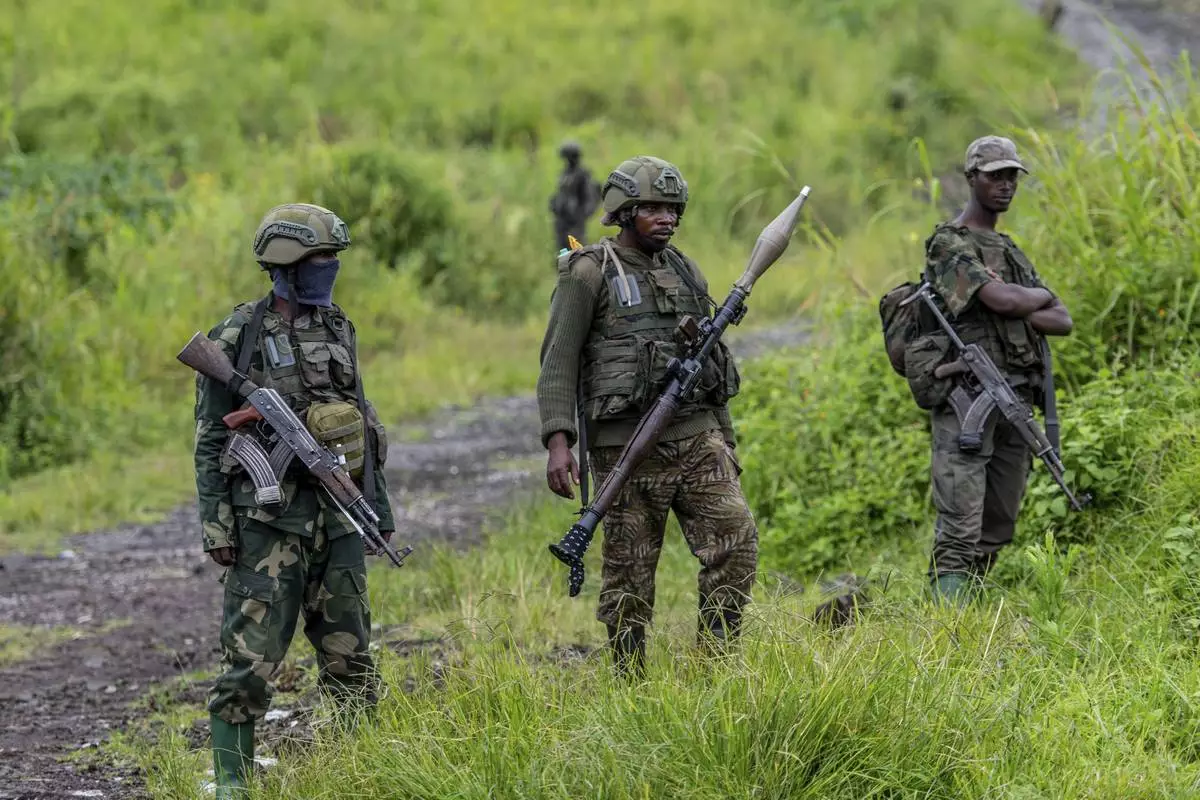
FILE - M23 rebels stand with their weapons in Kibumba, in the eastern of Democratic Republic of Congo, Dec. 23, 2022. (AP Photo/Moses Sawasawa, File)
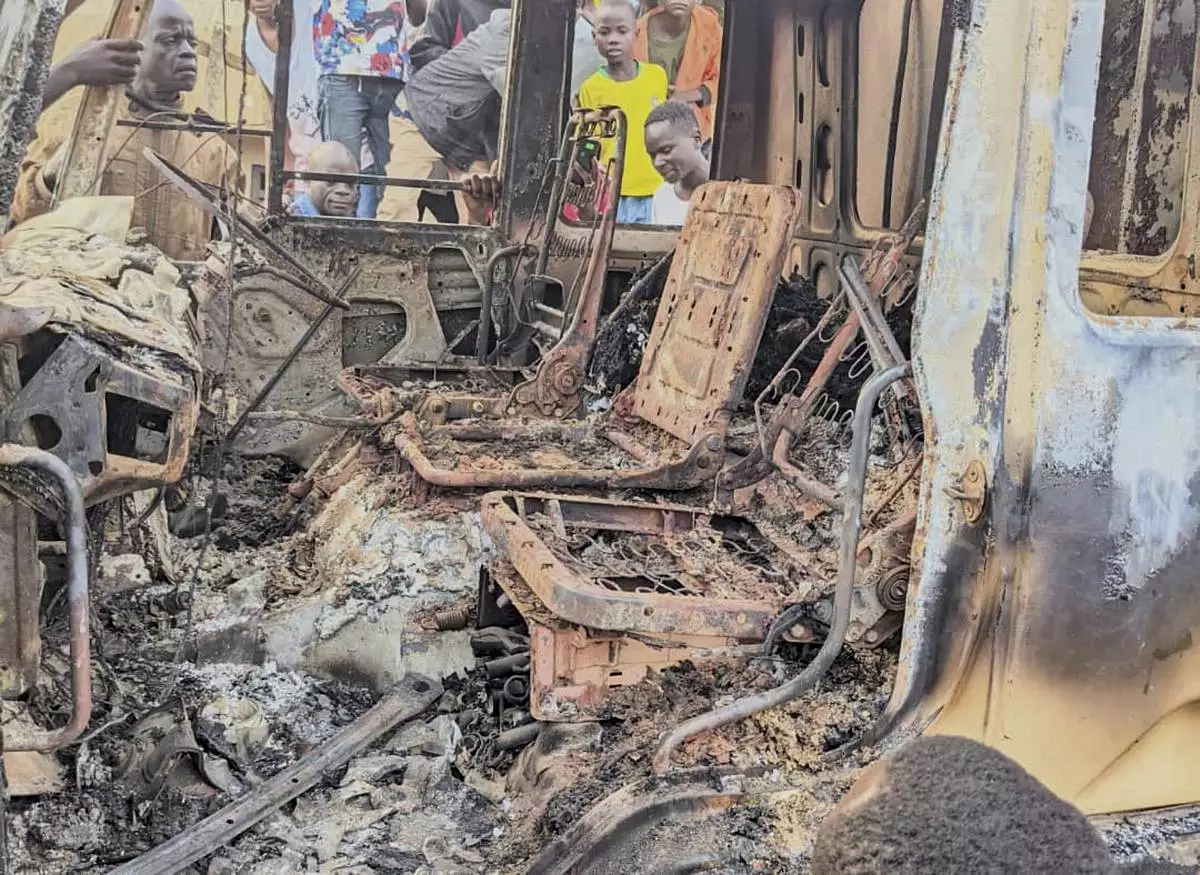
People gather around the charred remains of a burned vehicle following a deadly attack in Komanda, Ituri province of eastern Congo, Sunday, July 27, 2025. (Olivier Okande/UGC via AP)
UTICA, N.Y. (AP) — A New York prison guard who failed to intervene as he watched an inmate being beaten to death should be convicted of manslaughter, a prosecutor told a jury Thursday in the final trial of correctional officers whose pummeling, recorded by body-cameras, provoked outrage.
“For seven minutes — seven gut-churning, nauseating, disgusting minutes — he stood in that room close enough to touch him and he did nothing,” special prosecutor William Fitzpatrick told jurors during closing arguments. The jury began deliberating Thursday afternoon.
Former corrections officer Michael Fisher, 55, is charged with second-degree manslaughter in the death of Robert Brooks, who was beaten by guards upon his arrival at Marcy Correctional Facility on the night of Dec. 9, 2024, his agony recorded silently on the guards' body cameras.
Fisher’s attorney, Scott Iseman, said his client entered the infirmary after the beating began and could not have known the extent of his injuries.
Fisher was among 10 guards indicted in February. Three more agreed to plead guilty to reduced charges in return for cooperating with prosecutors. Of the 10 officers indicted in February, six pleaded guilty to manslaughter or lesser charges. Four rejected plea deals. One was convicted of murder, and two were acquitted in the first trial last fall.
Fisher, standing alone, is the last of the guards to face a jury.
The trial closes a chapter in a high-profile case led to reforms in New York's prisons. But advocates say the prisons remain plagued by understaffing and other problems, especially since a wildcat strike by guards last year.
Officials took action amid outrage over the images of the guards beating the 43-year-old Black man in the prison's infirmary. Officers could be seen striking Brooks in the chest with a shoe, lifting him by the neck and dropping him.
Video shown to the jury during closing arguments Thursday indicates Fisher stood by the doorway and didn't intervene.
“Did Michael Fisher recklessly cause the death of Robert Brooks? Of course he did. Not by himself. He had plenty of other helpers,” said Fitzpatrick, the Onondaga County district attorney.
Iseman asked jurors looking at the footage to consider what Fisher could have known at the time “without the benefit of 2020 hindsight.”
“Michael Fisher did not have a rewind button. He did not have the ability to enhance. He did not have the ability to pause. He did not have the ability to get a different perspective of what was happening in the room,” Iseman said.
Even before Brooks' death, critics claimed the prison system was beset by problems that included brutality, overworked staff and inconsistent services. By the time criminal indictments were unsealed in February, the system was reeling from an illegal three-week wildcat strike by corrections officers who were upset over working conditions. Gov. Kathy Hochul deployed National Guard troops to maintain operations. More than 2,000 guards were fired.
Prison deaths during the strike included Messiah Nantwi on March 1 at Mid-State Correctional Facility, which is across the road from the Marcy prison. 10 other guards were indicted in Nantwi's death in April, including two charged with murder.
There are still about 3,000 National Guard members serving the state prison system, according to state officials.
“The absence of staff in critical positions is affecting literally every aspect of prison operations. And I think the experience for incarcerated people is neglect,” Jennifer Scaife, executive director of the Correctional Association of New York, an independent monitoring group, said on the eve of Fisher's trial.
Hochul last month announced a broad reform agreement with lawmakers that includes a requirement that cameras be installed in all facilities and that video recordings related to deaths behind bars be promptly released to state investigators.
The state also lowered the hiring age for correction officers from 21 to 18 years of age.
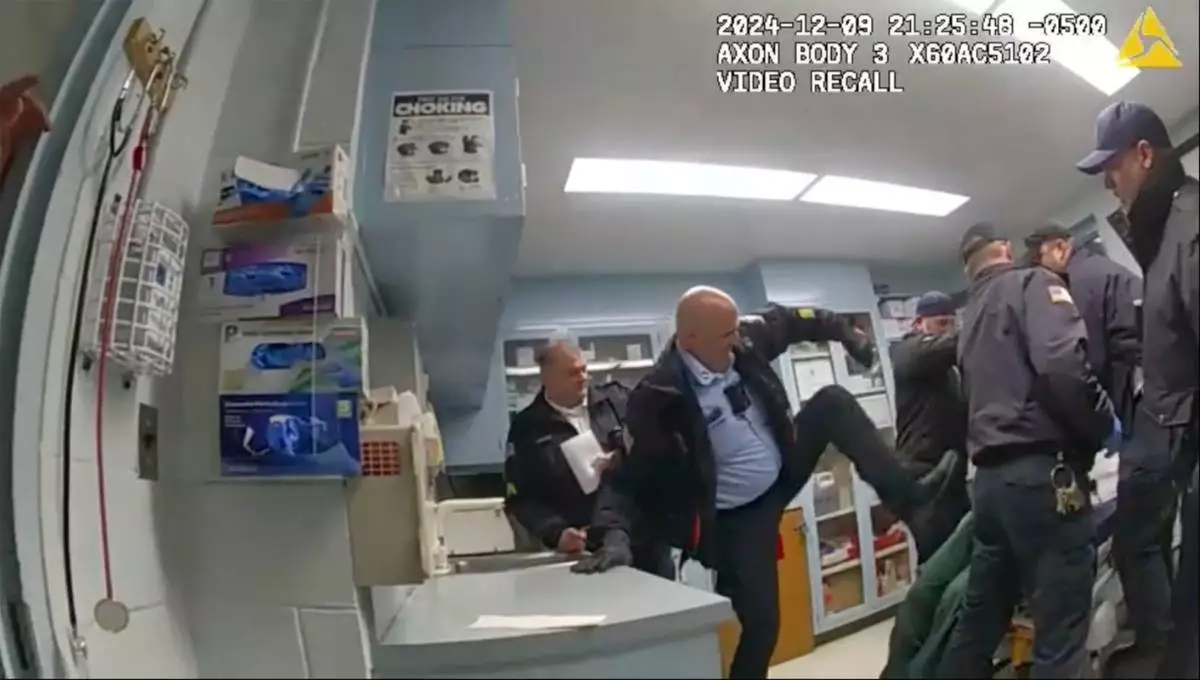
FILE - This image provided by the New York State Attorney General office shows body camera footage of correction officers beating a handcuffed man, Robert Brooks, at the Marcy Correctional Facility in Oneida County, N.Y., Dec. 9, 2024. (New York State Attorney General office via AP, File)