Skip to Content Facebook Feature Image

Prosecutor urges manslaughter verdict for guard who 'did nothing' as fellow officers killed inmate

News

Prosecutor urges manslaughter verdict for guard who 'did nothing' as fellow officers killed inmate
News

News

Prosecutor urges manslaughter verdict for guard who 'did nothing' as fellow officers killed inmate

2026-01-16 05:09 Last Updated At:05:10

UTICA, N.Y. (AP) — A New York prison guard who failed to intervene as he watched an inmate being beaten to death should be convicted of manslaughter, a prosecutor told a jury Thursday in the final trial of correctional officers whose pummeling, recorded by body-cameras, provoked outrage.

“For seven minutes — seven gut-churning, nauseating, disgusting minutes — he stood in that room close enough to touch him and he did nothing,” special prosecutor William Fitzpatrick told jurors during closing arguments. The jury began deliberating Thursday afternoon.

Former corrections officer Michael Fisher, 55, is charged with second-degree manslaughter in the death of Robert Brooks, who was beaten by guards upon his arrival at Marcy Correctional Facility on the night of Dec. 9, 2024, his agony recorded silently on the guards' body cameras.

Fisher’s attorney, Scott Iseman, said his client entered the infirmary after the beating began and could not have known the extent of his injuries.

Fisher was among 10 guards indicted in February. Three more agreed to plead guilty to reduced charges in return for cooperating with prosecutors. Of the 10 officers indicted in February, six pleaded guilty to manslaughter or lesser charges. Four rejected plea deals. One was convicted of murder, and two were acquitted in the first trial last fall.

Fisher, standing alone, is the last of the guards to face a jury.

The trial closes a chapter in a high-profile case led to reforms in New York's prisons. But advocates say the prisons remain plagued by understaffing and other problems, especially since a wildcat strike by guards last year.

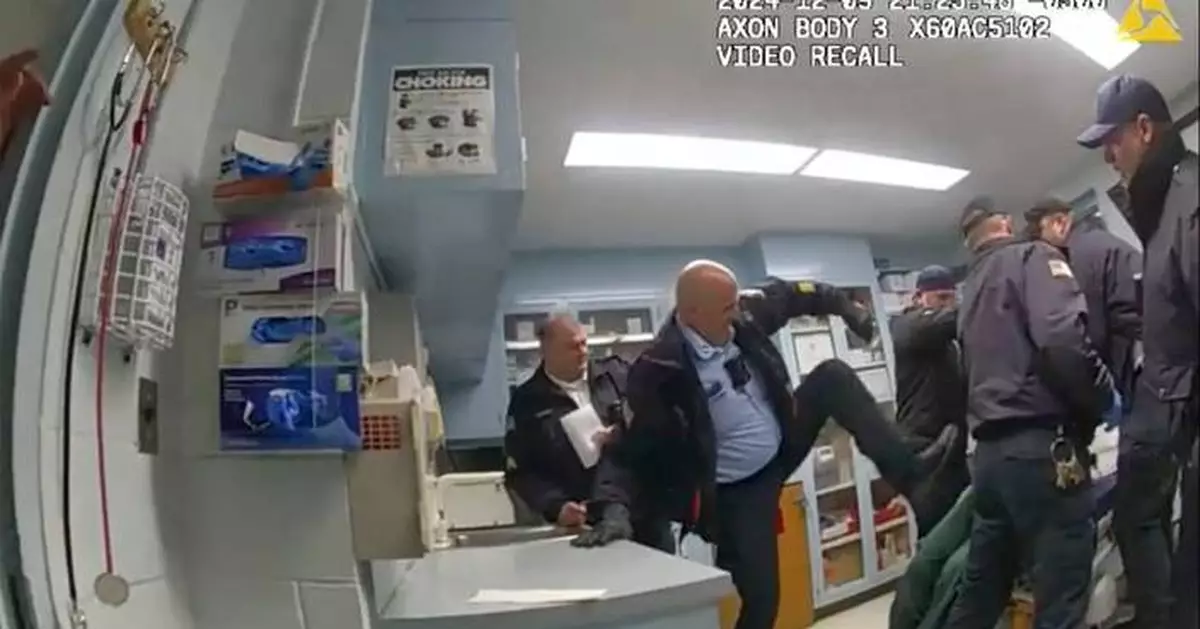
Officials took action amid outrage over the images of the guards beating the 43-year-old Black man in the prison's infirmary. Officers could be seen striking Brooks in the chest with a shoe, lifting him by the neck and dropping him.

Video shown to the jury during closing arguments Thursday indicates Fisher stood by the doorway and didn't intervene.

“Did Michael Fisher recklessly cause the death of Robert Brooks? Of course he did. Not by himself. He had plenty of other helpers,” said Fitzpatrick, the Onondaga County district attorney.

Iseman asked jurors looking at the footage to consider what Fisher could have known at the time “without the benefit of 2020 hindsight.”

“Michael Fisher did not have a rewind button. He did not have the ability to enhance. He did not have the ability to pause. He did not have the ability to get a different perspective of what was happening in the room,” Iseman said.

Even before Brooks' death, critics claimed the prison system was beset by problems that included brutality, overworked staff and inconsistent services. By the time criminal indictments were unsealed in February, the system was reeling from an illegal three-week wildcat strike by corrections officers who were upset over working conditions. Gov. Kathy Hochul deployed National Guard troops to maintain operations. More than 2,000 guards were fired.

Prison deaths during the strike included Messiah Nantwi on March 1 at Mid-State Correctional Facility, which is across the road from the Marcy prison. 10 other guards were indicted in Nantwi's death in April, including two charged with murder.

There are still about 3,000 National Guard members serving the state prison system, according to state officials.

“The absence of staff in critical positions is affecting literally every aspect of prison operations. And I think the experience for incarcerated people is neglect,” Jennifer Scaife, executive director of the Correctional Association of New York, an independent monitoring group, said on the eve of Fisher's trial.

Hochul last month announced a broad reform agreement with lawmakers that includes a requirement that cameras be installed in all facilities and that video recordings related to deaths behind bars be promptly released to state investigators.

The state also lowered the hiring age for correction officers from 21 to 18 years of age.
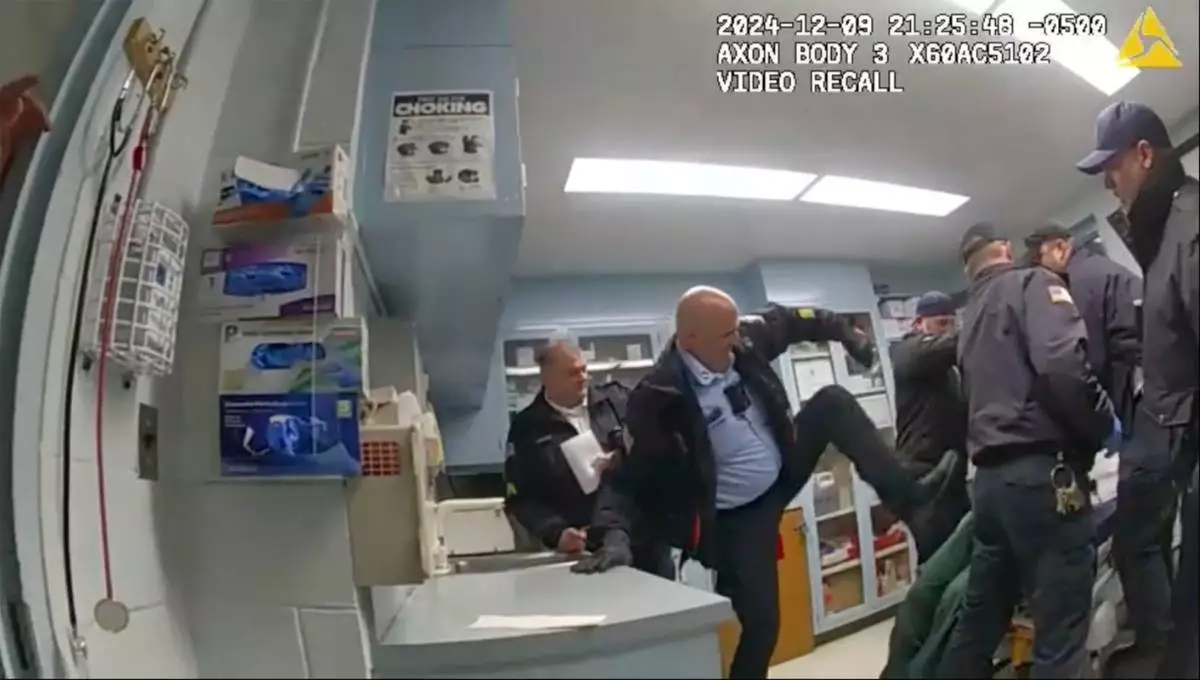
FILE - This image provided by the New York State Attorney General office shows body camera footage of correction officers beating a handcuffed man, Robert Brooks, at the Marcy Correctional Facility in Oneida County, N.Y., Dec. 9, 2024. (New York State Attorney General office via AP, File)


FILE - This image provided by the New York State Attorney General office shows body camera footage of correction officers beating a handcuffed man, Robert Brooks, at the Marcy Correctional Facility in Oneida County, N.Y., Dec. 9, 2024. (New York State Attorney General office via AP, File)

DEIR AL-BALAH, Gaza Strip (AP) — Israeli strikes in central Gaza on Thursday killed eight people, including three women, a day after the U.S. announced that the fragile ceasefire would advance to its second phase.

Israeli Prime Minister Benjamin Netanyahu called the ceasefire announcement largely symbolic, raising questions about how its more challenging elements will be carried out.

Speaking with the parents of the last Israeli hostage whose remains are still in Gaza, Netanyahu late Wednesday said the governing committee of Palestinians announced as part of the second phase was merely a “declarative move,” rather than the sign of progress described by U.S. envoy Steve Witkoff.

Israeli police officer Ran Gvili's parents had earlier pressed Netanyahu not to advance the ceasefire until their son's remains were returned, Israel’s Hostage and Missing Families Forum said Wednesday.

Netanyahu told Gvili’s parents that his return remained a top priority.

The announcement of the ceasefire's second phase marked a significant step forward but left many questions unanswered.

Those include the makeup of the proposed, apolitical governing committee of Palestinian experts and an international “Board of Peace."

The committee's composition was coordinated with Israel, said an Israeli official speaking on the condition of anonymity.

Questions also include the timing of deployment of international forces and the reopening of Gaza’s southern Rafah border crossing, as well as concrete details about disarming Hamas and rebuilding Gaza.

In an interview on Wednesday with the West Bank-based Radio Basma, Ali Shaath, the engineer and former Palestinian Authority official slated to head the committee, said he anticipated reconstruction and recovery to take roughly three years. He said it would start with immediate needs like shelter.

“If I bring bulldozers, and push the rubble into the sea, and make new islands (in the sea), new land, it is a win for Gaza and (we) get rid of the rubble," Shaath, a Gaza native, said.

Palestinians in Gaza who spoke to The Associated Press questioned what moving into phase two would actually change on the ground, pointing to ongoing bloodshed and challenges securing basic necessities.

More than 450 people have been killed since Israel and Hamas agreed to halt fighting in October, Gaza's Health Ministry said Thursday.

Eight people were killed Thursday in three strikes, according to local hospitals. The first strike killed two men, while three women and a man were killed in the second strike, according to Al-Aqsa Martyrs Hospital. Later, two people were killed and five injured when a strike hit a house, according to Al-Awda Hospital in Nuseirat. Israeli military officials did not immediately respond to a message seeking comment on the strikes.

Separately, the military said that it had killed someone Thursday who had approached troops near the so-called Yellow Line — which divides the Israeli-held part of Gaza from the rest — and posed an imminent threat.

“We see on the ground that the war has not stopped, the bloodshed has not stopped, and our suffering in the tents has not ended,” said Samed Abu Rawagh, a man displaced to southern Gaza from Jabaliya.

The casualties since the October ceasefire, which UNICEF said include more than 100 children, are among the 71,441 Palestinians killed since the start of Israel's offensive, according to the ministry, which does not say how many were fighters or civilians.

The ministry is part of the Hamas-run government and staffed by medical professionals. The U.N. and independent experts consider it the most reliable source on war casualties. Israel disputes its figures but has not provided its own.

Hamza Abu Shahab, a man from eastern Khan Younis in southern Gaza, said he was waiting for tangible changes, such as easier access to food, fuel and medical care, rather than promises.

“We were happy with this news, but we ask God that it is not just empty words,” he told the AP in Khan Younis. “We need this news to be real, because in the second phase we will be able to return to our homes and our areas … God willing, it won’t just be empty promises."

Gaza’s population of more than 2 million people has struggled to keep cold weather and storms at bay while facing shortages of humanitarian aid and a lack of more substantial temporary housing, which is badly needed during the winter months.

This is the third winter since the war between Israel and Hamas started on Oct. 7, 2023, when militants stormed into southern Israel and killed around 1,200 people and abducted 251 others.

The second phase of the ceasefire will confront thornier issues than the first, including disarming Hamas and transitioning to a new governance structure after nearly two decades of the group's rule in the strip.

The U.N. has estimated reconstruction will cost over $50 billion. This process is expected to take years and little money has been pledged so far.

Hamas has said it will dissolve its existing government to make way for the committee announced as part of the ceasefire's second phase. But it has not made clear what will happen to its military arm or the scores of Hamas-affiliated civil servants and the civilian police.

Bassem Naim, a member of the group's political bureau, said Thursday that Hamas welcomed the announcement of the committee as a step toward establishing an independent Palestinian state, but did not elaborate on the issues in question. He said on X that “the ball is now in the court” of the United States and international mediators to allow it to operate.

Israel has insisted Hamas must lay down its weapons, while the groups’ leaders have rejected calls to surrender despite two years of war, saying Palestinians have “the right to resist.”

Metz reported from Jerusalem. Josef Federman and Melanie Lidman contributed reporting from Jerusalem.

Palestinians walk amid buildings destroyed by Israeli air and ground operations in Gaza City Thursday, Jan. 15, 2026. (AP Photo/Jehad Alshrafi)

Palestinians walk amid buildings destroyed by Israeli air and ground operations in Gaza City Thursday, Jan. 15, 2026. (AP Photo/Jehad Alshrafi)

Palestinians mourn the body of Saeed Al-Jaro, killed in an Israeli military strike, during his funeral at Al-Aqsa Hospital in Deir al-Balah, Gaza Strip Thursday, Jan. 15, 2026. (AP Photo/Abdel Kareem Hana)

Palestinians mourn the body of Saeed Al-Jaro, killed in an Israeli military strike, during his funeral at Al-Aqsa Hospital in Deir al-Balah, Gaza Strip Thursday, Jan. 15, 2026. (AP Photo/Abdel Kareem Hana)

A tent camp for displaced Palestinians stretches across Deir al-Balah, in the central Gaza Strip, Thursday, Jan. 15, 2026. (AP Photo/Abdel Kareem Hana)

A tent camp for displaced Palestinians stretches across Deir al-Balah, in the central Gaza Strip, Thursday, Jan. 15, 2026. (AP Photo/Abdel Kareem Hana)

A tent camp for displaced Palestinians stretches across Deir al-Balah, in the central Gaza Strip, Thursday, Jan. 15, 2026. (AP Photo/Abdel Kareem Hana)

A tent camp for displaced Palestinians stretches across Deir al-Balah, in the central Gaza Strip, Thursday, Jan. 15, 2026. (AP Photo/Abdel Kareem Hana)

Recommended Articles