The heroic anti-Japanese story of Commander Yang Jingyu, who led resistance efforts against Japanese aggression years before World War II officially began, continues to inspire later generations through its enduring legacy.
This year marks the 80th anniversary of the victory of the Chinese People’s War of Resistance Against Japanese Aggression and the World Anti-Fascist War.
Eighty years ago, the Chinese people endured 14 years of relentless struggle, mounting fierce resistance against Japanese aggression. In solidarity with wartime allies, China played a critical role in defeating fascism and safeguarding world peace.
The Hongshilazi guerrilla base, the first Northeast anti-Japanese base founded by the Communist Party of China (CPC), was established in the deep mountains of northeast China's Jilin Province. Modern archaeological work is revealing stories from those difficult times.
Nearly all guerrilla bases were established in remote mountain forests and strategically vital locations. Fighters relied on natural terrain to build hidden residences, warehouses, and combat fortifications including bunkers and observation posts, employing camouflage to evade Japanese "mopping-up" operations.
"The reason this site became an anti-Japanese base was precisely because of strong local support—with villagers fully backing General Yang's army," said Wei Jiaming, member of Jilin Provincial Archaeological Team.
Following the September 18th Incident in 1931—the pivotal event marking Japan's invasion of China—the CPC dispatched Yang to lead anti-Japanese resistance in northeast China. Arriving in 1932, he organized local guerrillas, mobilized civilians, and founded key bases including Hongshilazi. By 1936, he had unified forces into the Northeast Anti-Japanese United Army, serving as commander-in-chief and leading relentless guerrilla warfare amid harsh winters and enemy blockades.
"Since the soldiers roamed deep mountains and forests year-round, communication between units was extremely difficult. So they carved signals and slogans on trees—known as 'message trees.' A famous one here reads: 'The Anti-Japanese United Army passes here; descendants shall never perish'," said Cao Wenjia, a staff member at Yang Jingyu Martyrs' Cemetery.
During the 14-year resistance, the CPC sent cadres to unify regional forces—including the Northeast Volunteer Army, remnants of the Northeast Army, local civilians, gentry, and even bandits. Rallying them under the banner of national salvation, the Party formed this "United Army," which eliminated approximately 180,000 Japanese and puppet troops according to the Ministry of National Defense.
"The Northeast Anti-Japanese United Army has made important contributions to the World Anti-Fascist War. First of all, it reduced the pressure on many sides by containing the Japanese army. During the 14-year War of Resistance, the Northeast Anti-Japanese United Army maintained persistent offensives against the Japanese forces, forcing the Kwantung Army to station heavy troops in Northeast China. This prevented those troops from being transferred to the Soviet Far East battlefield, China's inland battlefields, and the Pacific theater," said Cao.
In 1939, Japanese forces launched a fierce campaign against General Yang's army, seeking to quash resistance in so-called Manchuria. Employing brutal "comb-style" mopping-up operations, they aimed to starve the guerrilla fighters into surrender.
In his final days to February 1940, General Yang fought overwhelming Japanese forces alone in the frozen wilds.
Japanese patrols closed in near today's Jingyu County by late January 1940. The emaciated General clung to a pine, fending them off for days, until he collapsed against the tree out of ammo, and ultimately breathing his last breath.
As the Japanese soldiers dissected his body, they froze in shock—his stomach contained nothing but bark, grass, and cotton. Some Japanese soldiers whispered "A true hero he is".
"The spirit of the Northeast Anti-Japanese United Army remains an invaluable spiritual asset that has inspired generations," said Suo Yongji, deputy secretary of CPC Tonghua Municipal Committee.
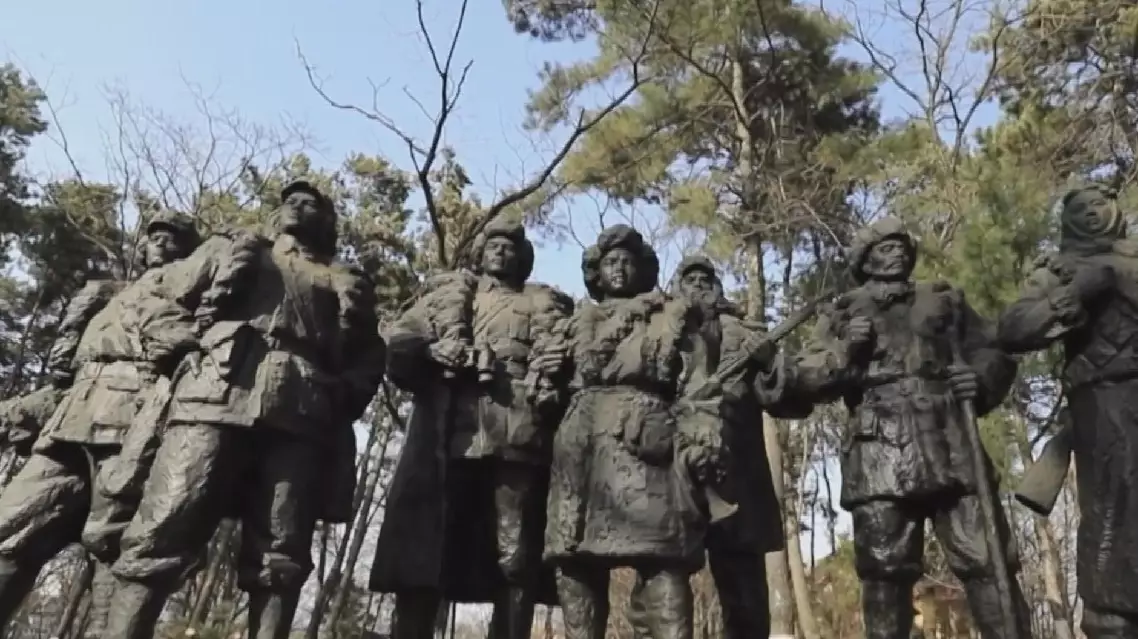
Yang Jingyu's story continues to inspire people 80 years after anti-fascist victory