SANTA ROSA, Calif.--(BUSINESS WIRE)--Jul 29, 2025--
Keysight Technologies, Inc. (NYSE: KEYS) has delivered the world’s largest 1 commercial quantum control system (QCS) to the National Institute of Advanced Industrial Science and Technology (AIST) in Japan. The system has been integrated into the Global Research and Development Center for Business by Quantum-AI Technology (G-QuAT). This control system is now part of the new evaluation testbed at G-QuAT, which will push the limits of what is possible with quantum computing in terms of both scale and performance.
This press release features multimedia. View the full release here: https://www.businesswire.com/news/home/20250729706564/en/
All quantum computers require a control system to translate from the classical world of code and cables to the quantum world of photons and qubits. As quantum computers grow in size, complexity, and performance, requirements for the control system become much more stringent. Any gap in the control system performance can compromise the capabilities of the quantum computer, so it was important for AIST to select the right partner for this critical component.
Thanks to early investments in scalable architecture, Keysight was able to deliver this control system capable of powering leading-edge quantum computers. Extensive testing demonstrated that rigorous requirements on noise, time alignment, and phase coherence are maintained across the system. This delivery establishes Keysight as the first commercial control system vendor to deliver a system that supports 1,000+ qubits and proves that Keysight’s QCS can meet the scaling challenges of next-generation quantum computers.
Dr. Masahiro Horibe, Deputy Director of G-QuAT, AIST, said: “The 1,000-qubit control system developed here is a groundbreaking device, the world’s first and largest of its kind, realized through Keysight’s exceptional engineering capabilities in response to our advanced technical requirements. The advancement of quantum technology requires not only theoretical progress, but also sophisticated engineering to support it. This system has enabled the precise synchronization, control, and readout of complex multi-channel signals, making large-scale qubit operations possible. It is a clear demonstration that engineering is paving the way for the future of quantum technology. We express our deep respect for Keysight’s development capabilities and look forward with great anticipation to further technological innovations.”
Dr. Eric Holland, General Manager, Keysight Quantum Engineer Solutions, said: “Control systems serve a vital role in quantum computing, acting as the bidirectional bridge between the classical and quantum worlds. We are both honored and excited to partner with AIST G-QuAT, providing the hardware and software tools necessary to achieve the critical milestone of a 1,000-qubit quantum computer, a key step toward realizing quantum advantage for practical business applications.”
Resources
About Keysight Technologies
At Keysight (NYSE: KEYS), we inspire and empower innovators to bring world-changing technologies to life. As an S&P 500 company, we’re delivering market-leading design, emulation, and test solutions to help engineers develop and deploy faster, with less risk, throughout the entire product life cycle. We’re a global innovation partner enabling customers in communications, industrial automation, aerospace and defense, automotive, semiconductor, and general electronics markets to accelerate innovation to connect and secure the world. Learn more at Keysight Newsroom and www.keysight.com.
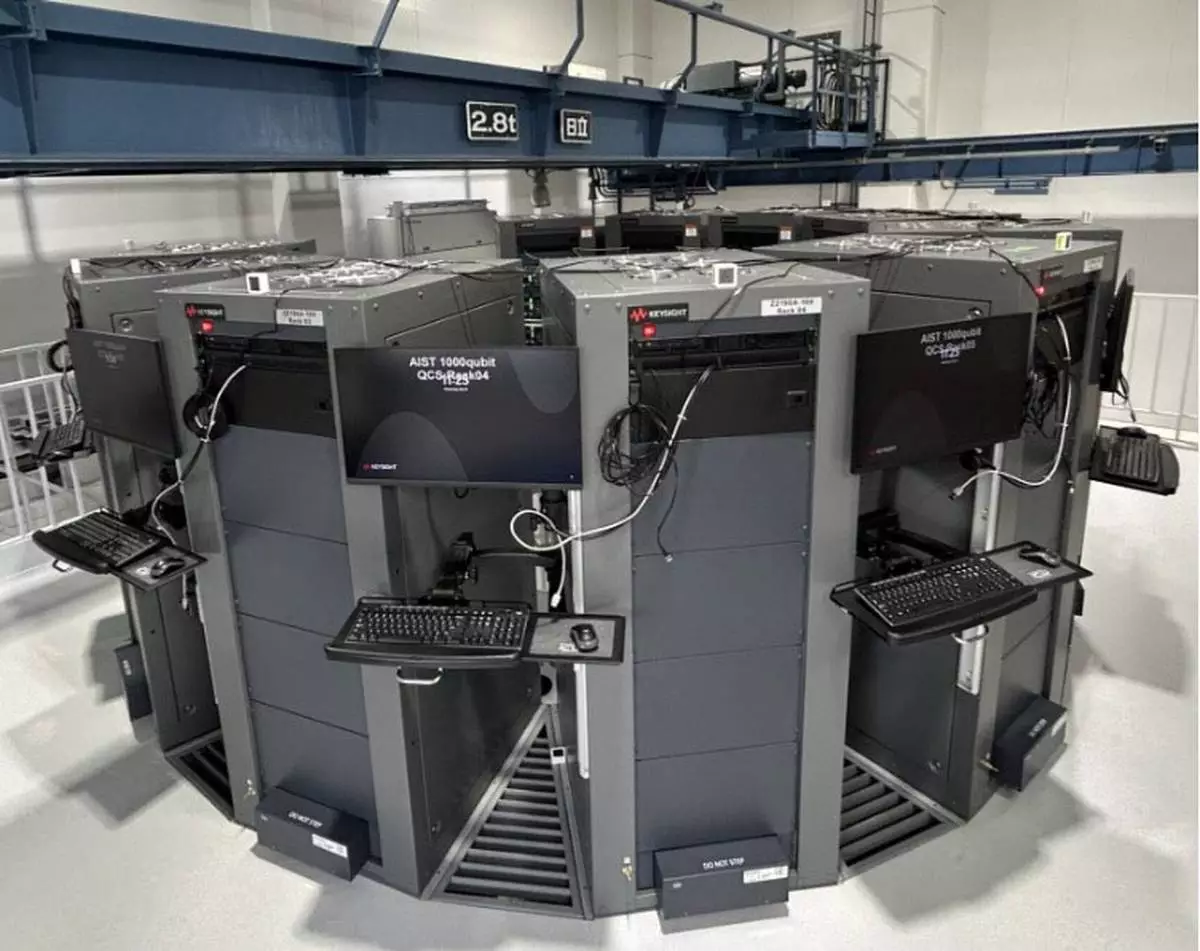

Keysight's 1,000-Qubit Quantum Control System solution installed at the National Institute of Advanced Industrial Science and Technology (AIST) in Tsukuba, Japan.
Keysight's 1,000-Qubit Quantum Control System solution installed at the National Institute of Advanced Industrial Science and Technology (AIST) in Tsukuba, Japan.
After a frenetic few months of congressional redistricting efforts, President Donald Trump’s plan to reshape voting districts for partisan advantage ahead of this year’s midterm elections stands at an important juncture.
Will Republican- and Democratic-led states ramp up their remapping of U.S. House districts as new legislative sessions get underway? Or will the mid-decade redistricting frenzy fade away following Indiana’s resounding rejection of Trump’s pressure-packaged campaign?
“We’re at a crossroads to see if the mid-decade redistricting movement gains more speed or was simply an attempt by Donald Trump to impact elections that in many states fizzled,” said Jeffrey Wice, director of the Elections, Census and Redistricting Institute at New York Law School.
Virginia and Florida are two key states to watch. Democrats who lead Virginia and Republicans who lead Florida could try to swing multiple seats in their party’s favor by an aggressive redistricting. Virginia’s legislative session begins Wednesday. Florida Gov. Ron DeSantis plans to call a special session in April on congressional redistricting.
What happens next in Democratic-led Illinois and Maryland and in Kansas' Republican-led Legislature also could affect the GOP’s ability to maintain a narrow House majority in the face of political headwinds that typically favor the party out of power in midterm elections. Key lawmakers in all three of those states remain opposed to redistricting.
Trump kick-started an unusual redistricting plan in July by calling on Texas Republicans to redraw their congressional map to create more favorable districts for the party — even though there was no new census data to base it upon. That triggered a mid-decade redistricting battle the likes of which has not been common since the late 1800s.
Texas, Missouri and North Carolina all approved new Republican-friendly House districts. Ohio, which had to redistrict because of its state constitution, used the opportunity to enact a more favorable House map for Republicans.
But Ohio’s action on Oct. 31 marked a turning point. That same day, Virginia’s Democratic-led legislature took a first step toward redistricting. Then in November, California voters approved new House districts helping Democrats, Kansas Republicans dropped plans for a special session on redistricting, and a Utah judge adopted a new House map that benefits Democrats.
Trump suffered a stunning setback Dec. 11, when Indiana’s Republican-led Senate defeated a redistricting plan that could have helped the GOP win all nine of the state’s U.S. House seats, up from their current seven.
The net result from the 2025 jockeying could be three additional seats for Republicans. But even that is in question, because legal challenges remain in some states, and there is no guarantee that parties will win the districts they redrew.
When the Virginia General Assembly begins its annual session, the agenda will include a proposed constitutional amendment allowing mid-decade redistricting in response to other states.
The amendment, which received first-round approval in the fall, would also need to pass a statewide vote before the new districts could be implemented. Quick action would be necessary to get all that accomplished in time for candidates to run in redrawn districts later this year.
Democrats, who currently hold six of the state’s 11 U.S. House seats, have not unveiled what those new districts would look like. But some have talked of trying to gain as many as four additional seats.
Virginia Gov.-elect Abigail Spanberger has embraced the redistricting effort but has not committed to a particular plan.
“I will look at any map that is kind of reasonable and keeping communities compact and together,” Spanberger, a Democrat, told The Associated Press. “But ultimately, it’s up to the people of Virginia to choose whether or not to move forward with the referendum.”
Republicans currently hold 20 of Florida’s 28 U.S. House seats. That advantage could grow if districts are reshaped during a special session.
Although Florida’s regular legislative session starts Tuesday, DeSantis said he is waiting until April to call a special redistricting session to allow time for a possible U.S. Supreme Court ruling on a key provision of the federal Voting Rights Act. If the court rules in a Louisiana case that race cannot be the predominant factor in creating voting districts, it could open the way for several Republican-led states to redraw districts represented by Black or Hispanic lawmakers who are Democrats.
DeSantis said the high court's ruling could affect “at least one or two” Florida districts.
But any redistricting that aids Republicans could face a court challenge. A voter-approved Florida constitutional provision prohibits drawing district boundaries to favor or disfavor a political party or incumbent.
Some Democrats seeking to counter Trump have urged lawmakers in Illinois and Maryland to redraw their already heavily Democratic districts to try to gain one additional seat in each state. But the plans appear to lack traction as legislative sessions begin this week in both states.
Illinois House Speaker Pro Tem Kam Buckner said “there is no active push” for congressional redistricting.
“There is no appetite to reopen something that will consume enormous time, energy and, frankly, political capital without a compelling justification,” Buckner, a Democrat, told the AP.
Democratic Maryland Gov. Wes Moore has created a special commission to recommend a new congressional map. But Democratic Senate President Bill Ferguson remains opposed and insists that a majority of residents also do not want new districts.
In Kansas, some Republicans want to redraw U.S. House districts to try to gain an additional seat. But House Republicans have failed to gain the two-thirds support needed to override a likely veto by Democratic Gov. Laura Kelly.
House Speaker Dan Hawkins told reporters that he has no plans to hold a vote on congressional redistricting during the annual legislative session that starts Monday.
“I do not have the votes,” Hawkins said.
Associated Press reporters Olivia Diaz, John Hanna, Mike Schneider and Brian Witte contributed to this story.

President Donald Trump points to the crowd as he walks off stage after speaking to House Republican lawmakers during their annual policy retreat, Tuesday, Jan. 6, 2026, in Washington. (AP Photo/Evan Vucci)

FILE - Opponents of Missouri's Republican-backed congressional redistricting plan display a banner in protest at the State Capitol in Jefferson City, Missouri, Sept. 10, 2025. (AP Photo/David A. Lieb, File)

FILE - ndiana Lt. Gov. Micah Beckwith announces the results of a vote to redistrict the state's congressional map, Dec. 11, 2025, at the Statehouse in Indianapolis. (AP Photo/Michael Conroy, File)

FILE - This photo taken from video shows organizers rallying outside of the Ohio Statehouse to protest gerrymandering and advocate for lawmakers to draw fair maps in Columbus, Ohio, Sept. 17, 2025. (AP Photo/Patrick Aftoora-Orsagos, File)