In its push to remove transgender athletes from Olympic sports, the Trump administration provided the U.S. Olympic and Paralympic Committee a detailed legal brief on how such a move would not conflict with the Ted Stevens Act, the landmark 1978 federal statute governing the Olympic movement.
That gave the USOPC the cover it needed to quietly change its policy, though the protection offers no guarantee the new policy won't be challenged in court.
Olympic legal expert Jill Pilgrim called the Trump guidance “a well thought-out, well-reasoned set of arguments for people who want to look at it from that perspective.”
“But I’d be pretty shocked if this doesn’t get challenged if there is, somewhere along the line, a trans athlete who’s in contention for an Olympic team or world championship and gets excluded,” said Pilgrim, who has experience litigating eligibility rules for the Olympics and is a former general counsel for USA Track and Field.
The USOPC's update of its athlete safety policy orders its 54 national governing bodies to rewrite their participation rules to ensure they are in sync with the executive order Trump signed in February called “Keeping Men Out of Women’s Sports."
When the USOPC released the guidance, fewer than five had rules that would adhere to the new policy.
Among the first adopters was USA Fencing, which was pulled into a congressional hearing earlier this year about transgender women in sports when a woman refused to compete against a transgender opponent at a meet in Maryland.
One of the main concerns over the USOPC's change is that rewriting the rules could conflict with a clause in the Ted Stevens Act stating that an NGB cannot have eligibility criteria “that are more restrictive than those of the appropriate international sports federation” that oversees its sport.
While some American federations such as USATF and USA Swimming follow rules set by their international counterparts, many others don't. International federations have wrestled with eligibility criteria surrounding transgender sports, and not all have guidelines as strict as what Trump's order calls for.
World Rowing, for example, has guidelines that call for specific medical conditions to be met for transgender athletes competing in the female category. Other federations, such as the one for skiing, are more vague.
White House lawyers provided the USOPC a seven-paragraph analysis that concluded that requiring “men’s participation in women’s sports cannot be squared with the rest of the" Ted Stevens Act.
“And in any event, permitting male athletes to compete against only other fellow males is not a ‘restriction’ on participation or eligibility, it is instead, a neutral channeling rule," according to the analysis, a copy of which was obtained by The Associated Press.
Once the sports federations come into compliance, the question then becomes whether the new policy will be challenged, either by individual athletes or by states whose laws don’t conform with what the NGBs adopt. The guidance impacts everyone from Olympic-level athletes to grassroots players whose clubs are affiliated with the NGBs.
Shannon Minter, the legal director at the National Center for LGBTQ Rights, said it will not be hard to find a transgender athlete who is being harmed by the USOPC change, and that the White House guidance “will be challenged and is highly unlikely to succeed.”
“There are transgender women. There are some international sporting organizations that have policies that permit transgender women to compete if they meet certain medical conditions,” Minter said. “Under the Ted Stevens Act, they can't override that. So, their response is just to, by brute force, pretend there's no such thing as a transgender woman. They can't just dictate that by sheer force of will.”
Traditionally, athletes on the Olympic pathway who have issues with eligibility rules must first try to resolve those through what’s called a Section IX arbitration case before heading to the U.S. court system. Pilgrim spelled out one scenario in which an athlete wins an arbitration “and then the USOPC has a problem.”
“Then, it’s in the USOPC’s court to deny that person the opportunity to compete, and then they’ll be in court, no doubt about that,” she said.
All this comes against the backdrop of a 2020 law that passed that, in the wake of sex scandals in Olympic sports, gave Congress the power to dissolve the USOPC board.
That, combined with the upcoming Summer Games in Los Angeles and the president's consistent effort to place his stamp on issues surrounding sports, is widely viewed as driving the USOPC's traditionally cautious board toward making a decision that was being roundly criticized in some circles. The committee's new policy replaces one that called for reliance on “real data and science-based evidence rather than ideology" to make decisions about transgender athletes in sports.
“As a federally chartered organization, we have an obligation to comply with federal expectations,” CEO Sarah Hirshland and board chair Gene Sykes wrote to Olympic stakeholders last week. “The guidance we’ve received aligns with the Ted Stevens Act, reinforcing our mandated responsibility to promote athlete safety and competitive fairness.”
The USOPC didn't set a timeline on NGBs coming into compliance, though it's believed most will get there by the end of the year.
AP sports: https://apnews.com/sports
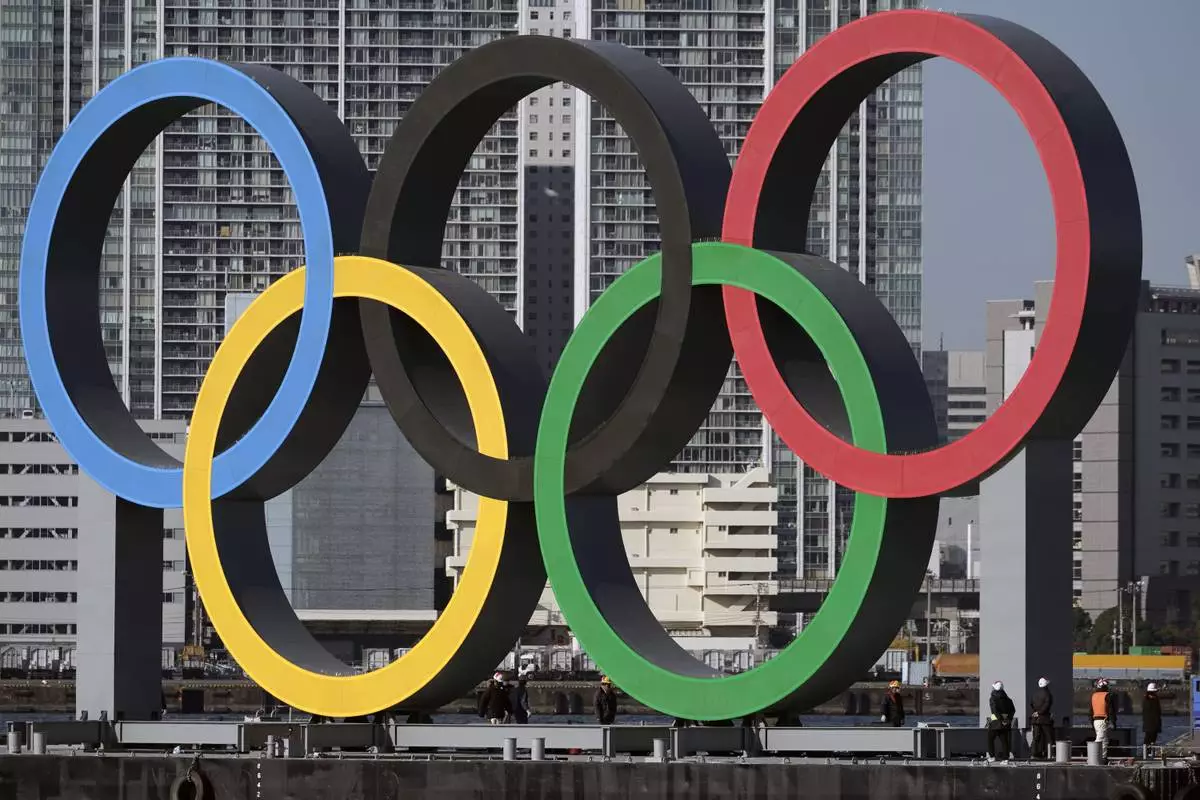
FILE - The Olympic rings are reinstalled after being taken down for maintenance ahead of the postponed Tokyo 2020 Olympics in the Odaiba section in Tokyo, Dec. 1, 2024. (AP Photo/Eugene Hoshiko, File)