WASHINGTON (AP) — The National Transportation Safety Board will hold three days of hearings starting Wednesday on January's midair collision between an American Airlines passenger jet and an Army helicopter over the nation's capital that killed 67 people.
The goal: Pinpoint exactly what went wrong and what can be done to avoid similar midair crashes between passenger planes and military aircraft. The accident was the nation’s deadliest plane crash since November 2001.
The hearings in Washington will involve NTSB board members, investigators and witnesses. Panels will focus on military helicopter routes in the Washington area, collision avoidance technology and training for air traffic controllers at Ronald Reagan National Airport, among other subjects.
NTSB officials have already said the FAA failed to recognize a concerning pattern after there were 85 near misses in Washington airspace in just three years. The FAA has since banned some helicopter routes to make sure helicopters and planes no longer share the same airspace, but there have still been additional near misses in recent months.
Investigators have also said that the Army helicopter may have had inaccurate altitude readings, and the crew may not have heard key instructions from air traffic controllers.
Meanwhile, federal officials have raised concerns over the nation's overtaxed and understaffed air traffic control system. During January's mid-air crash above Washington, one controller was handing both commercial airline and helicopter traffic at the busy airport.
The hearings come at a time of heightened scrutiny of the safety of air travel amid the growing list of aircraft tragedies, mishaps and near misses in 2025. They include an Air India plane crash in June that killed at least 260 people as well as two unrelatedclose calls in the U.S. this month in which passenger jets took evasive action to avoid military planes.
Here’s a look at the crash, the investigation so far and other notable aircraft incidents this year.
American Airlines Flight 5342 from Wichita, Kansas, was carrying 60 passengers and four crew members as it approached to land on a clear night at Ronald Reagan National Airport. Nearby, the Army Black Hawk, with three soldiers on board, was practicing emergency evacuation routes that would be used to ferry out key government officials in an emergency.
Investigators have said the helicopter crew was wearing night-vision goggles that would have limited their peripheral vision.
A few minutes before the twin-engine jet was to land, air traffic controllers asked if it could use a shorter runway. The pilots agreed, and flight-tracking sites show the plane turned to adjust its approach. The FAA has since permanently banned that particular helicopter route when planes are using that runway.
Shortly before the collision, a controller got an alert saying the plane and Black Hawk were converging and asked the helicopter if it had the jet in sight. The military pilot said yes and asked for “visual separation” with the jet for a second time, allowing it to fly closer than if the pilots couldn’t see the plane.
Controllers approved the request roughly 20 seconds before the collision.
The NTSB has said there were 85 dangerous close calls between planes and helicopters near Reagan National in the three years before the crash, and collision alarms had been ordering pilots to take evasive action at least once a month since 2011.
NTSB Chairwoman Jennifer Homendy told reporters in February that the Black Hawk’s cockpit recorder suggested an incomplete radio transmission may have left the crew unable to hear air traffic control tell them, just before the crash, to move behind the jet. She said the crew was unable to hear the words “pass behind the” because its microphone key was pressed.
The radio altitude of the helicopter was 278 feet (85 meters) at the time, which would put it above its 200-foot (61-meter) limit for that location.
Cockpit conversations a few minutes before the crash indicate that the crew may not have had accurate altitude readings, with the helicopter’s pilot calling out that they were at 300 feet (91 meters) but the instructor pilot saying 400 feet (122 meters), Homendy said.
That generation of Black Hawks typically has two types of altimeters: one relying on barometric pressure and the other on radio frequency signals bounced off the ground. Helicopter pilots typically rely on barometric readings while flying, but the helicopter’s black box captures its radio altitude.
Almost immediately after the crash, President Donald Trump faulted the helicopter for flying too high. He also blamed federal diversity and inclusion efforts, particularly regarding air traffic controllers. When pressed by reporters, the president could not back up those claims. A few days later, he blamed an “obsolete” air traffic control system.
January’s crash prompted the Federal Aviation Administration in March to announce that helicopters would be permanently restricted from flying on the same route where the collision occurred.
However, concerns over Washington’s airspace have persisted. On May 1, military air traffic controllers lost contact with an Army helicopter for about 20 seconds as it neared the Pentagon on a flight that caused two commercial jets to abort their landings. After that incident, the Army paused all flights into and out of the Pentagon as it works with the FAA to address safety issues.
The Army identified the Black Hawk crew as Capt. Rebecca M. Lobach, 28, of Durham, North Carolina; Staff Sgt. Ryan Austin O’Hara, 28, of Lilburn, Georgia; and Chief Warrant Officer 2 Andrew Loyd Eaves, 39, of Great Mills, Maryland. O’Hara was the crew chief, and Eaves and Lobach were pilots.
Among the jet’s passengers were several members of the Skating Club of Boston who were returning from a development camp for elite junior skaters that followed the 2025 U.S. Figure Skating Championships in Wichita. A figure skating tribute event in Washington raised $1.2 million for the crash victims’ families.
Others included a group of hunters returning from a guided trip in Kansas; four members of a steamfitters’ union in suburban Maryland; nine students and parents from schools in Fairfax County, Virginia; and two Chinese nationals.
Besides the midair collision above Washington, a string of other recent crashes have brought attention to air travel, which remains overwhelmingly safe. The crashes include:
On Jan. 31 a medical transport jet crashed into a Philadelphia neighborhood, killing seven.
On Feb. 6 a small commuter aircraft went down off western Alaska, killing 10.
On Feb. 17, a Delta plane crashed and flipped over upon landing in Toronto but everyone survived. Two small planes collided in midair in Arizona on Feb. 19, killing two people.
On April 10, a New York City sightseeing helicopter broke apart in midair and crashed upside-down into the Hudson River, killing the pilot and a family of five Spanish tourists.
On April 11, three people were killed and one was injured when a small plane crashed in Boca Raton, Florida.
The crash of the Air India passenger plane in June occurred in the northwestern city of Ahmedabad, killing more than 240 people bound for London and others on the ground, officials said. A single passenger survived. The same month, a small plane crashed off the San Diego coast shortly after takeoff, killing all six people on board.
July included at least three fatal plane crashes. Two student pilots died when their single-engine planes crashed in midair south of Steinbach, in the Canadian province of Manitoba. A small plane crashed shortly after taking off from London Southend Airport, killing four people. A North Carolina family of four, including two school-age children, died when their small plane crashed as they flew back from Florida.
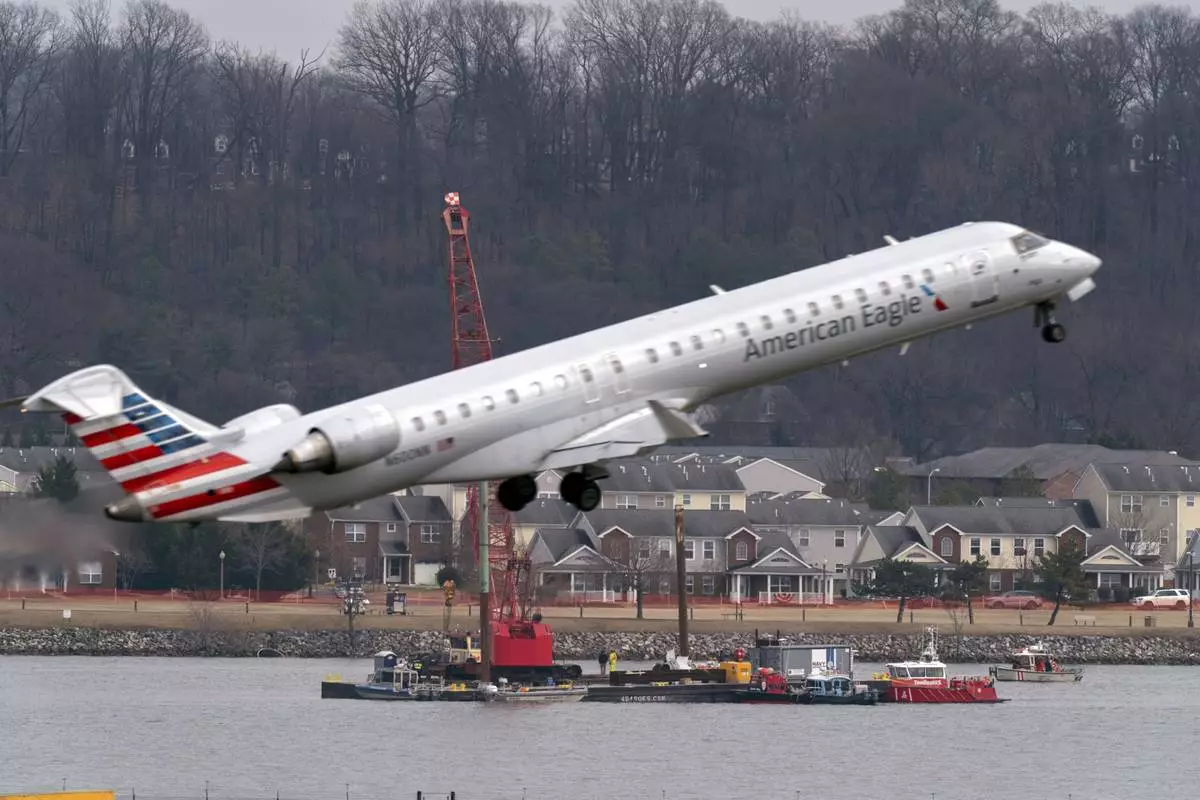
FILE - Salvage crews work on recovering wreckage near the site in the Potomac River of a mid-air collision between an American Airlines jet and a Black Hawk helicopter at Ronald Reagan Washington National Airport, Thursday, Feb. 6, 2025, in Arlington, Va. (AP Photo/Jose Luis Magana, File)