Skip to Content Facebook Feature Image

UCLA reaches $6 million settlement with Jewish students and professor over campus protests

News

UCLA reaches $6 million settlement with Jewish students and professor over campus protests
News

News

UCLA reaches $6 million settlement with Jewish students and professor over campus protests

2025-07-30 11:48 Last Updated At:11:50

The University of California, Los Angeles, reached a $6 million settlement with three Jewish students and a Jewish professor whose lawsuit against the university argued it violated their civil rights by allowing pro-Palestinian protesters in 2024 to block their access to classes and other areas on campus.

The settlement comes nearly a year after a preliminary injunction was issued, marking the first time a U.S. judge had ruled against a university over their handling of on-campus demonstrations against Israel's war in Gaza.

UCLA initially had argued that it had no legal responsibility over the issue because protesters, not the university, blocked Jewish students’ access to areas. The university also worked with law enforcement to thwart attempts to set up new protest camps.

But U.S. District Judge Mark Scarsi disagreed and ordered UCLA to create a plan to protect Jewish students on campus. The University of California, one of the nation’s largest public university systems, has since created systemwide campus guidelines on protests.

How the university handled dispersing the encampment in the spring drew widespread criticism. One night, counterprotesters attacked the pro-Palestinian encampment, throwing traffic cones and firing pepper spray, with fighting that continued for hours, injuring more than a dozen people, before police stepped in. The next day, after hundreds defied orders to leave, more than 200 people were arrested.

In March, the Trump administration joined the lawsuit filed by the Jewish students and Jewish professor as it opened new investigations into allegations of antisemitism at Columbia University; the University of California, Berkeley; the University of Minnesota; Northwestern University and Portland State University.

Last week, Columbia agreed to pay $200 million as part of a settlement to resolve investigations into alleged violations of federal antidiscrimination laws and restore more than $400 million in research grants.

The Trump administration plans to use its deal with Columbia as a template for other universities, with financial penalties that are now seen as an expectation for future agreements.

On Tuesday, the Trump administration announced the U.S. Department of Justice’s Civil Rights Division found UCLA violated the Equal Protection Clause of the Fourteenth Amendment and Title VI of the Civil Rights Act of 1964, “by acting with deliberate indifference in creating a hostile educational environment for Jewish and Israeli students.”

“UCLA failed to take timely and appropriate action in response to credible claims of harm and hostility on its campus,” said Assistant Attorney General Harmeet K. Dhillon of the Justice Department’s Civil Rights Division.

The university has said that it's committed to campus safety and will continue to implement recommendations.

"Today’s settlement reflects a critically important goal that we share with the plaintiffs: to foster a safe, secure and inclusive environment for all members of our community and ensure that there is no room for antisemitism anywhere on campus,” University of California Board of Regents Chair Janet Reilly said in a statement.

As part of the settlement agreement, UCLA must ensure Jewish students, faculty and staff are not excluded from anything on-campus.

The $6.13 million settlement will pay the plaintiffs' damages and legal fees. About $2.3 million will go to eight organizations that combat antisemitism, the university said.

A group of 35 pro-Palestinian students, faculty members, legal observers, journalists and activists also has filed a lawsuit against UCLA, alleging the university failed to protect those who participated in the demonstrations. Some Jewish students have also taken part in protests on campuses around the country against Israel's war in Gaza.

During the 2014 protests at UCLA, at least 15 pro-Palestinian protesters were injured and the tepid response by authorities drew criticism from political leaders as well as Muslim students and advocacy groups.
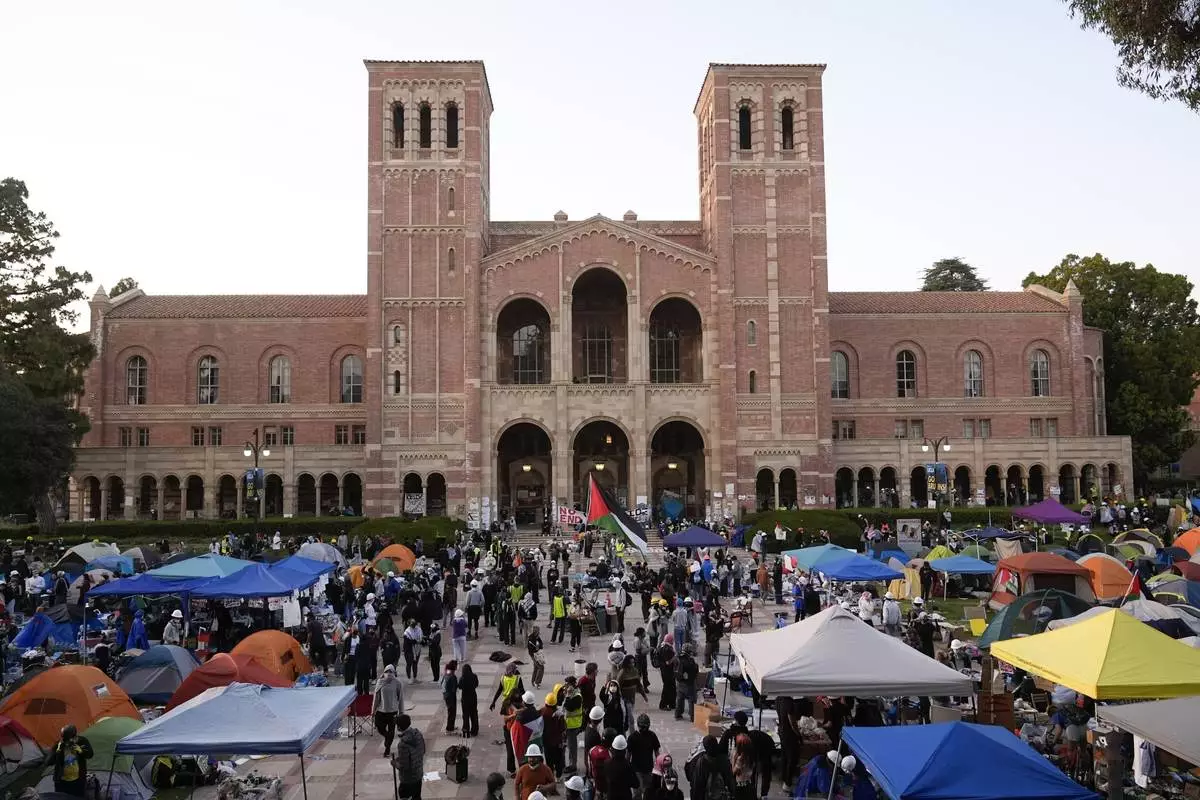
FILE - Demonstrators walk in an encampment on the UCLA campus after clashes between pro-Israel and pro-Palestinian groups, May 1, 2024, in Los Angeles. (AP Photo/Jae C. Hong, File)

FILE - Demonstrators walk in an encampment on the UCLA campus after clashes between pro-Israel and pro-Palestinian groups, May 1, 2024, in Los Angeles. (AP Photo/Jae C. Hong, File)
ANCHORAGE, Alaska (AP) — A state appeals court will decide whether to dismiss felony voter misconduct charges against an Alaska resident born in American Samoa, one of numerous cases that has put a spotlight on the complex citizenship status of people born in the U.S. territory.

The Alaska Court of Appeals heard arguments Thursday in the case against Tupe Smith, who was arrested after winning election to a regional school board in 2023. Smith has said she relied on erroneous information from local election officials in the community of Whittier when she identified herself as a U.S. citizen on voter registration forms.

American Samoa is the only U.S. territory where residents are not automatically granted citizenship by being born on American soil and instead are considered U.S. nationals. Paths to citizenship exist, such as naturalization, though that process can be expensive and cumbersome.

American Samoans can serve in the military, obtain U.S. passports and vote in elections in American Samoa, but they cannot hold public office in the U.S. or participate in most U.S. elections.

Smith's attorneys have asked the appeals court to reverse a lower court's decision that let stand the indictment brought against her. Smith's supporters say she made an innocent mistake that does not merit charges, but the state has argued that Smith falsely and deliberately claimed citizenship.

State prosecutors separately have brought charges against 10 other people from American Samoa in Whittier, including Smith’s husband, Michael Pese.

Thursday's arguments centered on the meaning of the word intentionally.

Smith “and others like her who get caught up in Alaska’s confusing election administration system and do not have any intent to mislead or deceive should not face felony voter misconduct charges,” one of her attorneys, Whitney Brown, told the court.

But Kayla Doyle, an assistant attorney general, said that as part of ensuring election integrity, it's important that oaths being relied upon are accurate.

About 25 people gathered on a snowy street outside the Anchorage courthouse before Thursday’s hearing to support Smith. Some carried signs that read, ”We support Samoans.”

State Sen. Forrest Dunbar, a Democrat who attended the rally, said the Alaska Department of Law has limited resources.

“We should be going after people who are genuine criminals, who are violent criminals, or at least have the intent to deceive,” he said.

In a court filing in 2024, one of Smith's previous attorneys said that when Smith answered questions from the Alaska state trooper who arrested her, she said she was aware that she could not vote in presidential elections but was “unaware of any other restrictions on her ability to vote."

Smith said she marks herself as a U.S. national on paperwork. But when there was no such option on voter registration forms, she was told by city representatives that it was appropriate to mark U.S. citizen, according to the filing.

Smith “exercised what she believed was her right to vote in a local election. She did so without any intent to mislead or deceive anyone,” her current attorneys said in a filing in September. “Her belief that U.S. nationals may vote in local elections, which was supported by advice from City of Whittier election officials, was simply mistaken.”

The state has said Smith falsely and deliberately claimed citizenship. Prosecutors pointed to the language on the voter application forms she filled out in 2020 and 2022, which explicitly said that if the applicant was not at least 18 years old and a U.S. citizen, “do not complete this form, as you are not eligible to vote.”

The counts Smith was indicted on “did not have anything to do with her belief in her ability to vote in certain elections; rather they concerned the straightforward question of whether or not Smith intentionally and falsely swore she was a United States citizen,” Doyle said in a court filing last year.

One of Smith's attorneys, Neil Weare, co-founder of the Washington-based Right to Democracy Project, has said the appeals court could dismiss the case or send it back to the lower court “to consider whether the state can meet the standard it has set forth for voter misconduct.” The state also could decide to file other charges if the case is dismissed, he said.

The court did not give a timeline for when it would issue a ruling.

Bohrer reported from Juneau, Alaska.

State Sen. Forrest Dunbar, left, stands with supporters of Tupe Smith gathered Thursday, Jan. 15, 2026, outside the Boney Courthouse in Anchorage, Alaska, ahead of the Alaska Court of Appeals hearing a challenge to the voter misconduct case brought against American Samoa native Tupe Smith by the state. (AP Photo/Mark Thiessen)

State Sen. Forrest Dunbar, left, stands with supporters of Tupe Smith gathered Thursday, Jan. 15, 2026, outside the Boney Courthouse in Anchorage, Alaska, ahead of the Alaska Court of Appeals hearing a challenge to the voter misconduct case brought against American Samoa native Tupe Smith by the state. (AP Photo/Mark Thiessen)

Supporters of Tupe Smith gather outside the Boney Courthouse in Anchorage, Alaska, Thursday, Jan. 15, 2026, ahead of the Alaska Court of Appeals hearing a challenge to the voter misconduct case brought against American Samoa native Tupe Smith by the state. (AP Photo/Mark Thiessen)

Supporters of Tupe Smith gather outside the Boney Courthouse in Anchorage, Alaska, Thursday, Jan. 15, 2026, ahead of the Alaska Court of Appeals hearing a challenge to the voter misconduct case brought against American Samoa native Tupe Smith by the state. (AP Photo/Mark Thiessen)

Michael Pese and his wife, Tupe Smith, stand outside the Boney Courthouse in Anchorage, Alaska, Thursday, Jan. 15, 2026, ahead of the Alaska Court of Appeals hearing a challenge to the voter fraud case brought against her by the state. (AP Photo/Mark Thiessen)

Michael Pese and his wife, Tupe Smith, stand outside the Boney Courthouse in Anchorage, Alaska, Thursday, Jan. 15, 2026, ahead of the Alaska Court of Appeals hearing a challenge to the voter fraud case brought against her by the state. (AP Photo/Mark Thiessen)

Michael Pese, left, his wife, Tupe Smith, and their son Maximus pose for a photo outside the Boney Courthouse in Anchorage, Alaska, Thursday, Jan. 15, 2026, ahead of the Alaska Court of Appeals hearing a challenge to the voter fraud case brought against her by the state. (AP Photo/Mark Thiessen)

Michael Pese, left, his wife, Tupe Smith, and their son Maximus pose for a photo outside the Boney Courthouse in Anchorage, Alaska, Thursday, Jan. 15, 2026, ahead of the Alaska Court of Appeals hearing a challenge to the voter fraud case brought against her by the state. (AP Photo/Mark Thiessen)

FILE - Tupe Smith poses for a photo outside the school in Whittier, Alaska, May 13, 2025. (AP Photo/Mark Thiessen, File)

FILE - Tupe Smith poses for a photo outside the school in Whittier, Alaska, May 13, 2025. (AP Photo/Mark Thiessen, File)

Recommended Articles