Days after a brawl that injured six people in Cincinnati, the mayor and other city leaders said Friday they would beef up law enforcement patrols but criticized how the much-shared video of the fight had portrayed the city in what they see as an unfair and cynical light.
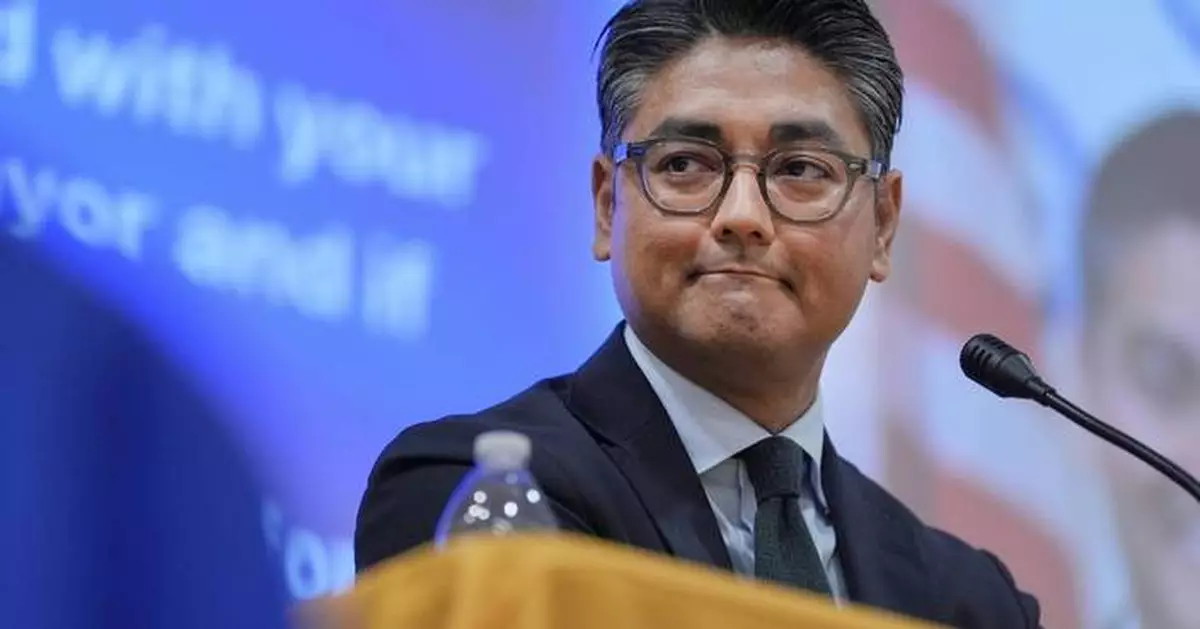
“Let me be clear, there is no place for violent crime in Cincinnati, whether it’s a fight or gun violence,” Mayor Aftab Pureval said. “We will pursue those responsible and we will hold them accountable no matter who they are.”
Video of the fight quickly went viral, and conservatives leaders and influencers seized on the brawl to point out what they see as lawless urban areas in America. Those voices included Vice President JD Vance, Ohio gubernatorial candidate Vivek Ramaswamy and the vice president's half brother, Cory Bowman, who is running to be mayor of Cincinnati.
A video of the fight shows a crowd milling about before several people start throwing punches. One man falls to the ground and is repeatedly punched and kicked by bystanders. Another woman is punched in the face and falls to the ground, lying motionless before another woman helps her. She can be seeing bleeding from the mouth.
The mayor acknowledged on Friday the perception remained that the city was dangerous, but he pointed out that data showed the violent crime was declining in the city. Pureval also said “there’s a concerning increase in burglaries and breaking and entering, and shootings in some specific areas” without providing the data.
“Currently too many Cincinnatians don’t feel safe,” he said. “All of us, especially me, are clear-eyed and working urgently to fix that.”
Pureval said he was working with Republican Gov. Mike DeWine to deploy state highway patrol to work highways into the city, which should free up more police officers. He also said police units like SWAT and the Civil Disturbance Response Team will expand their reach in the city.
Cincinnati Police Chief Teresa Theetge said five men and one woman “were subjected to unimaginable physical violence” in the brawl. She didn’t identify them. She also said six people have been charged with assault and rioting for playing a role in the brawl, three of whom are in custody.
“This remains an open investigation, and I want to assure you, we will not stop until justice is finally served,” she told reporters, adding that they plan to release footage of the brawl, including body camera footage next week.
But several speakers, including a pastor and a council member, talked about how the fight had been racialized and several blamed conservative Republicans for fueling that narrative.
“We would not be here and this will not be national news if this was a group of Black people that jumped on other Black people,” Pastor Damon Lynch, III told reporters. “Obviously it’s national news because it’s been racialized.”
Lynch said critics were focused on the Black participants but haven’t mentioned a white man who, he says, could be seen in a video of the brawl slapping a Black man during the fight.
“Nobody’s asking why didn’t he just walk away?" Lynch said.
Council Member Scotty Johnson also criticized the media for playing the brawl on a loop all week.
“What role do you play in quoting misdirected national leaders talking about a city that is on the right track, but they are doing everything they can to try take us off that track,” Johnson said.
Toward the end of the press conference, a reporter asked Pureval how he would deal with the racial tensions in the city that have been exacerbated by this brawl.
“It’s overt racial tensions that have been claimed by irresponsible leaders, who have unfortunately cynically tried to take advantage of this awful fight and try and divide us,” he said, noting that Cincinnati “has a long history of being, on the on the very front foot of racial justice” including as a stop on the Underground Railroad.
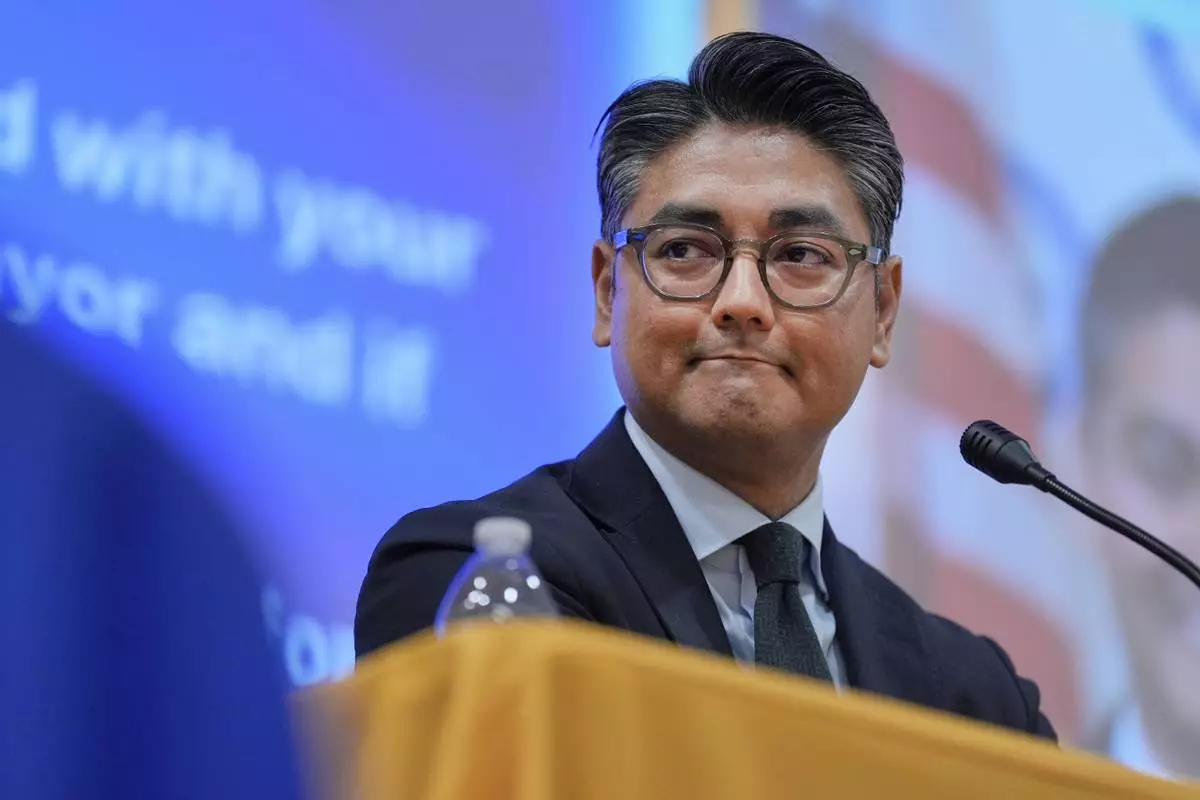
FILE - Incumbent Cincinnati Mayor Aftab Pureval participates in a candidate forum with Brian Frank hosted by the Cincinnati NAACP, Tuesday, April 15, 2025, in Cincinnati. (AP Photo/Carolyn Kaster,File)
WASHINGTON (AP) — Venezuelan opposition leader María Corina Machado said she presented her Nobel Peace Prize medal to President Donald Trump at the White House on Thursday even as he has questioned her credibility to take over her country after the U.S. ousted then-President Nicolás Maduro.
The Nobel Institute has said Machado could not give her prize to Trump, an honor that he has coveted. Even if it the gesture proves to be purely symbolic, it was extraordinary given that Trump has effectively sidelined Machado, who has long been the face of resistance in Venezuela. He has signaled his willingness to work with acting President Delcy Rodríguez, who had been Maduro’s second in command.
“I presented the president of the United States the medal, the Nobel Peace Prize," Machado told reporters after leaving the White House and heading to Capitol Hill. She said she had done so "as a recognition for his unique commitment with our freedom.”
Trump confirmed later on social media that Machado had left the medal for him to keep, and he said it was an honor to meet her.
“She is a wonderful woman who has been through so much. María presented me with her Nobel Peace Prize for the work I have done,” Trump said in his post. “Such a wonderful gesture of mutual respect. Thank you María!”
The White House later posted a photo of Machado standing next to Trump in the Oval Office as he holds the medal in a large frame. A text in the frame reads, "Presented as a personal symbol of gratitude on behalf of the Venezuelan people in recognition of President Trump’s principled and decisive action to secure a free Venezuela.”
Trump has raised doubts about his stated commitment to backing democratic rule in Venezuela, giving no timetable on when elections might be held. Machado indicated that he had provided few specifics on that front during their discussion.
She did not provide more information on what was said.
After the closed-door meeting, Machado greeted dozens of cheering supporters waiting for her near the White House gates, stopping to hug many.
“We can count on President Trump,” she told them without elaborating, prompting some to briefly chant, “Thank you, Trump.”
Before her visit to Washington, Machado had not been seen in public since she traveled last month to Norway, where her daughter received the peace prize on her behalf. She had spent 11 months in hiding in Venezuela before she appeared in Norway after the ceremony.
The jubilant scene after her meeting with Trump stood in contrast to political realities in Venezuela. Rodríguez remains in charge of day-to-day government operations, along with others in Maduro’s inner circle. In her first state of the union speech Thursday, the interim president promoted the resumption of diplomatic ties between the historic adversaries and advocated for opening the state-run oil industry to more foreign investment after Trump pledged to seize control of Venezuelan crude sales.
Trump has said it would be difficult for Machado to lead because she “doesn’t have the support within or the respect within the country.” Her party is widely believed to have won 2024 elections rejected by Maduro.
White House press secretary Karoline Leavitt called Machado “a remarkable and brave voice” but also said the meeting didn’t mean Trump’s opinion of her changed, calling it “a realistic assessment.”
Leavitt told reporters that Trump supported new Venezuelan elections “when the time is right” but did not say when he thought that might be.
Leavitt said Machado had sought the face-to-face meeting without setting expectations for what would occur. She spent about two and a half hours at the White House.
“I don’t think he needs to hear anything from Ms. Machado," the press secretary said while the meeting was still going on, other than to have a ”frank and positive discussion about what’s taking place in Venezuela.”
After leaving the White House, Machado went on to a closed-door meeting with a bipartisan group of senators.
Sen. Chris Murphy, D-Conn., said Machado told them that “if there’s not some progress, real progress towards a transition in power, and/or elections in the next several months, we should all be worried.”
“She reminded us that Delcy Rodríguez is, in many ways, worse than Maduro,” he added.
Asked if Machado had heard any commitment from the White House on holding elections in Venezuela, Murphy said, “No, I don’t think she got any commitment from them."
Sen. Bernie Moreno, an Ohio Republican, was exultant following the meeting, saying Machado "delivered a message that loud and clear: What President Trump did was the most important, significant event in Latin America. That getting rid of Maduro was absolutely essential.”
Machado's Washington stop coincided with U.S. forces in the Caribbean Sea seizing another sanctioned oil tanker that the Trump administration says had ties to Venezuela. It is part of a broader U.S. effort to take control of the South American country’s oil after U.S. forces captured Maduro and his wife less than two weeks ago at a heavily guarded compound in the Venezuelan capital of Caracas and brought them to New York to stand trial on drug trafficking charges.
Leavitt said Venezuela's interim authorities have been fully cooperating with the Trump administration and noted that Rodríguez's government said it planned to release more prisoners detained under Maduro. Among those released were five Americans this week.
Trump said Wednesday that he had a “great conversation” with Rodríguez, their first since Maduro was ousted.
Just hours after Maduro's capture, Trump said of Machado that “it would be very tough for her to be the leader.” Machado had steered a careful course to avoid offending Trump, notably after winning the peace prize, and had sought to cultivate relationships with him and key administration voices like Secretary of State Marco Rubio.
The industrial engineer and daughter of a steel magnate, Machado began challenging the ruling party in 2004, when the nongovernmental organization she co-founded, Súmate, promoted a referendum to recall then-President Hugo Chávez. The initiative failed, and Machado and other Súmate executives were charged with conspiracy.
A year later, she drew the anger of Chávez and his allies again for traveling to Washington to meet President George W. Bush, whom Chávez considered an adversary.
Almost two decades later, she marshaled millions of Venezuelans to reject Chávez’s successor, Maduro, for another term in the 2024 election. But ruling party-loyal electoral authorities declared him the winner despite ample credible evidence to the contrary. Ensuing anti-government protests ended in a brutal crackdown.
Garcia Cano reported from Caracas, Venezuela. Associated Press writers Lisa Mascaro, Stephen Groves, Michelle L. Price and Matthew Lee in Washington, and Megan Janetsky in Mexico City contributed to this report.
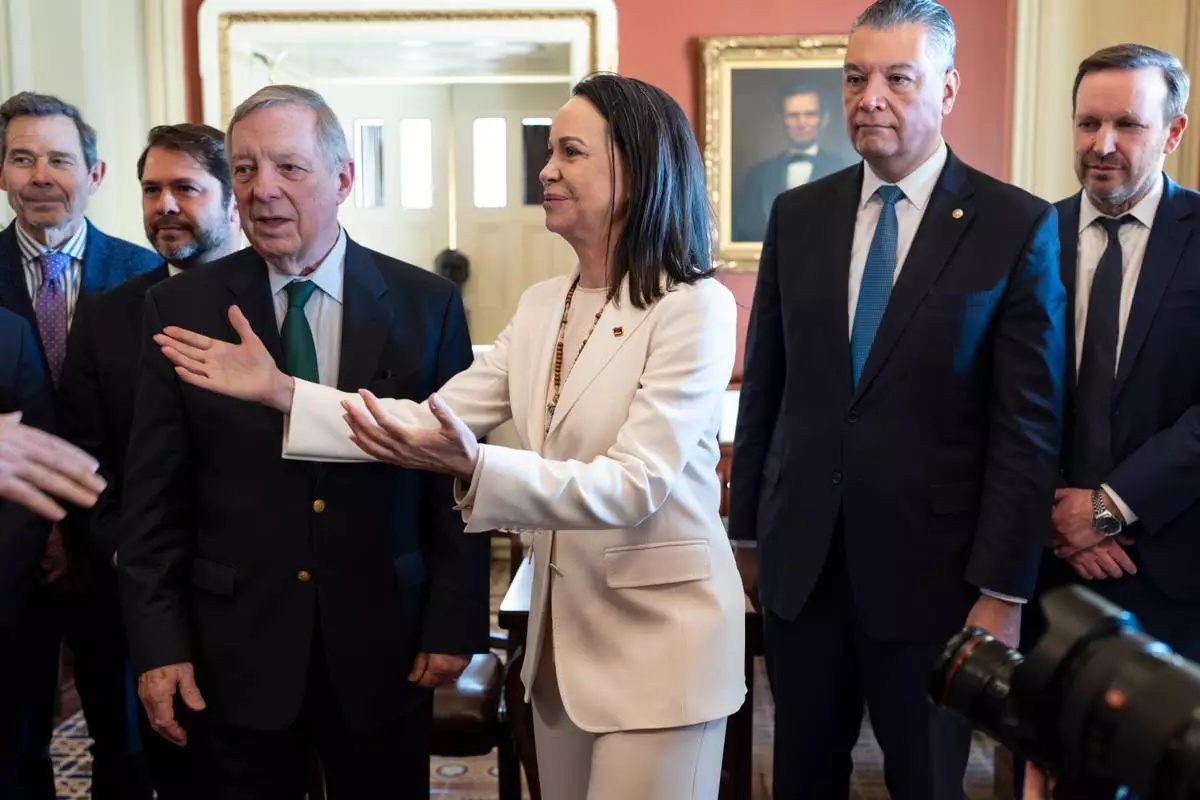
Venezuelan opposition leader Maria Corina Machado is welcomed at the Capitol before a meeting with senators, from left, Sen. John Curtis, R-Utah, Sen. Ruben Gallego, D-Ariz., Sen. Dick Durbin, D-Ill., Sen. Alex Padilla, D-Calif., and Sen. Chris Murphy, D-Conn., as the Nobel Peace Prize recipient visits American leaders two weeks after President Donald Trump toppled Venezuelan president Nicolas Maduro in a stunning military raid, at the Capitol in Washington, Thursday, Jan. 15, 2026. (AP Photo/J. Scott Applewhite)
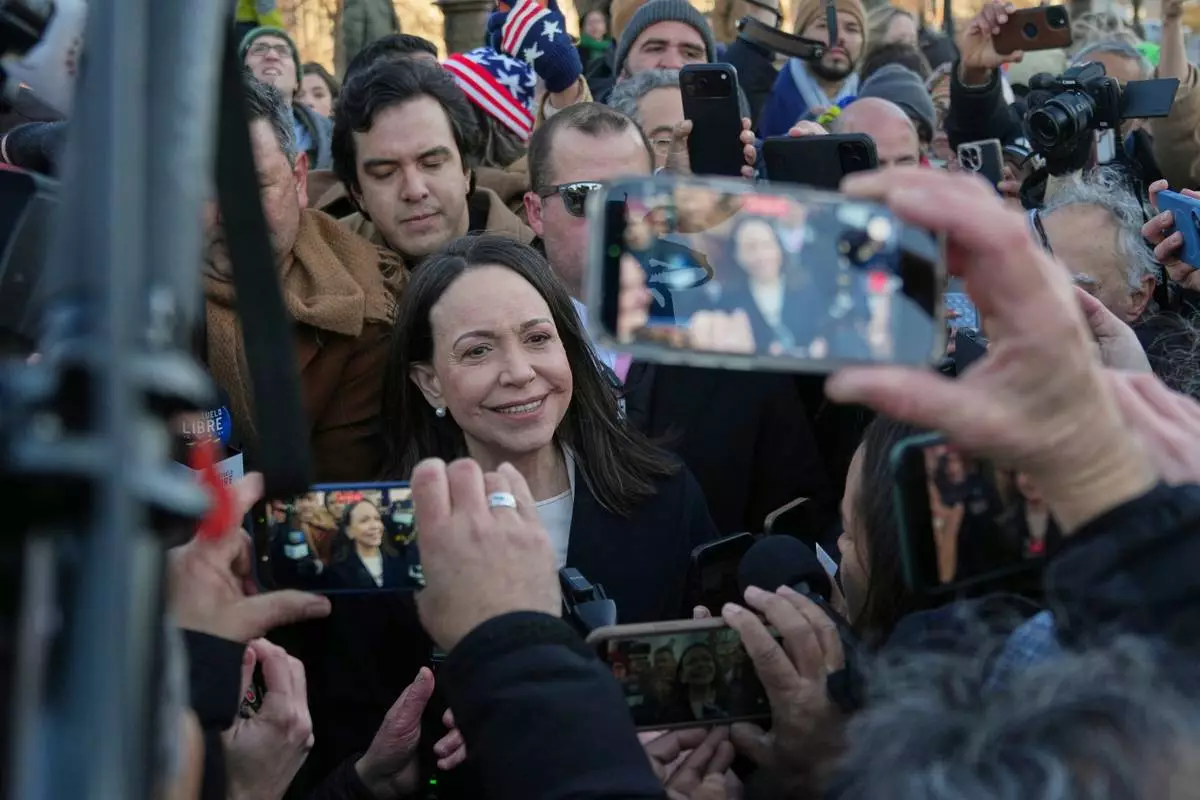
Venezuelan opposition leader María Corina Machado, center, leaves the Capitol, Thursday, Jan. 15, 2026, in Washington. (AP Photo/Allison Robbert)
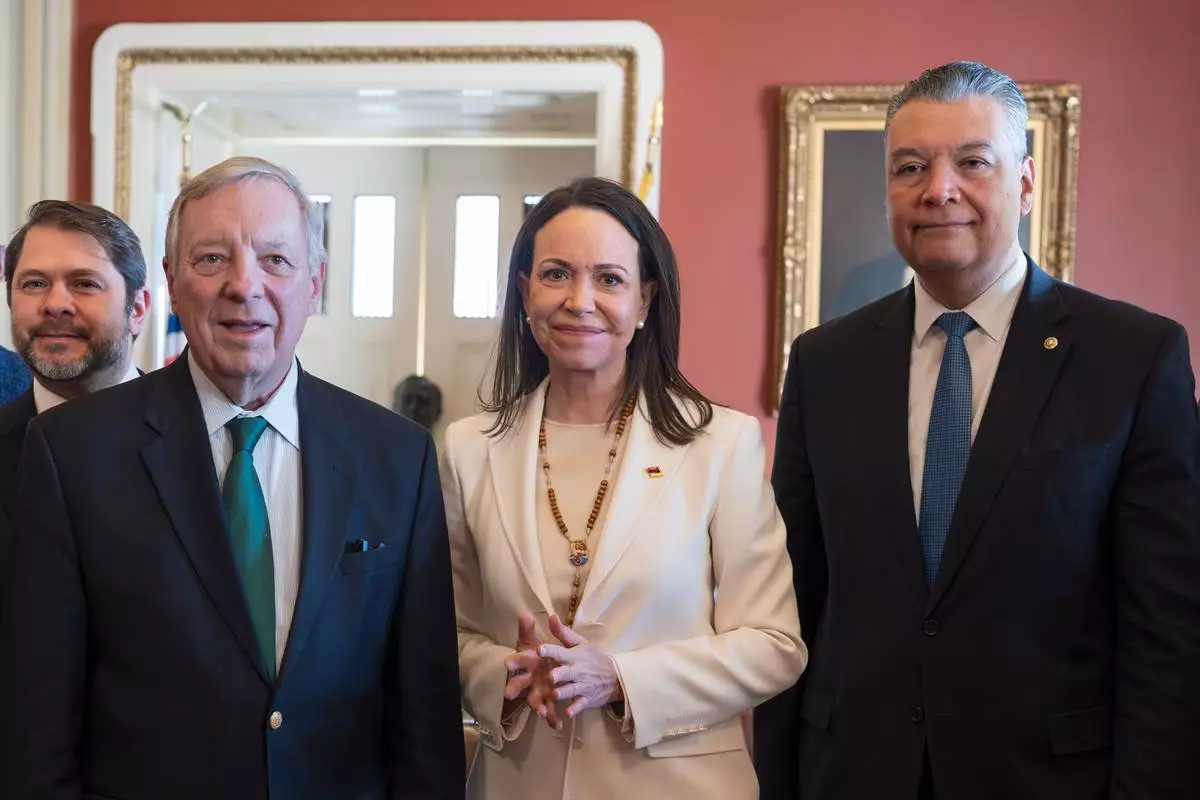
Venezuelan opposition leader Maria Corina Machado, center, is welcomed by Sen. Dick Durbin, D-Ill., left, Sen. Ruben Gallego, D-Ariz., far left, and Sen. Alex Padilla, D-Calif., right, as the Nobel Peace Prize recipient visits American leaders at the Capitol in Washington, Thursday, Jan. 15, 2026. (AP Photo/J. Scott Applewhite)
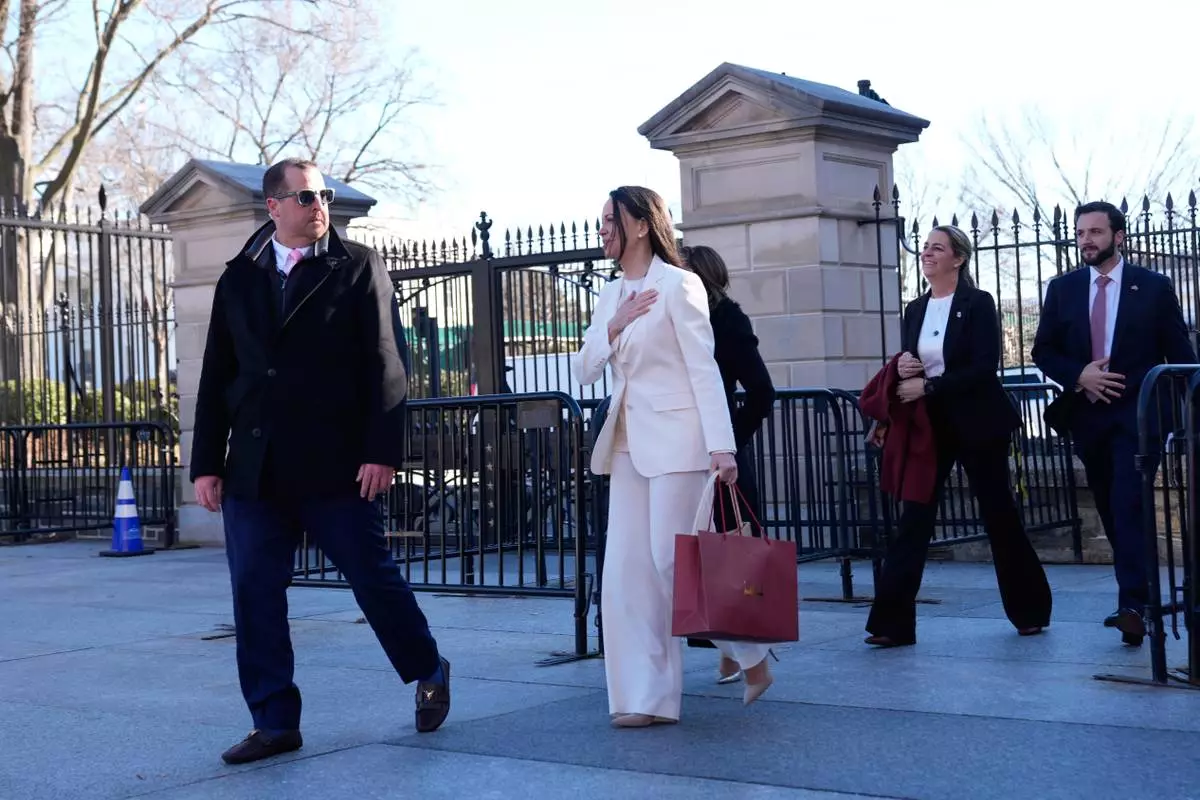
Venezuelan opposition leader María Corina Machado gestures to supporters on Pennsylvania Avenue as she leaves the White House after meeting with President Donald Trump Thursday, Jan. 15, 2026, in Washington. (AP Photo/Pablo Martinez Monsivais)
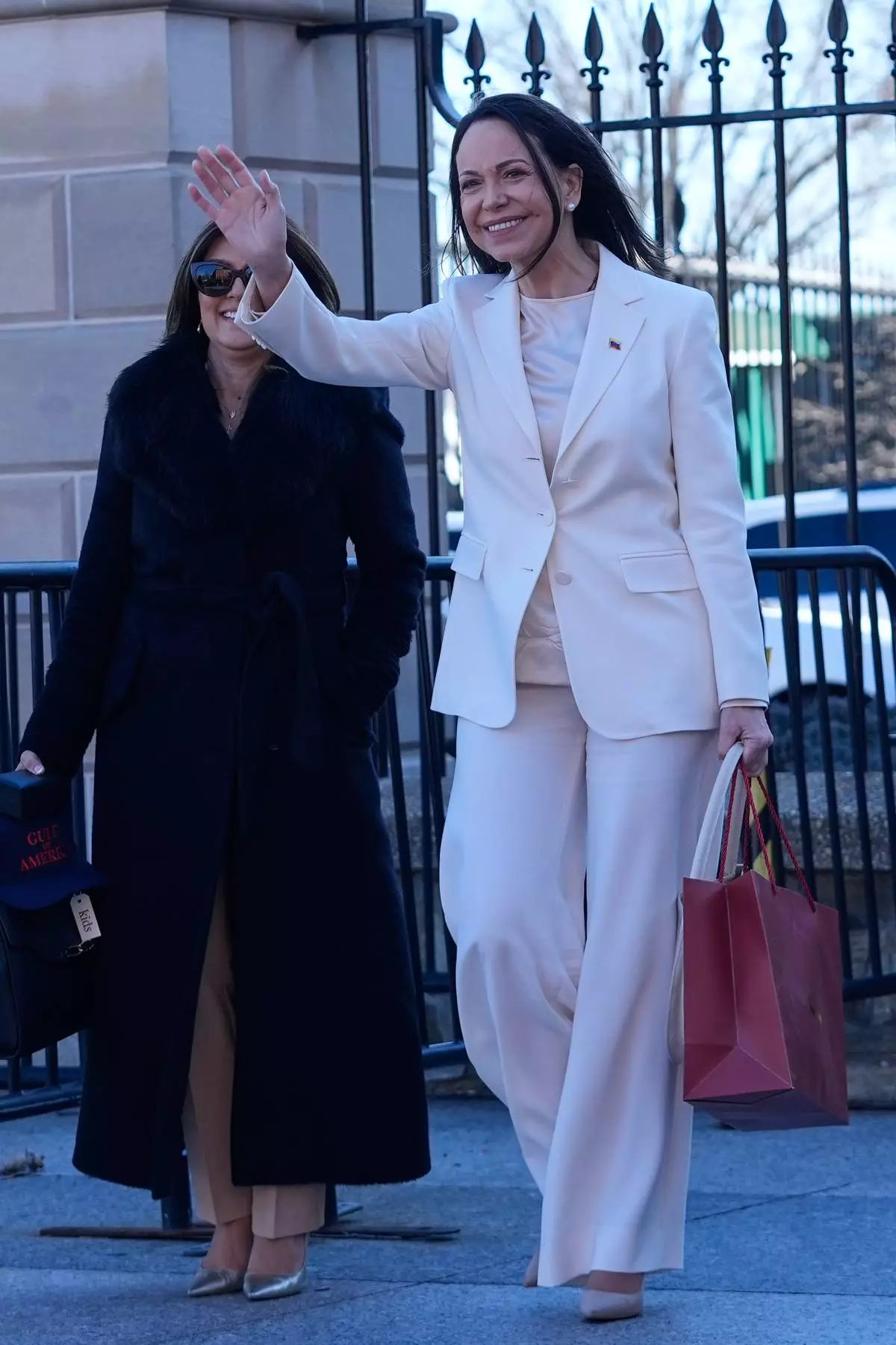
Venezuelan opposition leader María Corina Machado waves to supporters on Pennsylvania Avenue as she leaves the White House after meeting with President Donald Trump Thursday, Jan. 15, 2026, in Washington. (AP Photo/Pablo Martinez Monsivais)
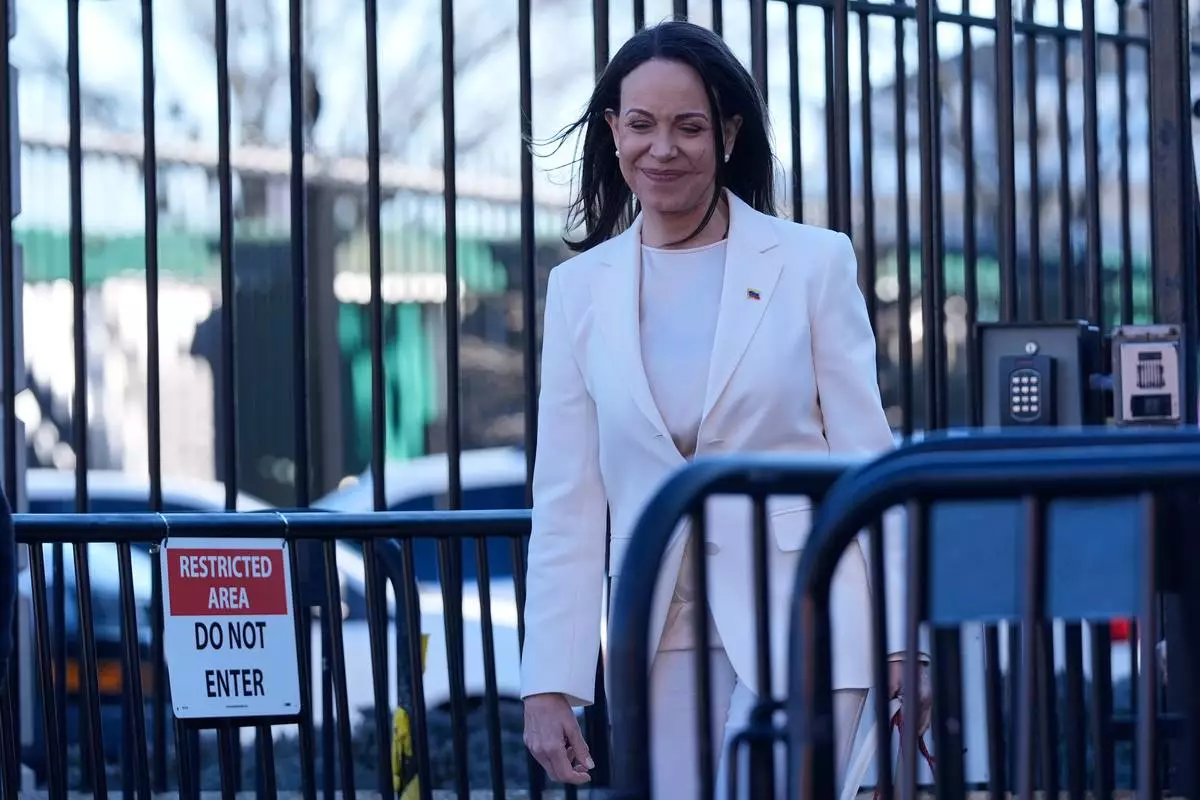
Venezuelan opposition leader María Corina Machado smiles on Pennsylvania Avenue as she leaves the White House after meeting with President Donald Trump Thursday, Jan. 15, 2026, in Washington. (AP Photo/Pablo Martinez Monsivais)
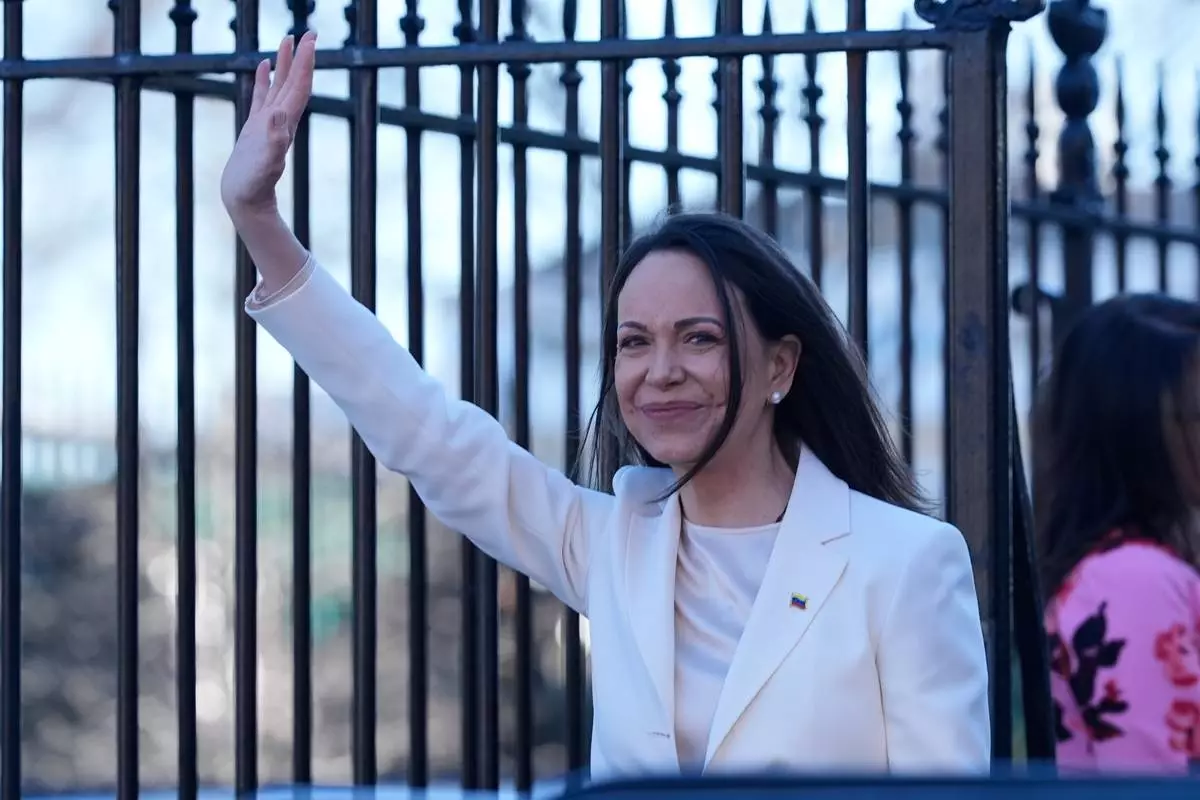
Venezuelan opposition leader María Corina Machado waves to supporters on Pennsylvania Avenue as she leaves the White House after meeting with President Donald Trump Thursday, Jan. 15, 2026, in Washington. (AP Photo/Pablo Martinez Monsivais)
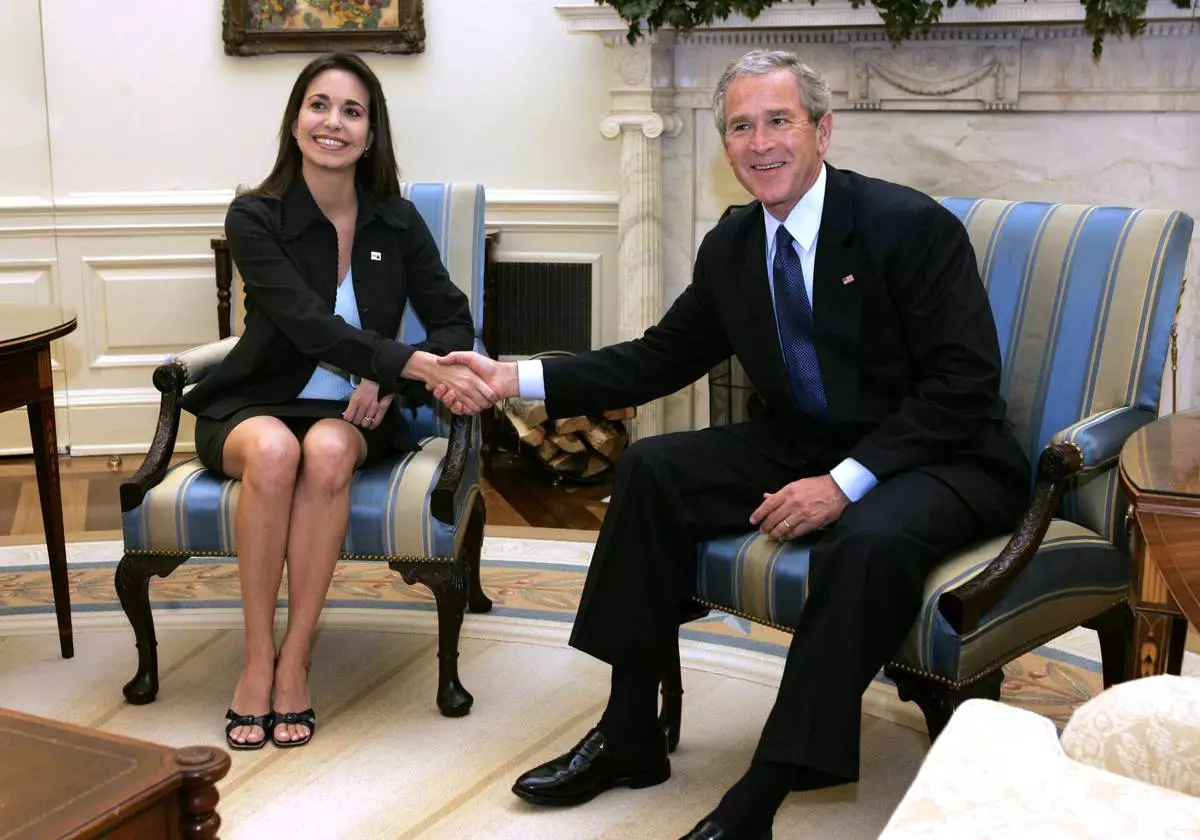
FILE - U.S. President George Bush, right, meets with Maria Corina Machado, executive director of Sumate, a non-governmental organization that defends Venezuelan citizens' political rights, in the Oval Office of the White House, Washington, May 31, 2005. (AP Photo/Charles Dharapak, File)
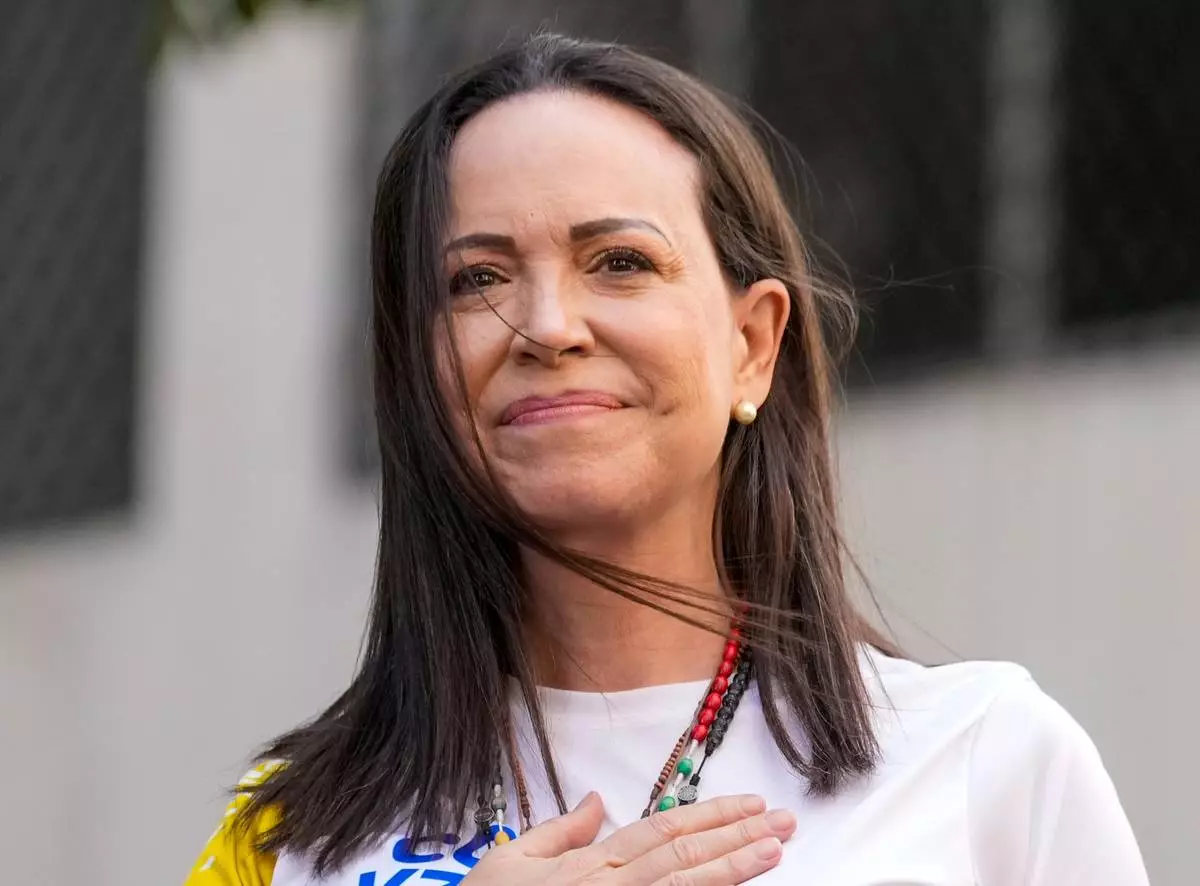
FILE - Opposition leader Maria Corina Machado gestures to supporters during a protest against President Nicolas Maduro the day before his inauguration for a third term, in Caracas, Venezuela, Thursday, Jan. 9, 2025. (AP Photo/Ariana Cubillos, file)