Skip to Content Facebook Feature Image

Japan experiences hottest July for 3rd consecutive year

China

China

China

Japan experiences hottest July for 3rd consecutive year

2025-08-03 11:02 Last Updated At:12:07

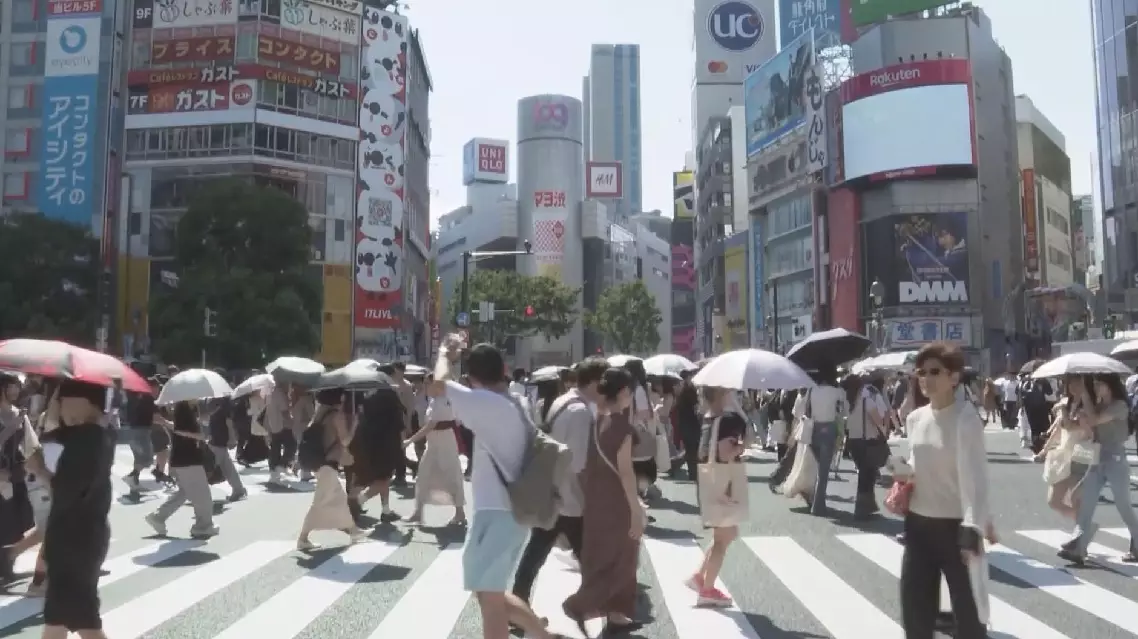
Japan experienced its hottest July for the third year in a row, with many regions across the country seeing precipitation less than 10 percent of normal levels, severely impacting rice production, according to the country's weather agency.

The nationwide average temperature was the highest for July, or 2.89 degrees Celsius higher than usual, since comparable records began in 1898, toppling the previous record set in 2024 by 2.161 degrees Celsius, the Japan Meteorological Agency (JMA) said on Friday.

Weather officials said this year's deviation from normal is much larger than past figures, adding that the country faced "abnormally high" temperatures.

On July 30, a temperature of 41.2 degrees was recorded in Tamba City in the western prefecture of Hyogo, the highest ever observed in the country. On July 24, the mercury rose to nearly 40 degrees in some parts of the northern prefecture of Hokkaido.

Furthermore, there were 4,565 locations across Japan experienced temperatures above 35 degrees Celsius, the highest number since comparable data began in 2010.

The rainfall in many parts of Japan in July was less than half the annual average. Rainfall in July on the Sea of Japan side of the northeastern Tohoku region and in the central Hokuriku region was the lowest since those statistics started binging recorded in 1946. These two regions recorded an amount of only 13 percent and 8 percent of their average precipitation, respectively.

In Tohoku region's Yamagata Prefecture, 26 out of 28 observation points recorded their lowest rainfall levels in history, while the rainfall in Wajima City of Hokuriku region's Ishikawa Prefecture was only 1 percent of the annual average.

According to statistics released by Japan's Ministry of Land, Infrastructure and Transport and Tourism on Friday, as of Thursday, 33 of reservoirs under the management of the ministry and other water resource agencies had water levels below the annual average, with one each in the prefectures of Iwate and Miyagi completely dry.

Many of the regions experiencing high temperatures and low rainfall are key rice-producing areas in Japan, which has adversely affected rice growth.

Japan’s Ministry of Agriculture, Forestry and Fisheries on Wednesday established a special division for dealing with water shortage and high temperature, urging water conservation and discussing response strategies.

The JMA forecasts that high temperatures will continue in August, with most regions, except for southern areas like Okinawa, remaining above annual average.
Japan experiences hottest July for 3rd consecutive year

Japan experiences hottest July for 3rd consecutive year
Li Li, a deputy to the National People's Congress (NPC) from southwest China's Guizhou Province, has made it her mission to preserve and promote the rich cultural heritage of the Buyi people, particularly their traditional clothing.

Born and raised in a village of Qinglong County, Qianxinan Buyei and Miao Autonomous Prefecture, Li began learning the intricate handicrafts of the Buyi people from her mother at a young age.

After spending over a decade working away from home, she felt a strong calling to return and safeguard her cultural roots. In 2015, she returned to her roots to start a business with the vision to revitalize Buyi clothing.

"Starting my own business was really tough in the beginning. If you want to make a Western-style suit, you could just buy some fabric and copy an existing design. But ethnic clothing is different. It requires constant innovation, and that takes a huge amount of time. Traditional fabrics tend to fade, and I spent months just trying to figure out how to fix the color. This problem had kept me up for a long time. But eventually, I tackled the challenges one by one," Li said.

Her persistence has paid off. This year, Li's team tapped into the cultural symbolism of the Year of the Horse, creating a range of horse-themed products that have quickly gained popularity.

"This year is the Year of the Horse, so we created a lot of horse-themed items. They are very popular and orders have been pouring in. Every year, we design our cultural products and clothing based on what the market wants. We started with a 300-square-meter workshop, and now we have our own intangible cultural heritage center. Over the years, we've trained more than a thousand embroiderers," she said.

As a grassroots NPC deputy, Li prioritizes listening to the voices of ordinary people. During work sessions with embroiderers, she takes time to listen to their concerns and offers flexible schedules for those with special needs.

The preservation of ethnic clothing and culture has always been at the heart of her work.

"During this year's 'two sessions', I will continue to focus on the preservation of ethnic clothing and culture. I want to encourage more young people to get involved in cultural inheritance. For example, I've been going to schools to teach students because I hope that intangible cultural heritage can take root in children's hearts from an early age. I want them to grow up knowing how remarkable our ethnic culture is and to develop a strong sense of cultural pride," Li said.

The "two sessions" refer to the annual meetings of the National People's Congress, China's top legislature, and the National Committee of the Chinese People's Political Conference, China's top political advisory body,which usually convene in early March.

NPC deputy from Guizhou revitalizes Buyi culture through inheritance and innovation

NPC deputy from Guizhou revitalizes Buyi culture through inheritance and innovation

Recommended Articles