The Shenzhou-20 crew aboard China's Tiangong space station steadily progresses their mission tasks this week, conducting various scientific experiments and tests while installing newly delivered equipment.
The three-member Chinese crew entered the Tiangong space station on April 25 and has completed a series of tasks in orbit since then.
Over this week, astronauts Chen Dong and Chen Zhongrui have installed the high-efficiency plant cultivation technology experimental device in the Wentian laboratory module. After completing the initial setup, the crew performed power-on tests to confirm the device's proper operation and then started a new round of plant cultivation in the space station. Astronaut Wang Jie has conducted cytological experiments in the Tianhe core module. He regularly retrieved experimental units cultured in the human system research cabinet, and completed manual observation of sample images, sample recovery and preservation, and other tasks.
The research not only contributes to the study of the impact of long-term space flights on astronauts' physical function, but also relates to the health issues of the general public on Earth.
The crew has continued to conduct multiple experiments in the field of aerospace medicine, including those concerning bone metabolism, interaction regulation, and aerospace integrative omics. The astronauts have completed tasks such as collecting blood samples, performing centrifugation, and cryopreservation.
Meanwhile, tests on the collaboration between astronauts and China's first intelligent spaceflight robot, Xiao Hang, were also conducted to explore efficient collaboration methods.
Additionally, research in microgravity physical sciences continued as scheduled. The crew completed tasks such as disassembling and assembling the experimental module in the two-phase system experimental cabinet and the online maintenance and adjustment operation cabinet. They also completed sample replacement, axis mechanism electrode maintenance, and observation port in the containerless experimental cabinet.
China launched the cargo spacecraft Tianzhou-9 last week to deliver supplies for the Tiangong space station.
It is loaded with essential supplies, totaling approximately 6.5 tonnes, including consumables for the orbiting crew, propellant, and equipment for application experiments and tests. This is the largest amount of cargo sent to the space station since the Tianzhou-6 mission.
The newly delivered cargo includes a core muscle training device. The three astronauts have assembled and installed the device on the wall of the Wentian laboratory module. With this device, astronauts can perform core muscle and upper limb exercises with constant resistance, effectively preventing atrophy of deep muscle groups, such as the paravertebral muscles, and improving their ability to readapt to gravity after returning to Earth.
The space station’s intelligent materials information management system has been upgraded again. The system is capable of recording the consumption and location changes of supplies in real time, aiding astronauts in efficiently managing their in-orbit supplies.
In addition, the crew completed multiple other tasks, including organizing supplies delivered by the Tianzhou-9, as well as cleaning and maintaining the station’s environment.
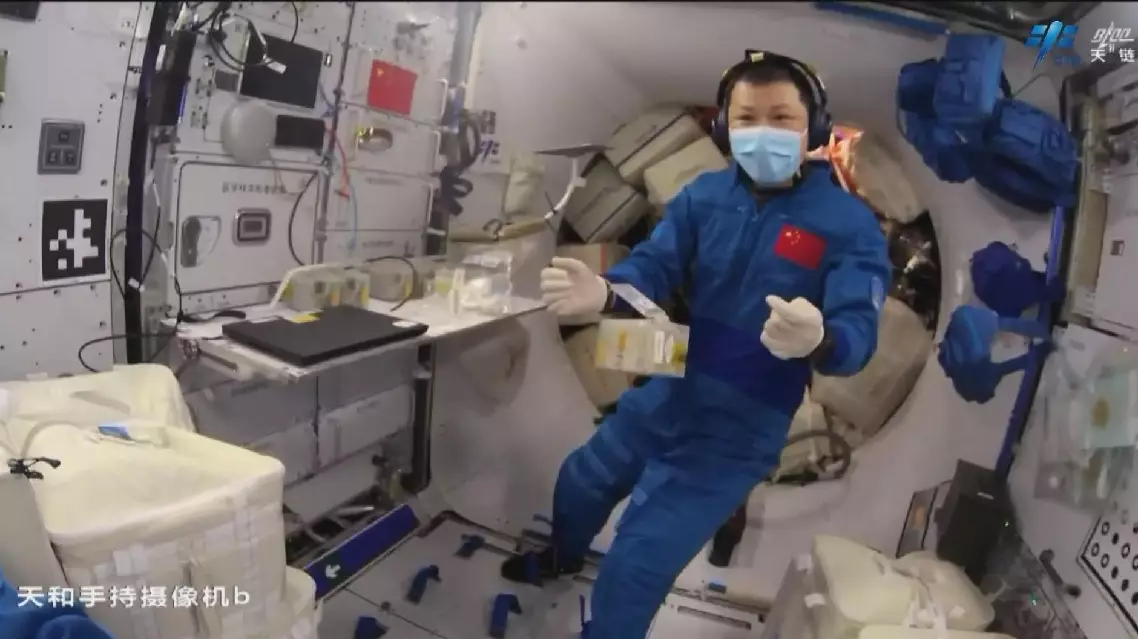
Chinese Shenzhou-20 crew steadily progresses mission tasks