The Haiyang nuclear power plant in Haiyang City, eastern China's Shandong Province, has successfully lifted into place all large modules for its Unit 3, marking a key milestone in the construction of the project.
The announcement was made on Monday by State Power Investment Corporation (SPIC), signaling that the unit has now fully entered the installation and commissioning phase.
The installed module is a cylindrical structure and was positioned atop the reactor building's nuclear island. Weighing about 419 tons, the precision lift was a critical step in the construction process.
Units 3 and 4 of the plant are being built simultaneously using domestically developed, independently designed nuclear technology.
The plant's Units 1 and 2 facilities began operating in October 2018 and January 2019, respectively.
Once all four units become operational by 2027, the plant will generate up to 40 billion kilowatt-hours of electricity annually, enough to meet the power needs of half of Shandong's population.
Construction of Units 5 and 6 of the plant received official approval in April this year. When all six units are complete, the Haiyang nuclear power plant will deliver significant carbon reduction benefits and become a major source of clean heating.
"Once all the six units of the nuclear plant are fully operational, the annual power generated will be sufficient to meet the needs of 70 million residents for a year. The carbon reduction achieved will be equivalent to planting 134,000 hectares of broadleaf forest, and the heating capacity will meet the clean heating needs of 25 county-level cities," said Nan Xiaofei, a manager of the Haiyang nuclear power project with the Shandong Nuclear Power Company, a subsidiary of the SPIC.

Haiyang nuclear power plant completes major work for its new construction in Shandong
After more than three months at sea, members of China's 16th Arctic Ocean expedition have jointly created a painting that captures both the triumphs and trials of polar scientific research.
Organized by the Ministry of Natural Resources, the expedition deployed four ships, Xuelong, Xuelong 2, Jidi, and Tansuo 3, to study extreme environmental changes in the Arctic against the backdrop of accelerating global warming. On September 29, Xuelong and Xuelong 2 returned to Shanghai after completing their missions.
During the voyage, China Media Group (CMG) reporters aboard Xuelong invited nearly 100 crew members to collaborate on a canvas, sharing their experiences. The painting depicts the difficulties and challenges they faced, the honors and expectations of their research, and the images of those dedicated to science.
Before any crew member ever picked up a brush, the Arctic had already sketched the background with its extreme weather. Strong winds, torrents, and a harsh environment posed major challenges for the researchers.
"After staying outside for some five or ten minutes, our hands would already be frozen red. When we reached the trough of the waves [on a boat], it would look as if the waves were coming right over our heads," recalled Zhu Chengwei, an expedition member.
Despite the hardship, the researchers successfully tested and used domestically produced advanced ocean observation equipment in polar research -- one of their proudest moments, which they recorded on the canvas.
Qin Chuan, captain of the Xuelong ocean team, chose to paint a domestically produced monitor float.
"This is an Argo float we deployed, which automatically monitors ocean profiles. It has great significance for understanding the basic marine environment, and it's made in China," he said.
Xie Haixiang, director of the Xuelong laboratory, sketched a fundamental research equipment for the trip.
"I will draw a CTD (Conductivity, Temperature, and Depth instrument). The CTD is the most important equipment for ocean surveys, providing the most basic data and water samples," he said.
"Only by carrying equipment onto the Arctic sea ice yourself and lowering the instruments, can you get what you want. For instance, we take a little ocean water, and analyze what's in it, to understand the changes each year. Global warming needs to be understood through different dimensions," recalled researcher Zhu.
Beyond the canvas, what stands out even more striking are the moments of dedication: veteran members leading newcomers onto the ice, a group holding its ground in level-8 gales and heavy snow, and 30 people relaying to recover equipment stuck in the ice.
The most important element, beyond any record or image in the painting, is this group of expedition members who fear no hardship.
"Whenever I think of the polar spirit, countless images of those standing at the very front would flash before my eyes," Zhu said.
"What we have done today will benefit future generations. Although we are doing something that may seem very insignificant, I believe it will surely prove its worth in the future,"said Ning Wenfeng, another team member.
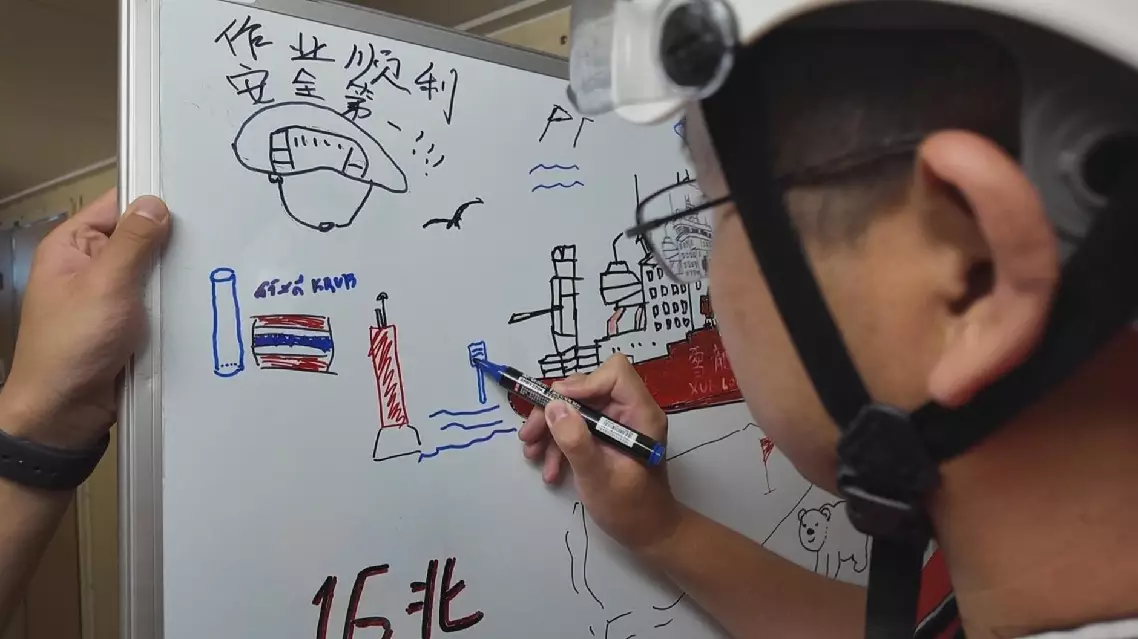
China's 16th Arctic expedition crews paint portrait of proud polar expedition moments, hardships