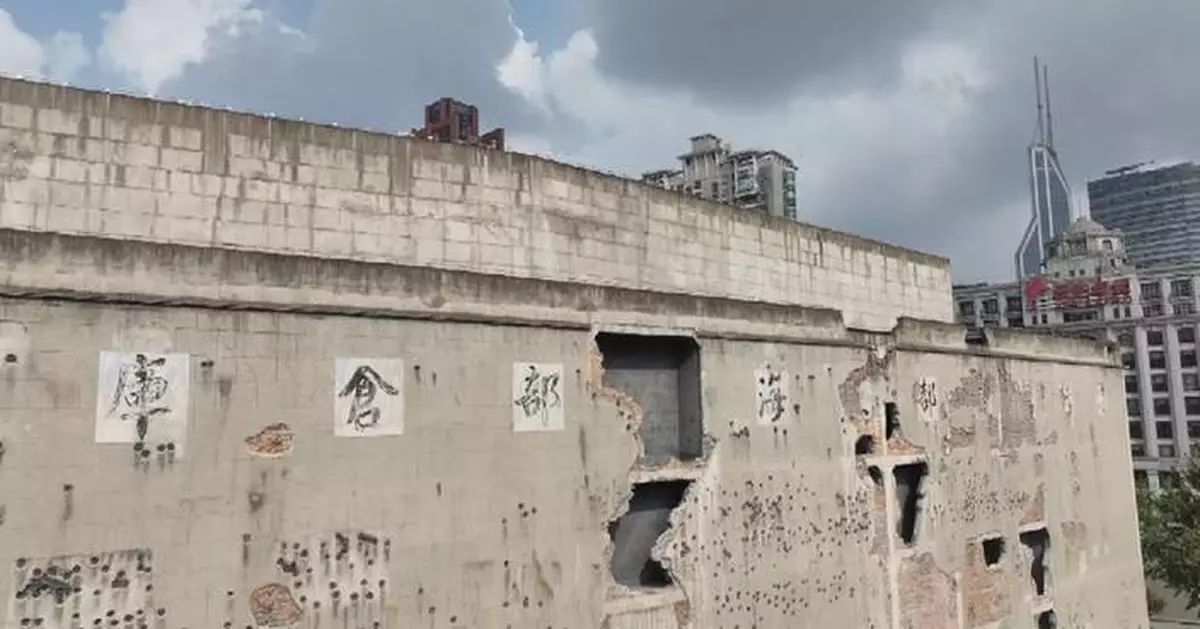
The blood-shedding resistance of "Eight Hundred Warriors" against Japanese invaders in a landmark warehouse in Shanghai in 1937 is still commemorated and cherished by people today as a spiritual fortress.
Sitting in the heart of Shanghai, the Sihang Warehouse with over 400 bullet holes may seem incompatible with the surrounding skyscrapers in Shanghai. Now it has become a memorial museum — restoring the scenes of a fierce battle in the Chinese People's War of Resistance Against Japanese Aggression from 1931 to 1945.
In October 1937, the Battle of Shanghai was worsening. In order to gain international support, the main resistance force was ordered to stay in Shanghai's "Zhabei" area, where the famous Sihang Warehouse was situated.
Under the leadership of Commander Xie Jinyuan, the "800" soldiers entered the "Sihang Warehouse." But in fact, there were only more than 400 soldiers.
The battle began on Oct 27. The walls of the warehouse were thick, but the doors and windows were the most vulnerable places. The soldiers used grain instead of sandbags to resist Japanese artillery fire.
Before dawn on Oct 28, Japanese troops stalked under the walls of the Sihang Warehouse, attempting to use explosives to blow up the gates and walls.
Chen Shusheng, who was only 21, jumped down from the fifth floor with several grenades bundled around his body, pulled open the fuse, and perished together with the enemy.
That night, Xie called soldiers for a meeting.
"My father (Xie Jinyuan) asked the comrades-in-arms around what this place was, and said, 'This is the Sihang Warehouse, the tomb of all of us more than 400 men. I, Xie Jinyuan, also have elderly parents, a wife, sons and daughters. Yet, I will fight with you here and sacrifice my life here to complete this mission," Xie Jimin, son of Xie Jinyuan, said in an interview.
The Chinese troops didn't bring any flag at that time. Xie said he wanted a flag. Scout Yang Huiming hid the flag under her uniform and sent the flag to the warehouse.
"When this national flag was raised before dawn on Oct 29, 1937, people were very excited because they, both Chinese and foreigners, could see it on the other side (of the river)," said Ma Youjiong, curator of the Sihang Warehouse Battle Memorial.
Ma introduced that at that time, the other side of the Suzhou Creek in the vicinity was the concession area. The bravery of the Chinese soldiers was witnessed by the Shanghai residents, and all reported by foreign media.
On the last day of October 1937, Xie and his men evacuated from the warehouse. There is no exact casualty record.
Now, the memorial museum receives tourists every day. They come to lay flowers and to pay tribute to the "Eight Hundred Warriors."
"Back then, under such harsh conditions, the martyrs still upheld their most sincere patriotism. Today living in a good time of peace, we need to cherish how hard-won our present life is," said a young man paying tribute.
This year marks the 80th anniversary of the victory in the Chinese People's War of Resistance Against Japanese Aggression and the World Anti-Fascist War. China has announced commemorative activities to mark the anniversary, include a military parade in Tian'anmen Square in central Beijing on Sept 3, the Victory Day marking the signing of the Japanese Instrument of Surrender on Sept 2, 1945.
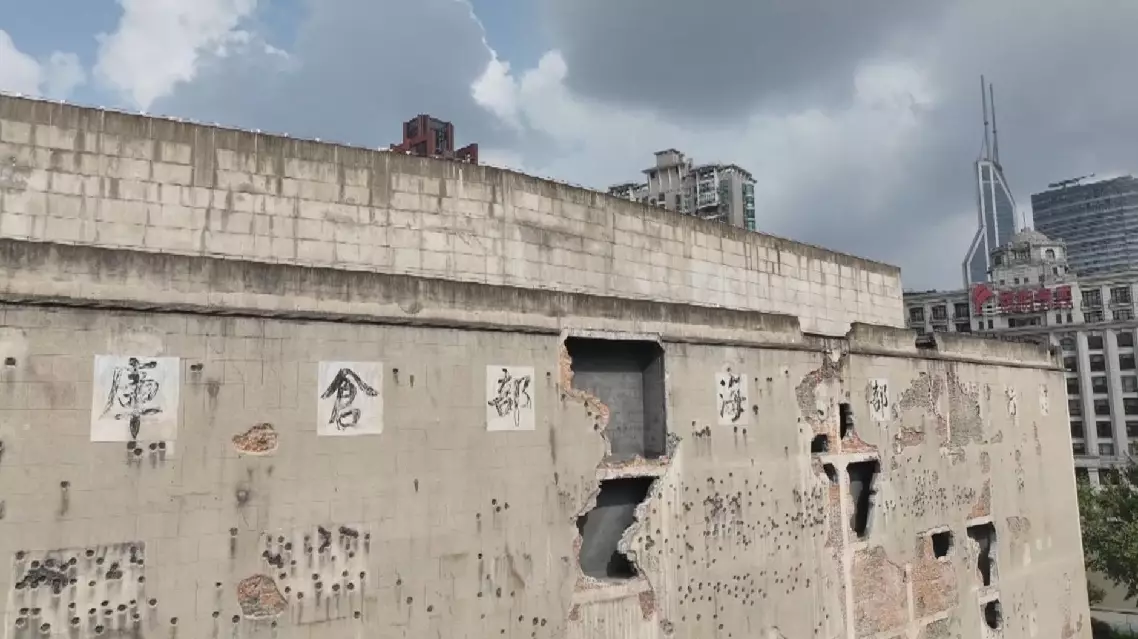
Spirit of resistance against Japanese invaders at landmark warehouse cherished by Chinese people