TOKYO & NOVI, Mich. & DÜSSELDORF, Germany--(BUSINESS WIRE)--Aug 5, 2025--
Diversified global manufacturer Asahi Kasei has successfully completed a demonstration trial of an innovative biogas purification system using zeolites in Kurashiki, Okayama Prefecture, Japan. Begun in February 2025, the trial achieved biomethane production with yield of up to 99.5% or more and purity of 97% or more. With such exceptional performance in both yield and purity, the system holds promise for the cost-effective production and utilization of biogas and biomethane across industries. Targeting commercialization in 2027, Asahi Kasei has launched full-fledged activity to license the technology to partners worldwide.
This press release features multimedia. View the full release here: https://www.businesswire.com/news/home/20250805629014/en/
As the use of renewable energy accelerates around the world, biomethane derived from biogas is attracting attention as a sustainable energy source. As of November 2024, 159 countries have signed the Global Methane Pledge, affirming their commitment to reducing methane emissions. Because biomethane can utilize existing natural gas infrastructure, it provides a unique opportunity to establish a circular economy that reduces waste while obtaining usable energy. Particularly in Europe, the demand for utilization in gas pipelines and conversion to bio-compressed natural gas (bio-CNG) is growing. In India, biogas is being promoted as part of a national policy to address waste disposal and energy supply issues associated with rapid urbanization. It is also used as a substitute for natural gas in the United States.
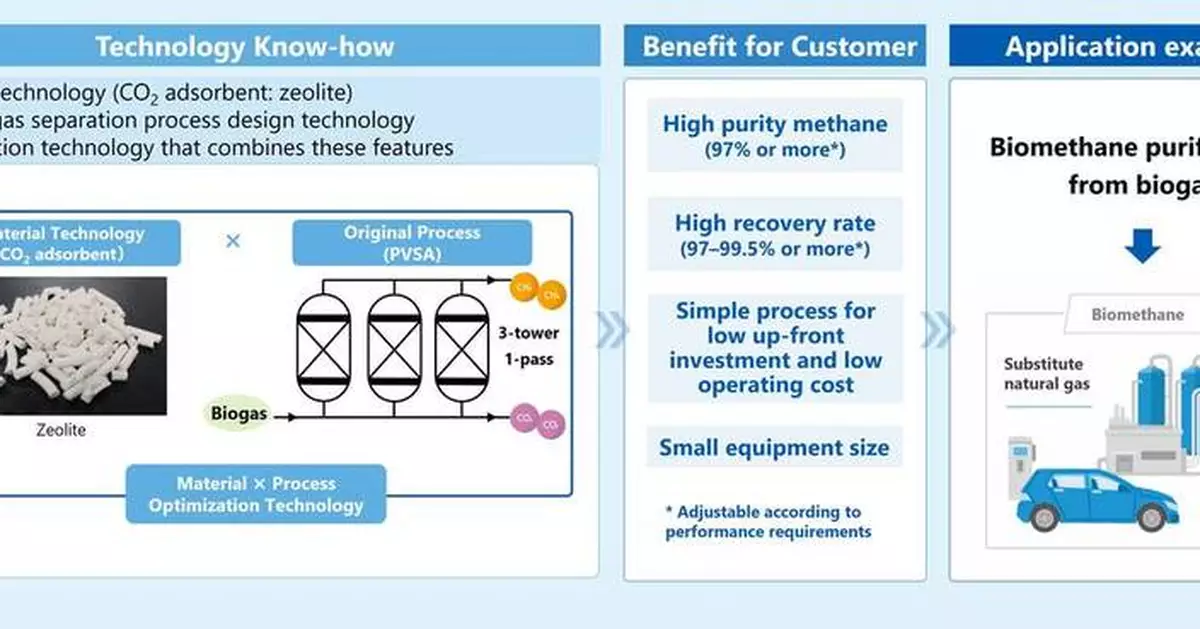
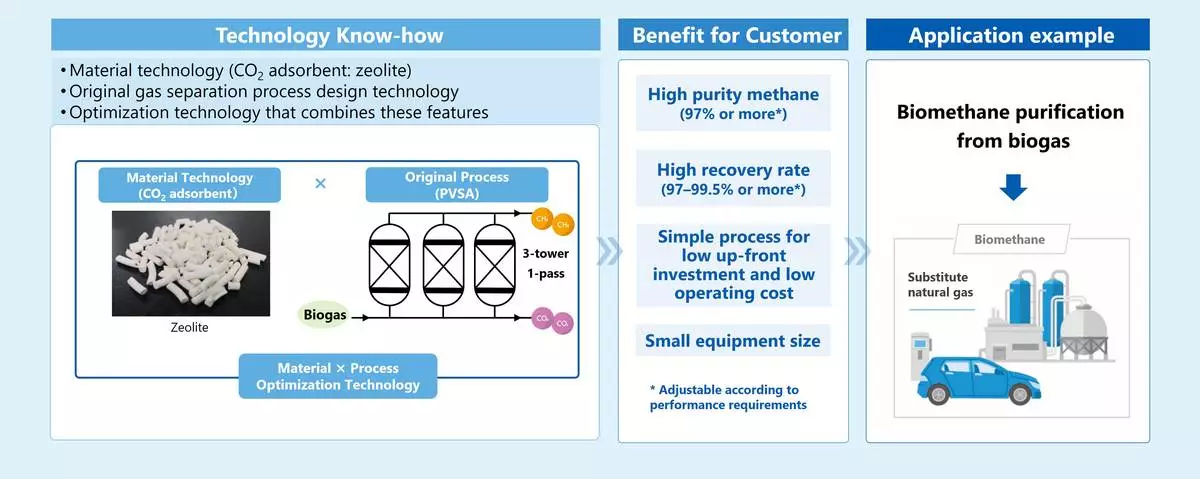
Asahi Kasei has a long track record in catalyst development and gas separation technologies. Based on this technological foundation, the company has developed a system that separates CO 2 and methane from biogas using the optimum combination of a special pressure vacuum swing adsorption (PVSA) process technology and a novel zeolite as an adsorbent. This unique configuration removes CO 2 from biogas to obtain biomethane with high purity and high yield. A zeolite is a crystalline aluminosilicate having regular pores and cavities controlled on the order of angstroms (ten-millionths of a millimeter) with a specific surface area of several hundred square meters per gram.
Commercialization planned for 2027
To verify the performance and operational stability of this system under actual operating conditions, Asahi Kasei has conducted a demonstration trial using a portion of biogas generated from sewage sludge at the Kojima Sewage Treatment Plant in Kurashiki City, Okayama Prefecture, since February 2025. In the purification of biomethane, there tends to be a trade-off between high purity and high yield; achieving both together has been a significant technical challenge.
The first course of this demonstration was performed with continuous operation for a period of one month. The biomethane obtained was confirmed to be over 97% pure, suitable for use as fuel by feeding into a natural gas pipeline injection or as CNG. A high yield of over 99.5% was also confirmed, indicating successful achievement of both high purity and high yield performance.
"We’re beginning to have concrete discussions with potential licensees around the world," commented Kazuya Noda, Senior General Manager of Asahi Kasei’s Material Business Research & Development. "After commercial-scale pilot studies, we plan market launch in 2027."
Asahi Kasei aims to achieve a better future for people and the Earth by creating intangible assets and providing value through R&D with a vision of “Where transforming tomorrow begins.”
About Asahi Kasei
The Asahi Kasei Group contributes to life and living for people around the world. Since its foundation in 1922 with ammonia and cellulose fiber business, Asahi Kasei has consistently grown through the proactive transformation of its business portfolio to meet the evolving needs of every age. With more than 50,000 employees worldwide, the company contributes to sustainable society by providing solutions to the world’s challenges through its three business sectors of Healthcare, Homes, and Material. For more information, visit www.asahi-kasei.com.
Asahi Kasei is also dedicated to sustainability initiatives and is contributing to reaching a carbon neutral society by 2050. To learn more, visit https://www.asahi-kasei.com/sustainability/.
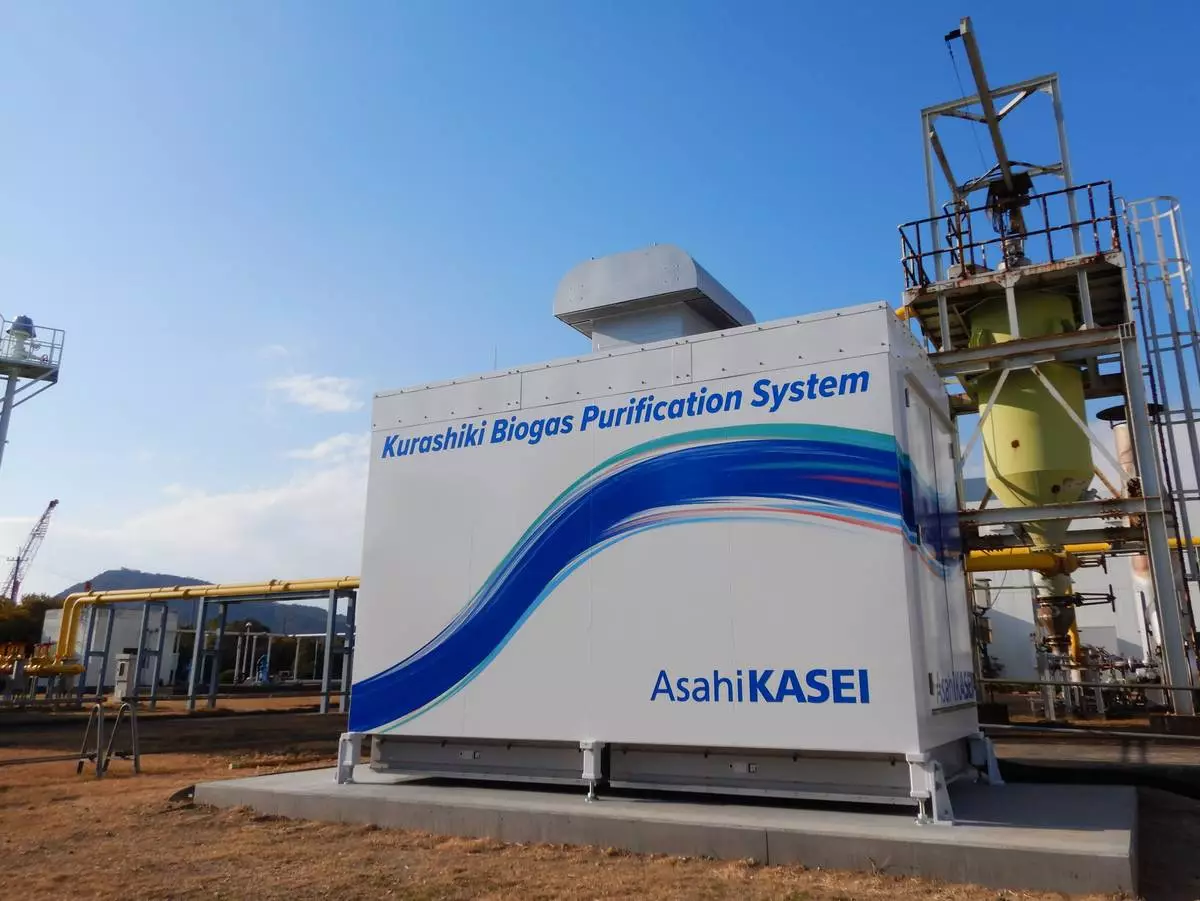
The biogas purification system
Biomethane purification technology using Asahi Kasei’s proprietary catalyst technology
NUUK, Greenland (AP) — U.S. President Donald Trump has made an American takeover of Greenland a focus of his second term in the White House, calling it a national security priority while repeating false claims about the strategic Arctic island.
In recent comments, he has floated using military force as an option to take control of Greenland. He has said if the U.S. does not acquire the island, which is a self-governing territory of NATO ally Denmark, then it will fall into Chinese or Russian hands.
Here’s a closer look at the facts.
TRUMP, discussing the security situation in the Arctic: “We need that because if you take a look outside of Greenland right now, there are Russian destroyers, there are Chinese destroyers and, bigger, there are Russian submarines all over the place. We’re not gonna have Russia or China occupy Greenland, and that’s what they’re going to do if we don’t."
THE FACTS: Experts have repeatedly rebuffed Trump's claims of Chinese and Russian military forces lurking off Greenland's coastline. Experts say Russia instead operates in the Barents Sea, off the Scandinavian coast, and both China and Russia have a presence in the Bering Sea south of Alaska.
“That statement makes no sense in terms of facts,” said Andreas Østhagen, research director for Arctic and ocean politics at the Fridtjof Nansen Institute in Oslo, Norway. “There are no Russian and Chinese ships all over the place around Greenland. Russia and/or China has no capacity to occupy Greenland or to take control over Greenland.”
“The only Chinese I see is when I go to the fast food market,” Lars Vintner, a heating engineer told The Associated Press in Greenland's capital Nuuk. He said he frequently goes sailing and hunting and has never seen Russian or Chinese ships. Another Greenlander, Hans Nørgaard, told AP that Trump's claims are “fantasy.”
Lin Mortensgaard, an expert on the international politics of the Arctic at the Danish Institute for International Studies, said that while there are probably Russian submarines — as there are across the vast Arctic region — near Greenland, there are no surface vessels.
China has research vessels in the Central Arctic Ocean, and while the Chinese and Russian militaries have done joint exercises in the Arctic, they have taken place closer to Alaska, she said.
Asked about Trump’s claim that there are multiple Chinese and Russian ships and submarines around the island, Greenland business minister Naaja Nathanielsen responded Tuesday: "Not that we are aware of."
While Russia and China have an interest in the Arctic, “we don’t detect an actual threat," she said.
“America is still recognized as quite a big superpower,” Nathanielsen added, “and I don’t see any appetite from Russia or China to destabilize this.”
__
TRUMP, discussing Denmark's defenses in Greenland: "You know what their defense is? Two dog sleds."
THE FACTS: The Sirius Dog Sled Patrol, an elite Danish naval unit that conducts long-range reconnaissance and enforces Danish sovereignty in the Arctic wilderness, is stationed in Greenland.
It's a key part of the Danish military infrastructure in the inhospitable Arctic terrain, experts say.
“Remember, transportation of the area is either by sea or by air. There are no highways,” said Steven Lamy, an international relations professor and Arctic security expert at the University of Southern California. “You can't basically get in a car or a Bradley vehicle or tank or anything and go up there. So they have dog sleds.”
In addition to these special elite forces, Denmark has several surface patrol ships and surveillance aircraft and the kingdom is moving to further strengthen its military presence around Greenland and in the wider North Atlantic. Last year, the government announced a roughly 14.6 billion-kroner ($2.3 billion) agreement with parties including the governments of Greenland and the Faroe Islands, another self-governing territory of Denmark, to “improve capabilities for surveillance and maintaining sovereignty in the region.”
The plan includes three new Arctic naval vessels, two additional long-range surveillance drones and satellite capacity.
Meanwhile, Denmark’s Joint Arctic Command is headquartered in Nuuk, the capital, and tasked with the “surveillance, assertion of sovereignty and military defense of Greenland and the Faroe Islands,” according to its website. It has smaller satellite stations across the island. Greenland also guards part of what is known as the GIUK (Greenland, Iceland, United Kingdom) Gap, where NATO monitors Russian naval movements in the North Atlantic.
The U.S. Department of Defense also operates the remote Pituffik Space Base in northwestern Greenland, which was built after the U.S. and Denmark signed the Defense of Greenland Treaty in 1951. It supports missile warning, missile defense and space surveillance operations for the U.S. and NATO.
__
TRUMP, discussing why Greenland is part of the Danish kingdom: “The fact that they had a boat land there 500 years ago doesn’t mean that they own the land. I’m sure we had lots of boats go there also.”
THE FACTS: The first humans arrived in northern Greenland circa 2,500 B.C., traveling from what is now Canada after the narrow strait separating the island from North America froze over. The Norse explorer Erik the Red arrived circa A.D. 985 with a fleet of Viking ships, according to the medieval Icelandic sagas.
In 1721, Lutheran missionary Hans Egede arrived in Greenland and ultimately began efforts to convert the Indigenous people to Christianity, marking the start of Denmark’s modern colonization of Greenland, which formally became a Danish colony in 1814. The U.S. government recognized Denmark’s right to the whole of Greenland more than a century later.
“It’s the same logic about the U.S. and sovereignty, right? You have a couple of boats arriving from Europe and now you own the United States of America,” said Østhagen, of the Fridtjof Nansen Institute. “The Indigenous population was there before you guys."
In 2009, Greenland became a self-governing country within the Danish kingdom. The island has a right to independence when requested by local voters.
International law has developed over the centuries, pivoting from land-grabbing colonial powers to modern-day treaties honoring borders largely developed after World War II.
Ulrik Pram Gad, a senior researcher and Arctic security expert at the Danish Institute for International Studies, said postwar it has remained important, especially to the U.S., for countries to refrain from exerting power over other territories.
“We shouldn’t just grab and go to war,” he said. “Rather, it should be peoples who have their self-determination.”
__
Find AP Fact Checks here: https://apnews.com/APFactCheck.
__
Dazio reported from Berlin and Zhang reported from Washington. Associated Press writer Jill Lawless in London contributed to this report.
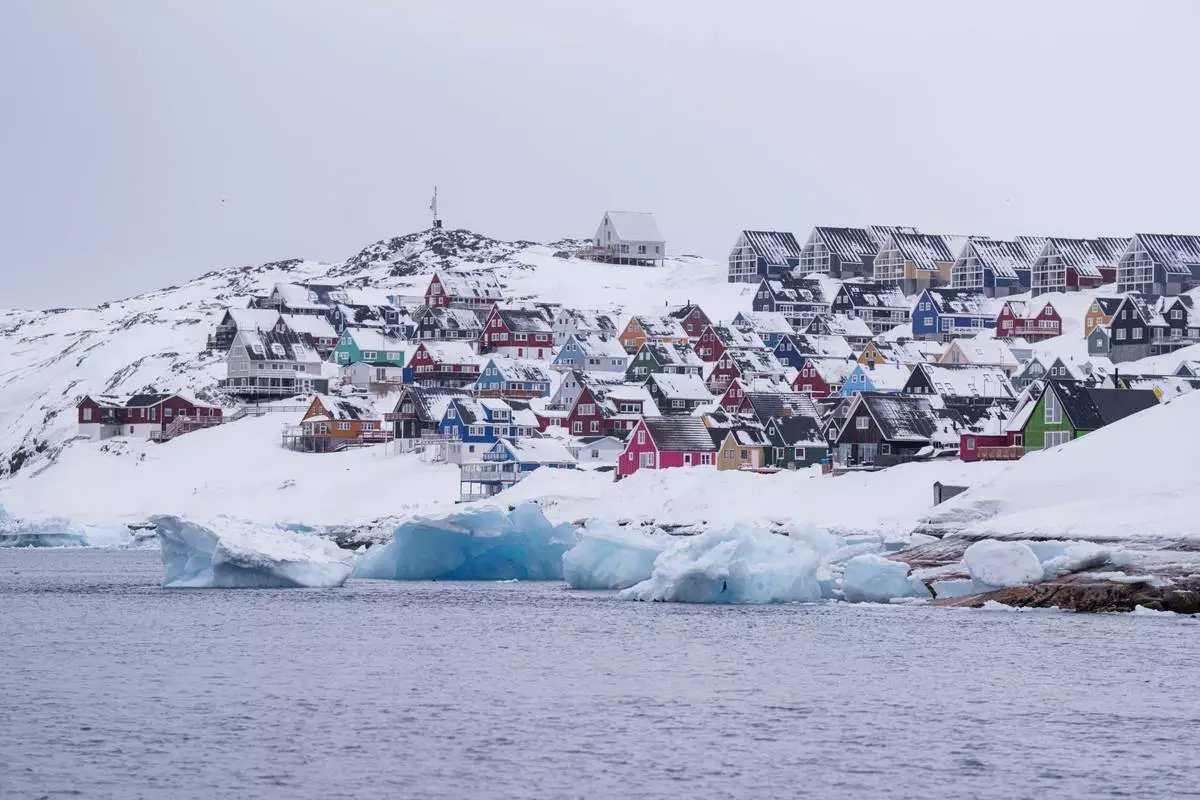
FILE - Coloured houses covered by snow are seen from the sea in Nuuk, Greenland, on March 6, 2025. (AP Photo/Evgeniy Maloletka, File)
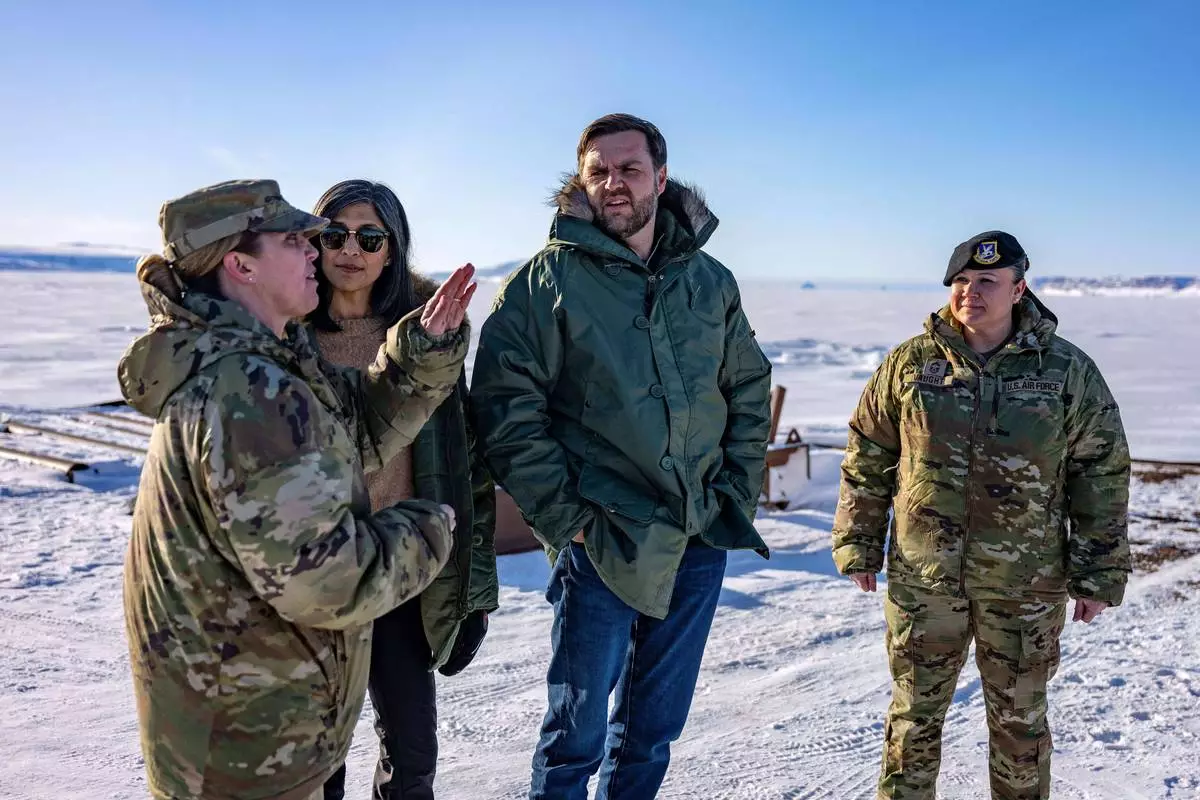
FILE - Vice President JD Vance and second lady Usha Vance tour the U.S. military's Pituffik Space Base in Greenland, March 28, 2025. (Jim Watson/Pool via AP, File)
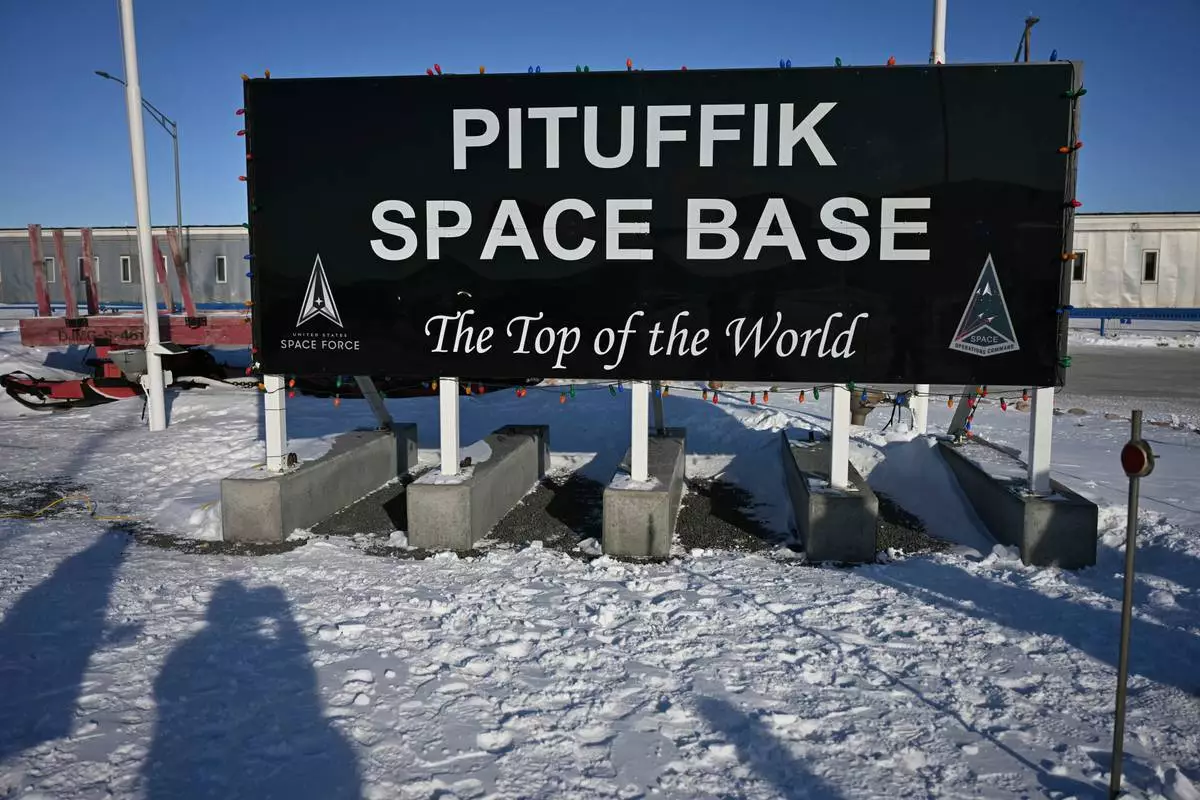
Pituffik Space Base is pictured as Vice President JD Vance visits, Friday, March 28, 2025, in Greenland. (Jim Watson/Pool via AP)
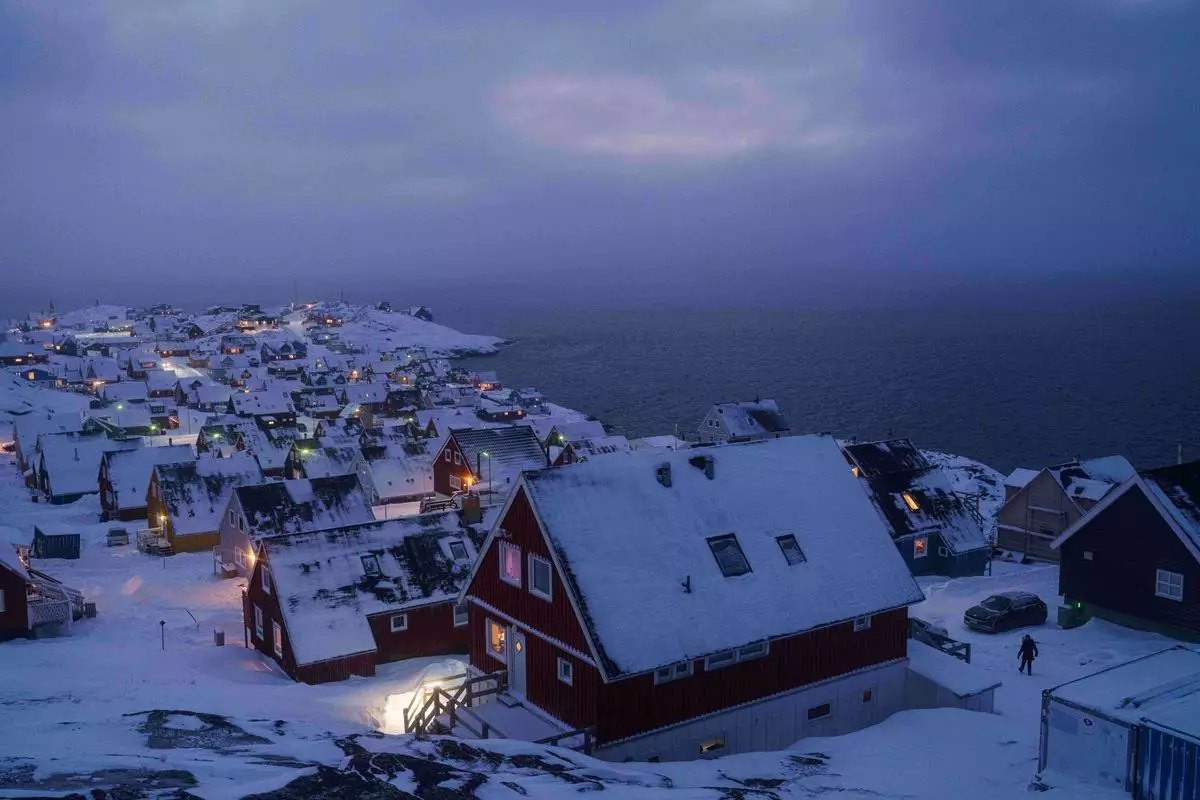
Houses covered by snow are seen on the coast of a sea inlet of Nuuk, Greenland, on Monday, Jan. 12, 2026. (AP Photo/Evgeniy Maloletka)