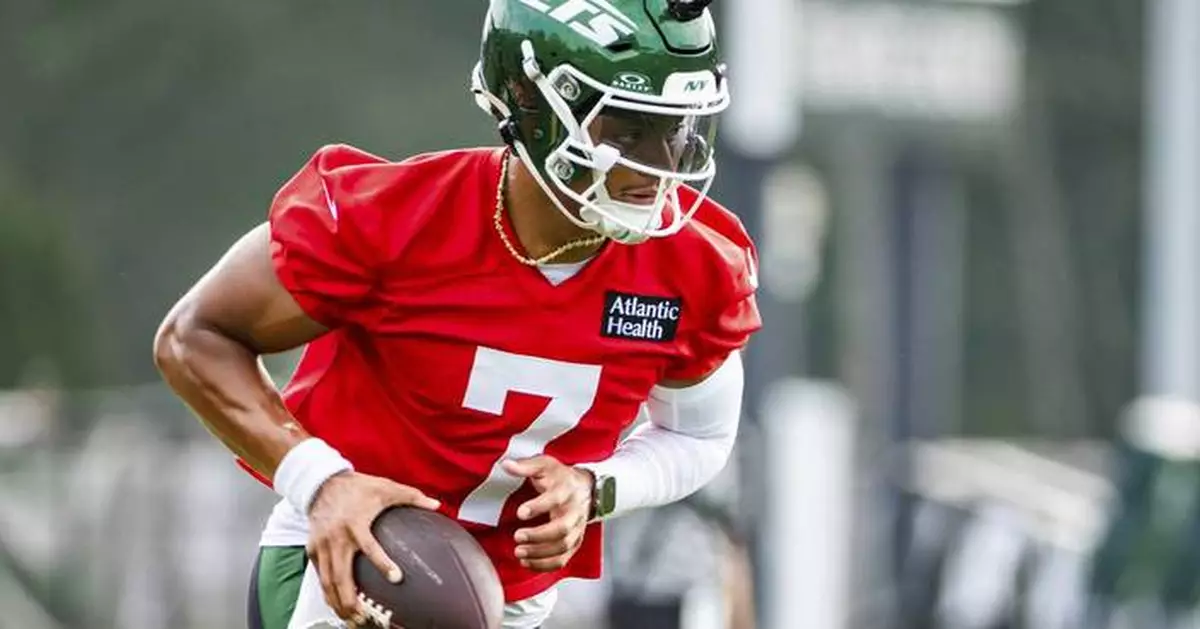
FLORHAM PARK, N.J. (AP) — Justin Fields knows he and the New York Jets' passing offense are a work in progress.
Well, the only way for them to go after 11 training camp practices is up. Especially after the past few underwhelming sessions.
“I think we’re improving, especially from the start of training camp to now,” Fields said Tuesday. “Of course, today wasn’t up to our standard in terms of penalties and stuff like that. But like I said, just a base summary for you all, I definitely think we have improved, for sure.”
A day after going 4 of 16 in team drills, Fields was unofficially 9 of 16 on Tuesday. There have been bad throws, ugly drops and penalties negating positive plays. But the focus — and of course, the blame — usually sits on the quarterback, especially after the Jets signed Fields to a two-year, $40 million contract in the offseason to replace Aaron Rodgers.
“Some of it’s me, some of it’s dropping the ball, some of it’s just plain and simple things,” Fields said. “Stuff that, you know, it’s practice.”
Fields also dealt with a dislocated toe on his right foot just a few days into camp, but says he's feeling a lot better.
“There’s probably still a little bit of swelling,” he said. “I just have to go from a 12 1/2 (shoe) to a 13. So, I’m all good other than that.”
Fields is on his third team while entering his fifth NFL season and learning his fourth offensive system. The Jets think he's a good fit for new coordinator Tanner Engstrand's offense, but it's still early in camp and mistakes have outnumbered the successes.
“There was a number of things, as far as the way his command was of the offense and knowing exactly what to do was outstanding,” coach Aaron Glenn said of Fields' performance Tuesday. "Some of his throws wasn’t on point, but again, a lot of them were on point and guys got to make plays for him, too. So that kind of showed up today and we've got to get ready to fix those things.
"So, it goes hand in hand with quarterback and receivers. He has to deliver the ball and they have to catch it."
Still, the defense has outplayed the offense by far — although the running game has been solid — through the first part of camp. But Glenn refuses to sound any alarms about his quarterback and the offense overall.
“It’s early right now and I’m looking at Week 1,” Glenn said of the regular-season opener against Rodgers and the Pittsburgh Steelers on Sept. 7. “We have a long time until we get to that point and the type of men that we have, I know our men are going to pick it up and get it going. So, I’m not worried at all. The thing that I’m more concerned about are things that we have to do to make ourselves ready for Week 1, the things that we’re trying to create in training camp, those are the things that I think about on a daily basis.”
Glenn hasn't publicly said whether his starters, including Fields, will play against the Packers. But the quarterback appeared in favor of doing so.
“I think we need to at least see the field each and every game,” Fields said. “I think that will be good for our team, it will be good for Tanner in the in-game stuff, it will be good for me, the guys on offense. I know some guys, they sit out the whole preseason, but I don’t think that’s the case for us, just because of the new team, new offense, and stuff like that. So, that’s kind of how I feel about the situation.”
The Jets have a day off followed by a practice Thursday, their last before they head to Green Bay.
“It’s inevitable,” Fields said. “You know you’re going to have these days in training camp. ... That’s why we’re out here working. And defense, they won the day at the end of the day.
"So, it’s about how we respond on Thursday, and we've got to come out hot.”
AP NFL: https://apnews.com/hub/nfl
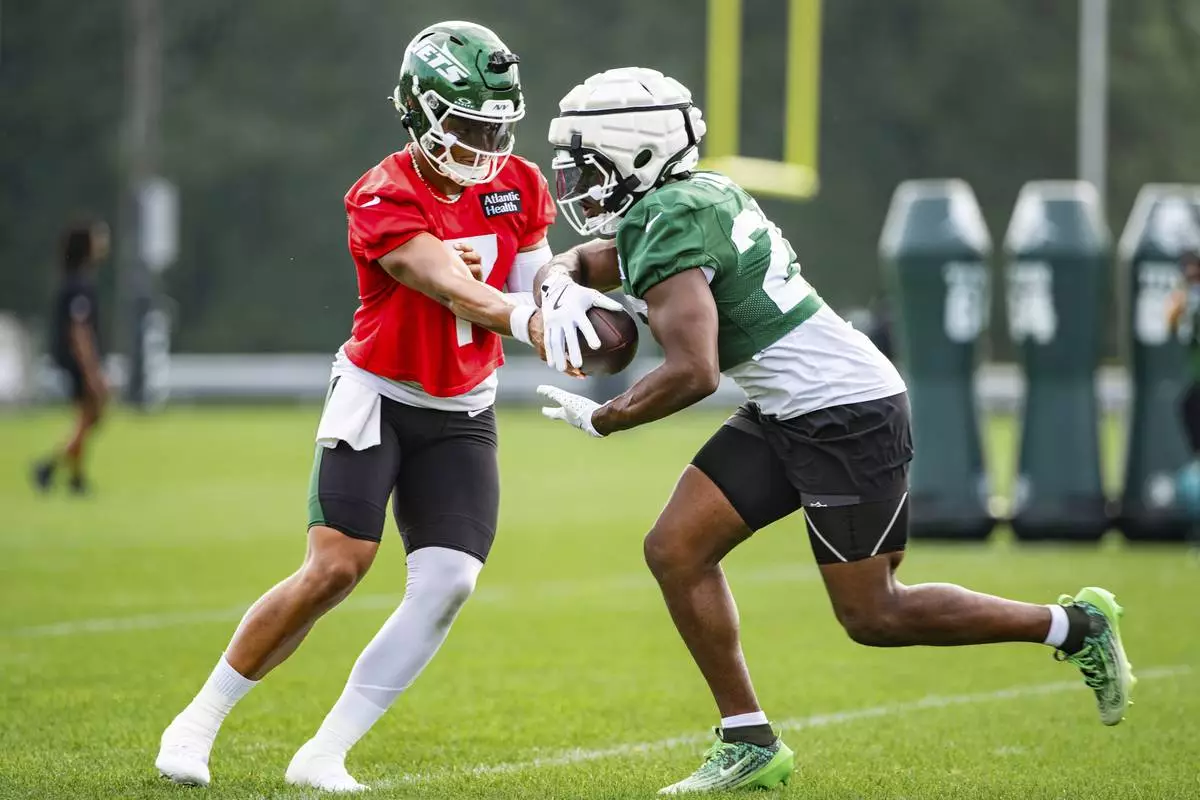
New York Jets quarterback Justin Fields (7) and running back Breece Hall (20) run drills together during practice at the team's NFL football training camp, Saturday, July 26, 2025, in Florham Park, N.J. (AP Photo/Angelina Katsanis)
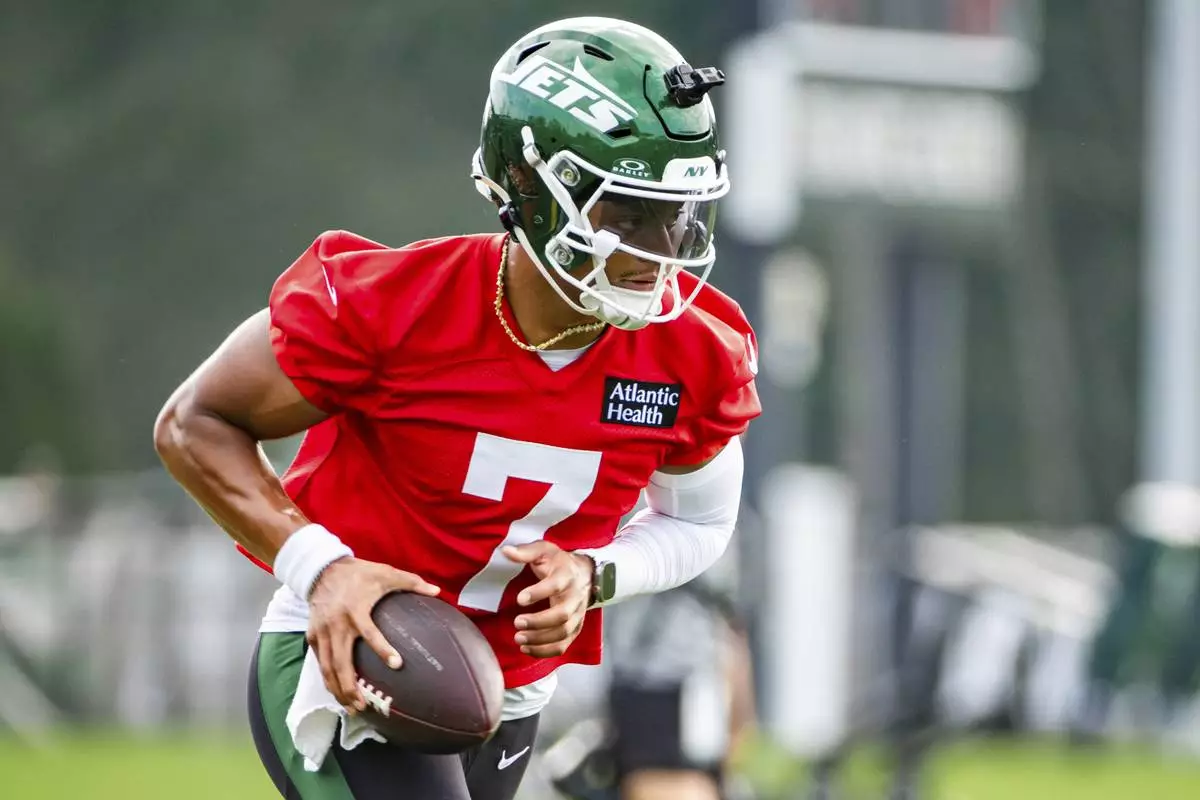
New York Jets quarterback Justin Fields (7) runs drills during practice at the team's NFL football training camp, Saturday, July 26, 2025, in Florham Park, N.J. (AP Photo/Angelina Katsanis)
KANSAS CITY, Mo. (AP) — Now that the Chiefs are moving across the state line from their longtime home in Missouri to a $3 billion domed stadium to be built in Kansas, attention in the area has swung to the Royals, who have a similar decision to make regarding their own future.
One thing is certain: They will not be playing at Kauffman Stadium once their lease there expires in January 2031.
Royals owner John Sherman has long said his preference is to build a downtown ballpark, but those plans have been bogged down at nearly every turn by politics and community backlash. Last year, voters in Jackson County, Missouri, soundly defeated the extension of an existing sales tax that pays for the upkeep of Kauffman Stadium and would have helped to fund the new ballpark.
The question now is whether the Royals continue their pursuit of downtown baseball, build a new stadium elsewhere on the Missouri side of the state divide, or follow the Chiefs in moving their new home to the Kansas side of the border.
“The Royals are also a great legacy team that we would love to keep in Missouri. We will do everything we can to continue those conversations,” said Gov. Mike Kehoe, who responded with scorn to the news Monday that the Chiefs had accepted a bond package approved by Kansas lawmakers that will cover 60% of a total project expected to exceed $4 billion.
The Chiefs also plan to build a $300 million training city in the Kansas City-metro suburb of Olathe, Kansas.
“If I’m the Royals," Kehoe said, “I’m in the driver’s seat now. I’m THE team.”
In their bid to keep the Chiefs at Arrowhead Stadium, Missouri lawmakers authorized bonds in June during a special legislative session that would cover up to 50% of the cost of new or renovated stadiums, plus up to $50 million of tax credits.
That is the financing package that still could be used by the Royals to build their ballpark.
But the bond package put forth by Kansas lawmakers, which would not tax residents but instead be paid off by state sales and liquor taxes generated in a defined area around the project, provides the potential to cover up to 70% of overall costs.
In the case of the Chiefs, the term sheet signed by owner Clark Hunt and Lt. Gov. David Toland calls for a stadium with at least 65,000 seats to be built by August 1, 2031, and the Chiefs to stay there for at least 30 years, with an option to remain up to 30 years more.
Along with the $3 billion stadium, the Chiefs committed to at least $1 billion in “ancillary development,” which includes a headquarters and training facility in Olathe and at least $700 million worth of retail, entertainment and other commercial space.
The agreement allows $100 million of that space to be built outside the two counties containing most of Kansas’ side of the metro.
The state agreed to issue a little more than $2.4 billion in bonds to cover roughly 60% of the costs, though if the extra development exceeds $1 billion, it would cover 70%. That makes it the largest public subsidy ever for a U.S. Stadium project.
“Missouri put together a very competitive package,” Kehoe said of the state's attempts to keeping the Chiefs at Arrowhead Stadium, adding: “Kansas is about to leverage ... Kansas taxpayer revenue to make this deal happen. I can’t see where the numbers would pencil on that, as a business person, where it would be a good deal for Missourians.”
The Royals have considered multiple sites around downtown Kansas City, but all have had issues, whether it be traffic flow, community support or something else. They also have provided renderings in the past of a stadium and ballpark district that would be built across the Missouri River in Clay County, which is technically North Kansas City, Missouri.
But momentum of late appears to be behind a move to the suburb of Overland Park, Kansas, and a tract of land known as the Aspiria Campus, where an affiliate of the Royals already holds the mortgage. The property, once home to Sprint and still the headquarters of T-Mobile and several other companies, lies just off Interstate 435 in the south part of the metro.
Those plans have been met by opposition from residents in the affluent neighboring suburb of Leawood, Kansas.
John Mosley, a 65-year-old fan from Kansas City, Missouri, said Monday that he had been hearing people talk about Kansas using a bond package to lure the Chiefs — and, perhaps, even the Royals — across the state line for years.
“To me personally, it doesn’t matter. But I’m noticing that most things are going over into Kansas,” he said. “I’m not sure what’s going on in Missouri. I think it’s a money issue. Maybe over in Kansas things are much better. It just seems like everything is moving.”
Associated Press writers John Hanna, David Lieb and Heather Hollingsworth contributed.
AP NFL: https://apnews.com/hub/nfl
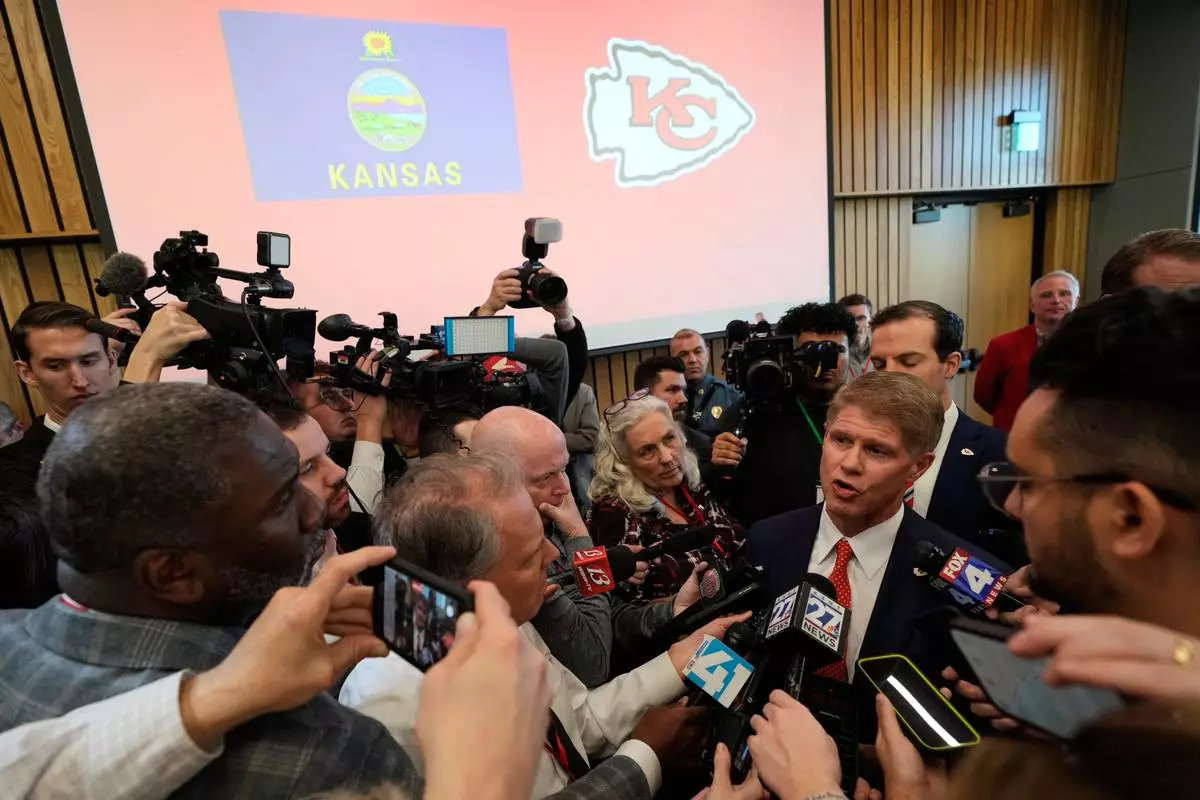
Kansas City Chiefs owner Clark Hunt, center right, talks to the media during an event Monday, Dec. 22, 2025, in Topeka, Kan., after announcing the team will leave Arrowhead Stadium in Kansas City, Mo., for a new stadium that will be built across the Kansas-Missouri state line and be ready for the start of the 2031 season. (AP Photo/Charlie Riedel)
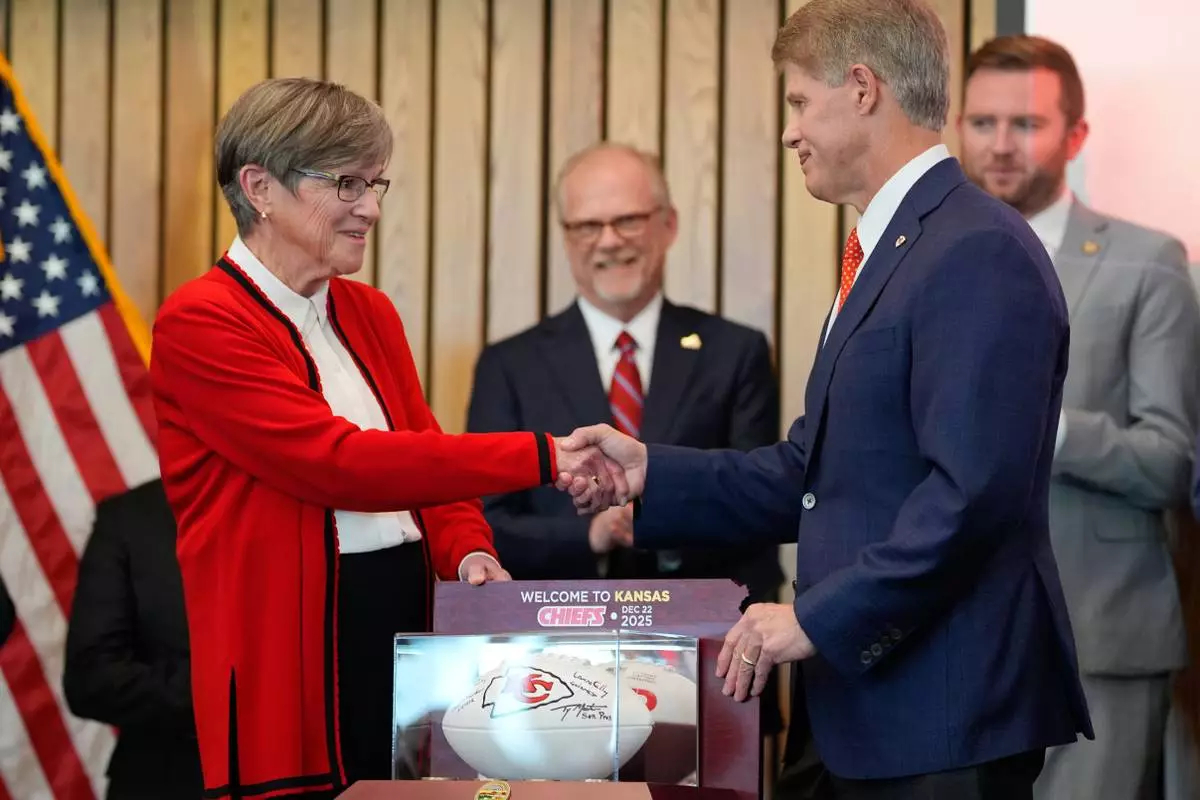
Kansas City Chiefs owner Clark Hunt, right, and Kansas Gov. Laura Kelly, shake hands during an event announcing the team will leave Arrowhead Stadium in Kansas City, Mo. for a new stadium that will be built across the Kansas-Missouri state line and be ready for the start of the 2031 season, during an event Monday, Dec. 22, 2025 in Topeka, Kan. (AP Photo/Charlie Riedel)
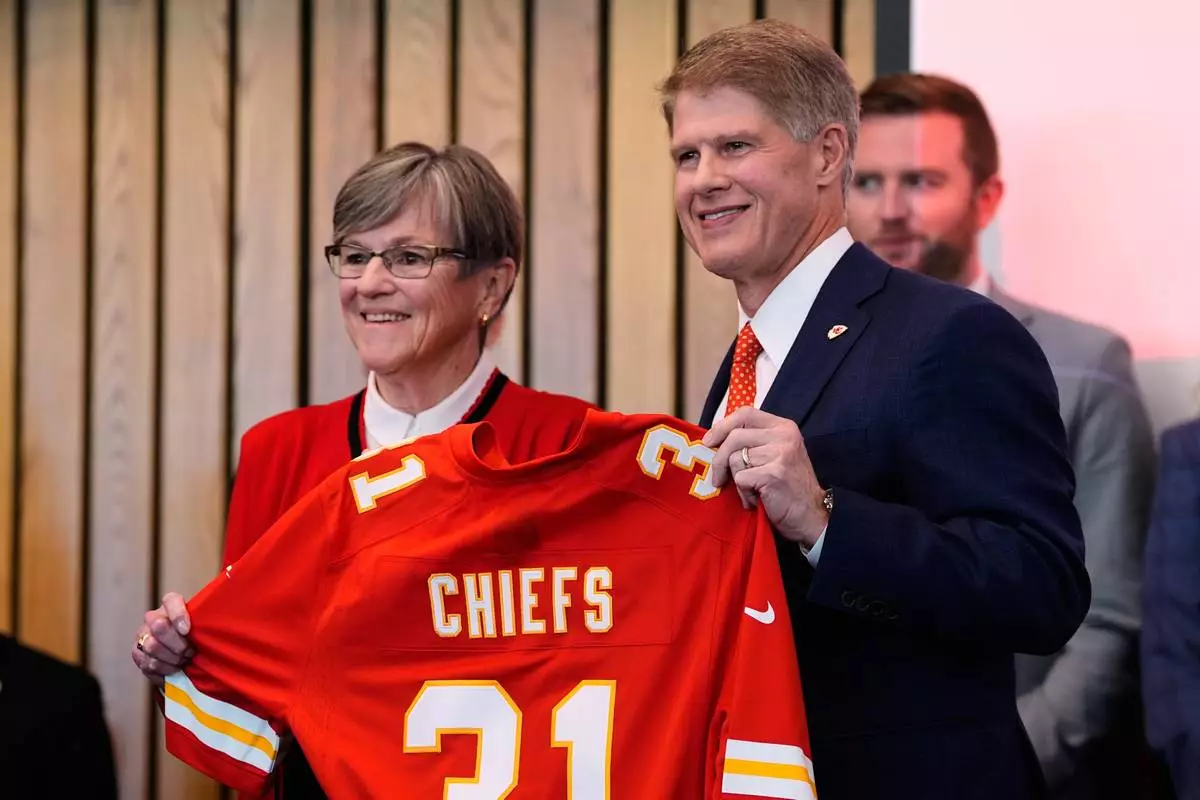
Kansas City Chiefs owner Clark Hunt, right, and Kansas Gov. Laura Kelly, pose for a photo during an event announcing the team will leave Arrowhead Stadium in Kansas City, Mo. for a new stadium that will be built across the Kansas-Missouri state line and be ready for the start of the 2031 season, during an event Monday, Dec. 22, 2025 in Topeka, Kan. (AP Photo/Charlie Riedel)
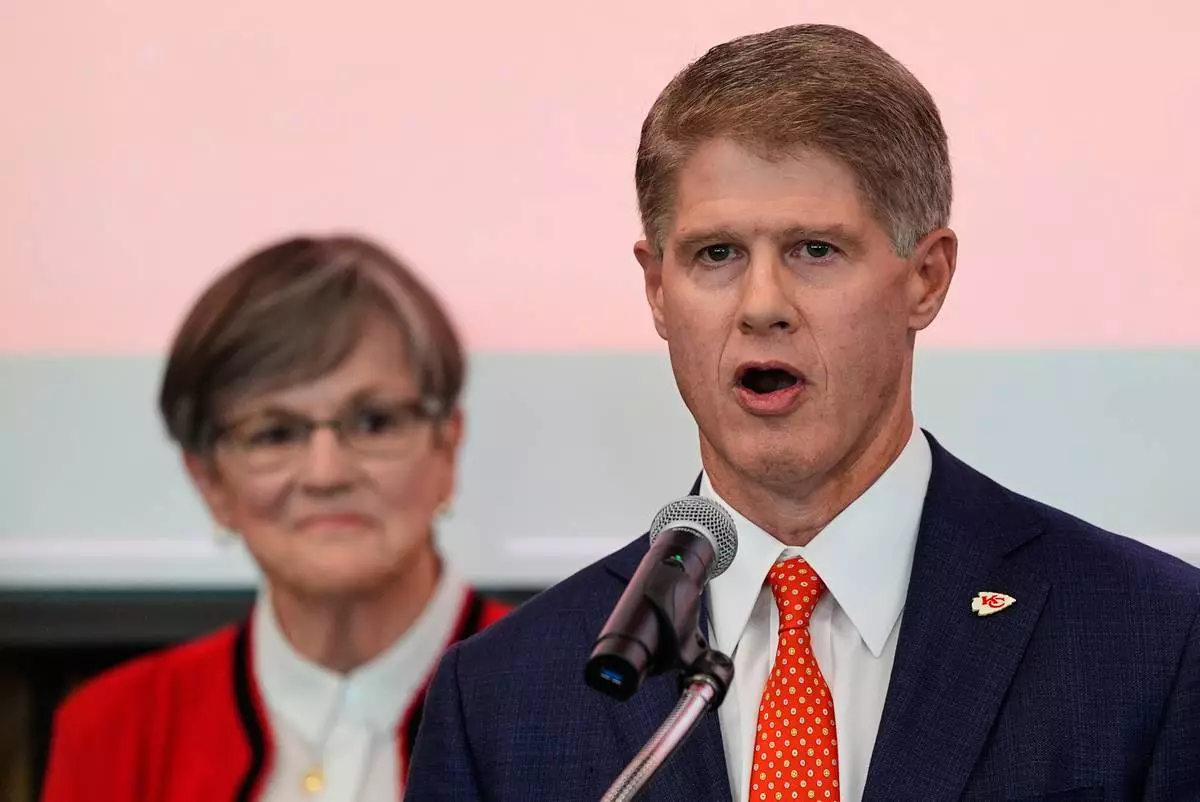
Kansas City Chiefs owner Clark Hunt, right, addresses attendees while Kansas Gov. Laura Kelly, left, looks on during an event Monday, Dec. 22, 2025, in Topeka, Kan., announcing the team will leave Arrowhead Stadium in Kansas City, Mo. for a new stadium that will be built across the Kansas-Missouri state line and be ready for the start of the 2031 season. (AP Photo/Charlie Riedel)