Skip to Content Facebook Feature Image

Afghanistan's Taliban have 'weaponized' the judicial system to oppress women, UN expert says

News

Afghanistan's Taliban have 'weaponized' the judicial system to oppress women, UN expert says
News

News

Afghanistan's Taliban have 'weaponized' the judicial system to oppress women, UN expert says

2025-08-07 07:21 Last Updated At:07:30

UNITED NATIONS (AP) — Afghanistan’s Taliban rulers have “weaponized” the legal and judicial system to oppress women and girls in what amounts to “crimes against humanity,” the independent U.N. investigator on human rights in the country said.

Richard Bennett said in a report to the U.N. General Assembly circulated Wednesday that after seizing power in 2021 the Taliban suspended the 2004 constitution and laws protecting the rights of women and girls. These include a landmark law that criminalized 22 forms of violence against women, including rape and child and forced marriage.

The Taliban dismissed all judges under the previous U.S.-backed government, including approximately 270 women, replacing them with men who share their extreme Islamic views, lack legal training and hand down decisions based on edicts issued by the Taliban, he said.

In addition, he noted that the Taliban have assumed full control over law enforcement and investigative agencies, systematically purging Afghans who worked for the previous government.

Bennett, who was appointed by the Geneva-based U.N. Human Rights Council, focused on access to justice and protection for women and girls in his report. He said he held meetings, focus-group discussions and one-on-one interviews with more that 110 Afghans inside and outside the country. He did so remotely because the Taliban have refused to grant him a visa to travel to Afghanistan.

Since the Taliban took control of Afghanistan, their crackdown on women and girls has been widely reported and globally denounced.

Taliban leaders have barred education for women and girls beyond sixth grade, banned most employment, and prohibited women from many public spaces, including parks, gyms and hairdressers. New laws ban women’s voices and bare faces outside the home.

The Taliban remain isolated from the West because of their restrictions on women and girls and have only been recognized by Russia.

Bennett said the Taliban did not respond to an advance copy of the report and a request for information about their efforts to ensure access to justice and protection for women and girls.

The Taliban defend their approach to justice by claiming they are implementing Islamic sharia law, but Islamic scholars and others have said their interpretation is unparalleled in other Muslim-majority countries and does not adhere to Islamic teachings. They say protecting the legal rights of women is a priority.

Bennett said, however, that women have virtually no rights.

“Today, there are no women judges or prosecutors and no officially registered female lawyers, leaving women and girls with fewer safe channels to report abuse or seek redress,” he wrote. “Coupled with a lack of female officials in the police and other institutions, the result is widespread underreporting of violence and discrimination against women and girls.”

Bennett said access to justice for girls “is further undermined by the dismantling of key legal safeguards and institutions protecting the rights of children,” including juvenile courts and juvenile rehabilitation centers.

The Taliban requirement that a woman must be accompanied by a male relative also creates barriers to filing complaints and attending court proceedings, he said, and disproportionately affects widows, women who are the heads of their households, the displaced and disabled.

“Women who engage with the Taliban court system — whether as victims seeking redress, to resolve family issues, to obtain official documents or as alleged offenders — face a hostile environment,” Bennett said. “Courts often reject complaints made by women and are especially reluctant to accept cases relating to divorce, child custody and gender-based violence.”

Facing these obstacles, Bennett said, women increasingly turn to traditional and informal justice mechanisms, including formal jirgas and shuras — community councils of elders — and informal mediation by religious leaders, community elders or family. But these are all male-dominated and raise “serious concerns about the rights of women and girls,” he said.

He said international forums offer the best hope for justice. He pointed to the International Criminal Court’s request on Jan. 23 for arrest warrants for two senior Taliban leaders accused of crimes against humanity for persecution “on gender grounds.” And he urged all countries to support efforts to bring Afghanistan before the International Court of Justice, the U.N.’s highest tribunal, for violating the Convention on the Elimination of All Forms of Discrimination against Women.
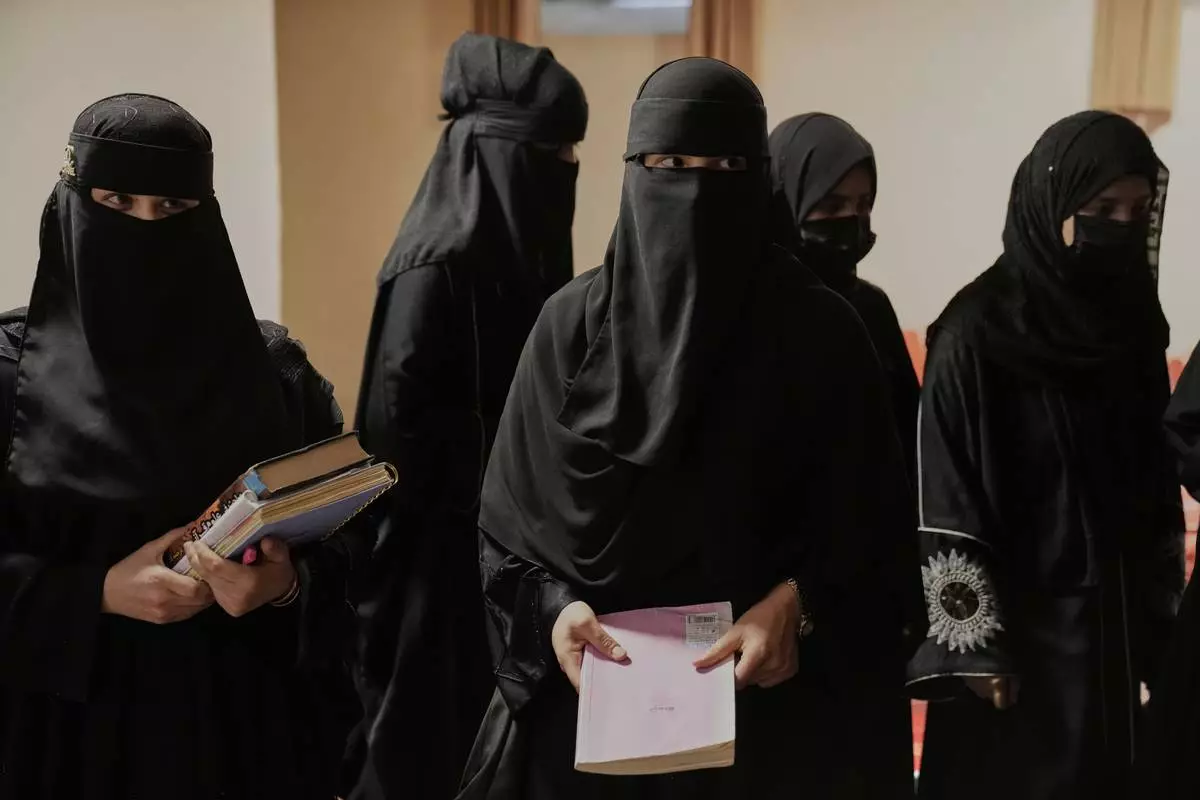
Afghan girls attend a religious studies class at the Tasnim-e-Nusrat religious education center in Kabul, Afghanistan, Wednesday, May 28, 2025. (AP Photo/Ebrahim Noroozi)

Afghan girls attend a religious studies class at the Tasnim-e-Nusrat religious education center in Kabul, Afghanistan, Wednesday, May 28, 2025. (AP Photo/Ebrahim Noroozi)

LONDON (AP) — Laws that will make it illegal to create online sexual images of someone without their consent are coming into force soon in the U.K., officials said Thursday, following a global backlash over the use of Elon Musk's artificial intelligence chatbot Grok to make sexualized deepfakes of women and children.

Musk's company, xAI, announced late Wednesday that it has introduced measures to prevent Grok from allowing the editing of photos of real people to portray them in revealing clothing in places where that is illegal.

British Prime Minister Keir Starmer welcomed the move, and said X must “immediately” ensure full compliance with U.K. law. He stressed that his government will remain vigilant on any transgressions by Grok and its users.

“Free speech is not the freedom to violate consent," Starmer said Thursday. “I am glad that action has now been taken. But we’re not going to let this go. We will continue because this is a values argument.”

The chatbot, developed by Musk's company xAI and freely accessed through his social media platform X, has faced global scrutiny after it emerged that it was used in recent weeks to generate thousands of images that “undress” people without their consent. The digitally-altered pictures included nude images as well as depictions of women and children in bikinis or in sexually explicit poses.

Critics have said laws regulating generative AI tools are long overdue, and that the U.K. legal changes should have been brought into force much sooner.

A look at the problem and how the U.K. aims to tackle it:

Britain's media regulator has launched an investigation into whether X has breached U.K. laws over the Grok-generated images of children being sexualized or people being undressed. The watchdog, Ofcom, said such images — and similar productions made by other AI models — may amount to pornography or child sexual abuse material.

The problem stemmed from the launch last year of Grok Imagine, an AI image generator that allows users to create videos and pictures by typing in text prompts. It includes a so-called “spicy mode” that can generate adult content.

Technology Secretary Liz Kendall cited a report from the internet Watch Foundation saying the deepfake images included sexualization of 11-year-olds and women subjected to physical abuse.

“The content which has circulated on X is vile. It is not just an affront to decent society, it is illegal,” she said.

Authorities said they are making legal changes to criminalize those who use or supply “nudification” tools.

First, the government says it is fast-tracking provisions in the Data (Use and Access) Act making it a criminal offense to create or request deepfake images. The act was passed by Parliament last year, but had not yet been brought into force.

The legislation is set to come into effect on Feb. 6

“Let this be a clear message to every cowardly perpetrator hiding behind a screen: you will be stopped and when you are, make no mistake that you will face the full force of the law,” Justice Secretary David Lammy said

Separately, the government said it is also criminalizing “nudification” apps as part of the Crime and Policing Bill, which is currently going through Parliament.

The new criminal offense will make it illegal for companies to supply tools designed to create non-consensual intimate images. Kendall said this would “target the problem at its source.”

The investigation by Ofcom is ongoing. Kendall said X could face a fine of up to 10% of its qualifying global revenue depending on the investigation’s outcome and a possible court order blocking access to the site.

Starmer has faced calls for his government to stop using X. Downing Street said this week it was keeping its presence on the platform “under review."

Musk insisted Grok complied with the law. “When asked to generate images, it will refuse to produce anything illegal, as the operating principle for Grok is to obey the laws of any given country or state,” he posted on X. “There may be times when adversarial hacking of Grok prompts does something unexpected. If that happens, we fix the bug immediately.”

FILE - Workers install lighting on an "X" sign atop the company headquarters, formerly known as Twitter, in downtown San Francisco, July 28, 2023. (AP Photo/Noah Berger, File)

FILE - Workers install lighting on an "X" sign atop the company headquarters, formerly known as Twitter, in downtown San Francisco, July 28, 2023. (AP Photo/Noah Berger, File)

Recommended Articles