
Skip to Content Facebook Feature Image

Ion Iliescu's death exposes Romania's deep divisions over his legacy as former leader laid to rest

News

Ion Iliescu's death exposes Romania's deep divisions over his legacy as former leader laid to rest
News

News

Ion Iliescu's death exposes Romania's deep divisions over his legacy as former leader laid to rest

2025-08-07 20:19 Last Updated At:20:41

BUCHAREST, Romania (AP) — On the day of Ion Iliescu’s funeral, the polarizing legacy of Romania’s first elected president after the fall of communism was laid bare. While many dignitaries paid their respects, others highlighted the oppression and bloodshed they say defined his political career.

A religious ceremony was held on Thursday in a church at the presidential Cotroceni Palace in Bucharest before Iliescu's casket was transferred to a cemetery for a funeral procession with military honors. He died on Tuesday, aged 95, after a lung cancer diagnosis in June following years of ill health.

More Images
Honor guard soldiers perform a changing of the guard by the coffin of late Ion Iliescu, Romania's first freely elected president after the fall of communism in 1989, at the Cotroceni Presidential Palace, in Bucharest, Romania, Wednesday, Aug. 6, 2025.(AP Photo/Vadim Ghirda)
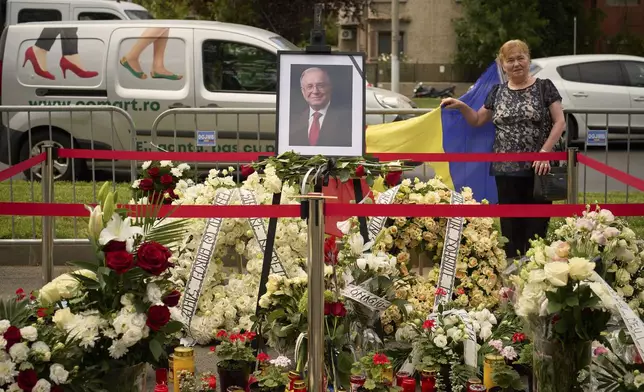
Honor guard soldiers perform a changing of the guard by the coffin of late Ion Iliescu, Romania's first freely elected president after the fall of communism in 1989, at the Cotroceni Presidential Palace, in Bucharest, Romania, Wednesday, Aug. 6, 2025.(AP Photo/Vadim Ghirda)
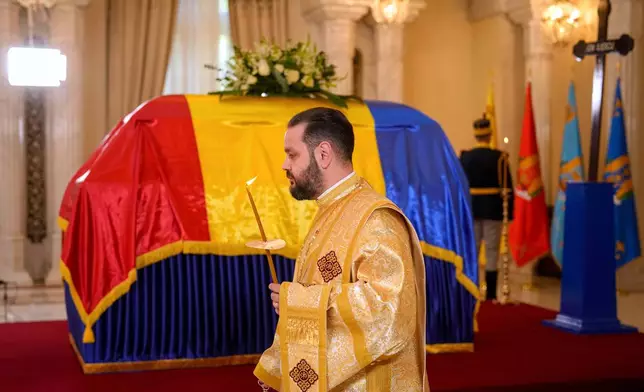
A woman poses next to floral tributes for the late Ion Iliescu, Romania's first freely elected president after the fall of communism in 1989, outside the Cotroceni Presidential Palace, in Bucharest, Romania, Wednesday, Aug. 6, 2025.(AP Photo/Vadim Ghirda)
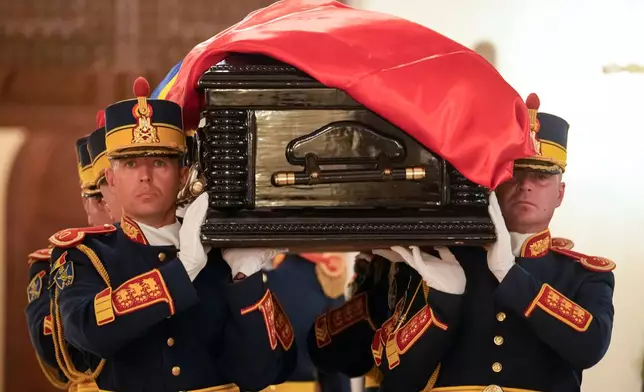
A woman poses next to floral tributes for the late Ion Iliescu, Romania's first freely elected president after the fall of communism in 1989, outside the Cotroceni Presidential Palace, in Bucharest, Romania, Wednesday, Aug. 6, 2025.(AP Photo/Vadim Ghirda)

A priest performs a brief religious service next to the coffin of the late Ion Iliescu, Romania's first freely elected president after the fall of communism in 1989, at the Cotroceni Presidential Palace, in Bucharest, Romania, Wednesday, Aug. 6, 2025.(AP Photo/Vadim Ghirda)

A priest performs a brief religious service next to the coffin of the late Ion Iliescu, Romania's first freely elected president after the fall of communism in 1989, at the Cotroceni Presidential Palace, in Bucharest, Romania, Wednesday, Aug. 6, 2025.(AP Photo/Vadim Ghirda)

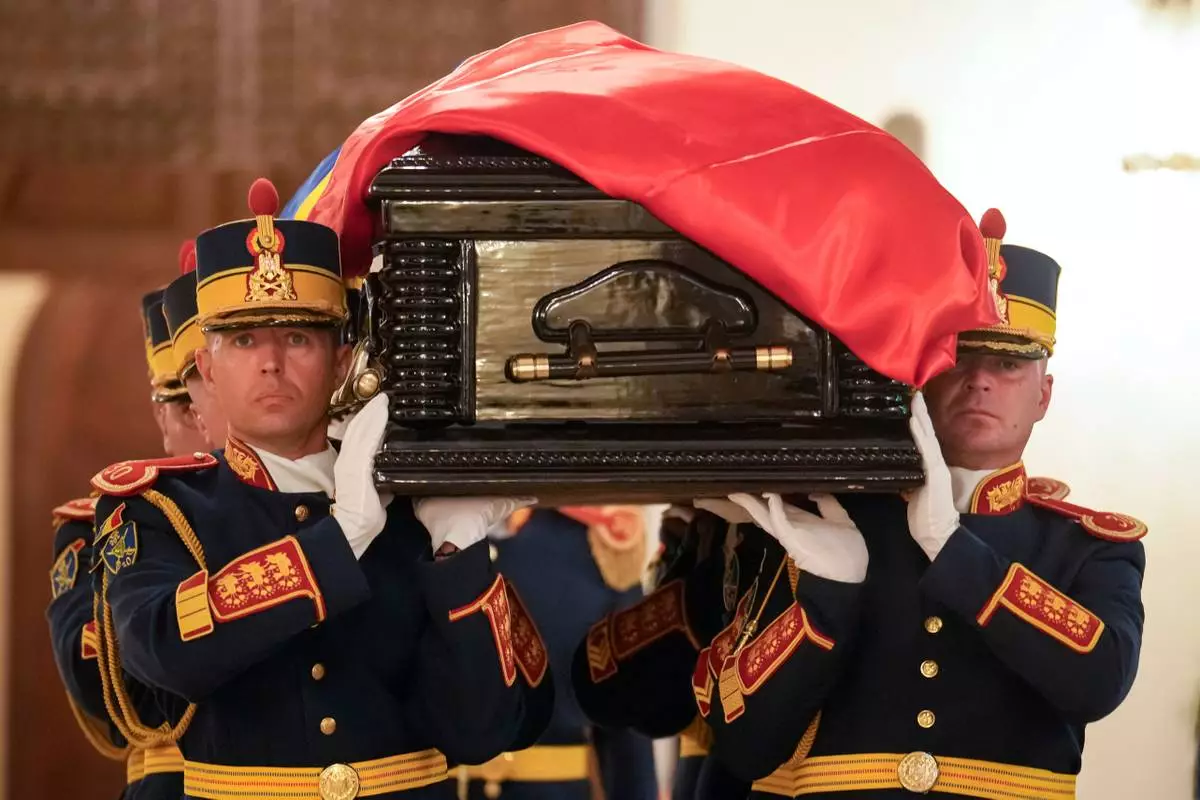
Honor guard soldiers carry the coffin of the late Ion Iliescu, Romania's first freely elected president after the fall of communism in 1989, at the Cotroceni Presidential Palace, in Bucharest, Romania, Wednesday, Aug. 6, 2025.(AP Photo/Vadim Ghirda)

Honor guard soldiers carry the coffin of the late Ion Iliescu, Romania's first freely elected president after the fall of communism in 1989, at the Cotroceni Presidential Palace, in Bucharest, Romania, Wednesday, Aug. 6, 2025.(AP Photo/Vadim Ghirda)

Honor guard soldiers stand next to the coffin of the late Ion Iliescu, Romania's first freely elected president after the fall of communism in 1989, at the Cotroceni Presidential Palace, in Bucharest, Romania, Wednesday, Aug. 6, 2025.(AP Photo/Vadim Ghirda)

Honor guard soldiers stand next to the coffin of the late Ion Iliescu, Romania's first freely elected president after the fall of communism in 1989, at the Cotroceni Presidential Palace, in Bucharest, Romania, Wednesday, Aug. 6, 2025.(AP Photo/Vadim Ghirda)

But as flags on official buildings flew at half-staff on Thursday, a national day of mourning, the former president's passing exposed stark divisions over his role in Romania’s violent transition after 1989, from communist dictatorship to a free market economy and eventual membership of NATO and the European Union.

Many former leaders and officials paid tribute to Iliescu, in contrast to the Save Romania Union party, a governing coalition partner that opposed the day of national mourning and said party representatives would not attend the funeral, triggering a rift in the recently sworn-in government.

USR’s decision drew the ire of coalition partners from the Social Democratic Party, or PSD, which Iliescu founded and has been the most dominant party since the revolution.

“These are just shameful attacks from people who will never live up to the legacy left by the founding leader of the PSD,” Marcel Ciolacu, a former PSD leader and prime minister, said in a post on Facebook, adding that it “demonstrates only sick hatred and lack of decency.”

A notable absence from the funeral was Romania’s recently elected President Nicusor Dan, who founded the USR party in 2016, and sent a short statement after the former president’s death, stating that “history will judge Ion Iliescu.”

After largely retiring from public life in 2017, Iliescu’s later years were plagued by major legal battles, including charges of crimes against humanity over his alleged role in the bloodshed of the revolution and the violent suppression of civilian protesters in the early 1990s.

Iliescu, who served as a minister in the Communist government but was sidelined in 1971, held de facto military authority during the anti-communist revolt. He assumed power after Communist dictator Nicolae Ceausescu and his wife Elena were executed by firing squad on Dec. 25, 1989.

More than 1,100 people died during the revolution, 862 of them after Iliescu had seized power. He denied any wrongdoing. In 2018, military prosecutors charged Iliescu with crimes against humanity for failing to prevent “numerous situations” in which civilians were needlessly killed during the revolution.

At the time of his death, he had never been convicted, and the case remained open.

In January this year, Iliescu’s legal woes mounted when prosecutors charged him with crimes against humanity in a second case. Prosecutors allege he implemented policies that led to a violent crackdown on civilian protesters in Bucharest in 1990, who were demanding the removal of former communists from power.

Iliescu had called on coal miners from the Jiu Valley to “restore order” in the capital. At least four people were killed.

A demonstration organized in Bucharest later on Thursday by the civic activist group “Corruption Kills," which opposed the national day of mourning, stated Iliescu's passing should serve as “a moment of critical reflection and remembrance” of the victims of violent repression under his leadership.

“We will do some mourning … but we will do it for the victims, not for the oppressor, not for the killer,” Florin Badita-Nistor, the group’s founder, told The Associated Press.

Twice re-elected, in 1992 and 2000, Iliescu was a central figure in the country’s transition years and its shift westward during his last tenure, which paved the way to membership of NATO and the EU.

In recent years, Iliescu’s health declined. In 2019, he underwent heart surgery and spent nearly two months in hospital before his death, during which he received the lung cancer diagnosis.

Stephen McGrath reported from Leamington Spa, U.K.

Honor guard soldiers perform a changing of the guard by the coffin of late Ion Iliescu, Romania's first freely elected president after the fall of communism in 1989, at the Cotroceni Presidential Palace, in Bucharest, Romania, Wednesday, Aug. 6, 2025.(AP Photo/Vadim Ghirda)
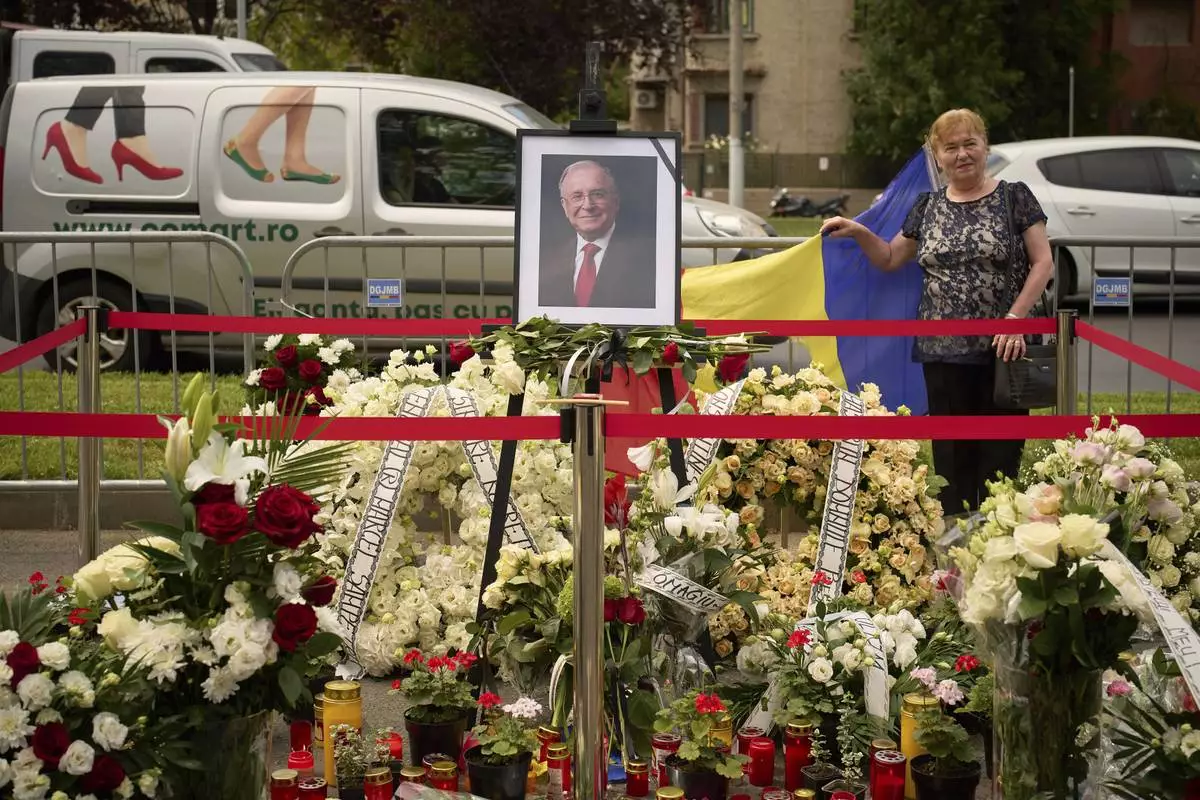
Honor guard soldiers perform a changing of the guard by the coffin of late Ion Iliescu, Romania's first freely elected president after the fall of communism in 1989, at the Cotroceni Presidential Palace, in Bucharest, Romania, Wednesday, Aug. 6, 2025.(AP Photo/Vadim Ghirda)

A woman poses next to floral tributes for the late Ion Iliescu, Romania's first freely elected president after the fall of communism in 1989, outside the Cotroceni Presidential Palace, in Bucharest, Romania, Wednesday, Aug. 6, 2025.(AP Photo/Vadim Ghirda)
A woman poses next to floral tributes for the late Ion Iliescu, Romania's first freely elected president after the fall of communism in 1989, outside the Cotroceni Presidential Palace, in Bucharest, Romania, Wednesday, Aug. 6, 2025.(AP Photo/Vadim Ghirda)

A priest performs a brief religious service next to the coffin of the late Ion Iliescu, Romania's first freely elected president after the fall of communism in 1989, at the Cotroceni Presidential Palace, in Bucharest, Romania, Wednesday, Aug. 6, 2025.(AP Photo/Vadim Ghirda)


A priest performs a brief religious service next to the coffin of the late Ion Iliescu, Romania's first freely elected president after the fall of communism in 1989, at the Cotroceni Presidential Palace, in Bucharest, Romania, Wednesday, Aug. 6, 2025.(AP Photo/Vadim Ghirda)

Honor guard soldiers carry the coffin of the late Ion Iliescu, Romania's first freely elected president after the fall of communism in 1989, at the Cotroceni Presidential Palace, in Bucharest, Romania, Wednesday, Aug. 6, 2025.(AP Photo/Vadim Ghirda)

Honor guard soldiers carry the coffin of the late Ion Iliescu, Romania's first freely elected president after the fall of communism in 1989, at the Cotroceni Presidential Palace, in Bucharest, Romania, Wednesday, Aug. 6, 2025.(AP Photo/Vadim Ghirda)

Honor guard soldiers stand next to the coffin of the late Ion Iliescu, Romania's first freely elected president after the fall of communism in 1989, at the Cotroceni Presidential Palace, in Bucharest, Romania, Wednesday, Aug. 6, 2025.(AP Photo/Vadim Ghirda)

Honor guard soldiers stand next to the coffin of the late Ion Iliescu, Romania's first freely elected president after the fall of communism in 1989, at the Cotroceni Presidential Palace, in Bucharest, Romania, Wednesday, Aug. 6, 2025.(AP Photo/Vadim Ghirda)

UTICA, N.Y. (AP) — A New York prison guard who failed to intervene as he watched an inmate being beaten to death should be convicted of manslaughter, a prosecutor told a jury Thursday in the final trial of correctional officers whose pummeling, recorded by body-cameras, provoked outrage.

“For seven minutes — seven gut-churning, nauseating, disgusting minutes — he stood in that room close enough to touch him and he did nothing,” special prosecutor William Fitzpatrick told jurors during closing arguments. The jury began deliberating Thursday afternoon.

Former corrections officer Michael Fisher, 55, is charged with second-degree manslaughter in the death of Robert Brooks, who was beaten by guards upon his arrival at Marcy Correctional Facility on the night of Dec. 9, 2024, his agony recorded silently on the guards' body cameras.

Fisher’s attorney, Scott Iseman, said his client entered the infirmary after the beating began and could not have known the extent of his injuries.

Fisher was among 10 guards indicted in February. Three more agreed to plead guilty to reduced charges in return for cooperating with prosecutors. Of the 10 officers indicted in February, six pleaded guilty to manslaughter or lesser charges. Four rejected plea deals. One was convicted of murder, and two were acquitted in the first trial last fall.

Fisher, standing alone, is the last of the guards to face a jury.

The trial closes a chapter in a high-profile case led to reforms in New York's prisons. But advocates say the prisons remain plagued by understaffing and other problems, especially since a wildcat strike by guards last year.

Officials took action amid outrage over the images of the guards beating the 43-year-old Black man in the prison's infirmary. Officers could be seen striking Brooks in the chest with a shoe, lifting him by the neck and dropping him.

Video shown to the jury during closing arguments Thursday indicates Fisher stood by the doorway and didn't intervene.

“Did Michael Fisher recklessly cause the death of Robert Brooks? Of course he did. Not by himself. He had plenty of other helpers,” said Fitzpatrick, the Onondaga County district attorney.

Iseman asked jurors looking at the footage to consider what Fisher could have known at the time “without the benefit of 2020 hindsight.”

“Michael Fisher did not have a rewind button. He did not have the ability to enhance. He did not have the ability to pause. He did not have the ability to get a different perspective of what was happening in the room,” Iseman said.

Even before Brooks' death, critics claimed the prison system was beset by problems that included brutality, overworked staff and inconsistent services. By the time criminal indictments were unsealed in February, the system was reeling from an illegal three-week wildcat strike by corrections officers who were upset over working conditions. Gov. Kathy Hochul deployed National Guard troops to maintain operations. More than 2,000 guards were fired.

Prison deaths during the strike included Messiah Nantwi on March 1 at Mid-State Correctional Facility, which is across the road from the Marcy prison. 10 other guards were indicted in Nantwi's death in April, including two charged with murder.

There are still about 3,000 National Guard members serving the state prison system, according to state officials.

“The absence of staff in critical positions is affecting literally every aspect of prison operations. And I think the experience for incarcerated people is neglect,” Jennifer Scaife, executive director of the Correctional Association of New York, an independent monitoring group, said on the eve of Fisher's trial.

Hochul last month announced a broad reform agreement with lawmakers that includes a requirement that cameras be installed in all facilities and that video recordings related to deaths behind bars be promptly released to state investigators.

The state also lowered the hiring age for correction officers from 21 to 18 years of age.

FILE - This image provided by the New York State Attorney General office shows body camera footage of correction officers beating a handcuffed man, Robert Brooks, at the Marcy Correctional Facility in Oneida County, N.Y., Dec. 9, 2024. (New York State Attorney General office via AP, File)

FILE - This image provided by the New York State Attorney General office shows body camera footage of correction officers beating a handcuffed man, Robert Brooks, at the Marcy Correctional Facility in Oneida County, N.Y., Dec. 9, 2024. (New York State Attorney General office via AP, File)

Recommended Articles