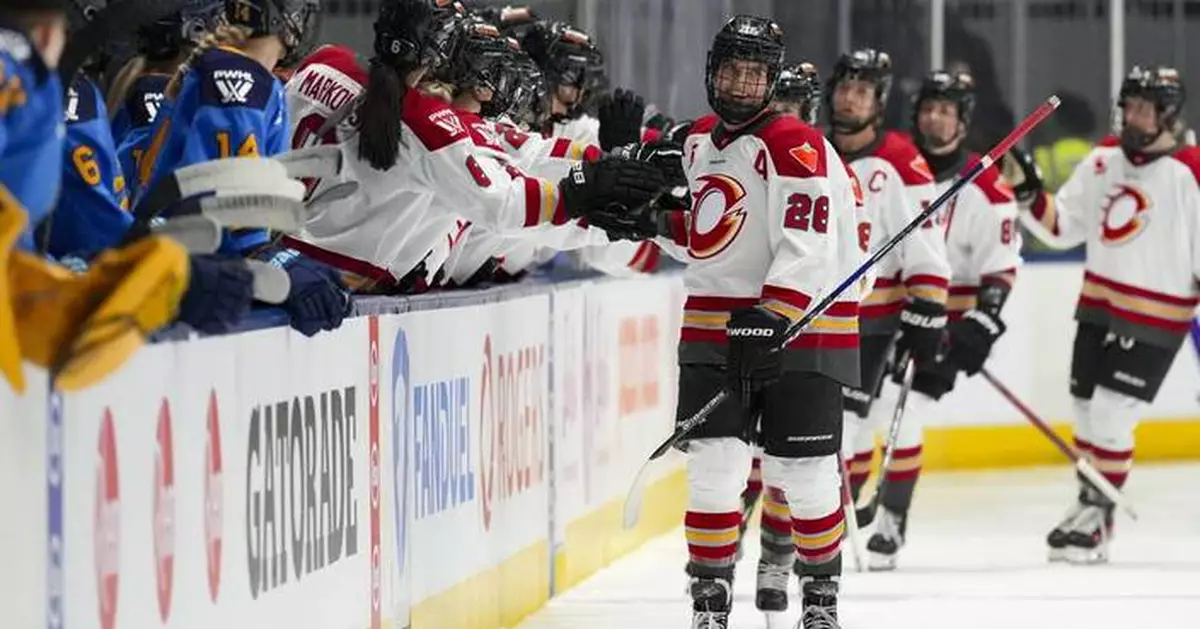
Ottawa Charge forward Emily Clark set a PWHL record in becoming the league’s highest-paid player based on single-season salary in signing a two-year contract extension on Thursday.
The team announced the signing that secures her through the 2027-28 season, but not the value of the contract. Two people with knowledge of the league’s payroll structure confirmed to The Associated Press that Clark's six-figure salary next season broke the record in restructuring the third and final year of her existing contract.
The people spoke on the condition of anonymity because the league and the PWHL Player’s Association doesn’t make salaries public.
While the PWHL’s collective bargaining agreement features a minimum salary of $35,000, there is no maximum under what will be the league's $1.3 million salary cap this season. The only requirement is that at least six players per team make at least $80,000 per season.
For context, one of the people said Clark will be among nine players making $100,000 or more with the PWHL expanding from six to eight teams next season.
Clark declined to reveal the value of her contract by saying she’d prefer placing the focus on the growth of the women’s game rather than herself.
It’s part of Clark’s modest background, growing up in Saskatoon, Saskatchewan, and reflects her style of play in being one of the game’s top two-way centers.
“I’m really proud to play the way that I do, but it might not be always the most attractive role or the stat lines don’t always show maybe some of the intangibles that I do,” Clark said, before crediting Charge general manager Mike Hirshfeld. “But for Mike and the organization to see that complete game that I try to bring every night and value it, I think it’s a testament to our organization."
Clark is a two-time Olympian and was one of the first three players signed by the Charge entering the league’s inaugural season in 2024. She’s relied upon to kill penalties, face opposing team’s top offensive lines, and contribute on offense.
Clark’s do-it-all ability was on full display during Ottawa’s playoff run in which the Charge went 3-1 to eliminate Montreal in the semifinals before losing in four games to defending champion Minnesota in the Walter Cup Finals. Clark led Ottawa in playoff scoring with three goals and five points, while also playing a key defensive role in which all eight of the Charge’s playoff games were decided by one goal.
In the regular season, Clark finished second on the Charge with nine goals and 19 points while leading team forwards in averaging 19:22 of ice time per outing.
“We know what she brings. She’s really the heart and soul of our organization,” Hirshfeld said. “Our organization is an offense by committee type of approach, and so she fits in the toughness, the competitiveness, the defensive side of it. She fits exactly what we’re trying to do as an organization.”
The contract is humbling for Clark, who recalled being in a room with her Team Canada teammates at the 2019 world championships in Finland when they were informed of the Canadian Women’s Hockey League folding.
“I’m in a room with all the women that built that league and feeling the emotion for them.
"But then also that realization of what does this mean for me?” Clark said, noting she was counting on competing in the CWHL fresh off winning a Frozen Four title during her senior season at Wisconsin.
“No, I couldn’t have imagined to be in this position,” Clark said, reflecting back. “I’m very grateful.”
AP women’s hockey: https://apnews.com/hub/womens-hockey
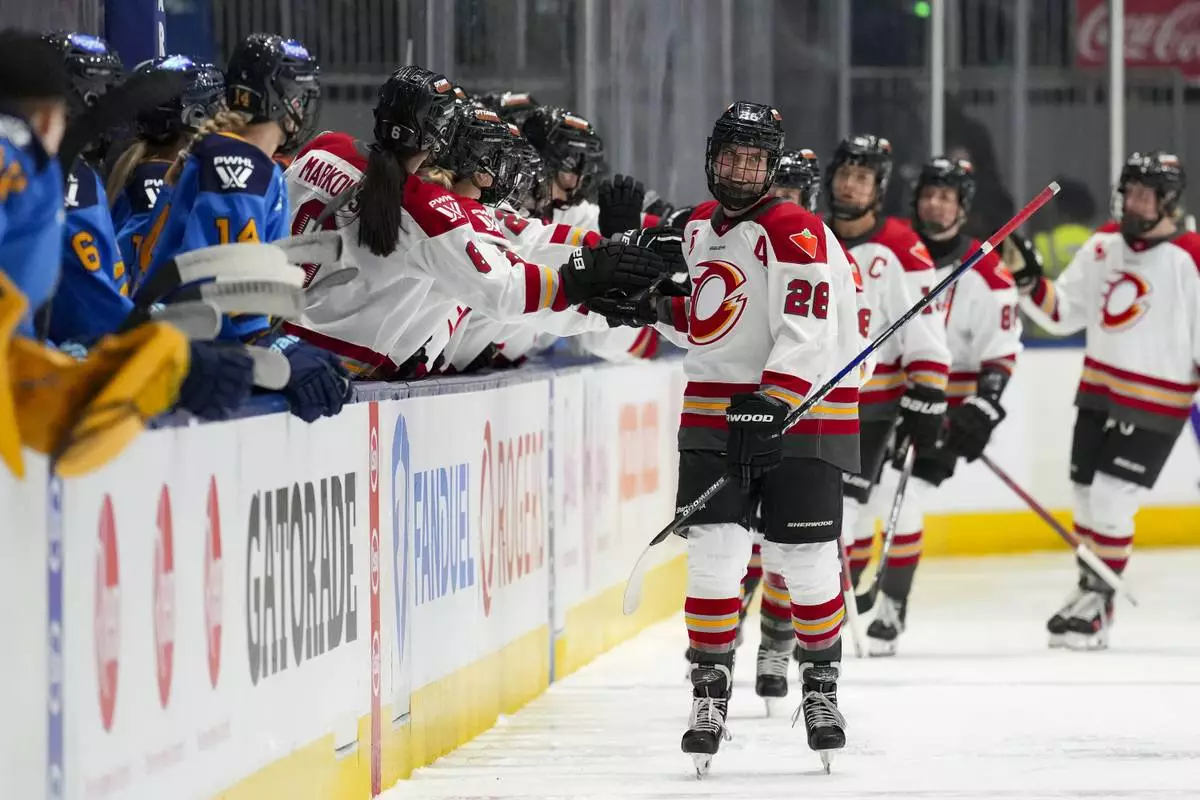
FILE - Ottawa Charge forward Emily Clark (26) is congratulated by her teammates after scoring a goal against the Toronto Sceptres during second period PWHL hockey action in Toronto, Feb. 1, 2025. (Arlyn McAdorey/The Canadian Press via AP, File)
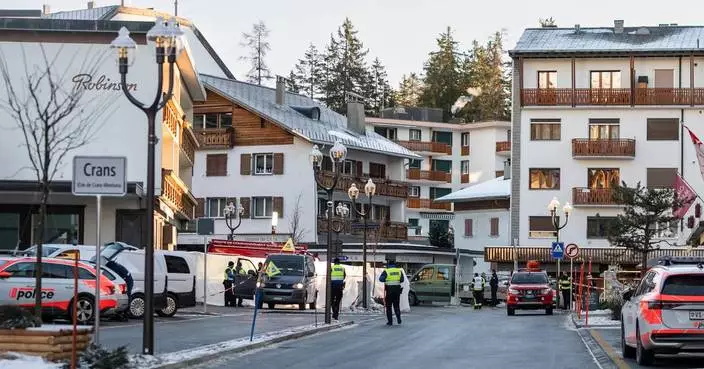
A fire at a bar in the Swiss ski resort of Crans-Montana in the early hours of New Year's Day has left dozens of people presumed dead and around 100 injured, according to authorities. Here is a look at some other nightclub, bar and music venue fires that have led to significant death tolls:
— March 2025: A fire and ensuing stampede at the crowded Pulse club in Kocani, North Macedonia, killed 63 people, most of them young revelers, and injured more than 200. It was set off by a pyrotechnic flame that engulfed the roof of the club.
— April 2024: A blaze at the Masquerade nightclub in Istanbul, Turkey, trapped workers and employees while the venue was closed for renovations, leaving 29 people dead. It was located on the ground and basement floors of a 16-story residential building.
— October 2023: A fire that started at a nightclub in the southeastern Spanish city of Murcia and spread to two other clubs left 13 people dead.
— January 2022: A nightclub in Sorong, in Indonesia’s West Papua province, burned after two groups attacked each other inside the building. Nineteen people were killed.
— January 2022: A blaze at Liv’s Nightclub Yaouba in Yaounde, the capital of Cameroon, set off explosions that killed 17 people. The government suggested that fireworks set the roof alight and the fire then spread to areas where cooking gas was stored.
— December 2016: Thirty-six people died in a fire at a warehouse in Oakland, California that had been converted into a residence and event space for artists dubbed the “Ghost Ship.” The blaze, which broke out during an electronic music and dance party, moved so quickly that victims were trapped on the illegally constructed second floor.
— October 2015: A blaze that broke out during a rock band’s pyrotechnics display at the Colectiv nightclub in the Romanian capital, Bucharest, killed 64 people and left some 190 injured.
— January 2013: A fire killed more than 200 people at the Kiss nightclub in the city of Santa Maria in southern Brazil. Investigators said soundproofing foam on the ceiling caught fire and released poisonous gases that quickly killed those attending a university party.
— December 2009: Some 152 people died when a blaze broke out at the Lame Horse nightclub in Perm, Russia. It started when an indoor fireworks display ignited a plastic ceiling decorated with branches.
— January 2009: An indoor fireworks display after a New Year’s countdown ignited a blaze in the Santika club in Bangkok, Thailand, killing 67 people and injuring many more. Victims died from burns, smoke inhalation, and from being crushed.
— September 2008: A fire killed 44 people at the jammed King of Dancers nightclub in Shenzhen, China, when a stampede broke out after a fireworks show ignited the ceiling.
— December 2004: In Buenos Aires, Argentina, a fire killed 194 people at the crowded Cromagnon Republic club after a flare ignited ceiling foam. Club owner Omar Chaban was sentenced to 20 years in prison for causing the deadly fire and for bribery. Others received lighter sentences.
— February 2003: A fire at the Station nightclub in West Warwick, Rhode Island, in the United States, killed 100 people and injured more than 200 others. Fireworks being used by the band set fire to flammable foam inside the club.
— January 2001: A fire at a cafe in the Dutch town of Volendam where people were celebrating the New Year killed 14 people and injured more than 200.
— December 2000: A fire that was blamed on a welding accident killed 309 people at a disco in the central Chinese city of Luoyang.
— October 1998: An arson attack against an overcrowded youth disco in the Swedish city of Goteborg killed 63 people and left around 200 injured. Four people were later convicted for starting the fire.
— March 1996: A fire at the Ozone Disco Pub in Quezon City, Philippines, killed 162 people. A large proportion of the victims were students partying to mark the end of the academic year.
— March 1990: An arson attack at the Happy Land nightclub in the Bronx borough of New York City killed 87 people. It started when a man angry with his girlfriend threw gasoline on the club’s only exit and set it on fire, then jammed down the metal front gate so people were trapped.
— December 1983: A fire at the Alcala dance hall in Madrid, Spain, left 78 people dead and more than 20 injured.
— May 1977: A fire at the Beverly Hills Supper Club in Southgate, Kentucky, killed 165 people and injured more than 200.
— November 1942: The deadliest nightclub fire in U.S. history killed 492 people at Boston’s Cocoanut Grove club. The fire at what had been one of Boston’s foremost nightspots led to new requirements for sprinkler systems and accessible exits.
— April 1940: A fire ignited the decorative Spanish moss draping the ceiling of the Rhythm Night Club in Natchez, Mississippi, killing 209 people. The windows had been boarded up to prevent people from sneaking in.

Police officers inspect the area where a fire broke out at the Le Constellation bar and lounge leaving people dead and injured, during New Year’s celebration, in Crans-Montana, Swiss Alps, Switzerland, Thursday, Jan. 1, 2026. (Alessandro della Valle/Keystone via AP)

Police officers inspect the area where a fire broke out at the Le Constellation bar and lounge leaving people dead and injured, during New Year’s celebration, in Crans-Montana, Swiss Alps, Switzerland, Thursday, Jan. 1, 2026. (Alessandro della Valle/Keystone via AP)