STAMFORD, Conn.--(BUSINESS WIRE)--Aug 8, 2025--
AI agents and AI-ready data are the two fastest advancing technologies on the 2025 Gartner Hype Cycle for Artificial Intelligence, according to Gartner, Inc. a business and technology insights company. These technologies are experiencing heightened interest this year, accompanied by ambitious projections and speculative promises, placing them at the Peak of Inflated Expectations.
This press release features multimedia. View the full release here: https://www.businesswire.com/news/home/20250808070139/en/
Gartner Hype Cycles provide a graphic representation of the maturity and adoption of technologies and applications, and how they are potentially relevant to solving real business problems and exploiting new opportunities. Gartner Hype Cycle methodology gives a view of how a technology or application will evolve over time, providing a sound source of insight to manage its deployment within the context of specific business goals.
“With AI investment remaining strong this year, a sharper emphasis is being placed on using AI for operational scalability and real-time intelligence,” said Haritha Khandabattu, Senior Director Analyst at Gartner. “This has led to a gradual pivot from generative AI (GenAI) as a central focus, toward the foundational enablers that support sustainable AI delivery, such as AI-ready data and AI agents.”
Among the AI innovations Gartner expects will reach mainstream adoption within the next 5 years, multimodal AI and AI trust, risk and security management (TRiSM) have been identified as dominating the Peak of Inflated Expectations (see Figure 1). Together, these developments will enable more robust, innovative and responsible AI applications, transforming how businesses and organizations operate.
“Despite the enormous potential business value of AI, it isn’t going to materialize spontaneously,” said Khandabattu. “Success will depend on tightly business aligned pilots, proactive infrastructure benchmarking, and coordination between AI and business teams to create tangible business value.”
AI Agents
AI agents are autonomous or semiautonomous software entities that use AI techniques to perceive, make decisions, take actions and achieve goals in their digital or physical environments. Using AI practices and techniques such as LLMs, organizations are creating and deploying AI agents to achieve complex tasks.
“To reap the benefits of AI agents, organizations need to determine the most relevant business contexts and use cases, which is challenging given no AI agent is the same and every situation is different,” said Khandabattu. “Although AI agents will continue to become more powerful, they can’t be used in every case, so use will largely depend on the requirements of the situation at hand.”
AI Ready Data
AI-ready data ensures datasets are optimized for AI applications, enhancing accuracy and efficiency. Readiness is determined through the data’s ability to prove its fitness for use for specific AI use cases. It can only be determined contextually to the AI use case and the AI technique used, which forces new approaches to data management.
According to Gartner, organizations that invest in AI at scale need to evolve their data management practices and capabilities to extend them to AI. This will cater to existing and upcoming business demands, ensure trust, avoid risk and compliance issues, preserve intellectual property and reduce bias and hallucinations.
Multimodal AI
Multimodal AI models are trained with multiple types of data simultaneously, such as images, video, audio and text. By integrating and analyzing diverse data sources, they can better understand complex situations better than models that use only one type of data. This helps users make sense of the world and opens up new avenues for AI applications.
Multimodal AI will become increasingly integral to capability advancement in every application and software product across all industries over the next five years, according to Gartner research.
AI TRiSM
AI TRiSM plays a crucial role in ensuring ethical and secure AI deployment. It comprises four layers of technical capabilities that support enterprise policies for all AI use cases and help assure AI governance, trustworthiness, fairness, safety, reliability, security, privacy and data protection.
“AI brings new trust, risk and security management challenges that conventional controls don’t address,” said Khandabattu. “Organizations must evaluate and implement layered AI TRiSM technology to continuously support and enforce policies across all AI entities in use.”
Gartner clients can read more in the report Hype Cycle for Artificial Intelligence, 2025.
Learn how to fortify 4 AI strategy pillars to drive business impact in the complimentary Gartner AI Strategy Planner.
About Gartner IT Symposium/Xpo
Additional AI trends will be presented during Gartner IT Symposium/Xpo, the world's most important conference for CIOs and other IT executives. Gartner analysts and attendees will explore how to become agents of change in their organizations and harness AI for successful digital transformation. Follow news and updates from the conferences on X and LinkedIn using #GartnerSYM, and on the Gartner Newsroom.
Upcoming dates and locations for Gartner IT Symposium/Xpo include:
September 8-10, 2025 | Gold Coast, Australia
October 20-23, 2025 | Orlando, FL
October 28-30, 2025 | Yokohama, Japan
November 10-13, 2025 | Barcelona, Spain
November 17-19, 2025 | Kochi, India
About Gartner for Information Technology Executives
Gartner for Information Technology Executives provides actionable, objective insights to CIOs and IT leaders to help them drive their organizations through digital transformation and lead business growth. Additional information is available at www.gartner.com/en/information-technology.
Follow news and updates from Gartner for IT Executives on X and LinkedIn using #GartnerIT. Visit the IT Newsroom for more information and insights.
About Gartner
Gartner (NYSE: IT) delivers actionable, objective business and technology insights that drive smarter decisions and stronger performance on an organization's mission-critical priorities. To learn more visit gartner.com.
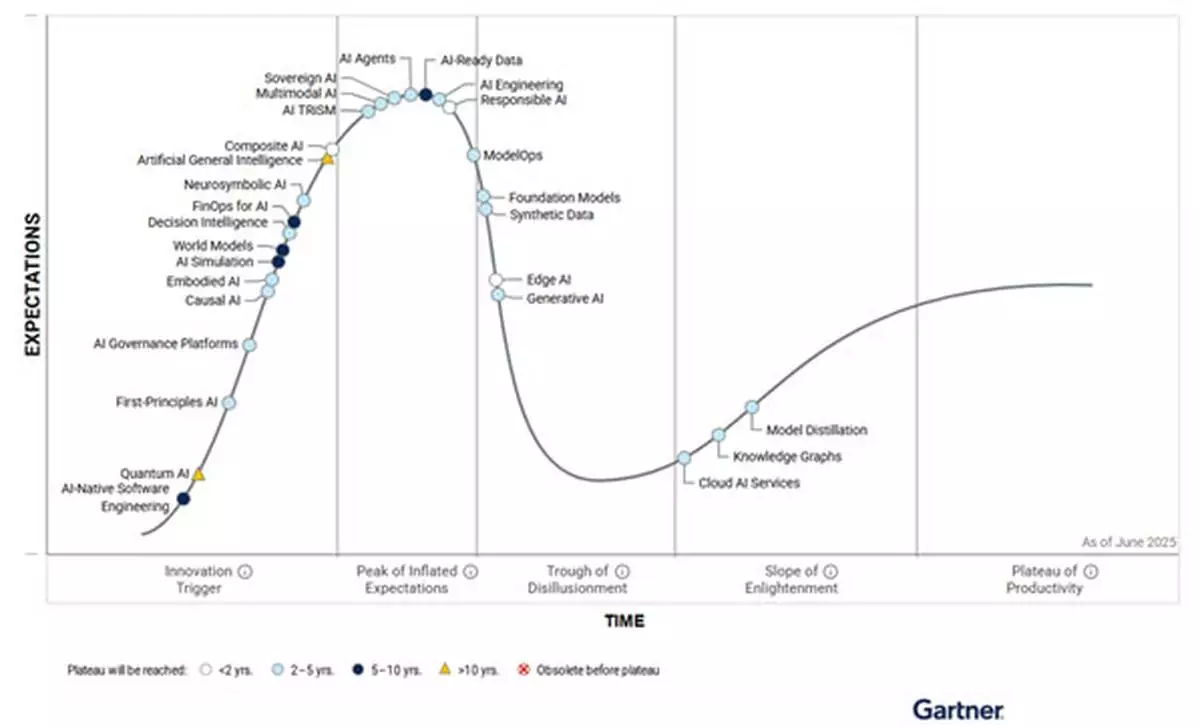
Figure 1: Hype Cycle for Artificial Intelligence 2025 | Source: Gartner (August 2025)
CHICAGO (AP) — Illinois Lt. Gov. Juliana Stratton won Tuesday's Democratic primary for U.S. Senate, edging out two sitting members of the U.S. House to advance to a November general election against Republican nominee Don Tracy, former state party chair.
The retirement of U.S. Sen Dick Durbin, the Senate’s longtime No. 2 Democrat, triggered a competitive campaign on the Democratic side, drawing as candidates Stratton and U.S. Reps. Raja Krishnamoorthi and Robin Kelly, among others. Furious fundraising and sharp elbows marked the race, which tested the influence of Democratic Gov. JB Pritzker. The governor, whose name has been floated as a 2028 presidential contender, backed Stratton.
The races were testing grounds for some of the biggest issues facing the Democratic Party, from support for Israel to immigration enforcement and the cryptocurrency and AI industries, as super PACs poured millions of dollars into the hotly contested primaries.
Most primary winners in the Democratic stronghold are expected to win in November, shaping a new generation of leadership in the state’s congressional delegation.
Among 10 Democrats in the race, Stratton lagged in fundraising but had the powerful backing of Pritzker, who campaigned with her around the state.
He introduced her Tuesday night before her victory speech, in which she pledged to push for Medicare for all and higher wages, abolish U.S. Immigration and Customs Enforcement and “bring this fight straight to Donald Trump’s door.”
“We are ready to take our democracy back into our own hands,” Stratton told supporters gathered in Chicago.
The race was expensive. Krishnamoorthi dominated fundraising and was the first on television with ads in July. He started 2026 with over $15 million on hand compared with Stratton's $1 million, according to campaign finance records. Late last year, Pritzker put $5 million into a super PAC aimed at electing her.
Stratton lit into Krishnamoorthi at debates, particularly on the five-term Democrat’s voting record and donations from an ICE contractor.
Krishnamoorthi, who has called to dismantle the agency, said he donated the money to immigrant rights groups. In a concession speech Tuesday, he brought up his roots as an immigrant who born in India and raised in central Illinois.
“Only in this country can a kid like me serve in the halls of Congress,” he said. “And now we must come together as Democrats and as Americans to make sure that we return to the principles that made us a beacon of freedom and opportunity for the world.”
Rochelle Brockenborough, 64, said she voted for Stratton at the Dr. Martin Luther King Community Service Center in Chicago.
“I wanted to make sure there was no AIPAC money. That’s important to me,” she said, adding that U.S. tax dollars shouldn’t be used to support Israel.
Candidates touted ties to iconic Chicagoans including President Barack Obama and the late Rev. Jesse Jackson, who died last month. However, an endorsement touted posthumously by Stratton caused a snag as Jackson’s family withdrew it Monday, saying the draft was not meant for public release.
In the GOP primary, Tracy, an attorney who led the Illinois Republican Party from 2021 to 2024, bested five other candidates. The state last had a Republican in the Senate a decade ago, when Mark Kirk was defeated by current Democratic Sen. Tammy Duckworth.
Election officials hoped to see busy polls after statewide turnout in the 2024 primary was 19%, the lowest in more than five decades. Initial turnout estimates in Chicago were around 25%, according to the Chicago Board of Elections.
Dozens of candidates ran for five open seats in the Chicago area.
In Kelly’s 2nd district, which spans parts of the South Side and suburbs and dips into the central Illinois farmlands, Cook County Commissioner Donna Miller emerged as the winner of a crowded Democratic field that included former U.S. Rep. Jesse Jackson Jr., son of the late civil rights leader. Miller will face off in November against Republican Michael Noack, who was unopposed.
Miller was backed by AIPAC, and that support prompted retiring U.S. Rep. Jan Schakowsky, of the 9th District, to withdraw her endorsement of Miller.
The open seat in Krishnamoorthi’s suburban 8th District attracted eight Democrats and four Republicans. Former U.S. Rep. Melissa Bean won the Democratic nomination and advances to face Republican Jennifer Davis.
“People are ready for change, they want to see a functional Congress,” Bean told The Associated Press. “We haven’t had one in quite some time.”
Two other House members are retiring after long careers.
The 7th District of Rep. Danny Davis, who was first elected in 1996, covers parts of downtown, the West Side and suburbs. The candidate he endorsed, state Rep. La Shawn Ford won the nomination over a pool of candidates that included Chicago City Treasurer Melissa Conyears-Ervin. Chad Koppie won for the GOP.
The primary for Schakowsky's 9th District seat was the most crowded. Among the 15 Democrats, Evanston Mayor Daniel Biss edged out digital creator Kat Abughazaleh and state Sen. Laura Fine, who was also backed by AIPAC. Republican John Elleson won the party's nomination.
Speaking to supporters, Biss called Schakowsky, who endorsed him, his “political hero” and said the contest to replace her raised fundamental questions about Democratic Party priorities.
“Are we going to double down on our progressive values, or are we going to shrink away from protecting the most vulnerable?” Biss said. “We are going to stand up, we are going to fight.”
Another open Chicago area seat was that of Rep. Jesus “Chuy” Garcia, who announced that he would not seek reelection citing health and personal reasons. The Democratic primary for the 4th District was uncontested after Garcia quietly schemed to place his chief of staff, Patty Garcia, on the ballot without any Democratic competition.
Patty Garcia, who is not related to the congressman, will face Republican Lupe Castillo, who also ran unopposed, in November.
Pritzker, an heir to the Hyatt Hotel fortune who was unopposed in his primary, is the first governor to seek a third term since the 1980s.
One of President Donald Trump’s most vocal critics, Pritzker used his victory speech to tout his efforts to oppose the aggressive federal immigration crackdown in Chicago last year. He criticized Republicans' agenda, called Trump's presidency an “unmitigated disaster” and vowing to help Democrats across Illinois win in November.
“This is the fight of our lives,” he told supporters at a downtown Chicago hotel. “Everything we care about is under siege from Washington.”
Pritzker also made digs at Republican candidate Darren Bailey, a former state senator whom he handily defeated in 2022.
Bailey, who bested three other Republicans vying for the nomination, said he did things differently this time, including focusing more on Chicago voters.
On the campaign trail and in his victory speech, Bailey criticized Pritzker’s leadership, including blaming him for rising costs. Heading into November, he vowed to include Democrats “who felt left behind.”
“I want to work together to make Illinois government work again at all levels,” he said.
Associated Press journalists Mike Householder in Chicago and Hannah Fingerhut in Des Moines, Iowa, contributed.
U.S. Rep. Raja Krishnamoorthi, D-Ill., center, concedes as his wife, Priya Bala, looks on during an election night watch party after losing the Democratic primary for U.S. Senate, Tuesday, March 17, 2026, in Chicago. (AP Photo/Nam Y. Huh)
Illinois Lt. Gov. Juliana Stratton, left, hugs her daughter Cassidy during a primary election night watch party after winning the Democratic primary for U.S. Senate, Tuesday, March 17, 2026, in Chicago. (AP Photo/Erin Hooley)
Supporters react as election results roll in during a primary election night watch party for Illinois Lt. Gov. Juliana Stratton, a Democratic candidate for U.S. Senate Tuesday, March 17, 2026, in Chicago. (AP Photo/Erin Hooley)
A pin reading "women for Juliana" is displayed during a primary election night watch party for Illinois Lt. Gov. Juliana Stratton, a Democratic candidate for U.S. Senate, Tuesday, March 17, 2026, in Chicago. (AP Photo/Erin Hooley)
Illinois Lt. Gov. Juliana Stratton waves during a primary election night watch party after winning the Democratic primary for U.S. Senate, Tuesday, March 17, 2026, in Chicago. (AP Photo/Erin Hooley)
Democratic candidate for Congress, Kat Abughazaleh smiles as she walks to vote on Election Day at Chicago Park District Loyola field house in Chicago, Tuesday, March 17, 2026. (AP Photo/Nam Y. Huh)
U.S. Rep. Raja Krishnamoorthi (D-Ill.), who is running in the Senate Democratic Primary Election, talks with election judges at Nerge Elementary School polling place in Schaumburg, Ill., Tuesday, March 17, 2026. (AP Photo/Nam Y. Huh)
Democratic candidate for Congress, Kat Abughazaleh, center, casts her vote in a primary election for the upcoming midterms, in Chicago, Tuesday, March 17, 2026. (AP Photo/Nam Y. Huh)
Patty García speaks during a news conference to announce her candidacy for the fourth district congressional race, Nov. 12, 2025, in Cicero, Ill. (Ashlee Rezin/Chicago Sun-Times via AP)