FEHD enhances promulgation of gravidtrap index for Aedes albopictus mosquitoes and strengthens mosquito prevention and control measures
The Food and Environmental Hygiene Department (FEHD) today (August 8) announced that the monthly gravidtrap index for Aedes albopictus mosquitoes in July was 8.1 per cent, at Level 2, which is lower than the 9.5 per cent in June, indicating that the distribution of Aedes albopictus mosquitoes in the survey areas was fairly extensive. Relevant government departments have persistently intensified mosquito prevention and elimination operations, resulting in the improvement of overall condition of mosquito infestation this month. In addition, the FEHD will strengthen the dissemination of information on gravidtrap index for Aedes albopictus mosquitoes so that more citizens can quickly grasp the mosquito infestation situation. The department will also further strengthen its mosquito control work to reduce the risk of transmission of chikungunya fever (CF).
In July, among the 64 survey areas, only the area gravidtrap index (AGI) of Ma Wan exceeded the alert level of 20 per cent, decreased from two survey areas in June. The relevant gravidtraps in the district concerned were mostly located in sports facilities and public places, and the FEHD has collaborated with other government departments and stakeholders to strengthen mosquito prevention and elimination work within 100-metre radius of the positive gravidtraps. The decreases in the monthly gravidtrap index and the number of areas with an AGI exceeding the alert level in July are attributable to the continuous and intensified mosquito prevention and elimination operations by various government departments and stakeholders, and may also have been affected by factors like weather. The monthly rainfall was 601.7 millimetres in July, showing a significant increase from the 23.73 millimetres in June.
Moreover, the monthly density index for Aedes albopictus in July was 1.2, which represented that an average of 1.2 Aedes albopictus adults were found in the Aedes-positive gravidtraps, indicating that the number of adult Aedes albopictus was not abundant in the survey areas.
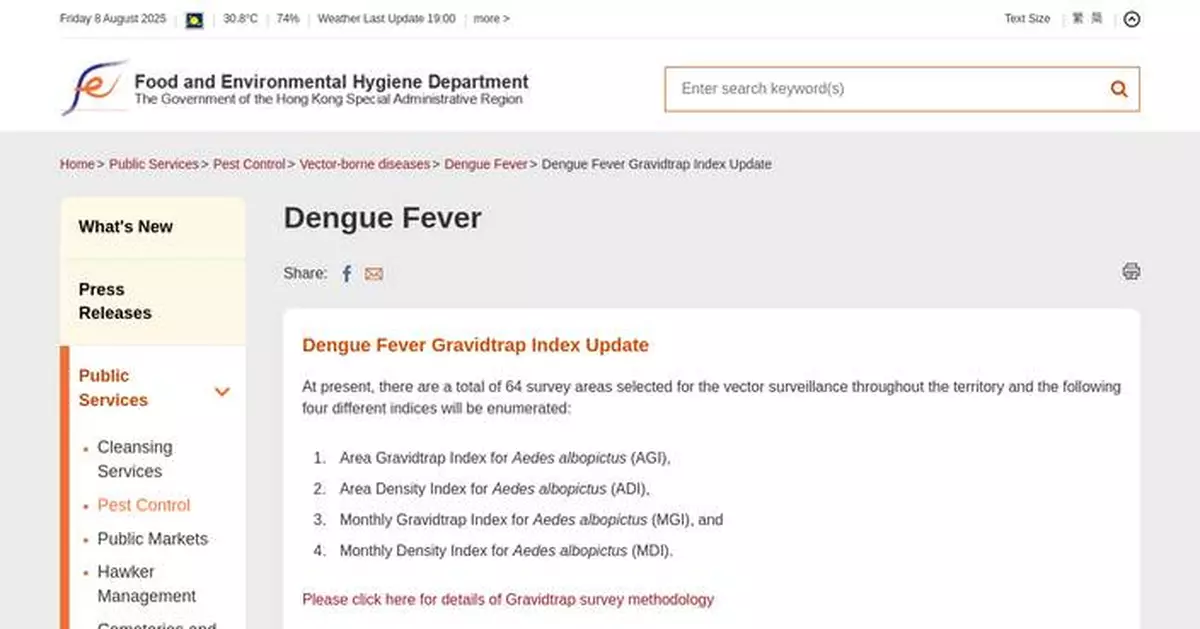
The FEHD has all along been regularly announcing the gravidtrap index for Aedes albopictus on its webpage. To allow more citizens to quickly grasp the mosquito infestation situation, the FEHD will strengthen the dissemination of information by early announcement of the latest gravidtrap index through press releases and social media platforms.
In addition, to further reduce the risk of transmission of CF, the FEHD will extend the intensified mosquito control work, which was originally activated when the AGI reaches 20 per cent, to cover areas with the AGI fall between 10 and 20 per cent. Specifically, the FEHD will conduct detailed risk assessments in the areas concerned to identify locations with higher mosquito infestation risks, and in collaboration with relevant departments and stakeholders, conduct intensive and targeted mosquito control work. The FEHD will also notify the nearby housing estates, advising property management agents and residents to stay vigilant and join hands in taking mosquito prevention and elimination measures.
Since last month, the FEHD has stepped up mosquito prevention and control measures across all districts to reduce the risk of transmission of CF and other mosquito-borne diseases. Following the recent imported CF cases, the FEHD has immediately conducted vector investigations and targeted mosquito control operations within 250-metre radius of the residence of the patients and the places they had visited during the infectious period, including removing mosquito breeding ground, applying larvicides to stagnant water that cannot be cleared, and carrying out ultra-low volume fogging operations in adult mosquito habitats such as densely wooded areas, dark and secluded places, and abandoned structures to eliminate adult mosquitoes.
Following the recommendations from the World Health Organization and taking into account the local situation in Hong Kong, the FEHD sets up gravidtraps in districts where mosquito-borne diseases have been recorded in the past, as well as in densely populated places such as housing estates, hospitals and schools, to monitor the breeding and distribution of Aedes albopictus mosquitoes, which can transmit CF and dengue fever. At present, the FEHD has set up gravidtraps in 64 survey areas of the community. During the two weeks of surveillance, the FEHD will collect the gravidtraps once a week. After the first week of surveillance, the FEHD will immediately examine the glue boards inside the retrieved gravidtraps for the presence of adult Aedine mosquitoes, to compile the Gravidtrap Index (First Phase) and Density Index (First Phase). At the end of the second week of surveillance, the FEHD will instantly check the glue boards for the presence of adult Aedine mosquitoes. Data of the two weeks' surveillance will be combined to obtain the AGI and the Area Density Index. The gravidtrap and density indices for Aedes albopictus in different survey areas as well as information on mosquito prevention and control measures are available on the department's webpage (www.fehd.gov.hk/english/pestcontrol/dengue_fever/Dengue_Fever_Gravidtrap_Index_Update.html).
Source: AI-found images