WASHINGTON (AP) — The Constitution makes it clear: “The People” get to pick those who'll represent their interests in the U.S. House of Representatives.
But just how closely do those choices reflect the overall political leanings of the people? The question is at the heart of a power play in Texas, where Republicans are trying to reshape the state’s congressional boundaries to help them maintain control of the House in next year’s midterm elections.
In many cases, a state’s congressional delegation doesn't align very closely with what would seem to be the will of the voters, although that’s not always because of partisan gerrymandering.
Every state decides how to draw its own congressional boundaries. Some, like California, rely on independent redistricting commissions, while most leave it to the state Legislature and the governor to hammer out a plan. It’s states where one party controls all the levers of government where redistricting dramas like the one in Texas often play out as the majority tries to maximize its power.
Regardless of the process, the resulting maps often produce congressional delegations much more lopsided in favor of one party than the state’s partisan demographics might suggest.
A state’s presidential vote result isn’t a precise tool for measuring what its congressional delegation ought to look like, but it can provide a compelling point of comparison. Politicians frequently cite it when decrying partisan redistricting practices they think are unfair.
President Donald Trump, who's pushing Texas and other GOP-controlled states to redraw their maps, said this week Republicans were “entitled to five more seats” in Texas based in part on the size of his win there in November. Trump won 56% of the Texas vote, but Republicans already hold 65% of the state's congressional delegation — which would rise to 79% if the GOP's new maps are adopted and past voting patterns hold in the next election.
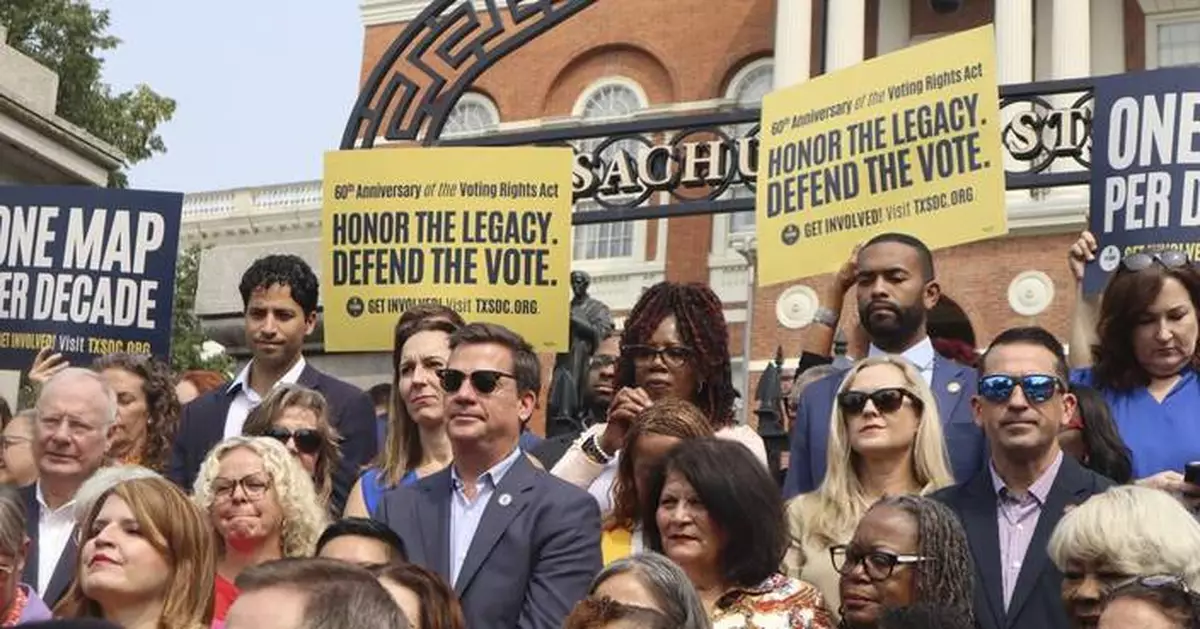
During an event with Texas Democratic lawmakers in Boston, Missouri state Rep. Ashley Aune cited her state’s presidential vote results in warning of possible Republican-driven redistricting efforts there.
“Fifty-eight percent of Missouri voted for Trump, but they want to send an 87% representation to Congress,” said Aune, a Democrat.
It’s actually fairly common for a state’s congressional delegation not to align with statewide presidential vote results.
In 41 of the 44 states with more than one congressional district, the party of the winning presidential candidate had a larger share of the state’s congressional seats than its share of the presidential vote, an Associated Press analysis found. In most cases, it was a much larger share, a gap of at least 10 percentage points.
Here’s a comparison of the congressional delegations and presidential vote results in a sampling of states, including some of those considering a redraw of their congressional boundaries after Texas called its special session.
In remarks to CNBC, Trump pointed to California and Illinois as justifications for redrawing the Texas map in Republicans’ favor.
“You notice they go to Illinois for safety, but that’s all gerrymandered,” he said in reference to the Texas Democrats who relocated to the Chicago area to block, at least temporarily, the Republican redistricting efforts.
“California’s gerrymandered. We should have many more seats in Congress in California,” he said.
He’s right about Illinois: Democrats have gerrymandered the lines so they hold 14 of the 17 House seats. Not so in California.
Democrats there do have an outsized majority, holding 43 of the state’s 52 House seats, about 83%. Vice President Kamala Harris, a Democrat, received about 59% of the November vote. But that's not because of Democratic gerrymandering. A ballot initiative took the process away from state lawmakers and gave it to an independent citizens commission.
California's lopsided map is due in part to the way like-minded people cluster: California Democrats tend to live in and near major cities that get more congressional districts because of their population.
Republican Gov. Ron DeSantis scored a legal victory in July when the state Supreme Court upheld his congressional redistricting plan redrawing a district with a large Black population. That plan resulted in Republicans holding about 71% of the state’s 28 U.S. House seats. Trump carried the state in November with 56% of the vote.
DeSantis later indicated there may be more “defects” in the map that need to be addressed before the next census.
Republicans held an 18-7 advantage over Democrats in Florida's House delegation after the 2000 census. Democrats slowly narrowed the gap, reaching 13 seats to Republicans’ 14 after the 2018 election. But Republicans reestablished their advantage after the redistricting that followed the 2020 census, when they reached the 20-8 split they hold today.
Democrats have long enjoyed an advantage at the New York ballot box in presidential and congressional elections. Harris received nearly 56% of the vote in 2024, while Democrats hold 73% of the state’s 26 House seats.
With Democratic advantages in both chambers of the state Legislature, New York might have been a ripe target for Democrats looking to offset Republican redistricting gains in Texas and elsewhere. But they would need to amend the state constitution to conduct a new round of redistricting before the next census. That constraint means the earliest Democrats could enact a new map would be for 2028.
North Carolina, among the most closely divided states, has been embroiled in its own redistricting drama.
State Republicans implemented new House boundaries in 2023 that turned a 7-7 congressional delegation into one in which Republicans took a 10-4 advantage with the 2024 elections. Several districts are now the subject of a federal lawsuit, with Democrats alleging Republicans illegally diluted Black voting power.
North Carolina has been among the most competitive states in the last several presidential elections. While Trump carried the state in November with about 51% of the vote, it has elected Democrats as governor and attorney general and to other statewide offices.
In the 2008 presidential election, Democrat Barack Obama narrowly edged Republican John McCain with 49.7% of the vote. The congressional delegation at the time mirrored that with an almost even split, with Democrats holding seven seats and Republicans six after the 2010 midterms.
But following rounds of Republican-controlled redistricting after the 2010 census, Republicans held a 10-3 or 9-4 advantage in the congressional delegation for the rest of that decade.
After the 2020 census, a Democratic-majority North Carolina Supreme Court threw out a Republican-drawn plan and permitted elections under a map adopted by trial judges that produced the 7-7 split. The U.S. Supreme Court allowed the boundaries to be used in the 2022 elections.
After flipping to a Republican majority in 2023, the state Supreme Court ruled partisan gerrymandering wasn’t outlawed by the state constitution, allowing GOP lawmakers to redraw a congressional map in use today that led to their party’s 10-4 majority.
Minnesota is the state where the congressional breakdown most closely matches the 2024 presidential result. Harris received 51% of that vote, compared with Trump's 47%. Democrats and Republicans split the state’s eight House seats with court-imposed maps.
Nevada, where a Democratic Legislature drew the lines, is the only state where the party of the winning presidential candidate is outnumbered by the other party in the state’s congressional delegation. Trump received 51% of the vote in Nevada, but Democrats hold three of the state’s four House districts.
Associated Press writer Leah Willingham in Boston contributed to this report.
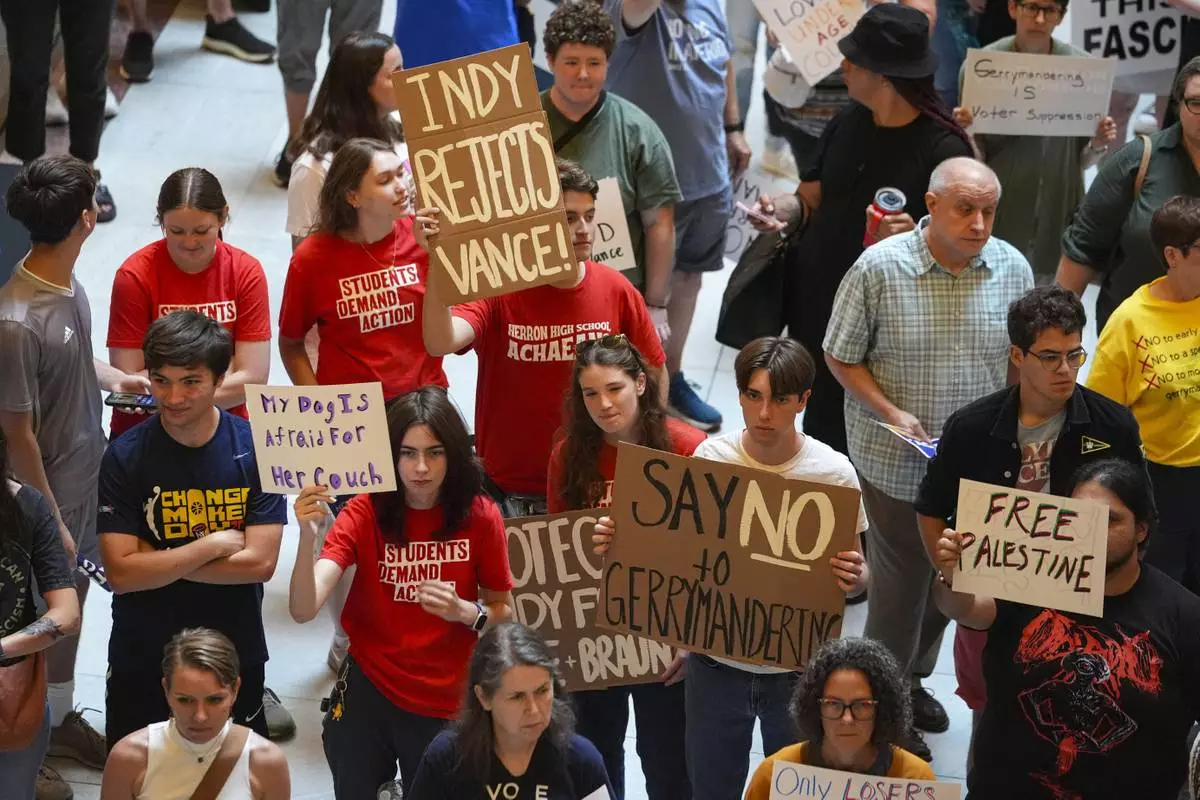
Protestors cheer during a really against redistricting at the Indiana Statehouse in Indianapolis, Thursday, Aug. 7, 2025. (AP Photo/Michael Conroy)

Empty chairs belonging to House Democrats remain empty during session convocation in the State Capitol, Tuesday, Aug. 5, 2025, in Austin, Texas. (AP Photo/Rodolfo Gonzalez)
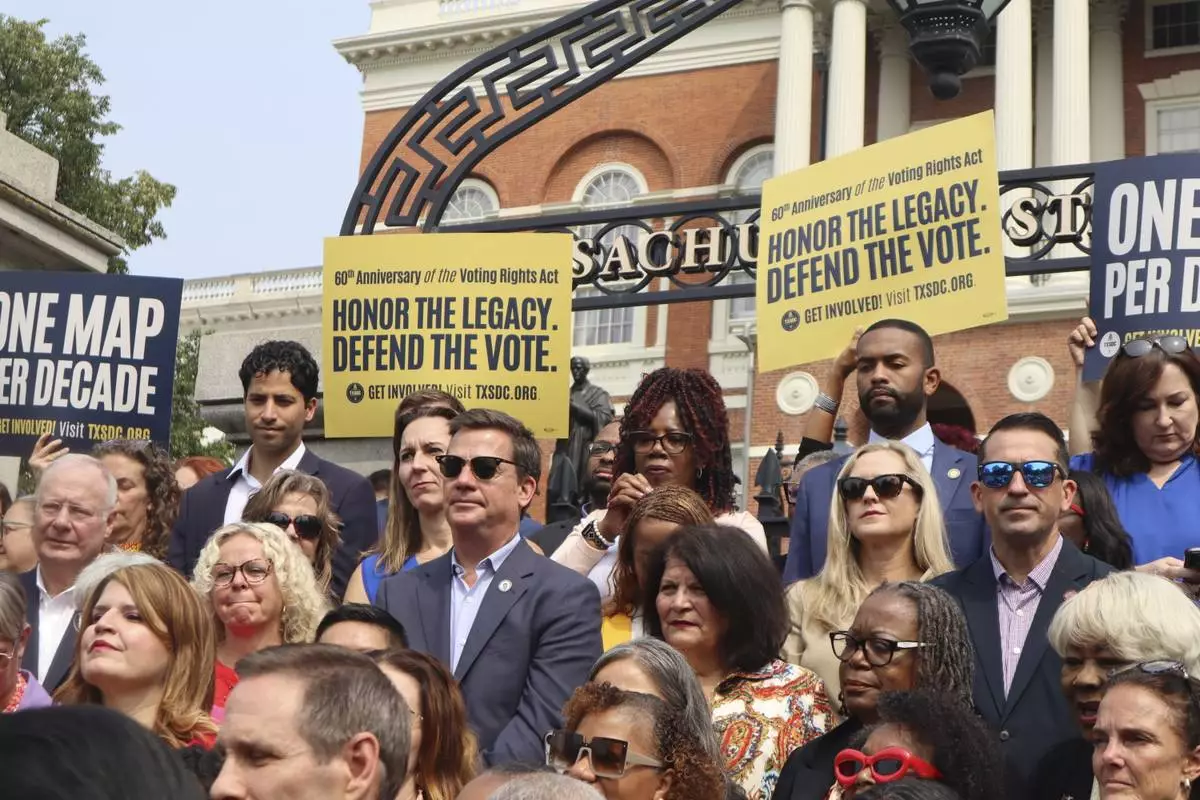
Democratic state lawmakers from across the U.S. and their supporters protest outside the Massachusetts State House on Wednesday, Aug. 6, 2025 in Boston. (AP Photo/Leah Willingham)