NEW YORK (AP) — A top official at the Federal Reserve said Saturday that this month's stunning, weaker-than-expected report on the U.S. job market is strengthening her belief that interest rates should be lower.
Michelle Bowman was one of two Fed officials who voted a week and a half ago in favor of cutting interest rates. Such a move could help boost the economy by making it cheaper for people to borrow money to buy a house or a car, but it could also threaten to push inflation higher.
Bowman and a fellow dissenter lost out after nine other Fed officials voted to keep interest rates steady, as the Fed has been doing all year. The Fed's chair, Jerome Powell, has been adamant that he wants to wait for more data about how President Donald Trump's tariffs are affecting inflation before the Fed makes its next move.
At a speech during a bankers' conference in Colorado on Saturday, Bowman said that “the latest labor market data reinforce my view” that the Fed should cut interest rates three times this year. The Fed has only three meetings left on the schedule in 2025.
The jobs report that arrived last week, only a couple of days after the Fed voted on interest rates, showed that employers hired far fewer workers last month than economists expected. It also said that hiring in prior months was much lower than initially thought.
On inflation, meanwhile, Bowman said she is getting more confident that Trump's tariffs “will not present a persistent shock to inflation” and sees it moving closer to the Fed's 2% target. Inflation has come down substantially since hitting a peak above 9% after the pandemic, but it has been stubbornly remaining above 2%.
The Fed’s job is to keep the job market strong, while keeping a lid on inflation. Its challenge is that it has one main tool to affect both those areas, and helping one by moving interest rates up or down often means hurting the other.
A fear is that Trump's tariffs could box in the Federal Reserve by sticking the economy in a worst-case scenario called “stagflation,” where the economy stagnates but inflation is high. The Fed has no good tool to fix that, and it would likely have to prioritize either the job market or inflation before helping the other.
On Wall Street, expectations are that the Fed will have to cut interest rates at its next meeting in September after the U.S. jobs report came in so much below economists' expectations.
Trump has been calling angrily for lower interest rates, often personally insulting Powell while doing so. He has the opportunity to add another person to the Fed's board of governors after an appointee of former President Joe Biden stepped down recently.

FILE - Michelle Bowman, Vice Chair for Supervision of the Federal Reserve Board of Governors, takes a seat for an open meeting of the Board of Governors at the Federal Reserve, in Washington, June 25, 2025. (AP Photo/Mark Schiefelbein, File)
ST. PETERSBURG, Fla. (AP) — For six innings, the Tampa Bay Rays were in complete control again.
Then they unraveled in a hurry.
Drew Rasmussen squandered a two-run lead on the mound, Tampa Bay's bullpen let the game get away and the Rays stumbled to a 7-3 loss against the Cleveland Guardians in their American League Championship Series opener Monday night.
Staked to a 2-0 advantage, Rasmussen gave up a leadoff homer to rookie Chase DeLauter in the sixth but retired the next three batters.
With two relievers ready and the bottom of the Guardians order due up, manager Kevin Cash sent out Rasmussen for the seventh. His first pitch was launched 436 feet to center field by light-hitting catcher Patrick Bailey for a tying home run that chased the All-Star right-hander.
“Cashy checked in with me and I told him I was good,” said Rasmussen, who had permitted just one run over 27 2/3 innings until DeLauter went deep. “Unfortunately, it just didn’t unfold the way we wanted.”
Nothing went right for the Rays after that.
José Ramírez reached on an infield single to start the eighth and DeLauter drilled a double off losing pitcher Tyler Wells, putting runners at second and third. One out later, left-hander Ian Seymour entered to face left-handed hitter Nathaniel Lowe and allowed a two-run single on an 0-2 fastball as the Guardians grabbed a 4-2 lead.
It was the first deficit this postseason for the AL East champion Rays, who had four days off following a three-game sweep of the New York Yankees in their Division Series. In the opener of that matchup, Rasmussen carried a no-hitter for 7 2/3 innings on the way to a 1-0 victory.
This time, Tampa Bay fell apart late.
After a home run by Cedric Mullins trimmed the deficit to 4-3 in the bottom of the eighth, Cole Sulser yielded a leadoff single to slumping Angel Martínez in the ninth and balked him to second base. Two outs later, Ramírez's soft RBI single made it 5-3.
But the Guardians weren't done.
Ramírez advanced on a wild pitch by Sulser, who then walked DeLauter. Rays sinkerballer Kevin Kelly entered to face Jo Adell, and Ramírez took off from second on a 1-2 pitch.
Third baseman Junior Caminero left his position to cover the bag, and Adell’s hard-hit grounder through the spot vacated by Caminero turned into a two-run double that put Tampa Bay in a 7-3 hole.
“You know what? We were throwing behind,” Cash said. “We were going to throw to second base. DeLauter had gone the first time. I haven’t spoke to Cami about it. We were going to go to second base. I’m guessing Cami recognized that DeLauter didn’t take off and attempted to go to third base. Totally understand how it seemed like the perfect play for the Guardians."
It was a stunning meltdown at Tropicana Field for the Rays, who matched Milwaukee for the best home record in the majors during the regular season.
They hadn't lost a game started by Rasmussen since July 9, a string of 13 straight wins.
“I thought he was outstanding. I thought he threw an incredible ballgame,” Cash said. “You've got to give credit to Cleveland’s lineup. They really put some pitches on him and some longer at-bats early on. But I felt like after the third or fourth inning, he really settled in.”
After giving up a total of 12 hits to the Yankees in three games, Rays pitchers allowed 14 in Game 1 alone against the Guardians.
“The guys have done everything they needed to do with the time off to keep their deliveries intact. We’re going to give up some hits at times,” Cash said. “That’s a very good team over there. They put a lot of pressure on pitchers and can foul balls off and lengthen out at-bats.”
Things nearly got even worse for the Rays in the ninth, when Caminero and left fielder Jonny DeLuca collided while chasing Brayan Rocchio’s foul ball.
Caminero, who had 42 homers, 101 RBIs and an .885 OPS during the regular season, was shaken up on the play but remained in the game after a brief delay.
Cash said he thought the All-Star slugger “just got the wind knocked out of him” and seemed to be “totally fine now.”
“I feel good overall. Just my head hurts a little bit, but overall good,” Caminero said. “I was just hit in the chest.”
See AP’s full MLB coverage here
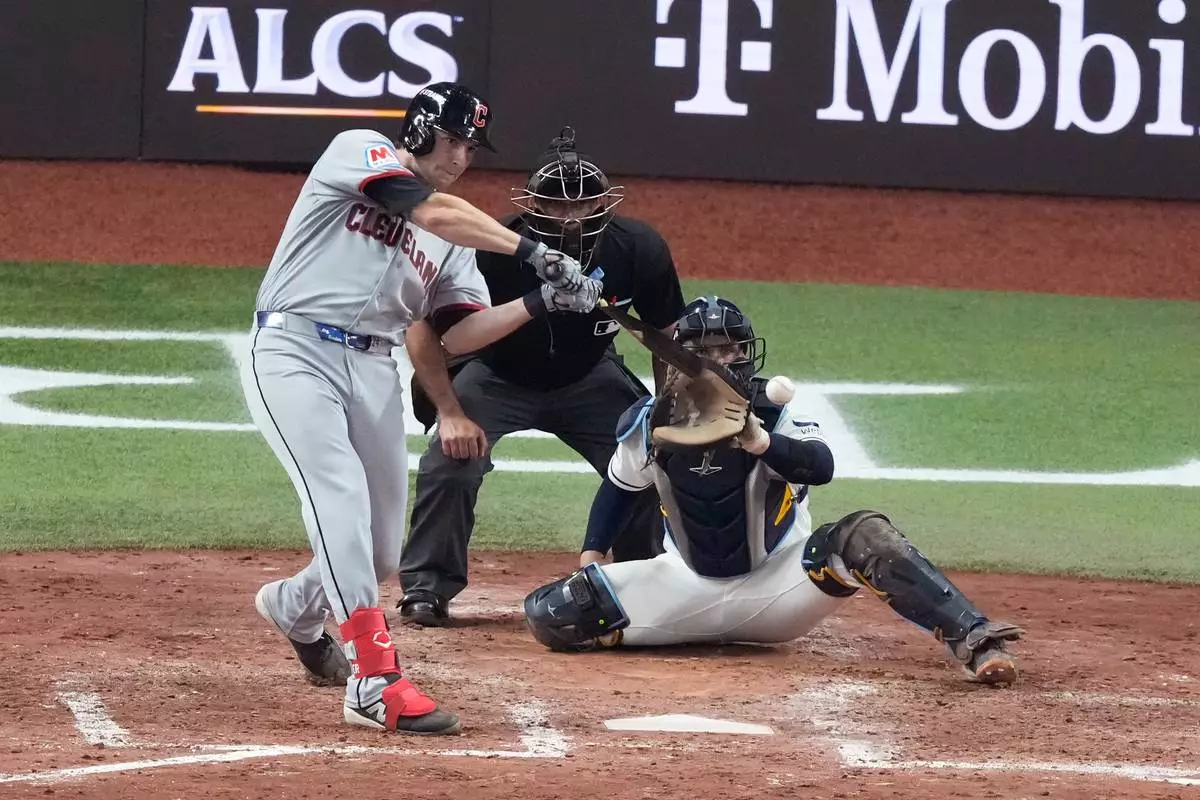
Cleveland Guardians' Chase DeLauter hits a home run against the Tampa Bay Rays during the sixth inning in Game 1 of an American League Championship Series baseball game in St. Petersburg, Fla. Monday, Oct. 12, 2026. (AP Photo/Chris O'Meara)
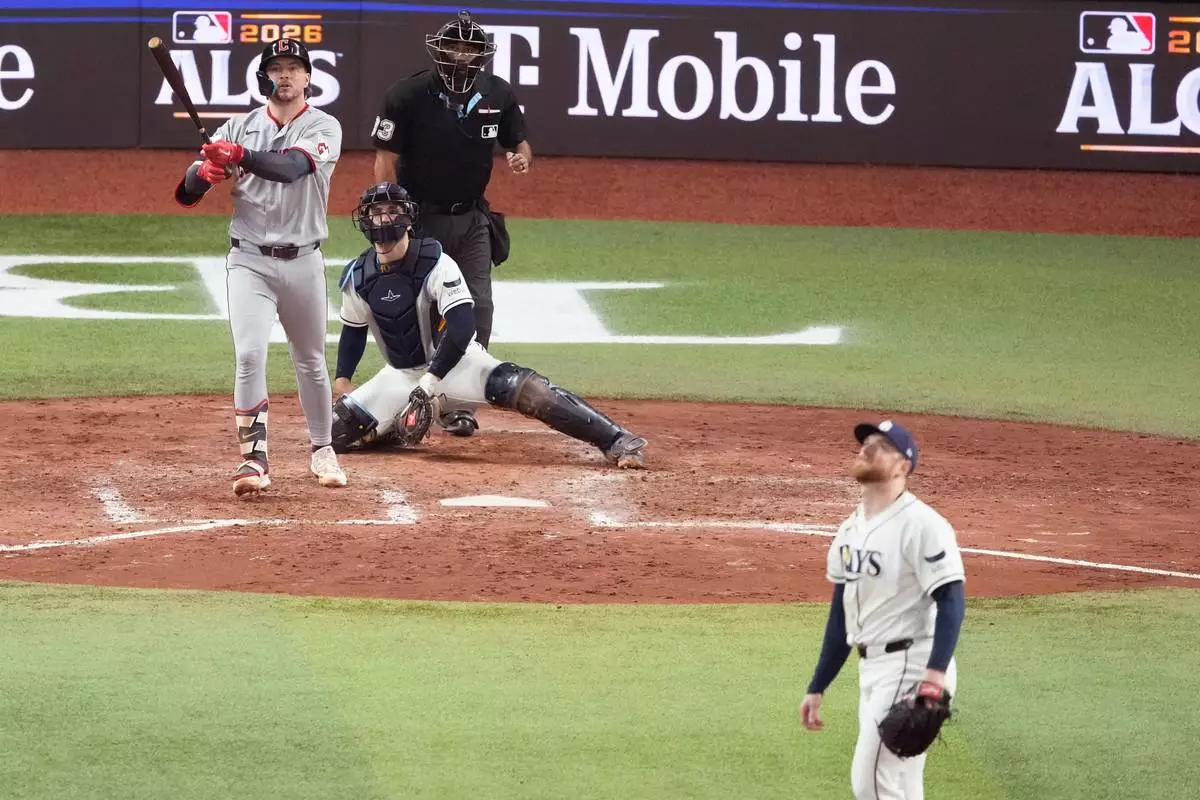
Cleveland Guardians' Patrick Bailey watches his home run against the Tampa Bay Rays during the seventh inning in Game 1 of an American League Championship Series baseball game in St. Petersburg, Fla. Monday, Oct. 12, 2026. (AP Photo/Chris O'Meara)
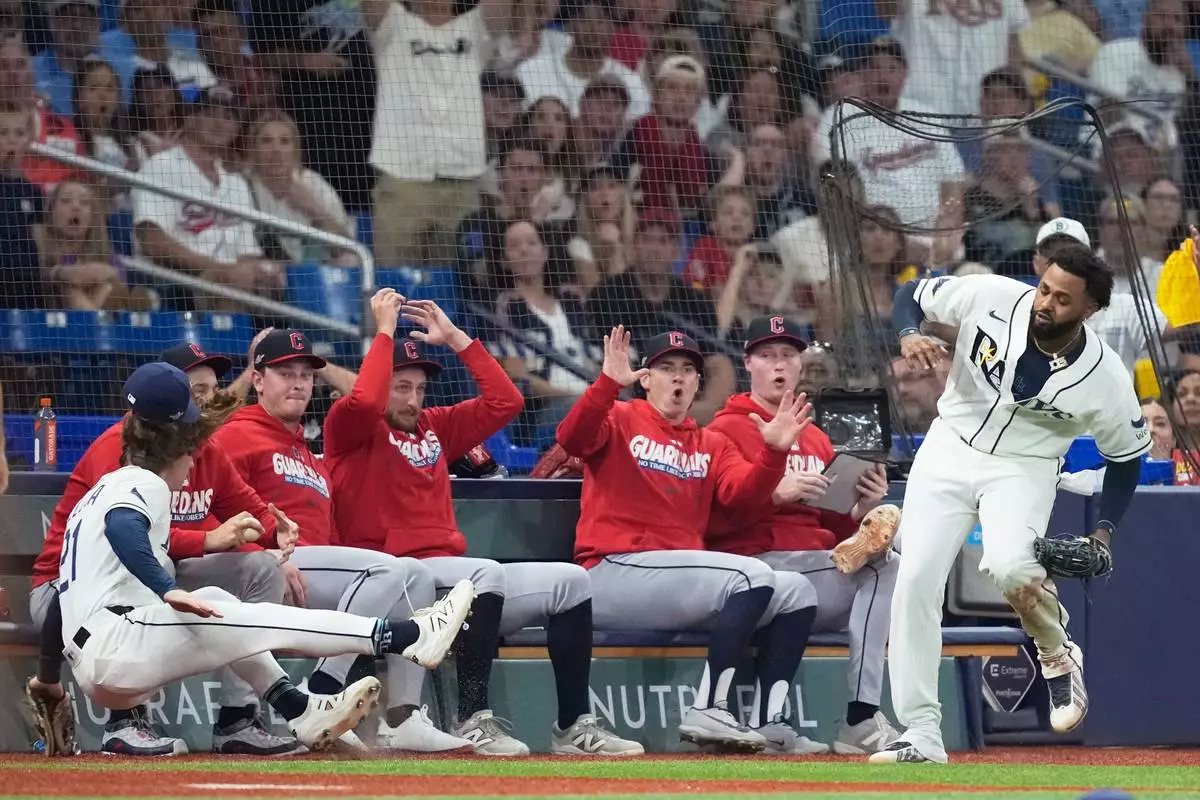
Tampa Bay Rays right fielder Jonny DeLuca and third baseman Junior Caminero collide try to catch a ball hit by Cleveland Guardians' Brayan Rocchio during the ninth inning in Game 1 of an American League Championship Series baseball game in St. Petersburg, Fla. Monday, Oct. 12, 2026. (AP Photo/David J. Phillip)
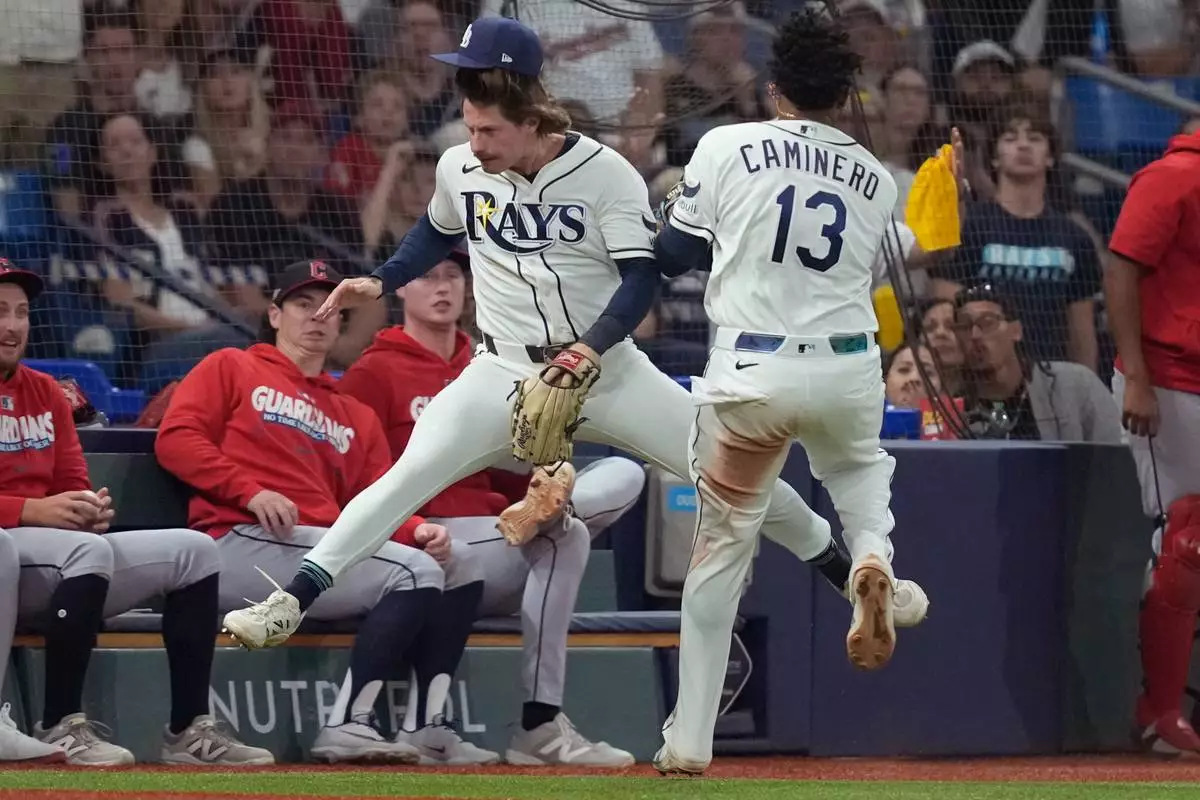
Tampa Bay Rays right fielder Jonny DeLuca and third baseman Junior Caminero collide try to catch a ball hit by Cleveland Guardians' Brayan Rocchio during the ninth inning in Game 1 of an American League Championship Series baseball game in St. Petersburg, Fla. Monday, Oct. 12, 2026. (AP Photo/David J. Phillip)
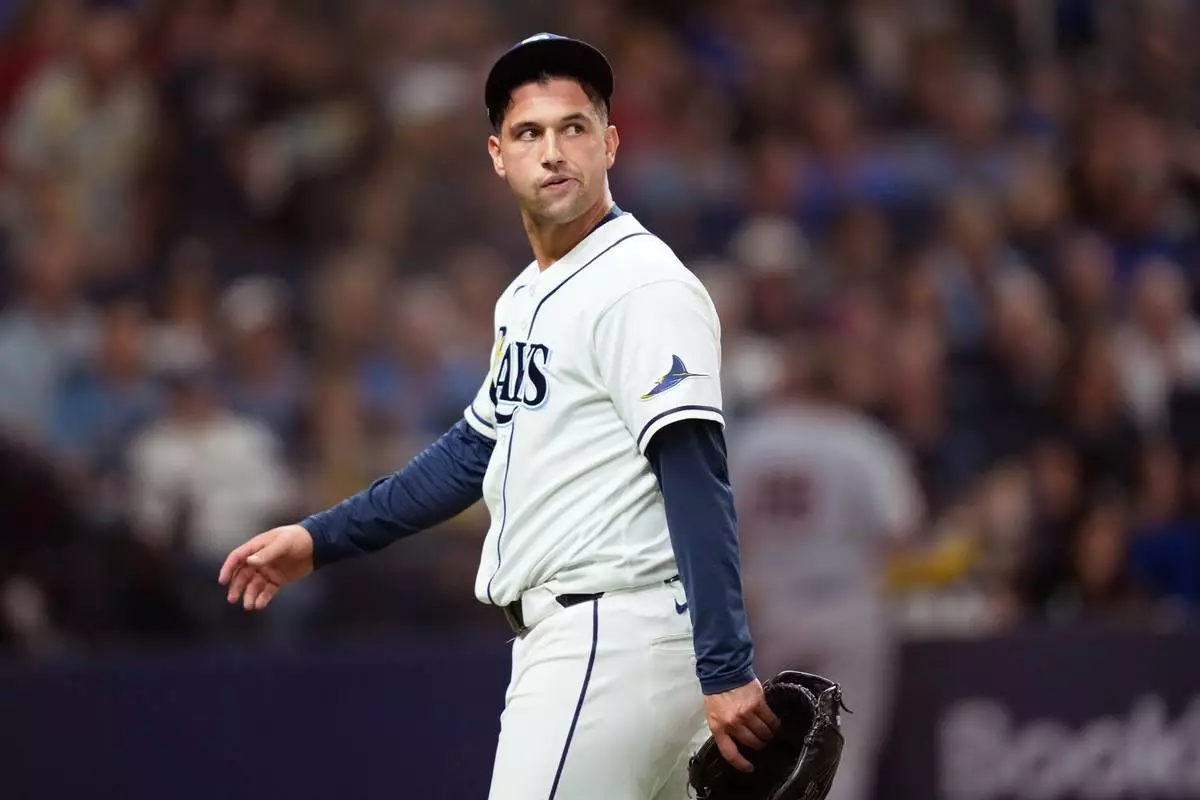
Tampa Bay Rays pitcher Ian Seymour reacts after giving up two runs against the Cleveland Guardians during the eighth inning in Game 1 of an American League Championship Series baseball game in St. Petersburg, Fla. Monday, Oct. 12, 2026. (AP Photo/David J. Phillip)