SAN JUAN, Puerto Rico (AP) — Haiti’s government announced Saturday that it is implementing a three-month state of emergency in the country’s central region as gang violence surges.
The measure will cover Haiti’s West, Artibonite and Center departments “to continue the fight against insecurity and respond to the agricultural and food crisis,” according to a government statement.
The region — known as Haiti’s rice basket — has been under attack in recent years, with gangs killing farmers or forcing them to abandon their fields as they raze nearby communities.
The United Nations’ human rights office noted that from October 2024 to the end of June 2025, more than 1,000 people have been killed, more than 200 injured and 620 kidnapped in the Artibonite and Central departments and nearby areas.
Gang violence also has displaced more than 239,000 people in Haiti’s central region, according to the U.N. In late April, dozens of people waded and swam across the country’s largest river in a desperate attempt to flee gangs.
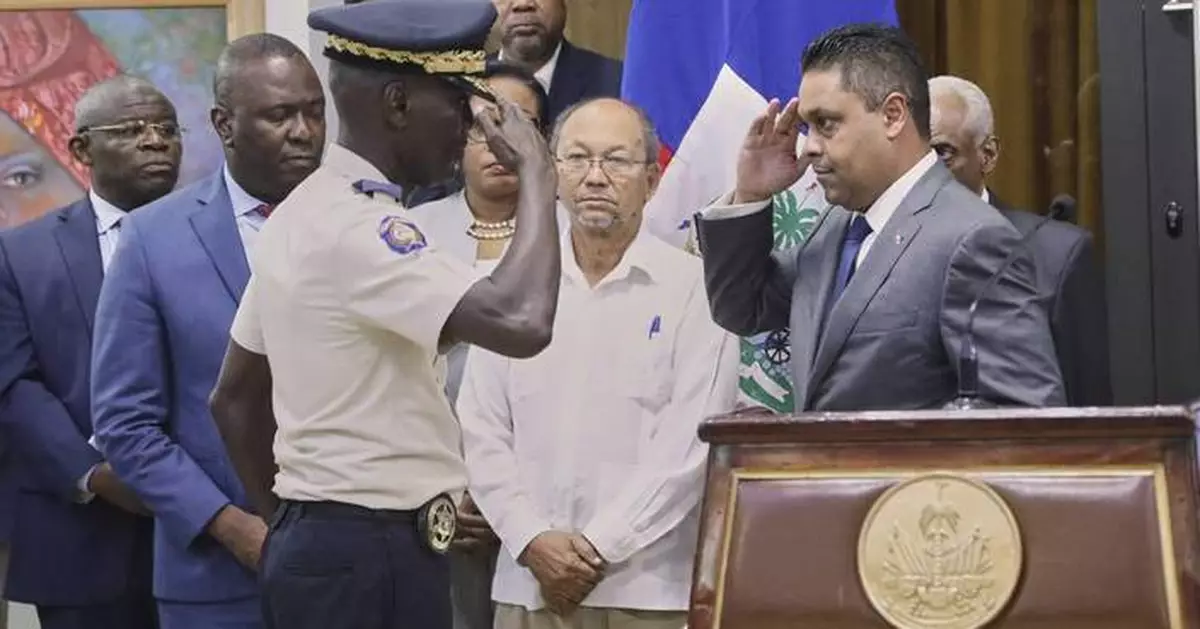
On Friday, the government appointed a new interim director general to oversee Haiti’s National Police, which is working with Kenyan police officers leading a U.N.-backed mission to help quell gang violence.
André Jonas Vladimir Paraison replaces former police director general Normil Rameau, who was criticized for his struggle to contain violence perpetrated by gangs that control up to 90% of Haiti’s capital, Port-au-Prince. Rameau had repeatedly warned about the department’s severe underfunding.
Paraison previously served as head of security of Haiti’s National Palace, and he was on duty as a police officer when former President Jovenel Moïse was killed at his private residence in July 2021.
The changes come as Laurent Saint-Cyr, a wealthy businessman, takes over as president of Haiti’s transitional presidential council, which is charged with holding elections by February 2026.

Newly-appointed police chief Vladimir Paraison, left, salutes Transitional Council President Laurent Saint-Cyr, during his presentation ceremony as the new interim police chief, in Port-au-Prince, Haiti, Friday, Aug. 8, 2025. (AP Photo/Odelyn Joseph)
ST. PETERSBURG, Fla. (AP) — For six innings, the Tampa Bay Rays were in complete control again.
Then they unraveled in a hurry.
Drew Rasmussen squandered a two-run lead on the mound, Tampa Bay's bullpen let the game get away and the Rays stumbled to a 7-3 loss against the Cleveland Guardians in their American League Championship Series opener Monday night.
Staked to a 2-0 advantage, Rasmussen gave up a leadoff homer to rookie Chase DeLauter in the sixth but retired the next three batters.
With two relievers ready and the bottom of the Guardians order due up, manager Kevin Cash sent out Rasmussen for the seventh. His first pitch was launched 436 feet to center field by light-hitting catcher Patrick Bailey for a tying home run that chased the All-Star right-hander.
“Cashy checked in with me and I told him I was good,” said Rasmussen, who had permitted just one run over 27 2/3 innings until DeLauter went deep. “Unfortunately, it just didn’t unfold the way we wanted.”
Nothing went right for the Rays after that.
José Ramírez reached on an infield single to start the eighth and DeLauter drilled a double off losing pitcher Tyler Wells, putting runners at second and third. One out later, left-hander Ian Seymour entered to face left-handed hitter Nathaniel Lowe and allowed a two-run single on an 0-2 fastball as the Guardians grabbed a 4-2 lead.
It was the first deficit this postseason for the AL East champion Rays, who had four days off following a three-game sweep of the New York Yankees in their Division Series. In the opener of that matchup, Rasmussen carried a no-hitter for 7 2/3 innings on the way to a 1-0 victory.
This time, Tampa Bay fell apart late.
After a home run by Cedric Mullins trimmed the deficit to 4-3 in the bottom of the eighth, Cole Sulser yielded a leadoff single to slumping Angel Martínez in the ninth and balked him to second base. Two outs later, Ramírez's soft RBI single made it 5-3.
But the Guardians weren't done.
Ramírez advanced on a wild pitch by Sulser, who then walked DeLauter. Rays sinkerballer Kevin Kelly entered to face Jo Adell, and Ramírez took off from second on a 1-2 pitch.
Third baseman Junior Caminero left his position to cover the bag, and Adell’s hard-hit grounder through the spot vacated by Caminero turned into a two-run double that put Tampa Bay in a 7-3 hole.
“You know what? We were throwing behind,” Cash said. “We were going to throw to second base. DeLauter had gone the first time. I haven’t spoke to Cami about it. We were going to go to second base. I’m guessing Cami recognized that DeLauter didn’t take off and attempted to go to third base. Totally understand how it seemed like the perfect play for the Guardians."
It was a stunning meltdown at Tropicana Field for the Rays, who matched Milwaukee for the best home record in the majors during the regular season.
They hadn't lost a game started by Rasmussen since July 9, a string of 13 straight wins.
“I thought he was outstanding. I thought he threw an incredible ballgame,” Cash said. “You've got to give credit to Cleveland’s lineup. They really put some pitches on him and some longer at-bats early on. But I felt like after the third or fourth inning, he really settled in.”
After giving up a total of 12 hits to the Yankees in three games, Rays pitchers allowed 14 in Game 1 alone against the Guardians.
“The guys have done everything they needed to do with the time off to keep their deliveries intact. We’re going to give up some hits at times,” Cash said. “That’s a very good team over there. They put a lot of pressure on pitchers and can foul balls off and lengthen out at-bats.”
Things nearly got even worse for the Rays in the ninth, when Caminero and left fielder Jonny DeLuca collided while chasing Brayan Rocchio’s foul ball.
Caminero, who had 42 homers, 101 RBIs and an .885 OPS during the regular season, was shaken up on the play but remained in the game after a brief delay.
Cash said he thought the All-Star slugger “just got the wind knocked out of him” and seemed to be “totally fine now.”
“I feel good overall. Just my head hurts a little bit, but overall good,” Caminero said. “I was just hit in the chest.”
See AP’s full MLB coverage here
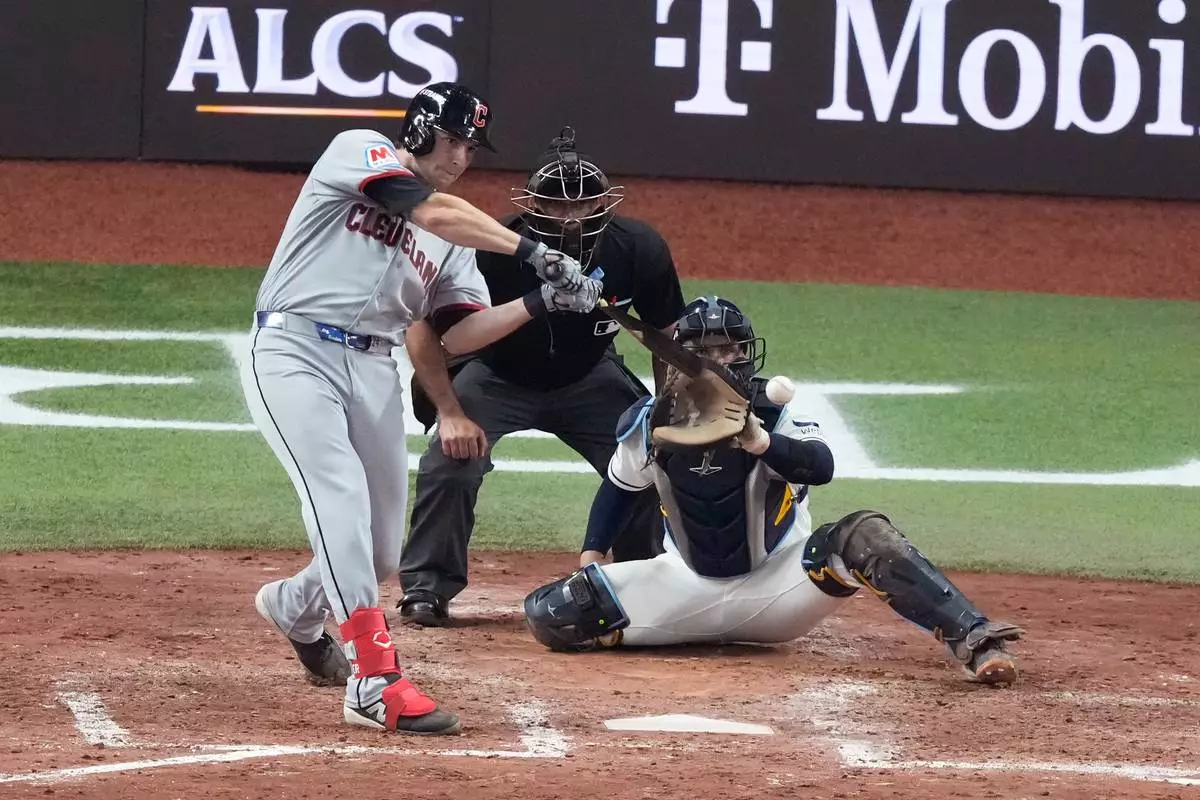
Cleveland Guardians' Chase DeLauter hits a home run against the Tampa Bay Rays during the sixth inning in Game 1 of an American League Championship Series baseball game in St. Petersburg, Fla. Monday, Oct. 12, 2026. (AP Photo/Chris O'Meara)
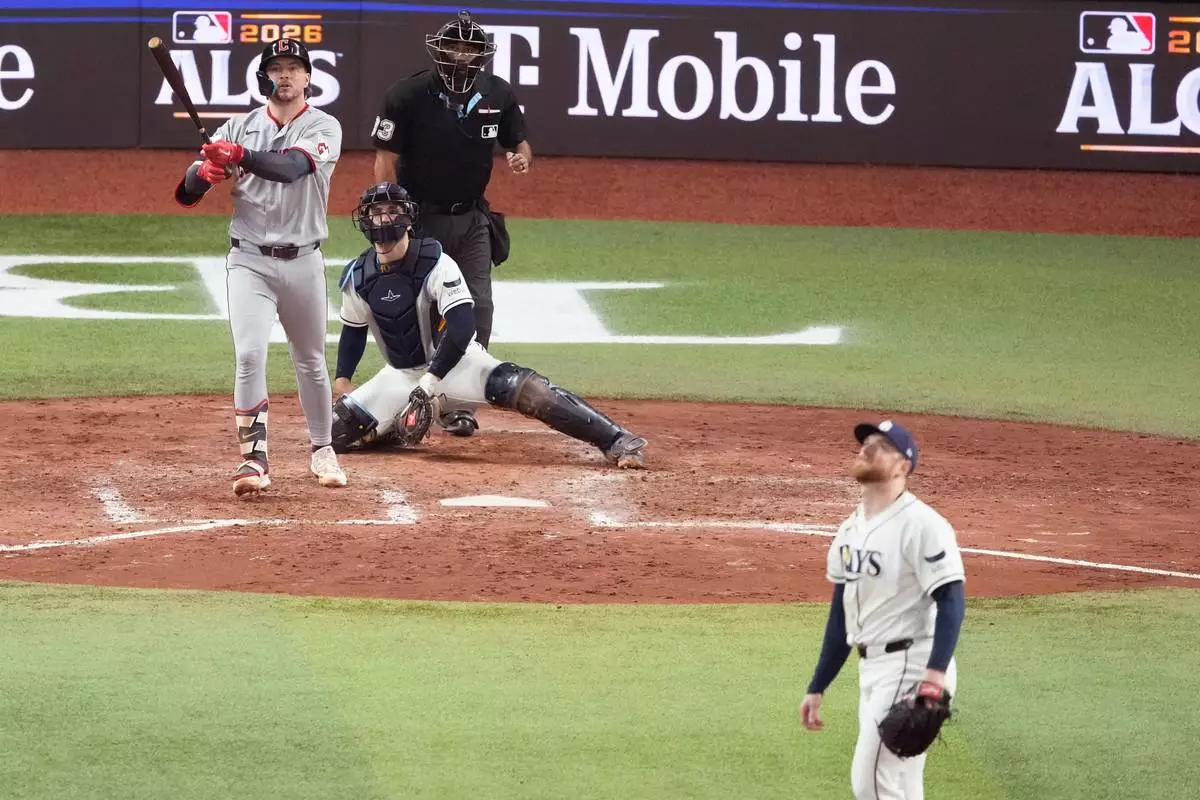
Cleveland Guardians' Patrick Bailey watches his home run against the Tampa Bay Rays during the seventh inning in Game 1 of an American League Championship Series baseball game in St. Petersburg, Fla. Monday, Oct. 12, 2026. (AP Photo/Chris O'Meara)
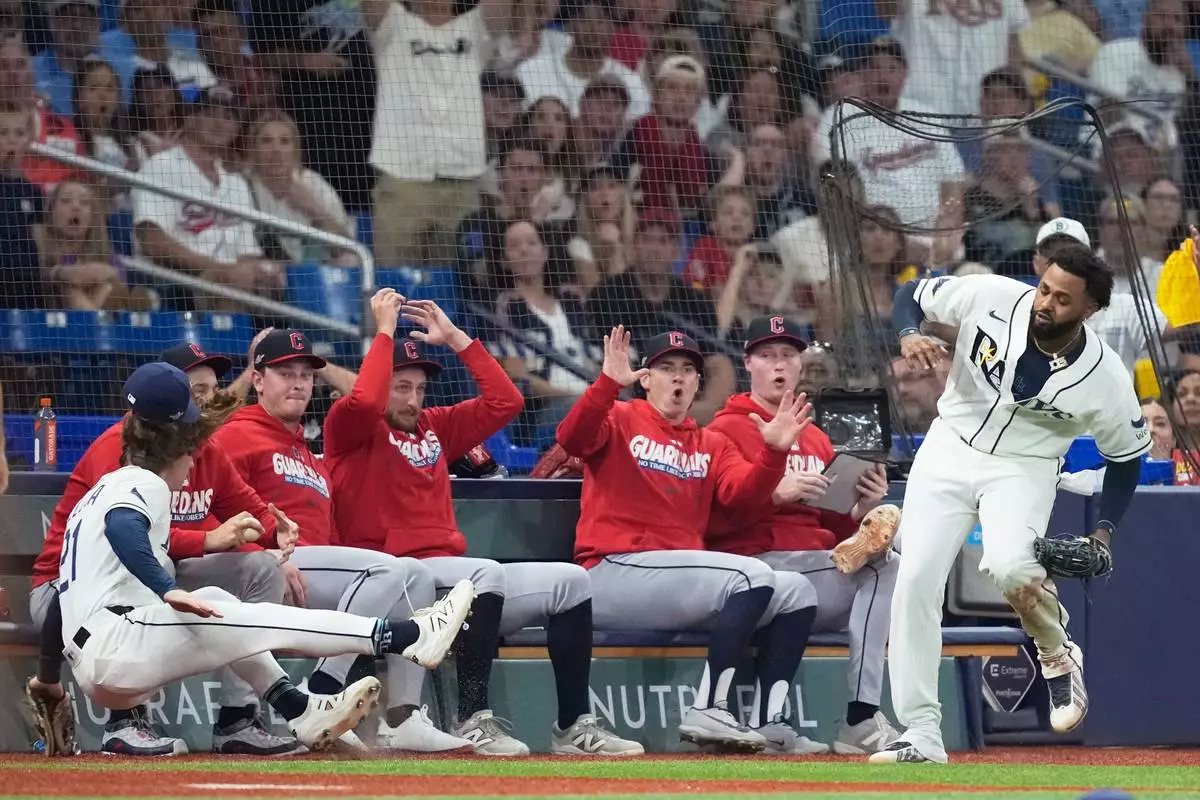
Tampa Bay Rays right fielder Jonny DeLuca and third baseman Junior Caminero collide try to catch a ball hit by Cleveland Guardians' Brayan Rocchio during the ninth inning in Game 1 of an American League Championship Series baseball game in St. Petersburg, Fla. Monday, Oct. 12, 2026. (AP Photo/David J. Phillip)
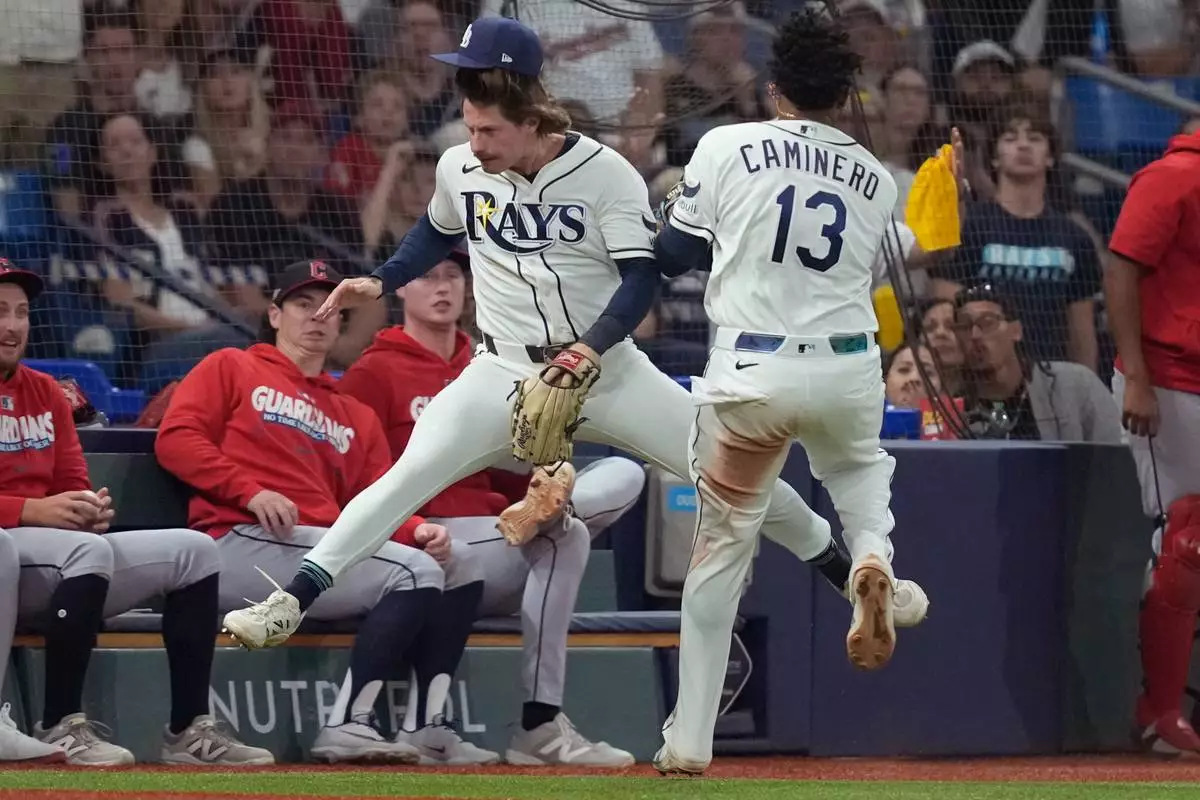
Tampa Bay Rays right fielder Jonny DeLuca and third baseman Junior Caminero collide try to catch a ball hit by Cleveland Guardians' Brayan Rocchio during the ninth inning in Game 1 of an American League Championship Series baseball game in St. Petersburg, Fla. Monday, Oct. 12, 2026. (AP Photo/David J. Phillip)
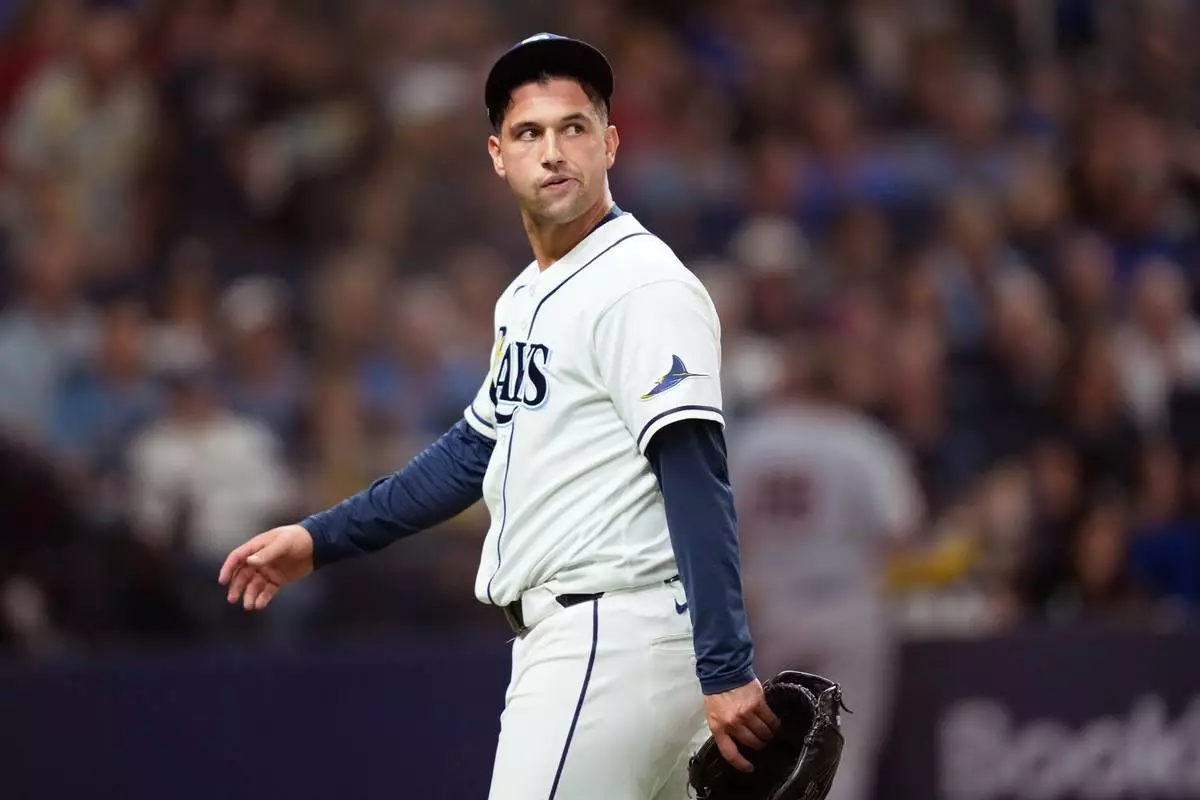
Tampa Bay Rays pitcher Ian Seymour reacts after giving up two runs against the Cleveland Guardians during the eighth inning in Game 1 of an American League Championship Series baseball game in St. Petersburg, Fla. Monday, Oct. 12, 2026. (AP Photo/David J. Phillip)