HONOLULU (AP) — Commercial fishing that recently resumed in a vast protected area of the Pacific Ocean must halt once again, after a judge in Hawaii sided this week with environmentalists challenging a Trump administration rollback of federal ocean protections.
The remote Pacific Islands Heritage Marine National Monument is home to turtles, marine mammals and seabirds, which environmental groups say will get snagged by longline fishing, an industrial method involving baited hooks from lines 60 miles (about 100 kilometers) or longer.
President Donald Trump's executive order to allow this and other types of commercial fishing in part of the monument changed regulations without providing a process for public comment and rulemaking and stripped core protections from the monument, the groups argued in a lawsuit.
U.S. District Judge Micah W. J. Smith granted a motion by the environmentalists on Friday. The ruling means boats catching fish for sale will need to immediately cease fishing in waters between 50 and 200 nautical miles (93 kilometers to 370 kilometers) around Johnston Atoll, Jarvis Island and Wake Island, said Earthjustice, an environmental law organization representing the plaintiffs.
U.S. Justice Department attorneys representing the government did not immediately return an email message seeking comment on Saturday.
Trump has said the U.S. should be “the world’s dominant seafood leader,” and on the same day of his April executive order, he issued another one seeking to boost commercial fishing by peeling back regulations and opening up harvesting in previously protected areas.
President George W. Bush created the marine monument in 2009. It consists of about 500,000 square miles (1.3 million square kilometers) in the remote central Pacific Ocean southwest of Hawaii. President Barack Obama expanded it in 2014.
Soon after Trump's executive order, the National Marine Fisheries Service sent a letter to fishing permit holders giving them the green light to fish commercially in the monument's boundaries, Earthjustice's lawsuit says. Fishing resumed within days, the group said.
Government attorneys say the fisheries service’s letter merely notified commercial fishers of a change that had already taken place through Trump’s authority to remove the prohibition on commercial fishing in certain areas.
Earthjustice challenged that letter, and by granting the motion in their favor, the federal judge found the government had chosen not to defend its letter on the merits and forfeited that argument. Smith also ruled against the government's other defenses, that the plaintiffs lacked standing to challenge the letter and that the court lacked jurisdiction over the matter.
David Henkin, an Earthjustice attorney, said Smith's ruling requires the government to go through a process to determine what kind of fishing, and under what conditions, can happen in monument waters in a way that wouldn't destroy the area.
Members of Hawaii’s longline fishing industry say they have made numerous gear adjustments and changes over the years, such as circle hooks, to avoid that.
The lawsuit says allowing commercial fishing in the monument expansion would also harm the “cultural, spiritual, religious, subsistence, educational, recreational, and aesthetic interests” of a group of Native Hawaiian plaintiffs who are connected genealogically to the Indigenous peoples of the Pacific.
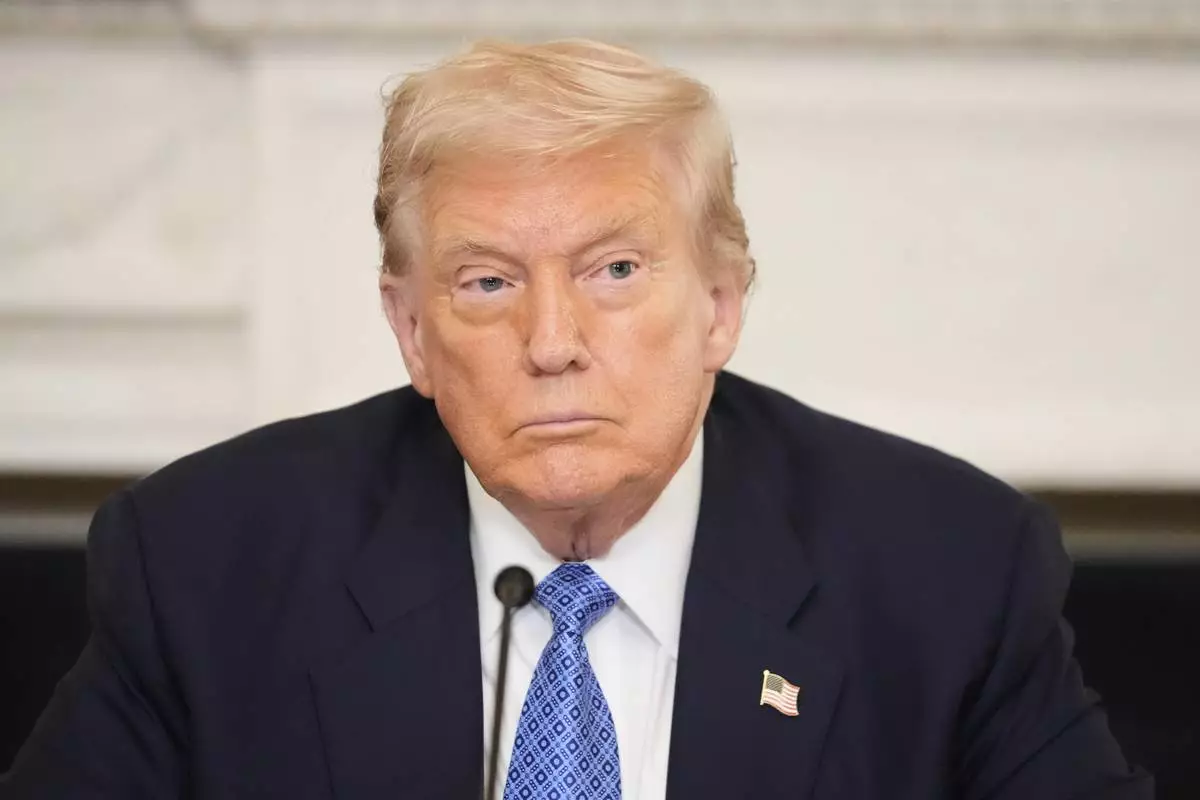
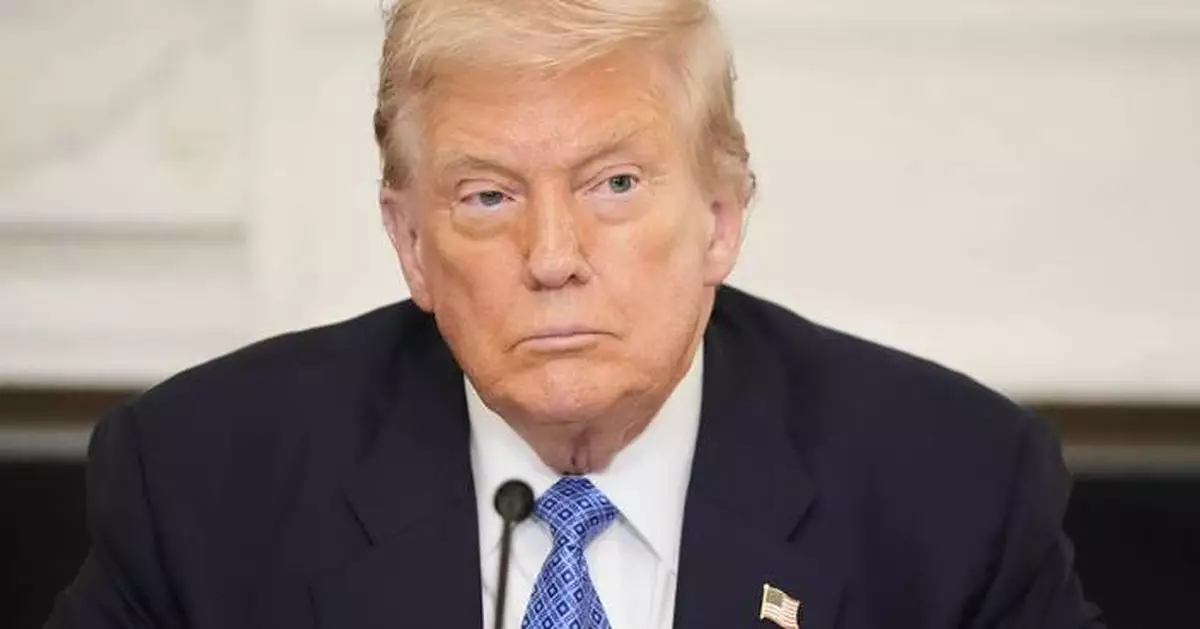
President Donald Trump participates in a trilateral signing ceremony with Armenian Prime Minister Nikol Pashinyan and Azerbaijan President Ilham Aliyev in the State Dining Room of the White House, Friday, Aug. 8, 2025, in Washington. (AP Photo/Mark Schiefelbein)
SEOUL, South Korea (AP) — A South Korean court sentenced former President Yoon Suk Yeol to five years in prison Friday in the first verdict from eight criminal trials over the martial law debacle that forced him out of office and other allegations.
Yoon was impeached, arrested and dismissed as president after his short-lived imposition of martial law in December 2024 triggered huge public protests calling for his ouster.
The most significant criminal charge against him alleges that his martial law enforcement amounted to a rebellion, and the independent counsel has requested the death sentence in the case that is to be decided in a ruling next month.
Yoon has maintained he didn’t intend to place the country under military rule for an extended period, saying his decree was only meant to inform the people about the danger of the liberal-controlled parliament obstructing his agenda. But investigators have viewed Yoon’s decree as an attempt to bolster and prolong his rule, charging him with rebellion, abuse of power and other criminal offenses.
In Friday’s case, the Seoul Central District Court sentenced Yoon for defying attempts to detain him, fabricating the martial law proclamation, and sidestepping a legally mandated full Cabinet meeting and thus depriving some Cabinet members who were not convened of their due rights to deliberate on his decree.
Judge Baek Dae-hyun said in the televised ruling that imposing “a grave punishment” was necessary because Yoon hasn’t shown remorse and has only repeated “hard-to-comprehend excuses.” The judge also restoring legal systems damaged by Yoon’s action was necessary.
Yoon’s defense team said they will appeal the ruling, which they believe was “politicized” and reflected “the unliberal arguments by the independent counsel.” Yoon’s defense team argued the ruling “oversimplified the boundary between the exercise of the president’s constitutional powers and criminal liability.”
Prison sentences in the multiple, smaller trials Yoon faces would matter if he is spared the death penalty or life imprisonment at the rebellion trial.
Park SungBae, a lawyer who specializes in criminal law, said there is little chance the court would decide Yoon should face the death penalty in the rebellion case. He said the court will likely issue a life sentence or a sentence of 30 years or more in prison.
South Korea has maintained a de facto moratorium on executions since 1997 and courts rarely hand down death sentences. Park said the court would take into account that Yoon’s decree didn’t cause casualties and didn’t last long, although Yoon hasn’t shown genuine remorse for his action.
South Korea has a history of pardoning former presidents who were jailed over diverse crimes in the name of promoting national unity. Those pardoned include strongman Chun Doo-hwan, who received the death penalty at a district court over his 1979 coup, the bloody 1980 crackdowns of pro-democracy protests that killed about 200 people, and other crimes.
Some observers say Yoon will likely retain a defiant attitude in the ongoing trials to maintain his support base in the belief that he cannot avoid a lengthy sentence but could be pardoned in the future.
On the night of Dec. 3, 2024, Yoon abruptly declared martial law in a televised speech, saying he would eliminate “anti-state forces” and protect “the constitutional democratic order.” Yoon sent troops and police officers to encircle the National Assembly, but many apparently didn’t aggressively cordon off the area, allowing enough lawmakers to get into an assembly hall to vote down Yoon’s decree.
No major violence occurred, but Yoon's stunt caused the biggest political crisis in South Korea and rattled its diplomacy and financial markets. For many, his decree, the first of its kind in more than four decades in South Korea, brought back harrowing memories of past dictatorships in the 1970s and 1980s, when military-backed leaders used martial law and emergency measures to deploy soldiers and tanks on the streets to suppress demonstrations.
After Yoon's ouster, his liberal rival Lee Jae Myung became president via a snap election last June. After taking office, Lee appointed three independent counsels to look into allegations involving Yoon, his wife and associates.
Yoon's other trials deal with charges like ordering drone flights over North Korea to deliberately inflame animosities to look for a pretext to declare martial law. Other charges accuse Yoon of manipulating the investigation into a marine’s drowning in 2023 and receiving free opinion surveys from an election broker in return for a political favor.

A supporter of former South Korean President Yoon Suk Yeol shouts slogans outside Seoul Central District Court, in Seoul, South Korea, Friday, Jan. 16, 2026. (AP Photo/Lee Jin-man)

Supporters of former South Korean President Yoon Suk Yeol hold signs and flags outside Seoul Central District Court, in Seoul, South Korea, Friday, Jan. 16, 2026. (AP Photo/Lee Jin-man)
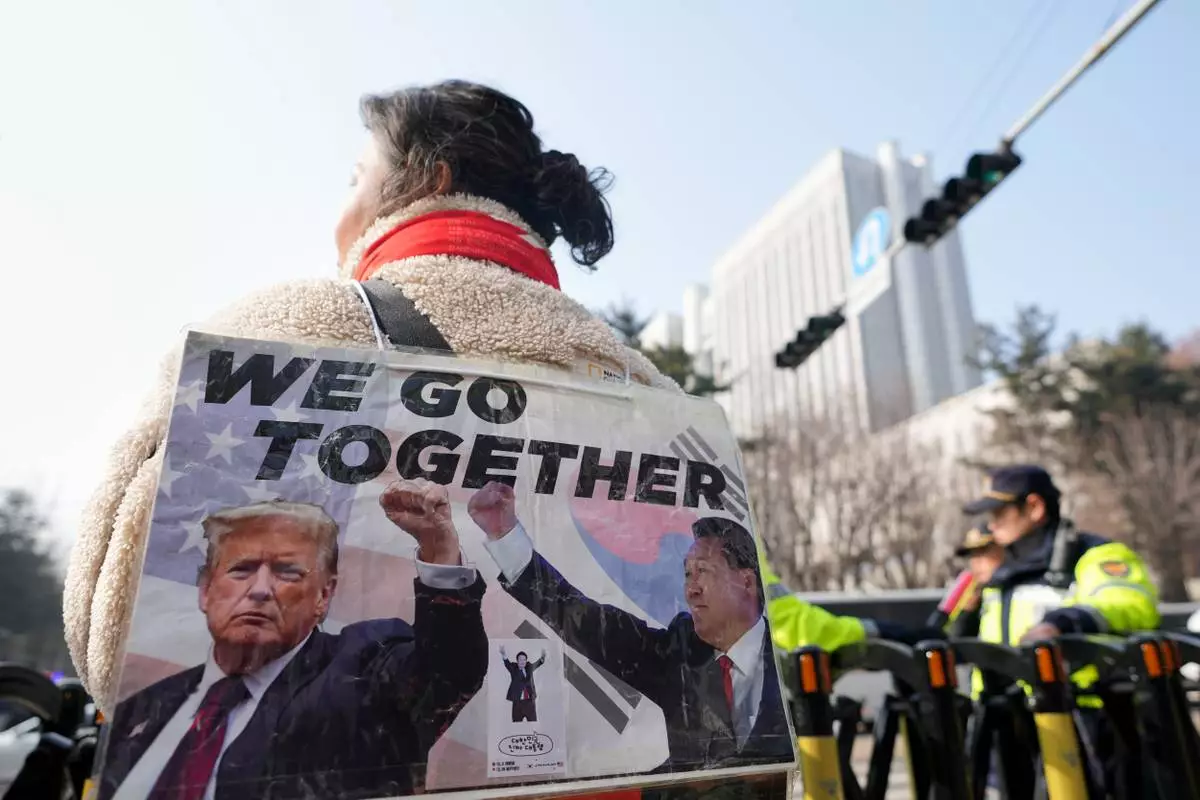
A supporter of former South Korean President Yoon Suk Yeol waits for a bus carrying former South Korean President Yoon Suk Yeol outside Seoul Central District Court, in Seoul, South Korea, Friday, Jan. 16, 2026. (AP Photo/Lee Jin-man)
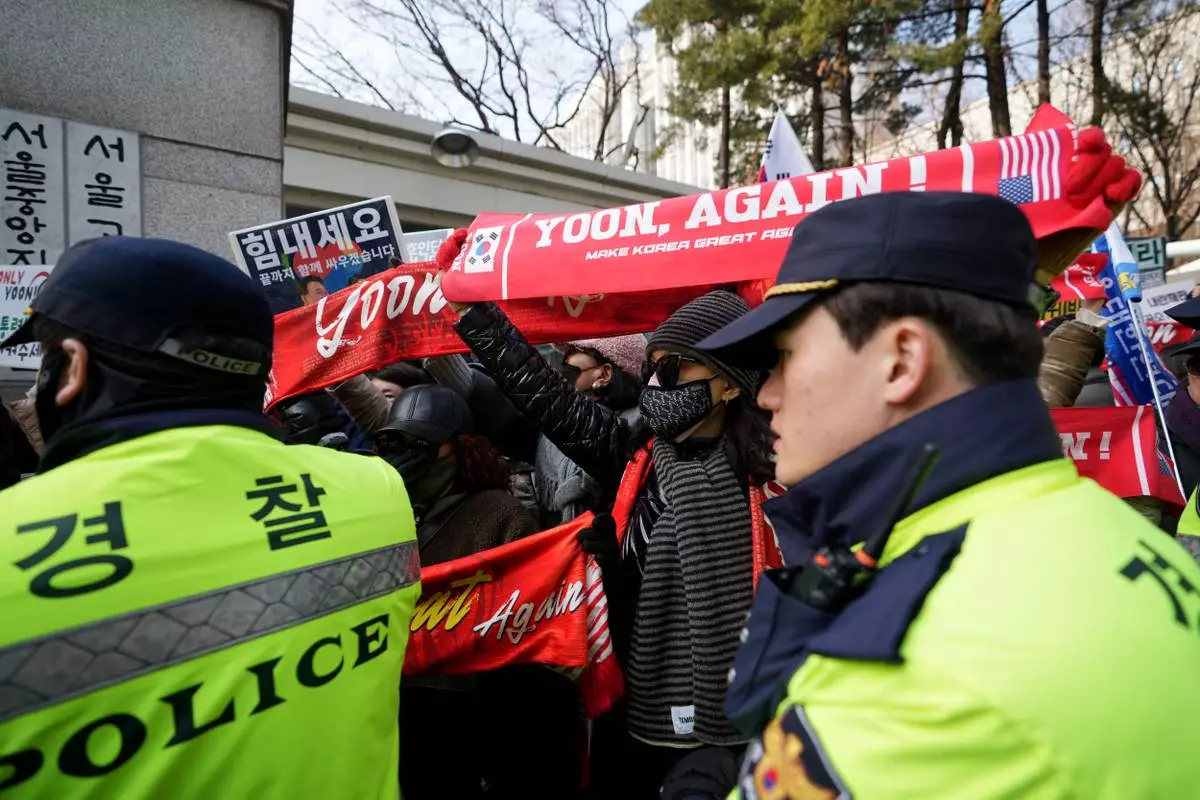
Supporters of former South Korean President Yoon Suk Yeol hold signs as police officers stand guard outside Seoul Central District Court, in Seoul, South Korea, Friday, Jan. 16, 2026. (AP Photo/Lee Jin-man)
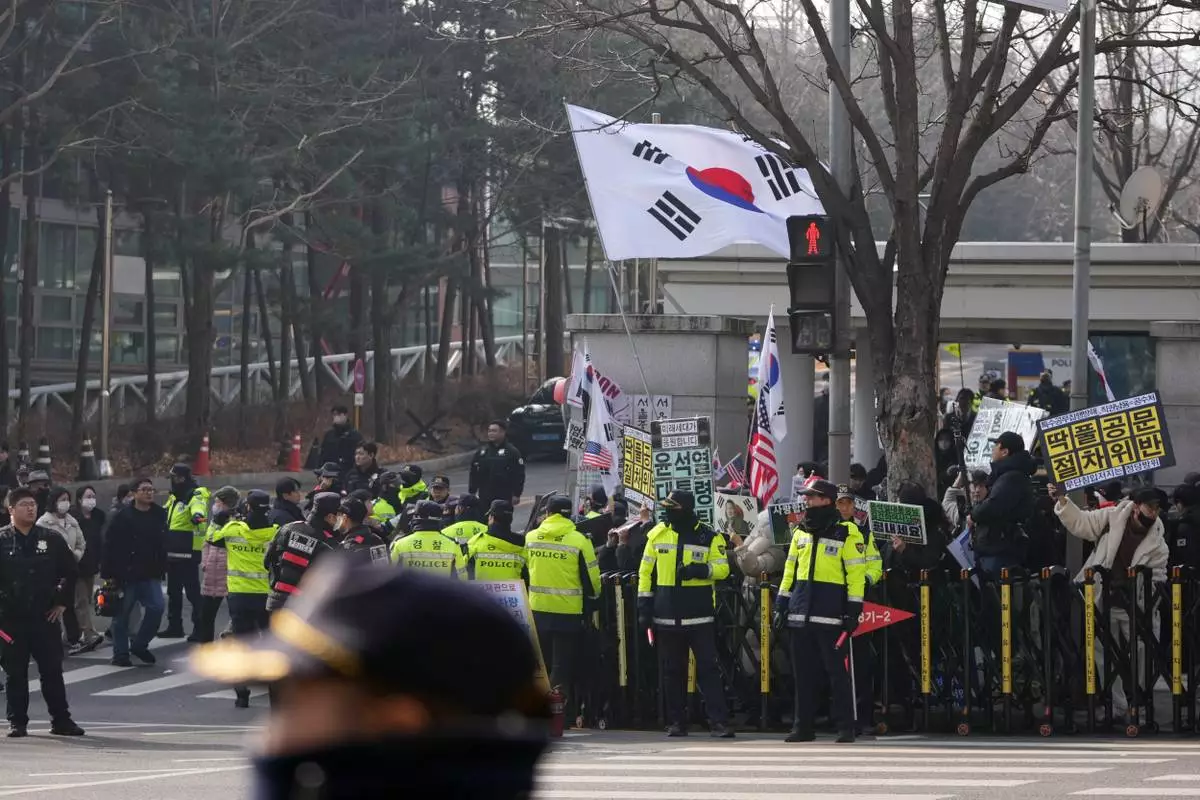
Supporters of former South Korean President Yoon Suk Yeol hold signs and flags outside Seoul Central District Court, in Seoul, South Korea, Friday, Jan. 16, 2026. (AP Photo/Lee Jin-man)
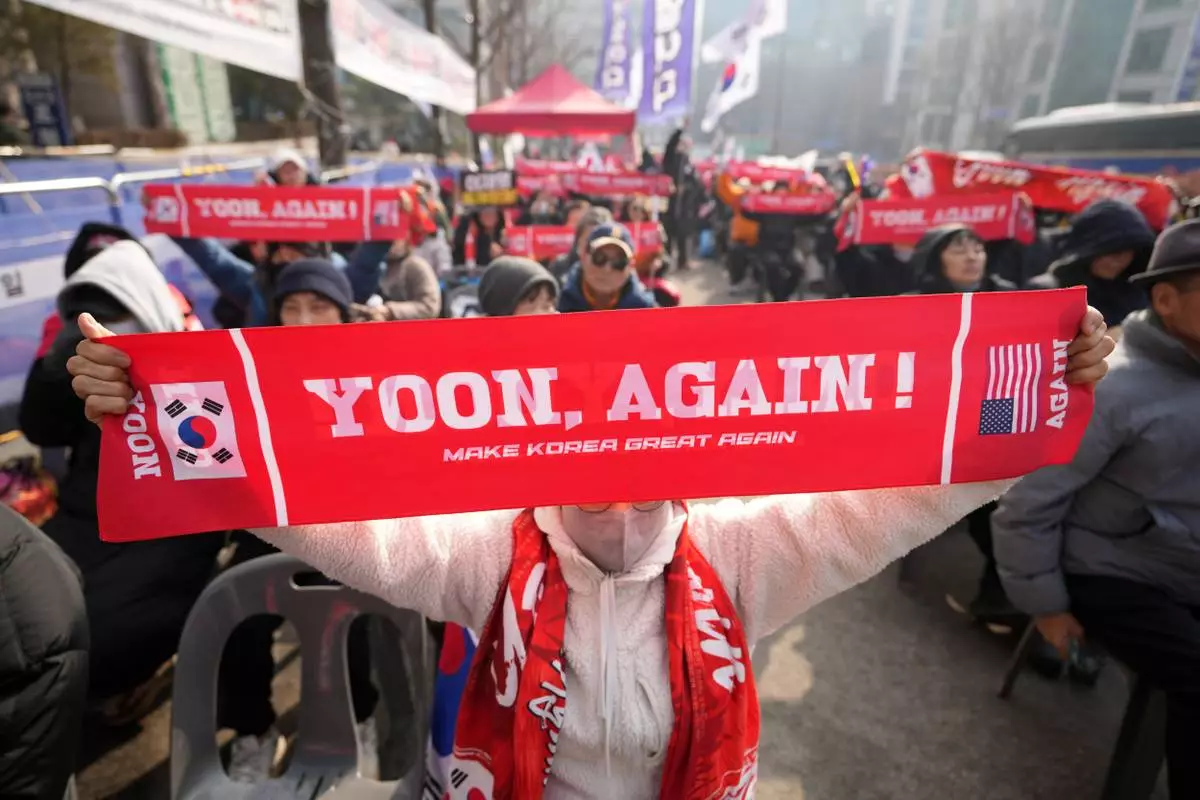
Supporters of former South Korean President Yoon Suk Yeol hold signs outside Seoul Central District Court, in Seoul, South Korea, Friday, Jan. 16, 2026. (AP Photo/Lee Jin-man)
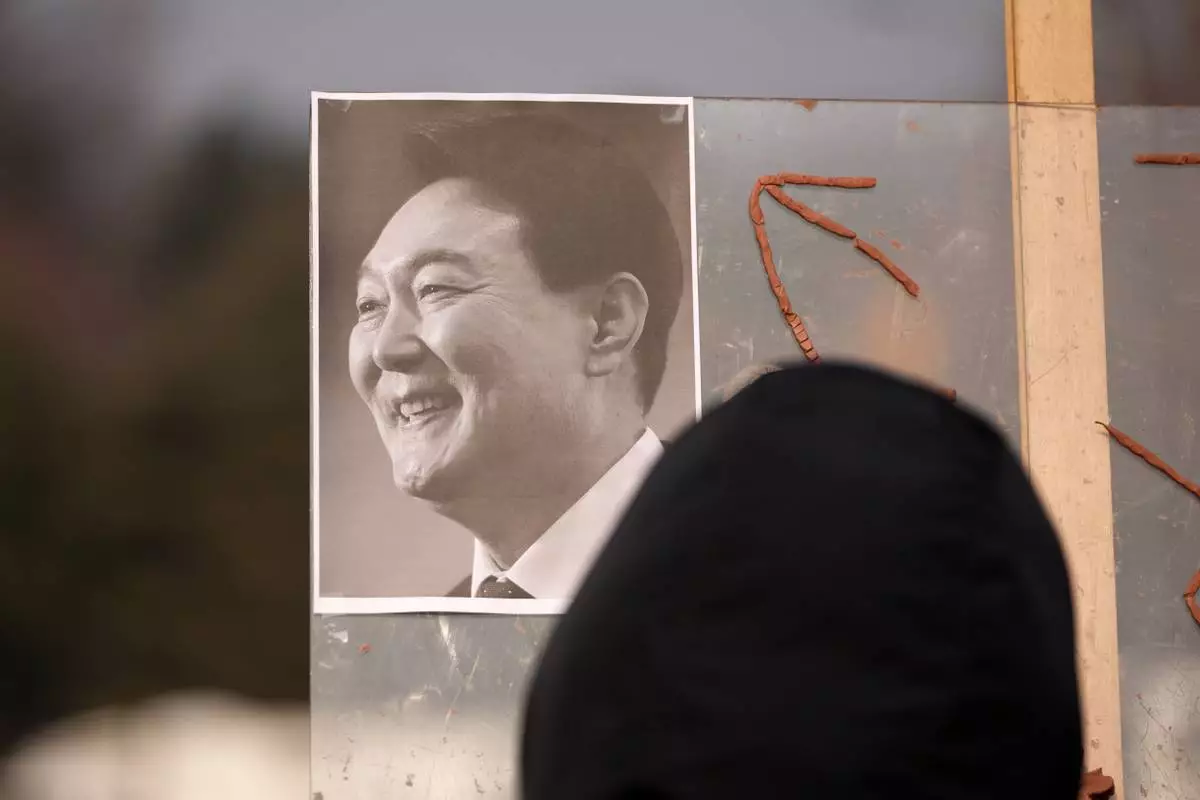
A picture of former South Korean President Yoon Suk Yeol is placed on a board as supporters gather outside Seoul Central District Court, in Seoul, South Korea, Friday, Jan. 16, 2026. (AP Photo/Lee Jin-man)