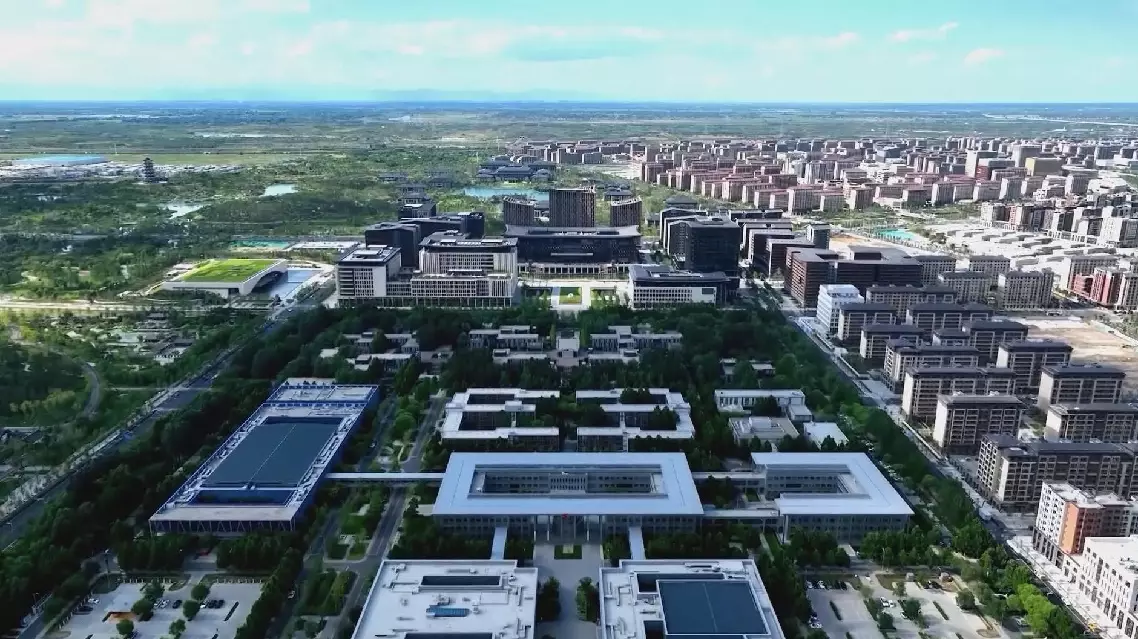
Investment in China's Xiong'an New Area, to the south of Beijing and in northern Hebei Province, increased by 13.5 percent year over year in the first half of 2025, driving investment growth in Hebei by 1.6 percentage points year over year.
As the central hub for relocating non-capital functions from Beijing, the Xiong'an New Area has entered a phase of parallel development that prioritizes both large-scale construction and functional transitions.
At present, a high-rise fortune tower project is underway in the financial island area of the Xiong'an New Area, with over 2,000 builders diligently working at the construction site.
The total construction area of the financial island project exceeds 780,000 square meters, covering functions such as offices, apartments, commerce, and transportation.
With the basic sites for the second batch of relocation projects selected, central state-owned enterprises have established over 300 branches in Xiong'an.
Meanwhile, the Xiong'an Aerospace Information Research Institute has leveraged China's BeiDou navigation system and 5G multi-mode convergence technology to solve the challenge of underground positioning, and the solution is now fully implemented in the Rongdong area of Xiong'an.
"We are currently promoting the Xiong'an New Area as a model to all parts of the country. We are already connecting with underground positioning in areas like Qingdao Port, and with several scenarios in Chongqing, Hainan, and Beijing," said Lu Zhaoming, deputy director of Xiongan Aerospace Information Research Institute.
Investment in Xiong'an New Area increases by 13.5 pct in H1
A delegation of foreign diplomatic envoys visited south China's Hainan from Wednesday to Saturday, learning about the province's rapid development and exploring potential areas of cooperation.
The trip, organized by the Ministry of Foreign Affairs, brought together over 30 ambassadors, chargés d'affaires, representatives of international organizations, and senior diplomats from countries including Kenya, Serbia, Spain and Vietnam.
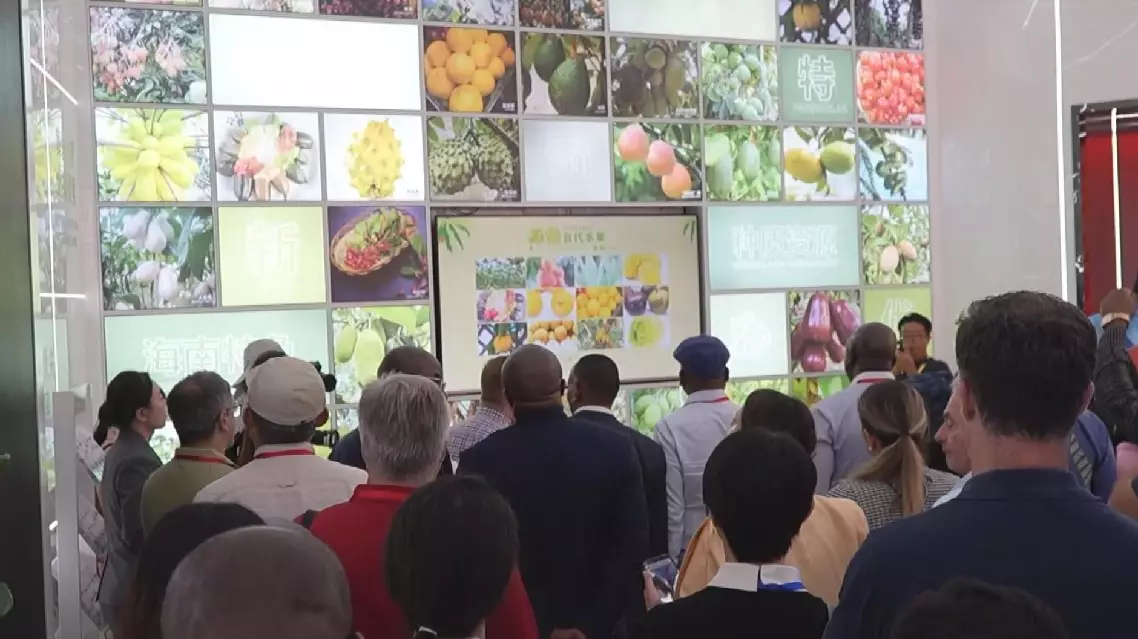
In Sanya's Yazhou Bay Science and Technology City, the delegates gained insights into China's independent innovation in the seed industry and the country's agricultural technological transformation in response to climate change.
"We can invite a lot of the persons from this institute to come to Dominica to teach us some of the advanced technologies and the practices that we should employ in agriculture," said Martin Charles, Dominica's Ambassador to China.
The delegates also toured the innovative drug and medical device exhibition, as well as health and wellness institutions in the Boao Lecheng International Medical Tourism Pilot Zone.
Hailed as China's sole "medical special zone", the pilot zone is home to over 30 top-tier domestic and international medical institutions.
"The medical advances are the ones that have struck me most for the moment. There are so many fields where we can cooperate," said Javier Garcia-Larrache, Spain's charge d'affaires ad interim in China.
The delegates also visited villages to experience folk culture, including Li brocade from the Li ethnic group, traditional Chinese medicine sachets, and bamboo pole dances, immersing themselves in the province's rich and vibrant local cultures.
Foreign diplomatic envoys visit Hainan
Foreign diplomatic envoys visit Hainan