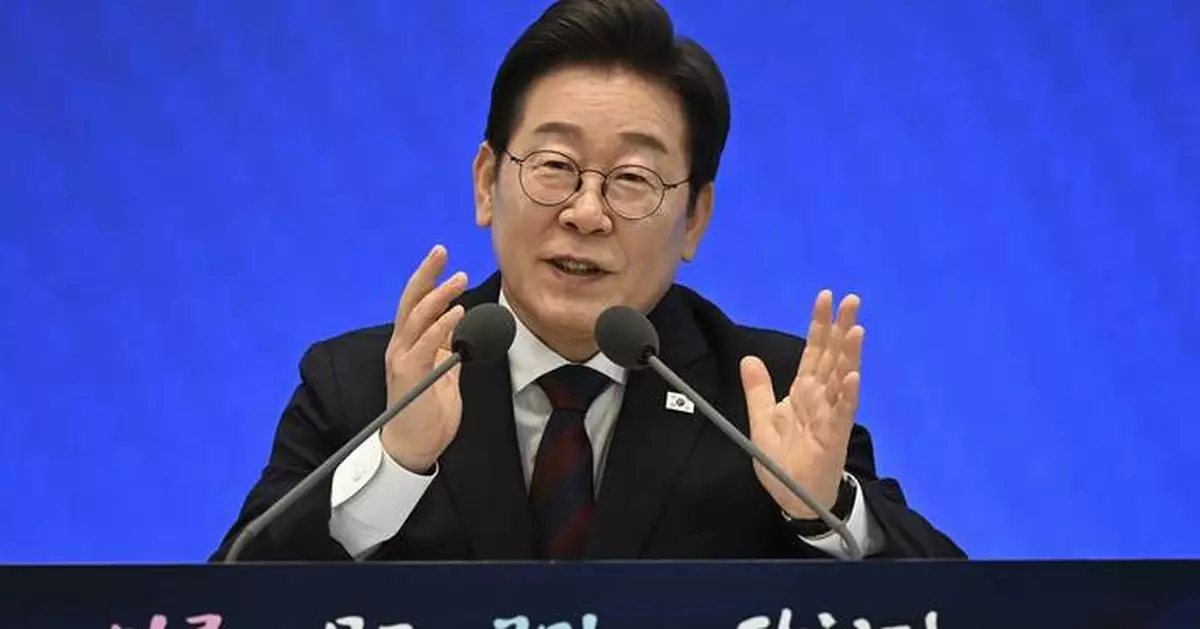
SEOUL, South Korea (AP) — South Korea’s new President Lee Jae Myung will travel to Washington later this month to meet with U.S. President Donald Trump, Lee’s office said Tuesday, for talks on trade and defense cooperation in the face of nuclear-armed North Korea and other threats.
Their Aug. 25 summit will follow a July trade deal in which Washington agreed to cut its reciprocal tariff on South Korea to 15% from the initially proposed 25% and to apply the same reduced rate to South Korean cars, the country’s top export to the United States.
South Korea also agreed to purchase $100 billion in U.S. energy and invest $350 billion in the country, and Lee and Trump may discuss how the investment package will be structured and managed. The talks are expected to cover expanding cooperation in key industries such as semiconductors, batteries and shipbuilding, Lee’s spokesperson Kang Yu-jung said.
Lee, a liberal who won an early election in June to replace ousted conservative Yoon Suk Yeol, has made the economy his top priority, aiming to shield the trade-dependent nation from the shocks of Trump’s tariff hikes and his demands that allies cut reliance on Washington and shoulder more of their own defense costs.
Lee's meeting with Trump comes amid concerns in Seoul that the Trump administration could shake up the decades-old alliance by demanding higher payments for the U.S. troop presence in South Korea and possibly move to reduce it as Washington shifts more focus on China.
Lee and Trump will discuss strengthening the allies’ defense posture against growing North Korean threats, and also developing the partnership into a “future-oriented, comprehensive strategic alliance” to address the changing international security and economic environment, according to Kang, who didn’t elaborate on the specific issues to be addressed.
Dating back to his first term, Trump has regularly called for South Korea to pay more for the 28,500 American troops stationed on its soil. Recent comments by key Trump administration officials, including Undersecretary of Defense Elbridge Colby, have also suggested a desire to restructure the alliance, which some experts say could potentially affect the size and role of U.S. forces in South Korea.
Under this approach, South Korea would take a greater role in countering North Korean threats while U.S. forces focus more on China, possibly leaving Seoul to face reduced benefits but increased costs and risks, experts say.
In a meeting with South Korean reporters last week, Gen. Xavier Brunson, commander of U.S. Forces Korea, stressed the need to “modernize” the alliance to address the evolving security environment, including North Korea’s expanding nuclear program, its deepening alignment with Russia, and what he called Chinese threats to a “free and open Indo-Pacific.”
When asked about a potential reduction in U.S. troops in South Korea, Brunson emphasized capabilities over numbers, highlighting advanced systems like fifth-generation fighters, and also stressed strategic flexibility, citing the recent deployment of Patriot air defense systems from South Korea to the Middle East.
“What’s being asked of Korea is to be stronger against DPRK — that we might have the flexibility as we modernize our alliance so that we could go do other things,” Brunson said, using the initials of North Korea’s formal name, the Democratic People’s Republic of Korea.
During his first term, Trump suspended U.S. military exercises with South Korea while pursuing diplomacy with North Korean leader Kim Jong Un. They met three times in 2018 and 2019 but their diplomacy quickly collapsed over disagreements about exchanging the release of U.S.-led sanctions against the North and the North’s steps to wind down its nuclear and missile program.
Kim has since suspended virtually all diplomacy with Washington and Seoul while accelerating the expansion of his weapons program. His foreign policy priority is now Russia, which he has supplied with weapons and troops to help prolong Russian President Vladimir Putin’s invasion of Ukraine.
Kim’s powerful sister recently dismissed Washington and Seoul’s stated desires to restart diplomacy aimed at defusing the North’s nuclear program, indicating that Pyongyang feels no urgency to resume diplomacy with South Korea and the U.S. anytime soon.
Tensions on the peninsula could rise again later this month, when South Korea and the United States proceed with their annual large-scale combined military exercises, which begin on Aug. 18. North Korea labels the allies’ joint drills as invasion rehearsals and often uses them as a pretext to dial up military demonstrations and weapons tests aimed at advancing its nuclear program.
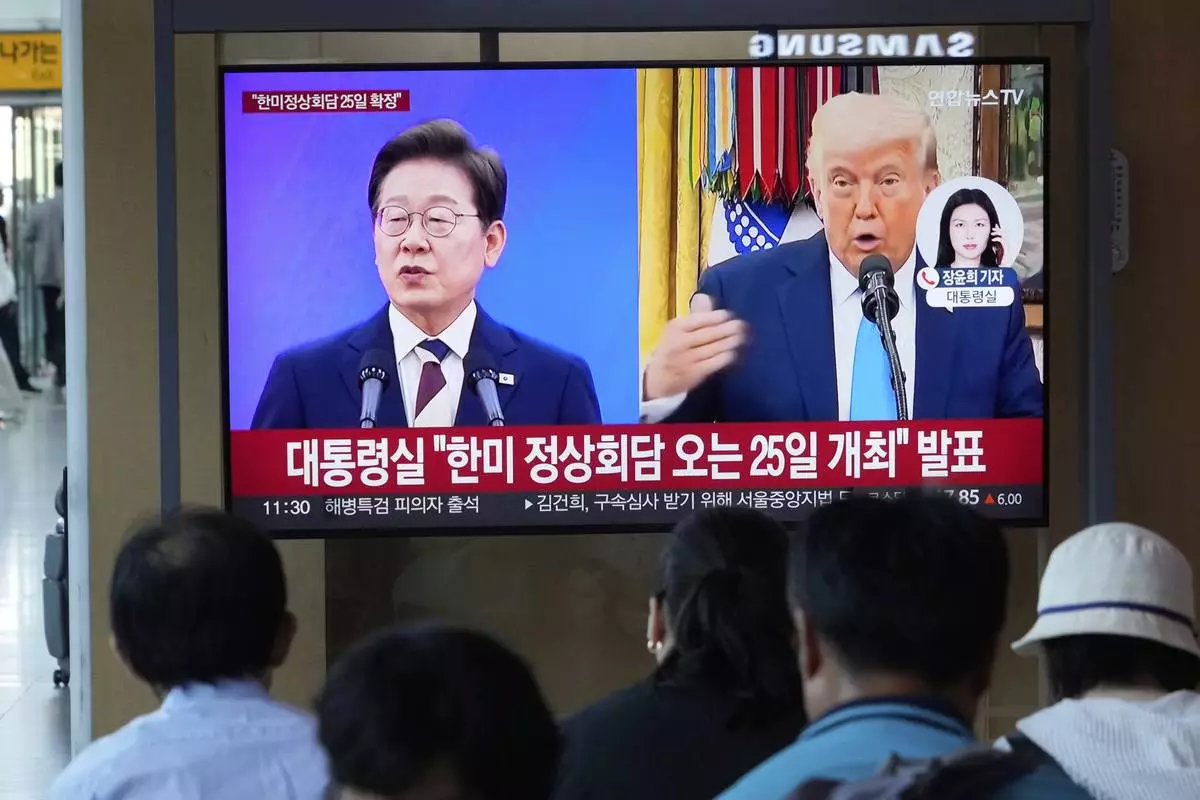
People watch a TV screen showing a file image of South Korean President Lee Jae Myung, left, and U.S. President Donald Trump during a news program at the Seoul Railway Station in Seoul, South Korea, Tuesday, Aug. 12, 2025. The signs read, "The presidential office announced that the South Korea-U.S. summit will be held on the 25th." (AP Photo/Ahn Young-joon)
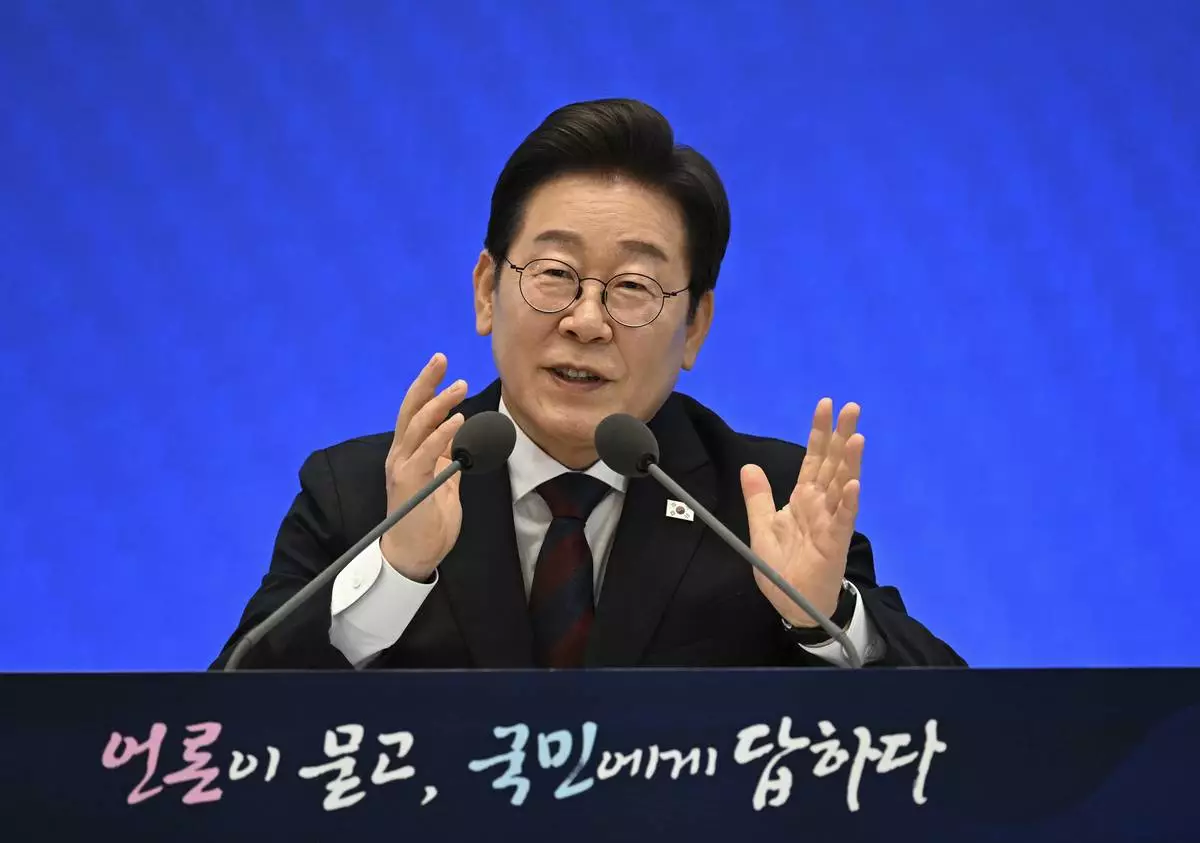
FILE - South Korean President Lee Jae Myung delivers a speech during a news conference to mark his first 30 days in office at Yeongbingwan of Blue House in Seoul, South Korea, July 3, 2025. (Kim Min-Hee/Pool Photo via AP, File)
WASHINGTON (AP) — Most American presidents aspire to the kind of greatness that prompts future generations to name important things in their honor.
Donald Trump isn't leaving it to future generations.
As the first year of his second term wraps up, his administration and allies have put the president’s name on the U.S. Institute of Peace, the Kennedy Center performing arts venue and a new class of battleships.
That’s on top of the “Trump Accounts” for tax-deferred investments, the TrumpRx government website soon to offer direct sales of prescription drugs, the “Trump Gold Card” visa that costs at least $1 million and the Trump Route for International Peace and Prosperity, a transit corridor included in a deal his administration brokered between Armenia and Azerbaijan.
On Friday, he plans to attend a ceremony in Florida where local officials will dedicate a 4-mile (6-kilometer) stretch of road from the airport to his Mar-a-Lago estate as President Donald J. Trump Boulevard.
It’s unprecedented for a sitting president to embrace tributes of that number and scale, especially those proffered by members of his administration. And while past sitting presidents have typically been honored by local officials naming schools and roads after them, it's exceedingly rare for airports, federal buildings, warships or other government assets to be named for someone still in power.
“At no previous time in history have we consistently named things after a president who was still in office,” said Jeffrey Engel, the David Gergen Director of the Center for Presidential History at Southern Methodist University in Dallas. “One might even extend that to say a president who is still alive. Those kind of memorializations are supposed to be just that — memorials to the passing hero.”
White House spokeswoman Liz Huston said the TrumpRx website linked to the president's deals to lower the price of some prescription drugs, along with “overdue upgrades of national landmarks, lasting peace deals, and wealth-creation accounts for children are historic initiatives that would not have been possible without President Trump’s bold leadership.”
"The Administration’s focus isn’t on smart branding, but delivering on President Trump’s goal of Making America Great Again," Huston said.
The White House pointed out that the nation's capital was named after President George Washington and the Hoover Dam was named after President Herbert Hoover while each was serving as president.
For Trump, it’s a continuation of the way he first etched his place onto the American consciousness, becoming famous as a real estate developer who affixed his name in big gold letters on luxury buildings and hotels, a casino and assorted products like neckties, wine and steaks.
As he ran for president in 2024, the candidate rolled out Trump-branded business ventures for watches, fragrances, Bibles and sneakers — including golden high tops priced at $799. After taking office again last year, Trump's businesses launched a Trump Mobile phone company, with plans to unveil a gold-colored smartphone and a cryptocurrency memecoin named $TRUMP.
That’s not to be confused with plans for a physical, government-issued Trump coin that U.S. Treasurer Brandon Beach said the U.S. Mint is planning.
Trump has also reportedly told the owners of Washington’s NFL team that he would like his name on the Commanders’ new stadium. The team’s ownership group, which has the naming rights, has not commented on the idea. But a White House spokeswoman in November called the proposed name “beautiful” and said Trump made the rebuilding of the stadium possible.
The addition of Trump’s name to the Kennedy Center in December so outraged independent Sen. Bernie Sanders of Vermont that he introduced legislation this week to ban the naming or renaming of any federal building or land after a sitting president — a ban that would retroactively apply to the Kennedy Center and Institute of Peace.
“I think he is a narcissist who likes to see his name up there. If he owns a hotel, that’s his business,” Sanders said in an interview. “But he doesn’t own federal buildings.”
Sanders likened Trump's penchant for putting his name on government buildings and more to the actions of authoritarian leaders throughout history.
“If the American people want to name buildings after a president who is deceased, that’s fine. That’s what we do,” Sanders said. “But to use federal buildings to enhance your own position very much sounds like the ‘Great Leader’ mentality of North Korea, and that is not something that I think the American people want.”
Although some of the naming has been suggested by others, the president has made clear he’s pleased with the tributes.
Three months after the announcement of the Trump Route for International Peace and Prosperity, a name the White House says was proposed by Armenian officials, the president gushed about it at a White House dinner.
“It’s such a beautiful thing, they named it after me. I really appreciate it. It’s actually a big deal,” he told a group of Central Asian leaders.
Engel, the presidential historian, said the practice can send a signal to people "that the easiest way to get access and favor from the president is to play to his ego and give him something or name something after him.”
Some of the proposals for honoring Trump include legislation in Congress from New York Republican Rep. Claudia Tenney that would designate June 14 as “Trump’s Birthday and Flag Day," placing the president with the likes of Martin Luther King Jr., George Washington and Jesus Christ, whose birthdays are recognized as national holidays.
Florida Republican Rep. Greg Steube has introduced legislation that calls for the Washington-area rapid transit system, known as the Metro, to be renamed the “Trump Train.” North Carolina Republican Rep. Addison McDowell has introduced legislation to rename Washington Dulles International Airport as Donald J. Trump International Airport.
McDowell said it makes sense to give Dulles a new name since Trump has already announced plans to revamp the airport, which currently is a tribute to former Secretary of State John Foster Dulles.
The congressman said he wanted to honor Trump because he feels the president has been a champion for combating the scourge of fentanyl, a personal issue for McDowell after his brother’s overdose death. But he also cited Trump’s efforts to strike peace deals all over the world and called him “one of the most consequential presidents ever.”
“I think that’s somebody that deserves to be honored, whether they’re still the president or whether they’re not," he said.
More efforts are underway in Florida, Trump’s adopted home.
Republican state lawmaker Meg Weinberger said she is working on an effort to rename Palm Beach International Airport as Donald J. Trump International Airport, a potential point of confusion with the Dulles effort.
The road that the president will see christened Friday is not the first Florida asphalt to herald Trump upon his return to the White House.
In the south Florida city of Hialeah, officials in December 2024 renamed a street there as President Donald J. Trump Avenue.
Trump, speaking at a Miami business conference the next month, called it a “great honor” and said he loved the mayor for it.
“Anybody that names a boulevard after me, I like,” he said.
He added a few moments later: “A lot of people come back from Hialeah, they say, ‘They just named a road after you.' I say, ‘That’s OK.’ It’s a beginning, right? It’s a start.”
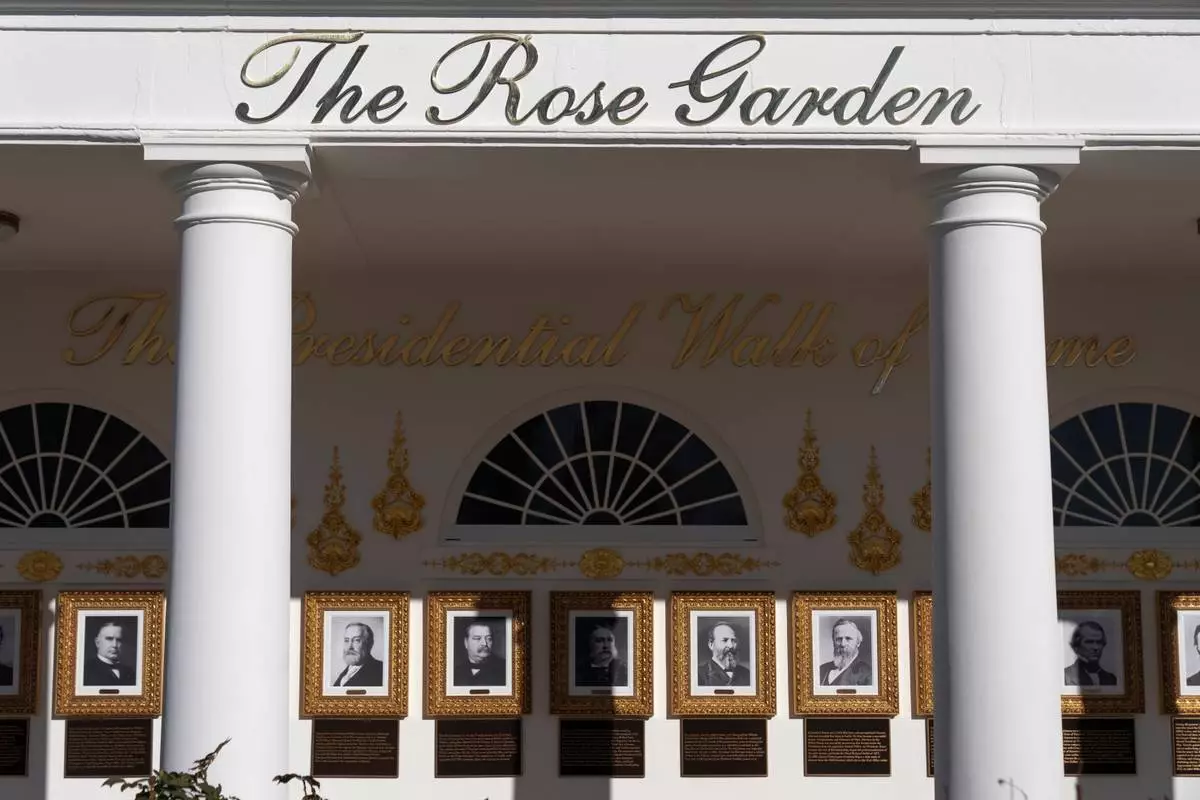
FILE - A sign for the Rose Garden is seen near the Presidential Walk of Fame on the Colonnade at the White House, Jan. 13, 2026, in Washington. (AP Photo/Mark Schiefelbein, File)
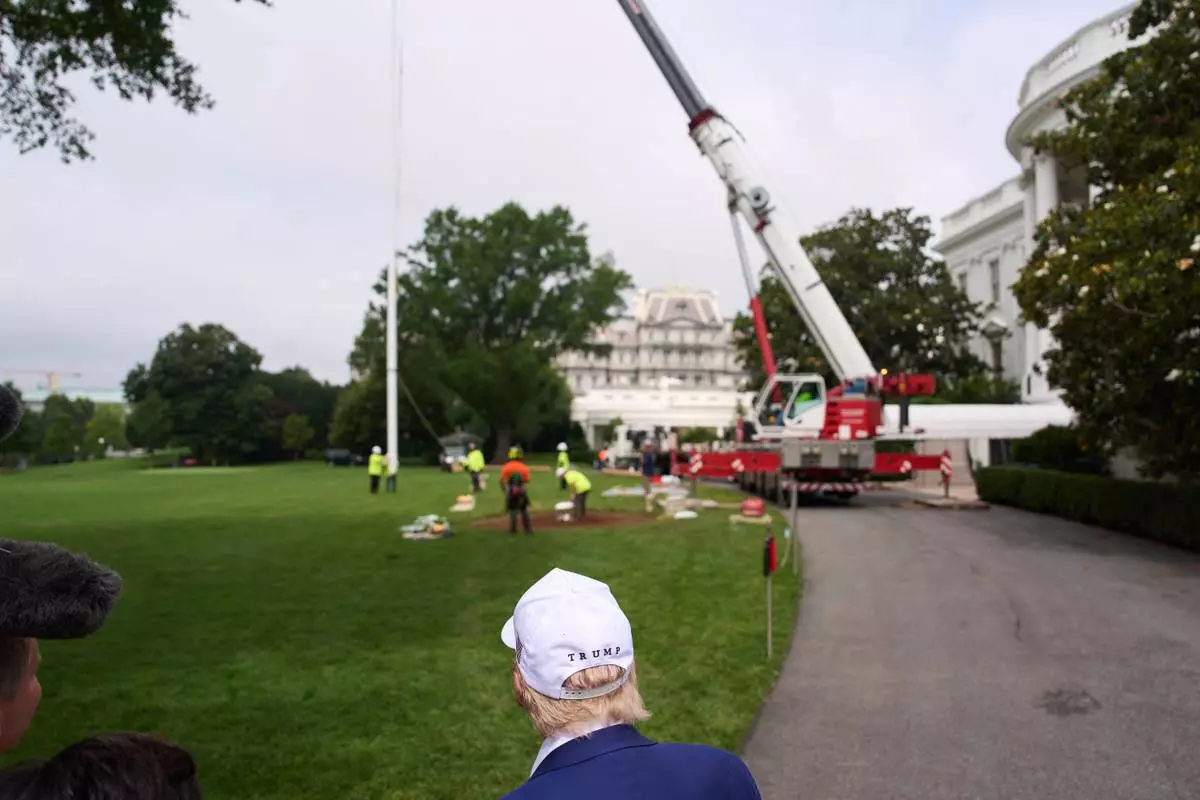
FILE - President Donald Trump speaks with reporters as a flag pole is installed on the South Lawn of the White House, June 18, 2025, in Washington. (AP Photo/Evan Vucci, File)
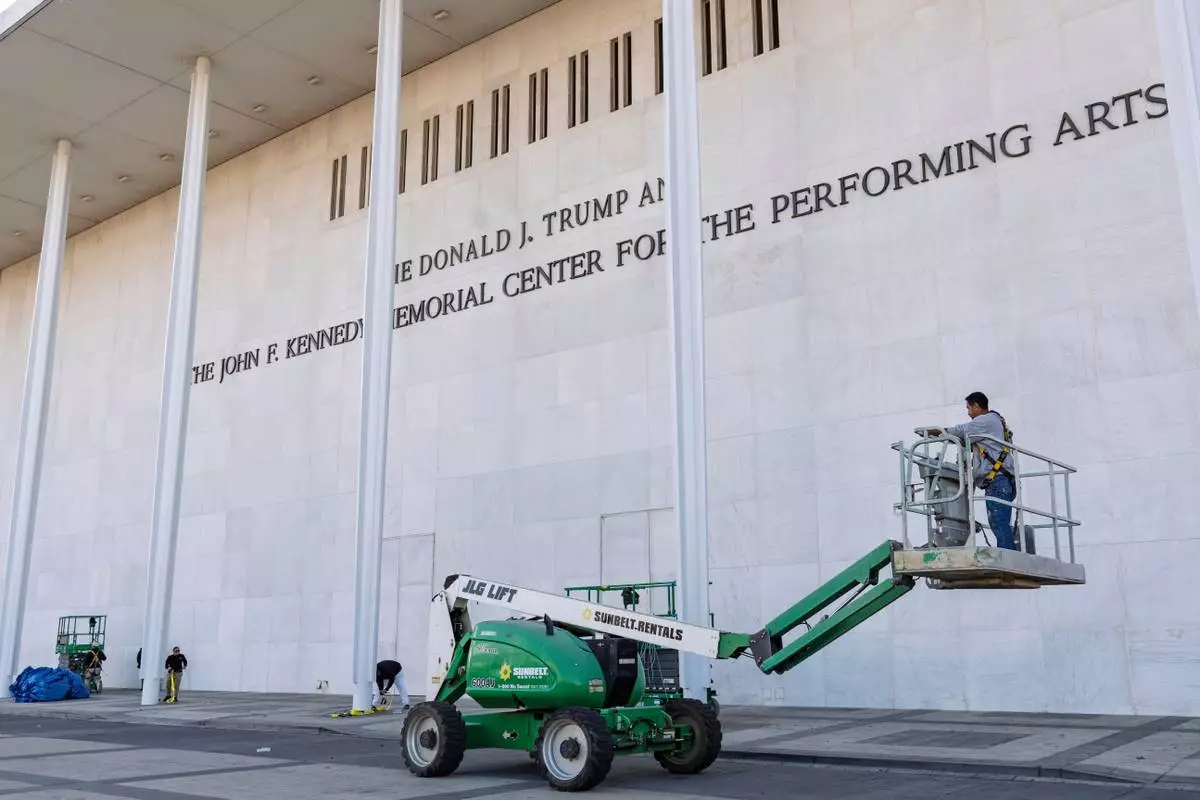
FILE - Workers add President Donald Trump's name to the John F. Kennedy Memorial Center for the Performing Arts, after a Trump-appointed board voted to rename the institution, in Washington, Dec. 19, 2025. (AP Photo/J. Scott Applewhite, File)
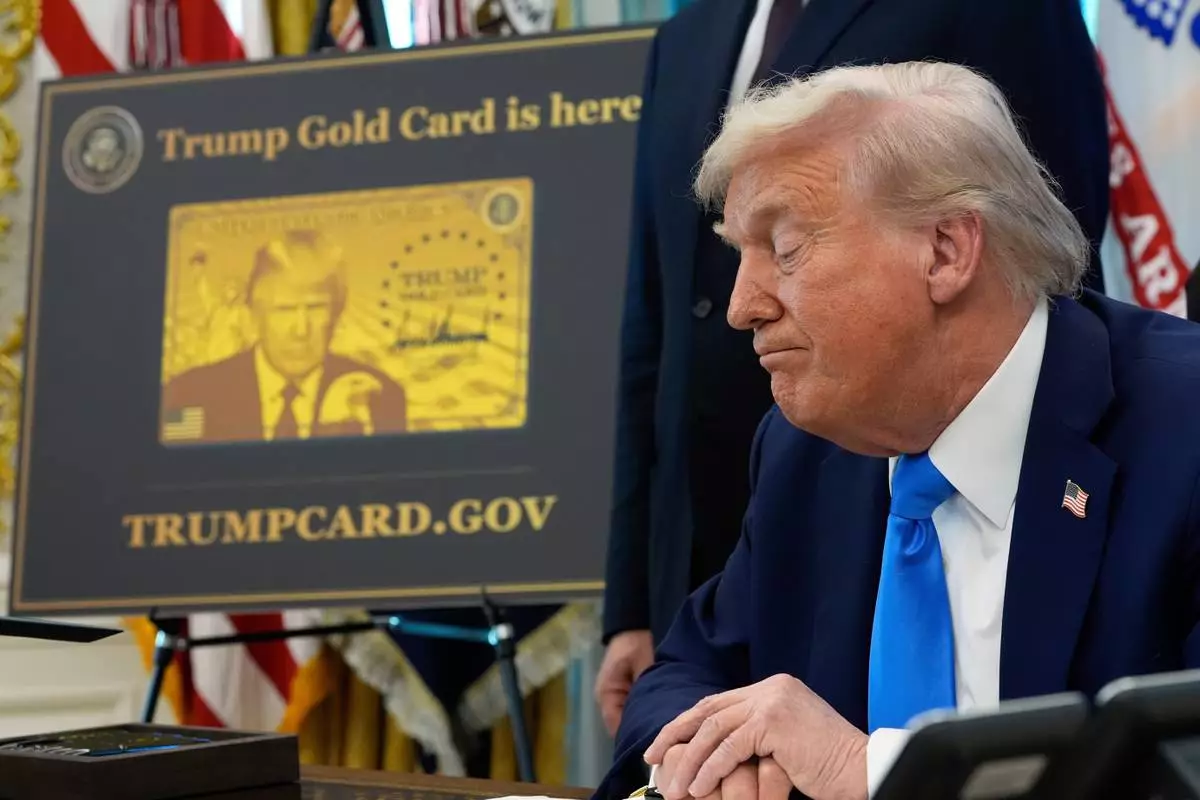
FILE - A poster showing the Trump Gold Card is seen as President Donald Trump signs executive orders in the Oval Office of the White House, Sept. 19, 2025, in Washington. (AP Photo/Alex Brandon, file)