Skip to Content Facebook Feature Image

National Guard rehearsed show of force against immigration raid protesters, general testifies

News

National Guard rehearsed show of force against immigration raid protesters, general testifies
News

News

National Guard rehearsed show of force against immigration raid protesters, general testifies

2025-08-13 07:59 Last Updated At:08:00

SAN FRANCISCO (AP) — National Guard troops repeatedly rehearsed their role in an operation at a Los Angeles park intended as a show of force against undocumented people and those protesting the Trump administration's immigration crackdown, a deputy commanding general testified Tuesday.

Maj. Gen. Scott Sherman, who commanded Guard troops in Los Angeles, was testifying at a trial to determine whether the Trump administration violated the Posse Comitatus Act when it deployed the soldiers and U.S. Marines to Southern California this summer. The 1878 law generally prohibits a president from using the military to police domestic affairs.

Sherman said the deployment of federal agents on horseback and on foot to MacArthur Park in a neighborhood with a large immigrant population was initially planned for Father's Day, June 15. But the operation was moved to July 7 after he raised concerns the park could be crowded, he said.

“We assessed that there could be a large amount of people in the park (on Father’s Day), which could quickly overwhelm Border Patrol,” Sherman testified.

Sherman said the decision to shift the timing of the operation came after discussion among the National Guard, the U.S. Northern Command, the Border Patrol, Department of Defense Secretary Peter Hegseth and Department of Homeland Security Kristi Noem.

The Guard troops were deployed to protect the perimeter and were instructed only to exit their vehicles if there was a direct threat to federal agents, he said.

All troops remained in their vehicles during the brief but mighty show of force. Sherman said the operation took just 20 minutes because it had been rehearsed multiple times. The Department of Homeland Security hasn't said if anyone was arrested.

Sherman testified during the second day of a three-day trial on whether President Donald Trump’s deployment of 4,700 armed forces to Los Angeles following protests over immigration raids this summer violated the Posse Comitatus Act. All but about 300 Guard troops have since left Los Angeles.

Sherman testified that he also raised concerns that military vehicles would be stationed along Wilshire Boulevard, which traverses the park, instead of staying in the perimeter during the so-called “Operation Excalibur."

After he raised his concerns, Gregory Bovino, the Border Patrol’s El Centro sector chief in charge of the immigration crackdown in Los Angeles, questioned his loyalty, Sherman told the court Monday.

On July 7, federal agents, many of them in tactical gear, walked and rode their horses around the park, which was nearly empty because word had spread of a potential raid.

LA Mayor Karen Bass and Gov. Gavin Newsom called it a political stunt and spectacle meant to intimidate the city’s immigrant communities.

Trump has pushed the bounds of typical military activity on domestic soil, including through the creation of militarized zones along the U.S.-Mexico border. On Monday, the president said he was deploying the National Guard across Washington, D.C., and taking over the city’s police department in hopes of reducing crime, even as the mayor has noted crime is falling in the nation’s capital.

California is asking Judge Charles Breyer to order the Trump administration to return control of the remaining troops to the state and to stop the federal government from using military troops in California “to execute or assist in the execution of federal law or any civilian law enforcement functions by any federal agent or officer.”

Eric Hamilton, a deputy assistant attorney general, said in his closing statement Tuesday that the troops did not break the Posse Comitatus Act because they were not enforcing federal law and were deployed “for a purely protective function.”

“The president federalized guardsmen and also deployed the Marines after multiple days of violent attacks on federal law enforcement officers and federal property. The deployment was a response to that violence and a recognition that federal law-enforcement officers and federal buildings needed additional protection," Hamilton said.

California Deputy Attorney General Meghan Strong told the court the Trump administration the troops went beyond providing protection to federal agents and federal buildings. The troops, she said, set up roadblocks and perimeters that restricted civilian movement, blocked access to public streets, detained civilians and engaged in a militaristic display of force in a public park.

The Trump administration, she said, broke the law and used the army to illegally enforce civilian law, and operate as a single force with federal immigration officers who often don military garb.

“Defendants have used that army to pervade the activities of civilian law enforcement and strike fear into the hearts of Californians," Strong said. “In doing so, defendants have disregarded America’s deep-rooted policy against military execution of the laws and the Posse Comitatus Act prohibitions.”

FILE - Federal agents stage at MacArthur Park, July 7, 2025, in Los Angeles. (AP Photo/Damian Dovarganes, File)
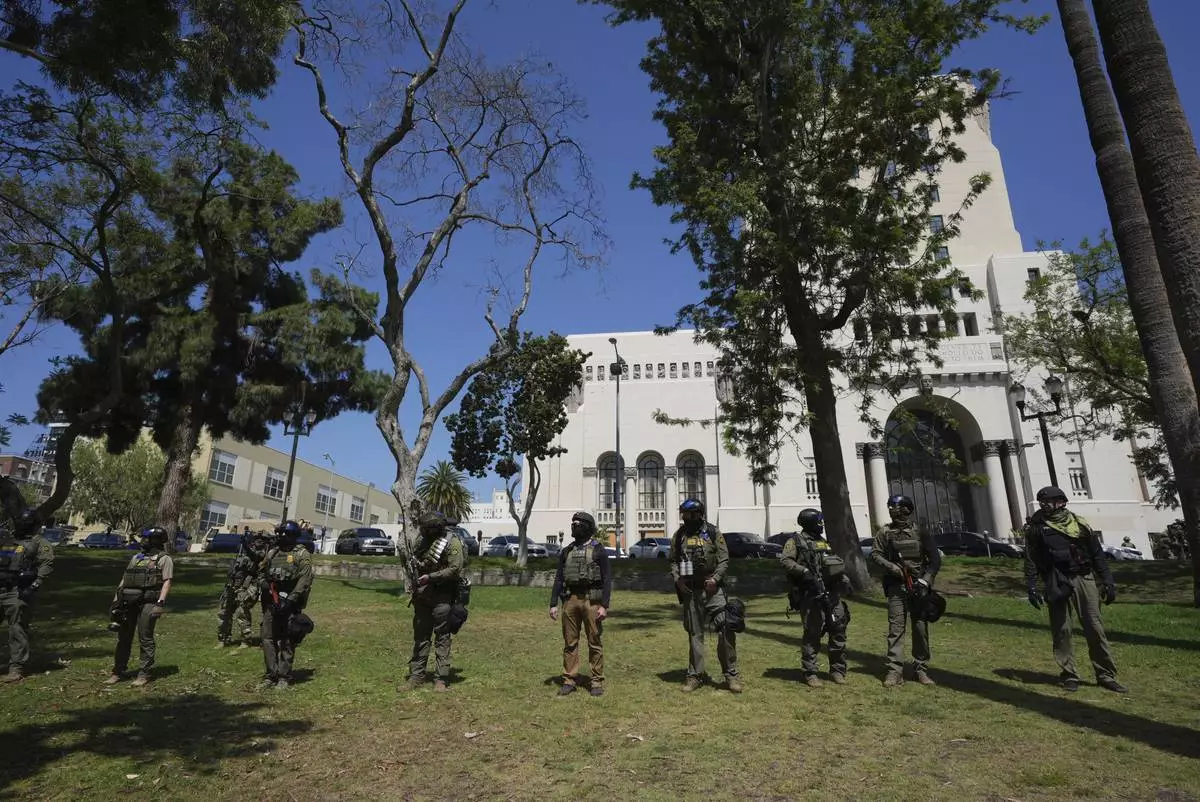
FILE - Federal agents stage at MacArthur Park, July 7, 2025, in Los Angeles. (AP Photo/Damian Dovarganes, File)
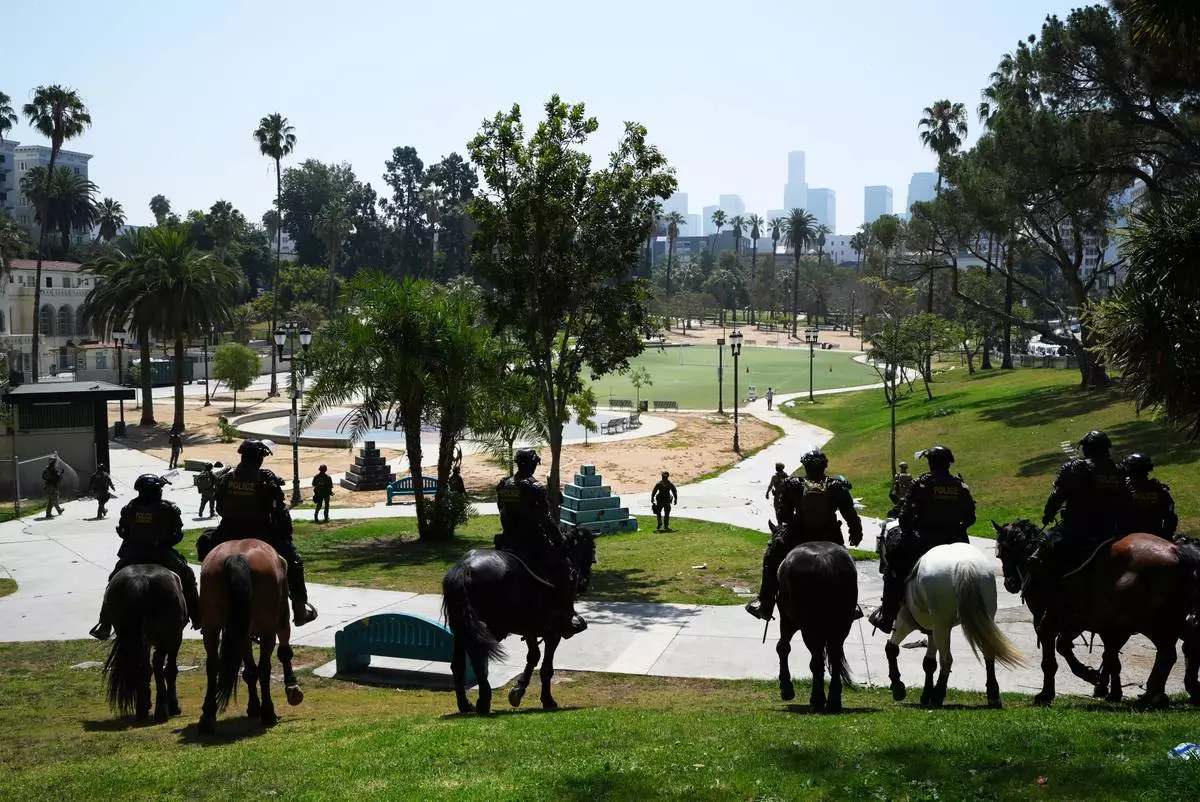
FILE - Federal agents stage at MacArthur Park, July 7, 2025, in Los Angeles. (AP Photo/Damian Dovarganes, File)

FILE - Federal agents stage at MacArthur Park, July 7, 2025, in Los Angeles. (AP Photo/Damian Dovarganes, File)

FILE - Federal agents ride on horseback at MacArthur Park, July 7, 2025, in Los Angeles. (AP Photo/Damian Dovarganes, File)
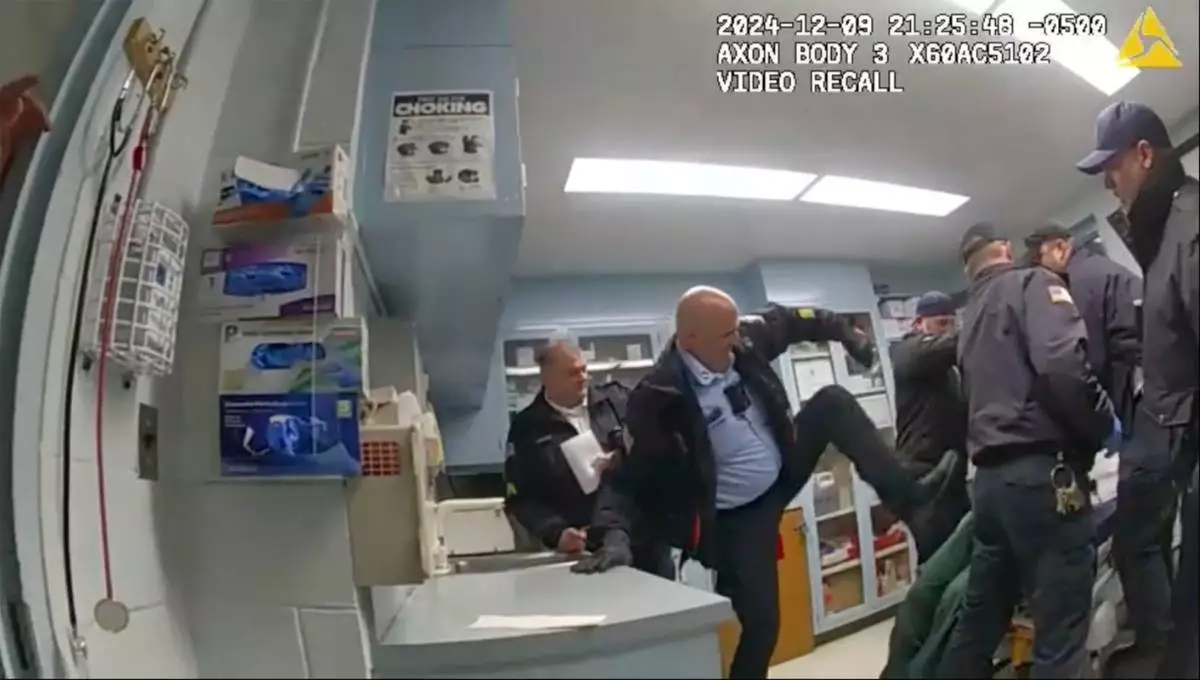

FILE - Federal agents ride on horseback at MacArthur Park, July 7, 2025, in Los Angeles. (AP Photo/Damian Dovarganes, File)
UTICA, N.Y. (AP) — A New York prison guard who failed to intervene as he watched an inmate being beaten to death should be convicted of manslaughter, a prosecutor told a jury Thursday in the final trial of correctional officers whose pummeling, recorded by body-cameras, provoked outrage.

“For seven minutes — seven gut-churning, nauseating, disgusting minutes — he stood in that room close enough to touch him and he did nothing,” special prosecutor William Fitzpatrick told jurors during closing arguments. The jury began deliberating Thursday afternoon.

Former corrections officer Michael Fisher, 55, is charged with second-degree manslaughter in the death of Robert Brooks, who was beaten by guards upon his arrival at Marcy Correctional Facility on the night of Dec. 9, 2024, his agony recorded silently on the guards' body cameras.

Fisher’s attorney, Scott Iseman, said his client entered the infirmary after the beating began and could not have known the extent of his injuries.

Fisher was among 10 guards indicted in February. Three more agreed to plead guilty to reduced charges in return for cooperating with prosecutors. Of the 10 officers indicted in February, six pleaded guilty to manslaughter or lesser charges. Four rejected plea deals. One was convicted of murder, and two were acquitted in the first trial last fall.

Fisher, standing alone, is the last of the guards to face a jury.

The trial closes a chapter in a high-profile case led to reforms in New York's prisons. But advocates say the prisons remain plagued by understaffing and other problems, especially since a wildcat strike by guards last year.

Officials took action amid outrage over the images of the guards beating the 43-year-old Black man in the prison's infirmary. Officers could be seen striking Brooks in the chest with a shoe, lifting him by the neck and dropping him.

Video shown to the jury during closing arguments Thursday indicates Fisher stood by the doorway and didn't intervene.

“Did Michael Fisher recklessly cause the death of Robert Brooks? Of course he did. Not by himself. He had plenty of other helpers,” said Fitzpatrick, the Onondaga County district attorney.

Iseman asked jurors looking at the footage to consider what Fisher could have known at the time “without the benefit of 2020 hindsight.”

“Michael Fisher did not have a rewind button. He did not have the ability to enhance. He did not have the ability to pause. He did not have the ability to get a different perspective of what was happening in the room,” Iseman said.

Even before Brooks' death, critics claimed the prison system was beset by problems that included brutality, overworked staff and inconsistent services. By the time criminal indictments were unsealed in February, the system was reeling from an illegal three-week wildcat strike by corrections officers who were upset over working conditions. Gov. Kathy Hochul deployed National Guard troops to maintain operations. More than 2,000 guards were fired.

Prison deaths during the strike included Messiah Nantwi on March 1 at Mid-State Correctional Facility, which is across the road from the Marcy prison. 10 other guards were indicted in Nantwi's death in April, including two charged with murder.

There are still about 3,000 National Guard members serving the state prison system, according to state officials.

“The absence of staff in critical positions is affecting literally every aspect of prison operations. And I think the experience for incarcerated people is neglect,” Jennifer Scaife, executive director of the Correctional Association of New York, an independent monitoring group, said on the eve of Fisher's trial.

Hochul last month announced a broad reform agreement with lawmakers that includes a requirement that cameras be installed in all facilities and that video recordings related to deaths behind bars be promptly released to state investigators.

The state also lowered the hiring age for correction officers from 21 to 18 years of age.

FILE - This image provided by the New York State Attorney General office shows body camera footage of correction officers beating a handcuffed man, Robert Brooks, at the Marcy Correctional Facility in Oneida County, N.Y., Dec. 9, 2024. (New York State Attorney General office via AP, File)

FILE - This image provided by the New York State Attorney General office shows body camera footage of correction officers beating a handcuffed man, Robert Brooks, at the Marcy Correctional Facility in Oneida County, N.Y., Dec. 9, 2024. (New York State Attorney General office via AP, File)

Recommended Articles