China's coastal provinces have stepped up preparations to prevent potential damage in anticipation of Typhoon Podul, evacuating civilians from vulnerable areas and ordering boats back to port.
Podul, the 11th typhoon of the year, made landfall on the coast of Taitung County in China's Taiwan region at around 13:00 local time Wednesday, with winds as strong as 191 kmh near the center, according to the meteorological observatory of east China's Fujian Province.
In Fujian, strong winds and waves have forced all fishing boats back to port, with over 15,000 people evacuated. Fifty-seven passenger ferry routes, including key cross-Strait routes, have been suspended, and 114 coastal construction projects have been suspended.
Authorities in Guangdong Province in south China have intensified evacuations from high-risk areas, with 38 ferry routes closed and all offshore work paused.
Service has been suspended on several high-speed rail lines, including parts of the Beijing-Guangzhou and Hangzhou-Shenzhen routes.
The flood and typhoon emergency response has been raised to Level III in Fujian and Guangdong -- the third highest on a four-tier warning system -- while the Ministry of Water Resources initiated a Level IV flood response for the four provincial regions of Fujian, Guangdong, Guangxi and Hunan.
Heavy rains are forecast over the next three days in south and southwest China, raising risks of landslides and flooding.
In Wenzhou City in east China's Zhejiang Province, 332 fishing boats returned to port ahead of the storm, nearly 2,000 vessels have sought shelter, and 504 aquaculture workers have been evacuated.

China's coastal region on high alert as Typhoon Pudol approaches
The 79th World Health Assembly (WHA), the highest decision-making body of the World Health Organization (WHO), on Monday decided not to include in its agenda a so-called proposal on Taiwan's participation in the annual assembly as an observer.
This marks the 10th consecutive year that the WHA has rejected such a Taiwan-related proposal.
Addressing the assembly, Jia Guide, China's permanent representative and ambassador to the United Nations Office at Geneva and other international organizations in Switzerland, reiterated that there is but one China in the world, Taiwan is an inalienable part of China's territory, and the Government of the People's Republic of China is the sole legal government representing the whole of China.
Jia said that the issue regarding the Taiwan region's participation in the WHA must be handled in accordance with the one-China principle as affirmed by the UN General Assembly Resolution 2758 and the WHA Resolution 25.1.
Jia said that due to the stubborn adherence to the persistent separatist stance of Taiwan's Democratic Progressive Party (DPP) authorities, the political foundation for the Taiwan region to participate in the WHA no longer exists.
Prior to the opening of this year's WHA, the overwhelming majority of countries in the international community have reiterated to China their firm support for the one-China principle and their opposition to Taiwan's participation in the WHA, Jia noted.
Jia emphasized that the so-called claim of a "gap in the international epidemic prevention system" is sheer nonsense.
China's central government has always attached great importance to the well-being of Taiwan compatriots and has made proper arrangements for the Taiwan region's participation in technical activities of the WHO on the premise of adhering to the one-China principle, he added.
Jia said the Taiwan-related proposal severely violates the basic norms of international relations based on the purposes and principles of the UN Charter.
In order to pursue their own political interests, the separatist forces in the Taiwan region have instigated certain countries to put forward the Taiwan-related proposal to engage in Taiwan secessionist activities at the WHA, Jia said.
Such acts are doomed to gain no support and will inevitably end in failure, he added.
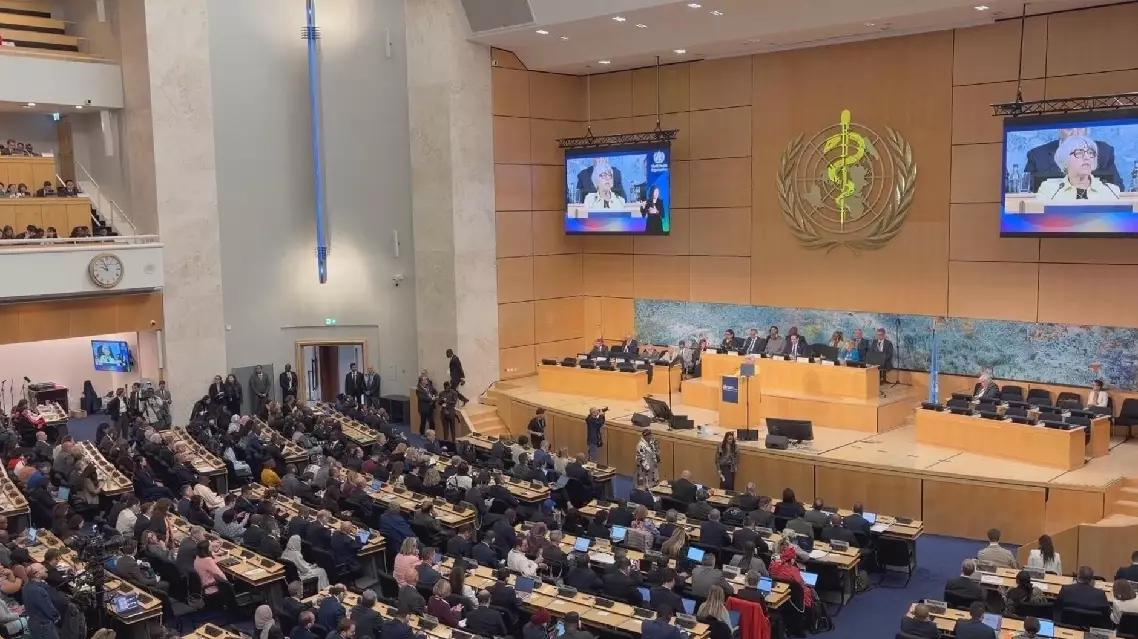
World Health Assembly rejects Taiwan-related proposal for 10th consecutive year