Skip to Content Facebook Feature Image

Judge weighs whether Trump violated federal law by deploying National Guard to Los Angeles

News

Judge weighs whether Trump violated federal law by deploying National Guard to Los Angeles
News

News

Judge weighs whether Trump violated federal law by deploying National Guard to Los Angeles

2025-08-14 07:08 Last Updated At:07:11

SAN FRANCISCO (AP) — A federal judge in San Francisco is weighing whether the Trump administration violated federal law by sending National Guard troops to accompany immigration agents on raids in Southern California.

A three-day trial on the matter concluded Wednesday.

California has argued the troops violated the Posse Comitatus Act, which generally prohibits military enforcement of domestic laws. Lawyers for the administration said the law doesn’t apply because President Donald Trump called up the National Guard under an authority that allows their deployment if "the president is unable with the regular forces to execute the laws of the United States.”

Federal and military officials were called to testify, and the trial's third day largely focused on weedy arguments about the 1878 law and whether the court even had a role in determining the limits of presidential power.

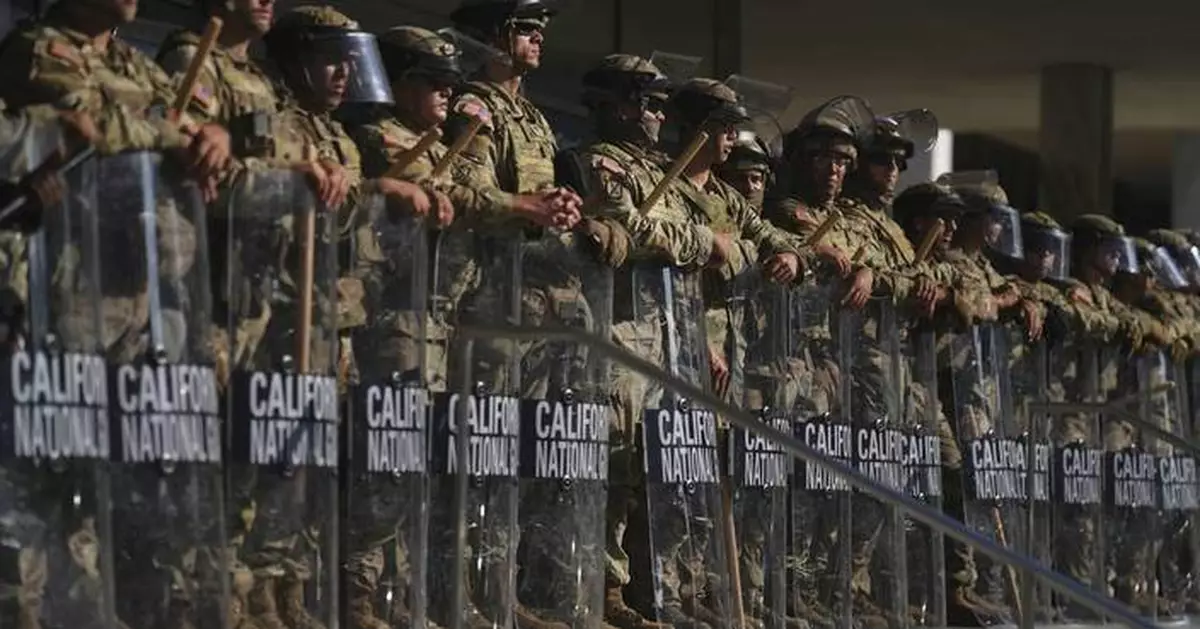
Trump deployed 4,000 National Guard members and later 700 Marines to Los Angeles in June after protests in response to immigration raids around the city. They were originally deployed to protect federal property, including a detention center targeted by protesters. The Guard members later began guarding agents as they continued arresting people suspected of being in the U.S. illegally. Between 250 and 300 Guard troops remain and have been activated through November.

Deputy Assistant Deputy Assistant Attorney General Eric Hamilton said Wednesday that the Posse Comitatus Act does not apply because the Guard was deployed under a section of U.S. Code that allows the president to call any state's guard into federal service when the country “is invaded,” when “there is a rebellion or danger of a rebellion against the authority of the Government,” or when the president is unable “to execute the laws of the United States.”

He said Guard members weren't engaged in law enforcement and were just providing backup security for federal agents.

“If the purpose is the protection of law enforcement officers, it isn't law enforcement in the first place,” he said. “On top of that, there’s the fact that a (president's) constitutional inherent protective power is at work. That is itself an exception to the Posse Comitatus Act.”

California Deputy Attorney General Meghan Strong argued the troops’ role went beyond providing protection to federal agents and buildings. The troops, she said, had “an active, direct role” enforcing the law when they detained people at least in two occasions and set up roadblocks and perimeters blocking access to public streets.

“For all the pretense and wordsmithing defendants have tried to employ, the facts are inescapable: The activities defendants have ordered Task Force 51 troops to engage in across Southern California violate the Posse Comitatus Act,” she said. Task Force 51 was the name of the command post activated to coordinate the troops deployment deployment.

The Trump administration, she said, broke the law by using the troops to illegally enforce civilian law and operate as a single force with federal immigration officers, who often don military garb.

California is asking Judge Charles Breyer to order the Trump administration to return control of the remaining troops to the state and to stop the federal government from using military troops in California “to execute or assist in the execution of federal law or any civilian law enforcement functions by any federal agent or officer.”

“The question in this case is whether the troops that have been stationed in Los Angeles have or have not crossed that line,” said David Levine, a professor at UC College of the Law San Francisco. “Are they acting as military or are they acting as police? They can’t act as police. They can only act within their bounds.”

Troops deployed to Southern California received at least 60 requests for assistance from federal officials and responded to the majority of them, Hamilton told the judge.

Army Maj. Gen. Scott Sherman, who commanded Task Force 51, said there were some times when troops outnumbered federal officers. He said that during an immigration enforcement at an illegal marijuana growing operation in Mecca, a desert community about 140 miles (225 kilometers) east of Los Angeles, about 300 task force soldiers were present, compared to 200 federal law enforcement agents.

National Guard troops also accompanied federal immigration officers on raids at two state-licensed marijuana nurseries in Ventura County and to an operation at MacArthur Park in downtown Los Angeles intended as a show of force against people in the U.S. illegally and those protesting the Trump administration’s immigration crackdown.

Sherman testified during the second day of the trial that he raised concerns the deployment could violate the Posse Comitatus Act.

He said soldiers were trained on the law and given materials that included a list of specific activities prohibited by the act, including doing security patrols and conducting traffic control, crowd control and riot control.

Sherman said that while the Posse Comitatus Act prohibits troops from carrying out those actions, he was told by his superiors that there was a “constitutional exception” that permitted such activities when the troops are protecting federal property or personnel.
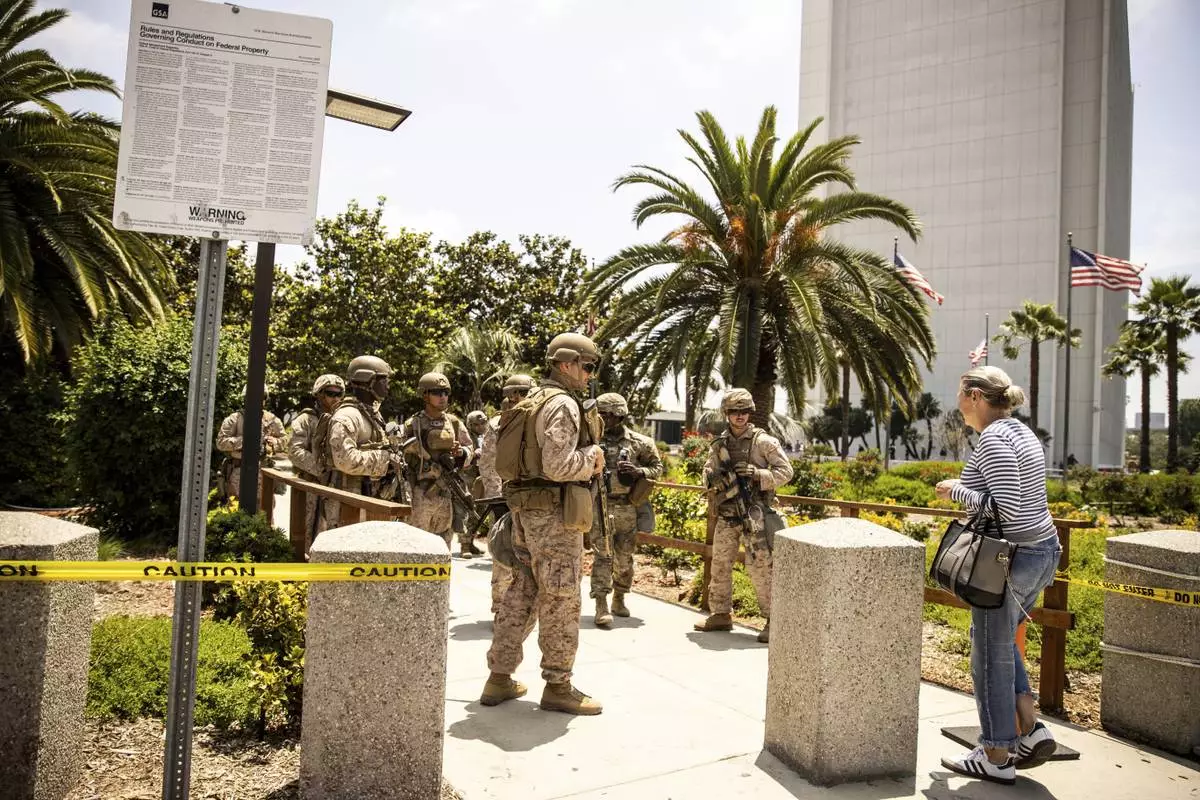
FILE - Members of the California National Guard and U.S. Marines, guard the entrance outside the Wilshire Federal in Los Angeles, June 13, 2025. (Stephen Lam/San Francisco Chronicle via AP, File)

FILE - Members of the California National Guard and U.S. Marines, guard the entrance outside the Wilshire Federal in Los Angeles, June 13, 2025. (Stephen Lam/San Francisco Chronicle via AP, File)

FILE - Protesters stand off against California National Guard soldiers at the Federal Building in downtown Los Angeles during a "No Kings" protest, June 14, 2025. (AP Photo/Richard Vogel, File)
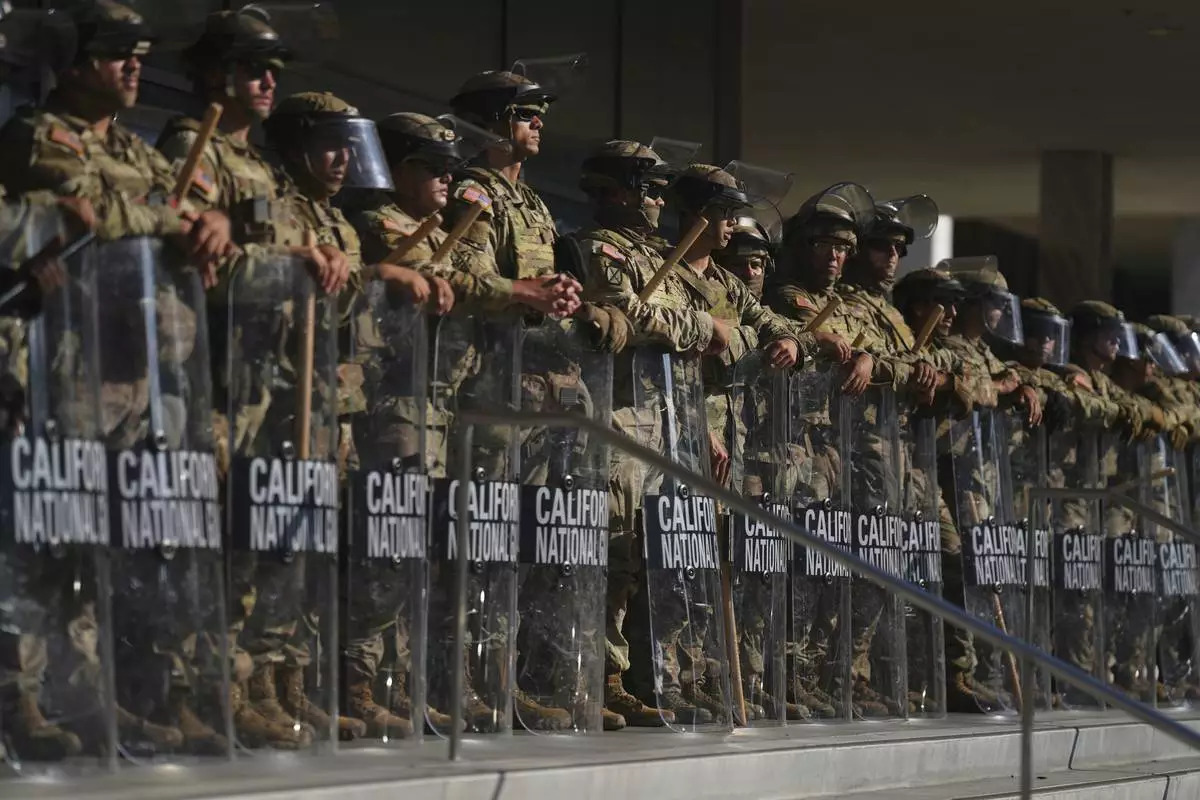
FILE - Protesters stand off against California National Guard soldiers at the Federal Building in downtown Los Angeles during a "No Kings" protest, June 14, 2025. (AP Photo/Richard Vogel, File)

FILE - California National Guard members are positioned at the Federal Building in downtown Los Angeles, on June 10, 2025. (AP Photo/Eric Thayer, File)
FILE - California National Guard members are positioned at the Federal Building in downtown Los Angeles, on June 10, 2025. (AP Photo/Eric Thayer, File)
CARACAS, Venezuela (AP) — Venezuelan opposition leader María Corina Machado comes to the White House on Thursday to discuss her country's future with President Donald Trump even after he publicly dismissed her credibility to take over after an audacious U.S. military raid captured then-President Nicolás Maduro.

Trump has raised doubts about his stated commitment to backing democratic rule in Venezuela. His administration has signaled its willingness to work with acting President Delcy Rodríguez, who was Maduro’s vice president and, along with others in the deposed leader’s inner circle, remains in charge of day-to-day governmental operations.

In endorsing Rodríguez so far, Trump has sidelined Machado, who has long been a face of resistance in Venezuela and sought to cultivate relationships with Trump and key administration voices like Secretary of State Marco Rubio among the American right wing in a gamble to ally herself with the U.S. government.

The White House says Machado sought the face-to-face meeting with Trump without setting expectations for what would occur. Her party is widely believed to have won 2024 elections rejected by Maduro. Machado previously offered to share with Trump the Nobel Peace Prize she won last year, an honor he has coveted.

Machado plans to have a meeting at the Senate following her lunch with Trump, who has called her “a nice woman” while indicating they might not touch on major issues in their talks Thursday.

Her Washington swing began after U.S. forces in the Caribbean Sea seized another sanctioned oil tanker that the Trump administration says had ties to Venezuela. It is part of a broader U.S. effort to take control of the South American country’s oil after U.S. forces seized Maduro and his wife at a heavily guarded compound in the Venezuelan capital of Caracas and brought them to New York to stand trial on drug trafficking charges.

The White House says Venezuela has been fully cooperating with the Trump administration since Maduro’s ouster.

Rodríguez, the acting president, herself has adopted a less strident position toward Trump and his “America First” policies toward the Western Hemisphere, saying she plans to continue releasing prisoners detained under Maduro — a move thought to have been made at the behest of the Trump administration. Venezuela released several Americans this week.

Trump, a Republican, said Wednesday that he had a “great conversation” with Rodríguez, their first since Maduro was ousted.

“We had a call, a long call. We discussed a lot of things,” Trump said during an Oval Office bill signing. “And I think we’re getting along very well with Venezuela.”

Even before indicating the willingness to work with Venezuela's interim government, Trump was quick to snub Machado. Just hours after Maduro's capture, Trump said of Machado that “it would be very tough for her to be the leader. She doesn’t have the support within or the respect within the country.”

Machado has steered a careful course to avoid offending Trump, notably after winning last year’s Nobel Peace Prize, which Trump wanted to win himself. She has since thanked Trump. Her offer to share the peace prize with him was rejected by the Nobel Institute.

Machado’s whereabouts have been largely unknown since she went into hiding early last year after being briefly detained in Caracas. She briefly reappeared in Oslo, Norway, in December after her daughter received the Nobel Peace Prize on her behalf.

The industrial engineer and daughter of a steel magnate began challenging the ruling party in 2004, when the nongovernmental organization she co-founded, Súmate, promoted a referendum to recall then-President Hugo Chávez. The initiative failed, and Machado and other Súmate executives were charged with conspiracy.

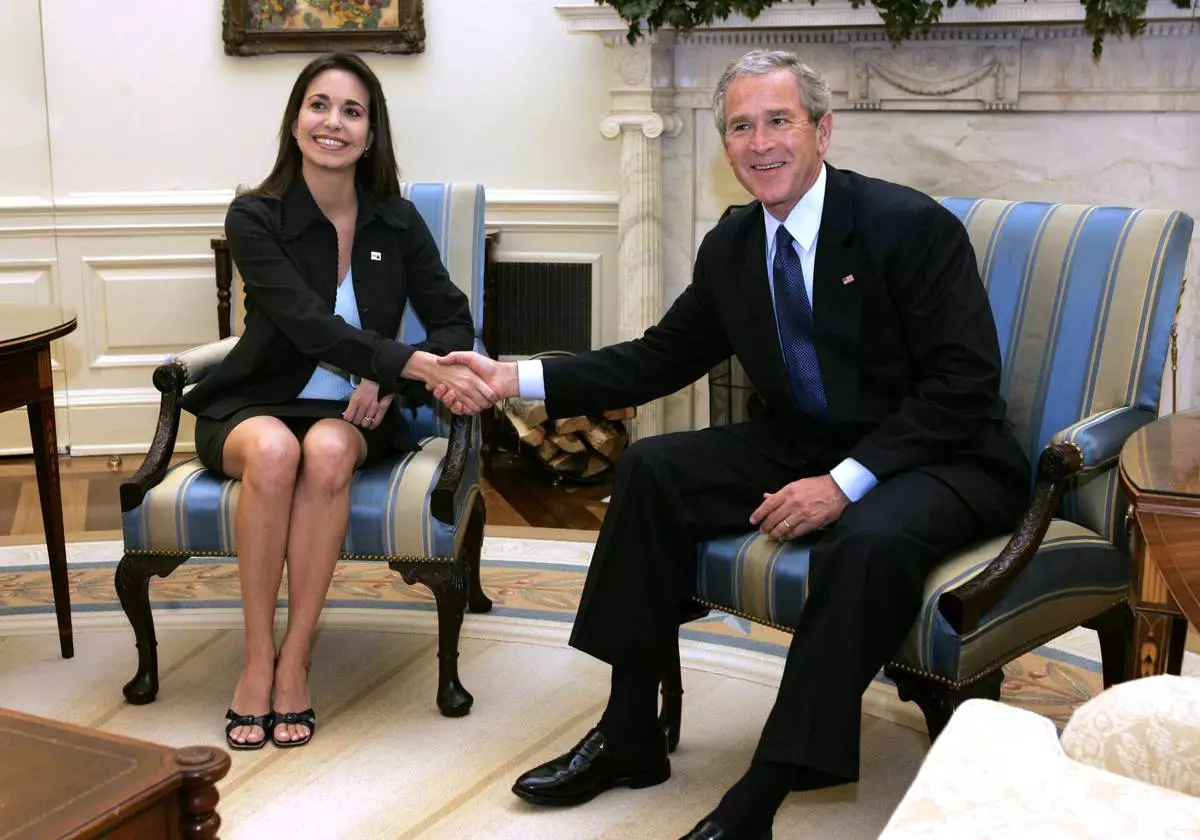
A year later, she drew the anger of Chávez and his allies again for traveling to Washington to meet President George W. Bush. A photo showing her shaking hands with Bush in the Oval Office lives in the collective memory. Chávez considered Bush an adversary.

Almost two decades later, she marshaled millions of Venezuelans to reject Chávez’s successor, Maduro, for another term in the 2024 election. But ruling party-loyal electoral authorities declared him the winner despite ample credible evidence to the contrary. Ensuing anti-government protests ended in a brutal crackdown by state security forces.

Garcia Cano reported from Caracas, Venezuela, and Janetsky from Mexico City. AP Diplomatic Writer Matthew Lee in Washington contributed to this report.

FILE - U.S. President George Bush, right, meets with Maria Corina Machado, executive director of Sumate, a non-governmental organization that defends Venezuelan citizens' political rights, in the Oval Office of the White House, Washington, May 31, 2005. (AP Photo/Charles Dharapak, File)

FILE - U.S. President George Bush, right, meets with Maria Corina Machado, executive director of Sumate, a non-governmental organization that defends Venezuelan citizens' political rights, in the Oval Office of the White House, Washington, May 31, 2005. (AP Photo/Charles Dharapak, File)

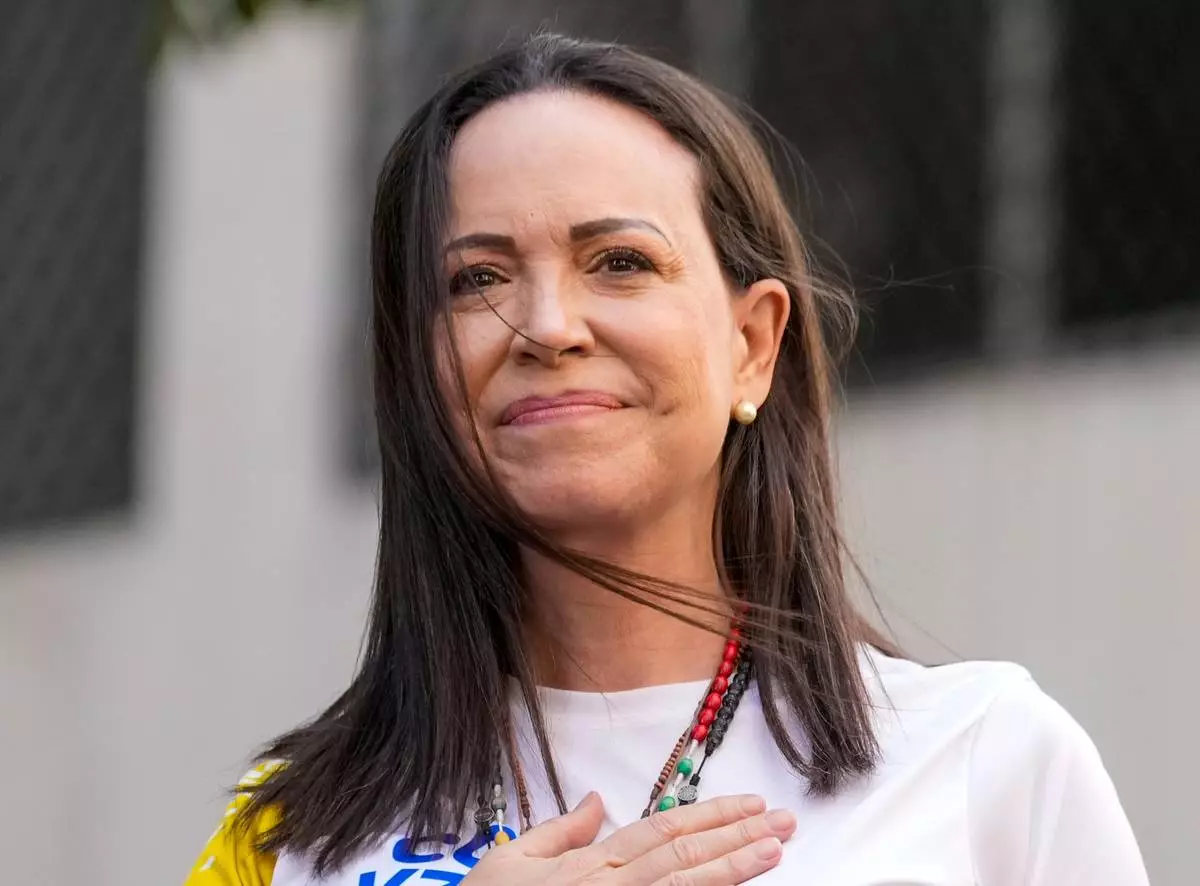
FILE - Opposition leader Maria Corina Machado gestures to supporters during a protest against President Nicolas Maduro the day before his inauguration for a third term, in Caracas, Venezuela, Thursday, Jan. 9, 2025. (AP Photo/Ariana Cubillos, file)

FILE - Opposition leader Maria Corina Machado gestures to supporters during a protest against President Nicolas Maduro the day before his inauguration for a third term, in Caracas, Venezuela, Thursday, Jan. 9, 2025. (AP Photo/Ariana Cubillos, file)

Recommended Articles