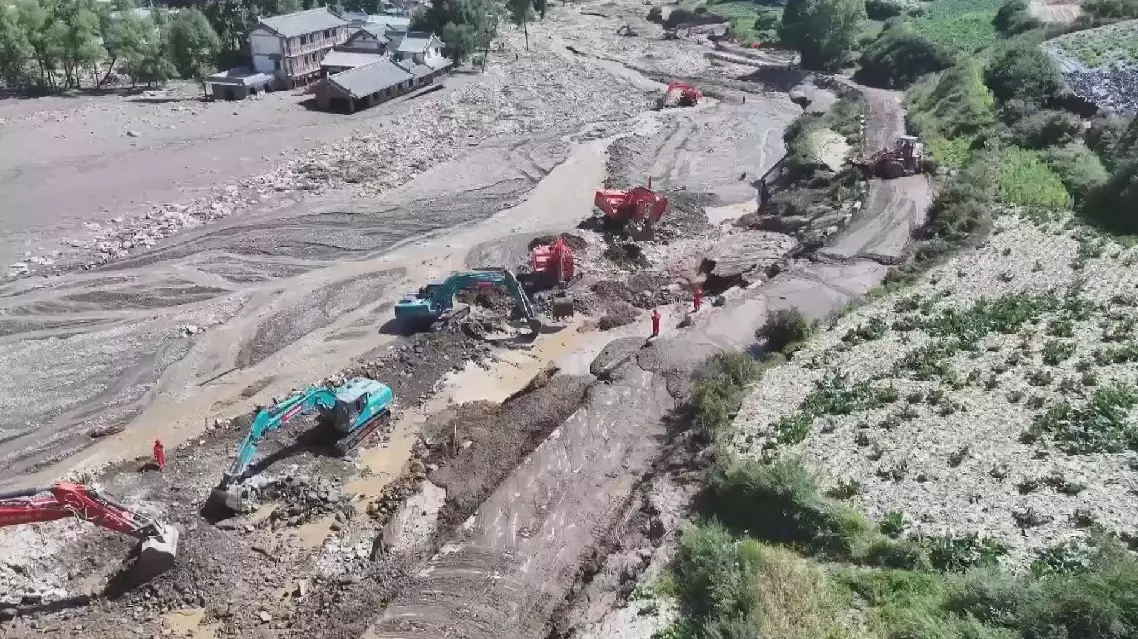
Post-disaster rural housing reconstruction in flood-hit areas has started in Yuzhong County, northwest China's Gansu Province, aiming to help affected residents move into new homes soon.
Torrential rain lashed Yuzhong and some other parts of Lanzhou City, the provincial capital, on August 7, triggering flash floods which have affected eight townships in Yuzhong, impacting over 2,000 residents from 485 households and damaging more than 2,500 houses.
"Our primary task is to conduct a preliminary seismic assessment of six resettlement sites initially selected by the government. Since this site is situated between the Maxian Mountain fault zone and the Xinglong Mountain fault zone, at a relatively close distance, we're here to determine its precise position, in order to provide scientific support for the government's subsequent decision making and the resettlement implementation," said Liu Xiaofeng, deputy director of the earthquake risk prevention center of Gansu Earthquake Agency.
To ensure the safety of residents, the county government has organized third-party agencies to conduct safety assessments of the damage to houses in affected villages.
Preliminary results show that approximately 80 homes need to relocate and rebuild in Maliantan Village, one of the hardest-hit areas.
Deputy head of Mapo Township, Wei Zhoujun, shared the considerations for a resettlement site from aspects of connection and traffic.
"First, the site needs to be close to the previous residential areas, allowing locals to stay concentrated. Placing a centralized resettlement zone here is convenient for infrastructure like water, electricity, road networks, and transportation. Additionally, it's near the Xinghuang Highway. These factors were comprehensively considered," said Wei.
In Shangzhuang Village, near Maliantan Village, a preliminary site for a centralized resettlement area capable of accommodating 20 affected households has also been designated.
"The advantages of this place are its higher elevation, flat terrain, and at a center of the Shangzhuang Village, right behind the villagers committee. The road access is also manageable, it's just a straight 200-meter stretch to the main road," said Chen Wankai, the Party chief of the Shangzhuang Village, Mapo Township.
Following the disaster, drones were used to take a great number of photos of Mapo's Maliantan and Jiuzhuanggou villages, producing post-disaster orthophoto maps of the two villages. Comparing these with the images shot in 2024 clearly reveals the extent of the flood impact.
Post-flood reconstruction starts in northwest China county
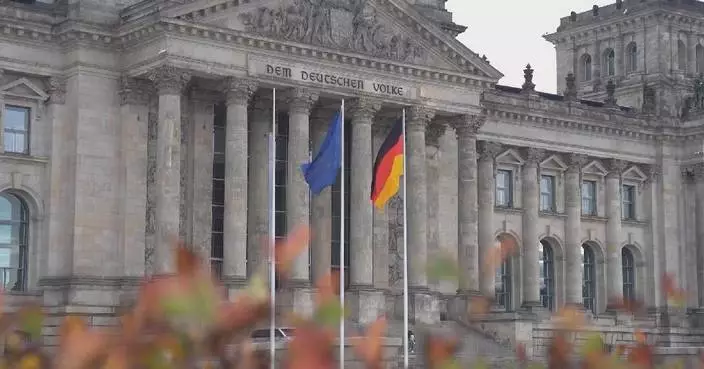
China and Germany, as major countries, should shoulder their responsibilities, uphold mutual respect, transcend differences in social systems, historical backgrounds and cultures, and build a more mature model of positive interaction and a more stable bilateral policy framework, Chinese Foreign Minister Wang Yi said on Monday in Beijing.
Wang, also a member of the Political Bureau of the Communist Party of China Central Committee, told German Foreign Minister Johann Wadephul that it is hoped that Germany will view China's development as an opportunity for deeper cooperation and a driving force for mutual benefit and win-win outcomes, and work together to promote the steady and healthy development of the China-Germany all-round strategic partnership.
Noting that this is the first visit to China by a German foreign minister since the formation of Germany's new government -- though the visit has encountered twists and turns -- Wang quoted a Chinese saying: "Good things come to those who wait." He emphasized that "the timing is not the key; what truly matters is the purpose. The visit should be for cooperation, not confrontation; for enhancing mutual understanding and trust, not widening differences."
Wang further urged Germany to encourage the EU to return to a rational and pragmatic China policy, adhere to the correct direction of mutually beneficial cooperation, resolve differences through dialogue, and avoid politicizing economic issues, instrumentalizing trade issues, or securitizing normal cooperation.
Wang emphasized that the one-China principle serves as an important political foundation for China-Germany relations, and there is no room for ambiguity. He further noted that unlike Germany, Japan has yet to conduct a thorough reflection on its history of aggression in the eight decades since the end of WWII.
Wadephul said that in the face of a turbulent global landscape, Germany and China need to shoulder special responsibilities, strengthen communication and coordination, and become reliable and predictable partners for each other.
He said that Germany remains firmly committed to the one-China policy, and this position is unwavering.
German enterprises in China have full confidence in the Chinese market and are willing to further deepen their presence in the country, Wadephul said, adding that Germany supports the EU and China in seeking mutual benefit and win-win outcomes through dialogue and stands ready to play a constructive role in this regard.
The two sides also exchanged views on the Ukraine crisis. Wadephul elaborated on Germany's position and expressed hope that China would leverage its influence to help bring about an early end to the crisis.
Wang reaffirmed China's consistent stance, emphasizing that all parties should cherish the current momentum for a political settlement, work towards the same goal, and ultimately reach a fair, durable and binding peace agreement through dialogue and negotiations.
China supports all efforts conducive to peace and will continue to play a constructive role in this regard, Wang added.
Chinese FM calls on China, Germany to shoulder responsibilities as major countries for more stable bilateral policy framework