China's data industry scale reached 5.86 trillion yuan (about 821.45 billion U.S. dollars) by the end of 2024, up 117 percent from the end of 2020, Liu Liehong, head of the National Data Administration, said at a press conference Thursday in Beijing.
Liu said the number of data-related enterprises in China had exceeded 400,000 by the end of 2024, and the sector is expected to maintain strong growth in the coming years.
By 2024, the average research and development investment of listed data companies increased by 79 percent compared with the end of 2020, with an average annual growth rate of 15.7 percent.
The Yangtze River Delta, one of China's most economically vibrant regions including cities of Shanghai, Hangzhou and Nanjing, gathered more than 100,000 data companies by the end of 2024.
The data industry scale in the Yangtze River Delta accounted for 22.6 percent of the national total by 2024.
Beijing, Shanghai, Guangzhou, Shenzhen and Hangzhou are playing leading roles in the data industrial development in the country with their advantages of rich resources, technological innovation and diverse application scenarios, according to the National Data Administration.
"This year, we plan to deploy a new batch of pilot projects for the construction of data industry clusters. With these new projects, we will continuously optimize the industrial layout and accelerate the formation of industrial ecology and scale advantages," Liu said.

China's data industry more than doubles in market size during 2021-2025 period
Geoeconomic confrontation is the leading short-term global threat in 2026, the World Economic Forum (WEF) warned in its Global Risks Report 2026 released on Wednesday ahead of its annual meeting in Davos, Switzerland.
The report ranks geoeconomic confrontation as the top risk for 2026, followed by interstate conflict, extreme weather, societal polarization, and misinformation and disinformation. It also identifies geoeconomic confrontation as the most severe risk over the next two years.
"I think if there is to be one key takeaway from the report, it's that we are entering an age of competition and this new competitive order is then shaping current global risks, but it is also shaping and to some extent hindering our ability to actually cope with them. That's really the key takeaway. If we take a look at, the number one risk both for 2026 and two years out, it's dual economic confrontation. But then if we look at the risks 10 years out. It's really the climate and environment related risks. All of these things require global cooperation and that's where we're seeing a big backsliding in this new age of competition," said Saadia Zahidi, managing director of the WEF.
Economic risks showed the largest increase in the two-year outlook, with concerns over economic downturns, inflation, rising debt and potential asset bubbles intensifying amid geoeconomic tensions, the report said.
Environmental risks remain the most severe overall, led by extreme weather, biodiversity loss and critical changes to Earth systems. The report noted that three-quarters of respondents expect a turbulent environmental outlook.
Risks related to adverse outcomes of artificial intelligence rose sharply, climbing from 30th in the two-year horizon to fifth in the 10-year outlook, reflecting concerns over impacts on labor markets, society and security.
The 21st edition of the report draws on views from more than 1,300 experts, policymakers and industry leaders.
The WEF's annual meeting will be held in Davos from Jan 19 to 23 and draw nearly 3,000 guests from more than 130 countries and regions to participate.
"So overall, we are starting to see this shift away from what have traditionally been the ways in which people have been able to cooperate. Now, that is not to say that any of this is a foregone conclusion. And I think that's a really important message around the risks report. None of this is set in stone. All of this is in the hands of leaders. Whether they choose to cooperate and invest in resilience or whether they do not. So that's really what we'll be focused on next week in Davos bringing leaders together under this overall theme of 'a spirit of dialogue' and trying to reestablish relationships, cooperation and trust. That's the fundamental," said Zahidi.
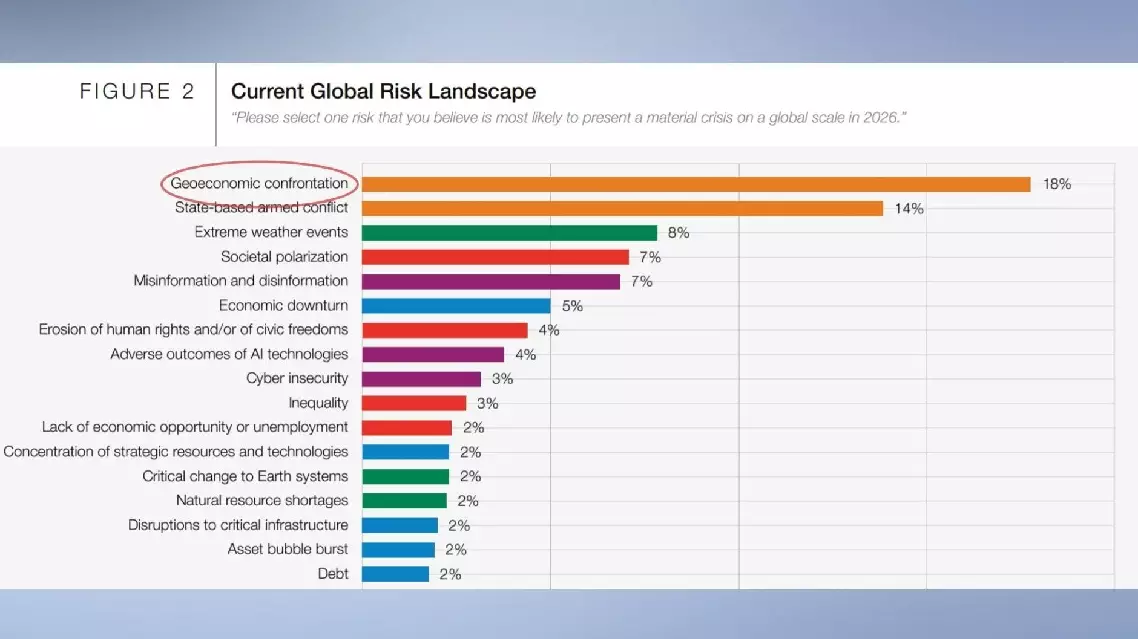
WEF warns of rising geoeconomic risks in 2026