Tibetan art has always been rooted in sacred traditions - but one visionary artist is redefining what it means to paint Xizang for the modern era.
For 25 years, Tseten Gyurme has crafted pieces that bridge past and present. At the Xizang Art Museum, a striking new cultural space on the outskirts of Lhasa, Tseten's dazzling piece entitled 'Bumian Zhongcai' (Heavy Color Painting on Cloth) is being displayed to showcase Xizang's evolving identity.
"Contemporary Tibetan heavy color painting on cloth emerged on the plateau during the 1970s and 1980s. It evolved from traditional Tibetan Thangka art and the meticulous brushwork of Chinese gongbi heavy color painting. By blending these techniques and thematic approaches, a new artistic school was born - one that combines the delicate precision of gongbi with the rich texture of oil paintings," Tseten Gyurme said.
To Tseten Gyurme, heavy color painting on cloth is the perfect medium to capture the unique culture, ecology and daily life of the Tibetan plateau. In July 2025, the Xizang Museum unveiled its new wing, and at its heart stood Tseten's masterpiece: Pearl of the Plateau. A collaboration of over 20 artists, this epic painting weaves together tradition and modernity - from the Potala Palace to new highways and stadiums, a living testament to Xizang's evolution.
"This work was completed by artists from Xizang's six major Thangka schools, taking a year and a half to finish. Over 20 painters participated, spanning three generations - veterans, mid-career artists, and young talents - including esteemed inheritors and leaders of each school. The painting captures everything from tradition to modernity: The Potala Palace, the 13th Five-Year Plan's infrastructure projects, and newly built stadiums. Its themes and scope are vast. It stands as a permanent display of Thangka, an intangible cultural heritage, in a contemporary museum," Tseten said of the grand painting.
Tseten's genius lies in finding harmony across cultures. His work reimagines legends, like linking the mythical figure Yu the Great (who tamed floods) in Central Plains culture with Xizang's bridge-building hero, Thangtong Gyalpo - two pioneers separated by millennia, yet united in spirit.
"Yu the Great controlled the floods and passed his home three times without entering. That's a story dating back to around 2000 BCE. To me, he resonates deeply with Xizang's master bridge-builder, Thangtong Gyalpo. Though they lived in different eras, their charisma and the emotional impact they inspire are strikingly similar. In my work, I incorporated elements from traditional Thangka and motifs from Han Dynasty tomb murals in Wu Liang Shrine, seeking shared values across cultures," said Tseten Gyurme.
In Tseten Gyurme's art, every stroke asks: What does it mean to be Tibetan today? The artist is always committed to his artistic standards.
"Many of my pieces stem from immediate inspiration. Creation is a journey across time - it must move me first. My artistic drive hinges on whether the piece resonates with me - only then can it touch others," Tseten said.
That passion resonates globally. His innovative installation "Time and Buddha" stunned audiences in France and Germany - merging Tibetan motifs with Greenwich time zones.
"I mapped Greenwich's 12 time zones onto 12 cultural landmarks. In this heavy color painting on cloth, I embedded actual clock hands representing each time zone. This work was exhibited throughout France and Germany. I initially worried the concept might feel forced or fail to connect with other cultures. But the response was overwhelming. Xizang isn't confined to traditional Thangka - this fresh expression left them intrigued," said Tseten Gyurme.
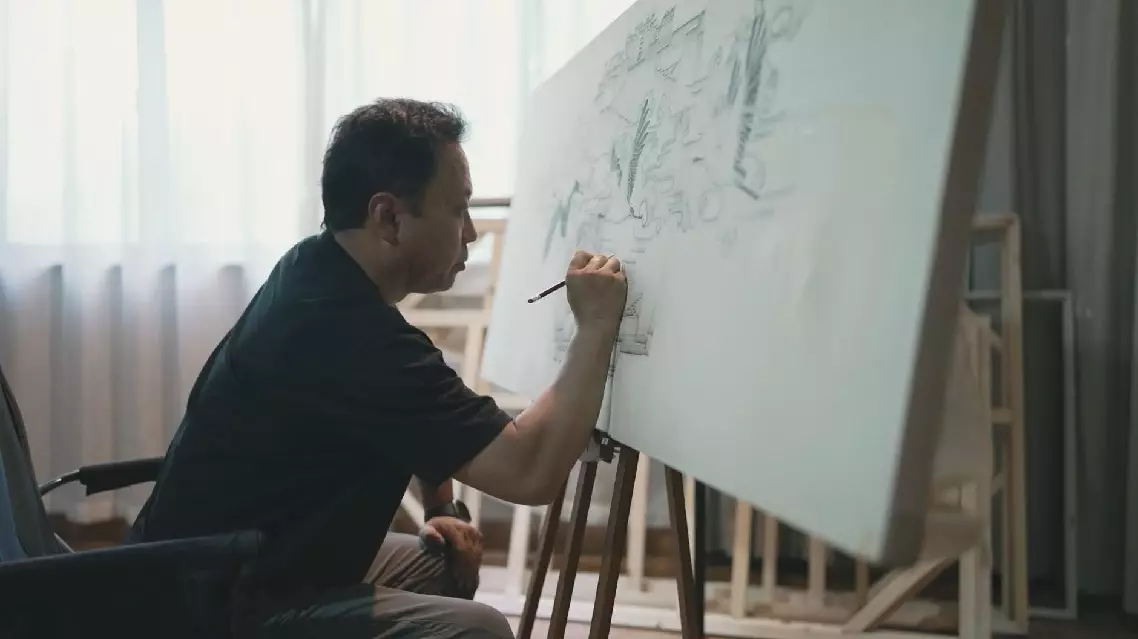
Visionary artist Tseten Gyurme redefines Tibetan art