For 100 years, The Associated Press has honored the best of the best in college football with its annual All-America team.
Nearly 2,000 men — from Red Grange to Travis Hunter — have earned the distinction of AP All-American in a tradition that rivals the longest in the history of the game.
Click to Gallery
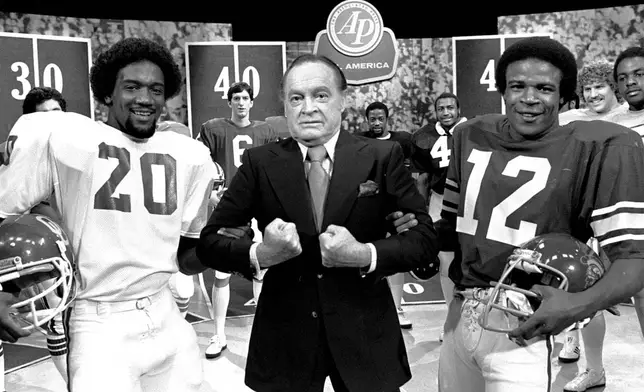
FILE - Comedian Bob Hope is pictured at a taping session Monday, Dec. 10, 1979, in NBC's Burbank Studios with members of the Associated Press All-America football team. With Hope are: Billy Sims of Oklahoma, left, and Charles White of USC, Heisman Trophy winner. Sims won the Heisman Trophy in 1978. (AP Photo/Wally Fong, File)
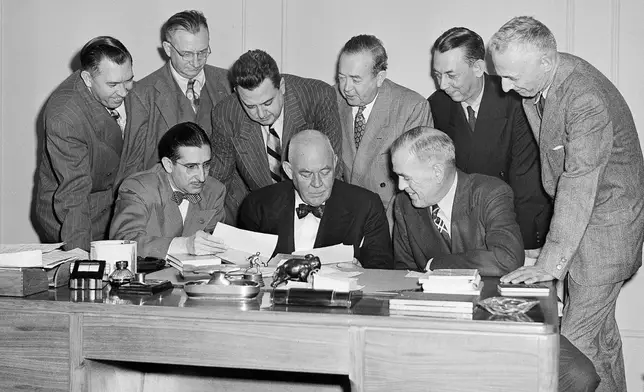
FILE - A group of sportswriters confer with Grantland Rice, noted sports authority, seated at center, in Chicago, Nov. 13, 1949, to select Look Magazine's All-America college football team. Seated, from left: Hal Middlesworth, Daily Oklahoman; Rice; and Bert McGrane, Des Moines Register. Standing from left: Raymond Johnson, Nashville Tennessean; Francis Powers, Chicago Daily News; Tim Cohane, Look Magazine; Charley Johnson, Minneapolis Star; Bill Leiser, San Francisco Chronicle, and HG. Salsinger, Detroit News. (AP Photo/Paul Cannon, File)
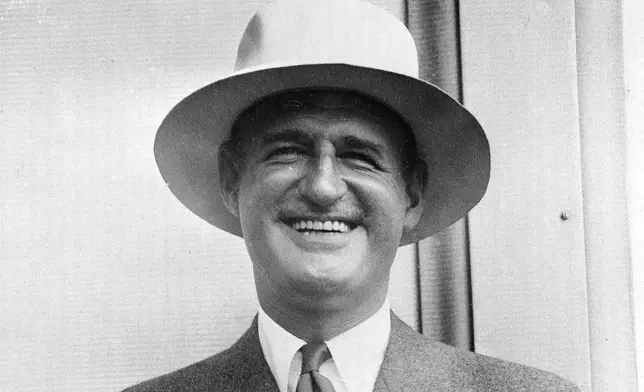
FILE - Former football player Walter Camp Jr., is shown at the Yale Club in New York, on Sept. 24, 1929. (AP Photo/File)
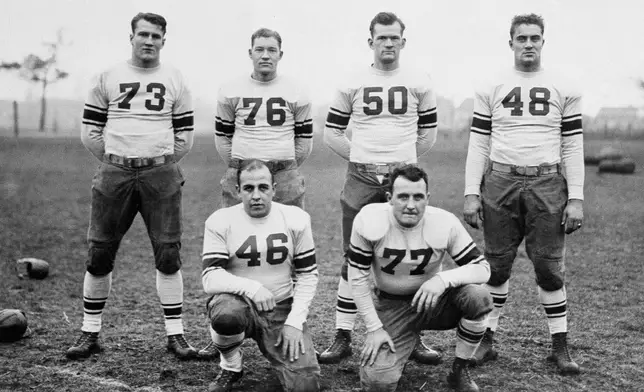
Six outstanding stars on Coach Hanley's squad that will represent the East in the East-West Game at San Francisco on New Year's Day pose Dec. 17, 1929. They are, standing from left, Bronko Nagurski, Minnesota; Tony Holm, Alabama; Elmer Sleight, Purdue, Ted Twomey, Notre Dame: kneeling from left, Willis Glasgow, Iowa; and Jack Cannon, Notre Dame. (AP Photo/File)
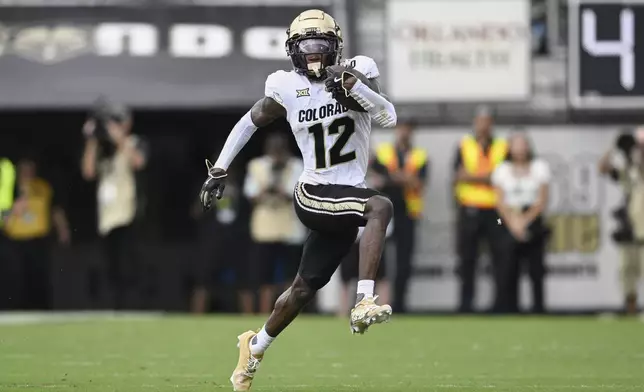
FILE - Colorado wide receiver Travis Hunter (12) runs after catching a pass during the first half of an NCAA college football game against Central Florida, Saturday, Sept. 28, 2024, in Orlando, Fla. (AP Photo/Phelan M. Ebenhack, File)
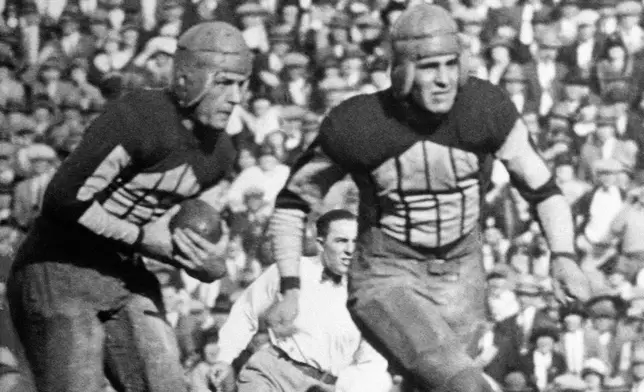
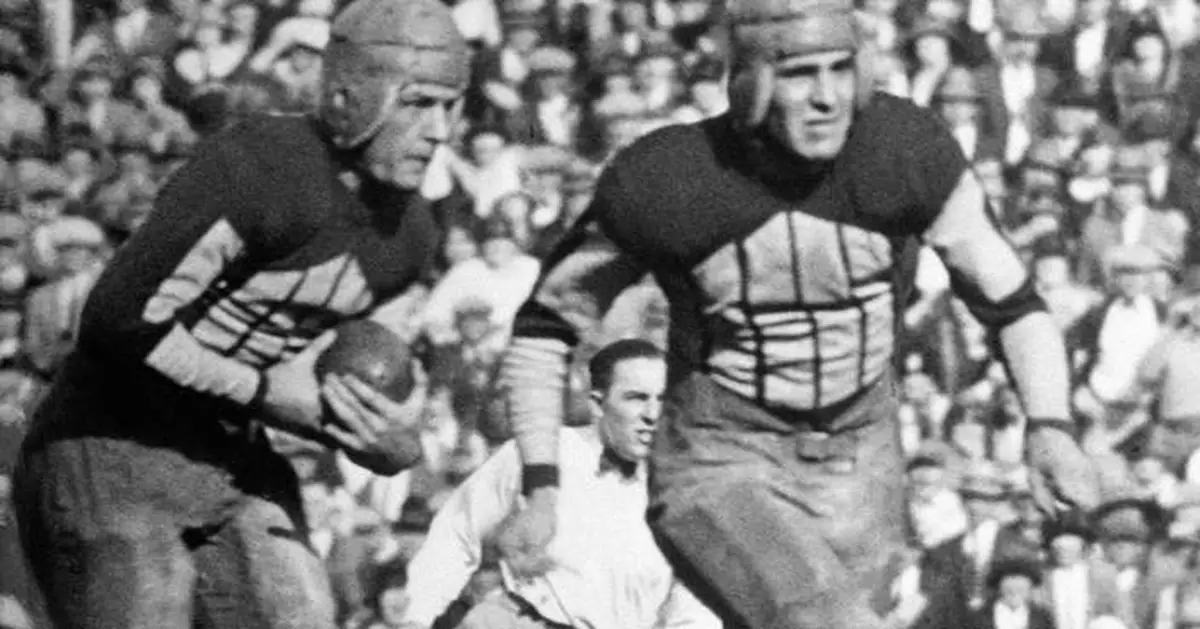
FILE - Illinois' Red Grange, left, follows a blocker on a 95-yard kickoff return for a touchdown against Michigan during a college football game on Oc.t 18, 1924, in Champaign, Ill. (AP Photo/File)
“For anyone named an AP All-America, the honor has immediate cachet,” said John Heisler, who worked in media relations at Notre Dame for 41 years and is the author of 11 books on the Irish's football history. “If anyone received multiple All-America honors, it always seemed like the AP recognition would be at the top of the list.”
Notre Dame leads all schools with 85 AP first-team picks since the news organization's All-America honors debuted in 1925. The Irish are followed by Alabama (83), Ohio State (79), Southern California (77) and Oklahoma (75).
The Southeastern Conference has had the most first-team picks with 340. The Big Ten has had 331. Independents, which anchored the sport's power structure into the 1950s, have had 309.
There have been 204 players twice named first-team All-American, including 12 three-time picks.
Malcolm Moran, who covered college football for four decades at The New York Times and other major newspapers, said the AP All-America team drove growth of the sport because it introduced football stars to pockets of the country where exposure to the game was limited to newsreels.
“The thing that connected 3,000 miles of players," said Moran, now director of the Sports Capital Journalism Program at IU Indianapolis, “was the AP All-America team.”
It still does.
“The AP All-America teams are probably the most consistent throughout the last 100 years and have been considered the measure most often used when chronicling the history of college football’s greatest players,” said Claude Felton, who retired as senior associate athletic director at Georgia last year after overseeing the Bulldogs' sports communications for 45 years.
Walter Camp, regarded as the “Father of Football,” is credited with being the first to honor the top players across the college game. Camp starred as a player at Yale and later was its coach, and he was the sport's chief rules maker and ambassador in the early days. He saw football as a means to develop manly traits necessary for success in the male-dominated corporate and industrial worlds at the turn of the 20th century, Camp biographer Julie Des Jardins said.
Camp named 11 players to his first All-America team, in 1889, and their names appeared in This Week’s Sport, a publication owned by Camp associate Caspar Whitney. Camp selected All-America teams every year until his death, in 1925. Famed sports writer Grantland Rice selected the Walter Camp teams into the 1950s, and coaches and college sports information directors have picked the teams for the Walter Camp Football Foundation since the 1960s.
What constitutes an All-American has evolved since the days of Camp, who didn’t necessarily look at the All-Americans as individual standouts. To Camp, it was more about team.
“He almost looked at them as the ones who were doing all the work under the hood,” Des Jardins said. “He really glorified the center because you could barely see what he was doing. But the center was essential. And he also was part of the machine that made the machine work better than the sum of its parts.”
By the 1920s, when a multitude of media outlets were naming All-America teams, individual performance was the main criteria. Grange, Bronko Nagurski, Davey O’Brien, Glenn Davis and Doc Blanchard became synonymous with gridiron greatness in an era when sports fans relied on the nation’s sports pages and magazines to be arbiters of who was best.
The NCAA football record book lists 22 organizations that have named All-America teams, and there have been dozens of others. Most have come and gone.
Like Camp, Alan J. Gould, the AP sports editor in the 1920s and ’30s, saw All-America teams as a way to promote the sport and create a national conversation. He unveiled the inaugural All-America team the first week of December in 1925.
Those early teams were selected by consensus of “prominent eastern coaches,” according to dispatches at the time. As it was then and remains today, the picks can be fodder for debate, the conversation around game days and postseason hopes.
In a write-up about that inaugural team, it was noted that Dartmouth coach Jess Hawley chose three of his own players — not surprising given the undefeated team's dominance that year — but one of his omissions prompted second guessing.
“Hawley honors three of his own stars, Parker, Diehl and Oberlander with places on the team but does not pick his brilliant end, Tully, who has been placed on nearly every all-star team named so far," the AP story said. No worries. George Tully got enough votes from other coaches to make the AP All-America team anyway.
The methods for selecting the AP All-America teams have varied over the years. Coaches' picks gave way to a media panel headed by the AP sports editor and made up of sports writers from the AP and newspapers across the nation. Later, the teams were picked by a small group of AP sports writers. For the past two decades, the teams have been selected by some five dozen media members who vote in the weekly AP Top 25 football poll.
“The AP was the one I that cared about -- the writers telling me that I was the player that deserved to be All-American,” 2004 All-America receiver Braylon Edwards of Michigan said. "That was the one that I was waiting for.”
Exposure for the AP All-America team was elevated when selected players were featured during a segment of entertainer Bob Hope's Christmas television special. Each player, including the likes of Earl Campbell, Billy Sims and Marcus Allen, would jog on stage. Hope would make a funny remark and then the next player would come out. The tradition lasted 24 years, until 1994.
“That’s the first thing I thought of when I saw ‘AP All-American.’ I thought of Bob Hope," Moran said.
Where the AP once was the chief purveyor of national college football news, there are now myriad outlets where fans can get their fix. But through all the changes in the media landscape, the AP All-America team has endured and continues to have the most gravitas.
“This," Moran said, “has been the gold standard.”
Associated Press data journalist Michaela Herbst contributed from San Francisco; AP Sports Writer Larry Lage contributed from Ann Arbor, Michigan.
Get poll alerts and updates on the AP Top 25 throughout the season. Sign up here. AP college football: https://apnews.com/hub/ap-top-25-college-football-poll and https://apnews.com/hub/college-football
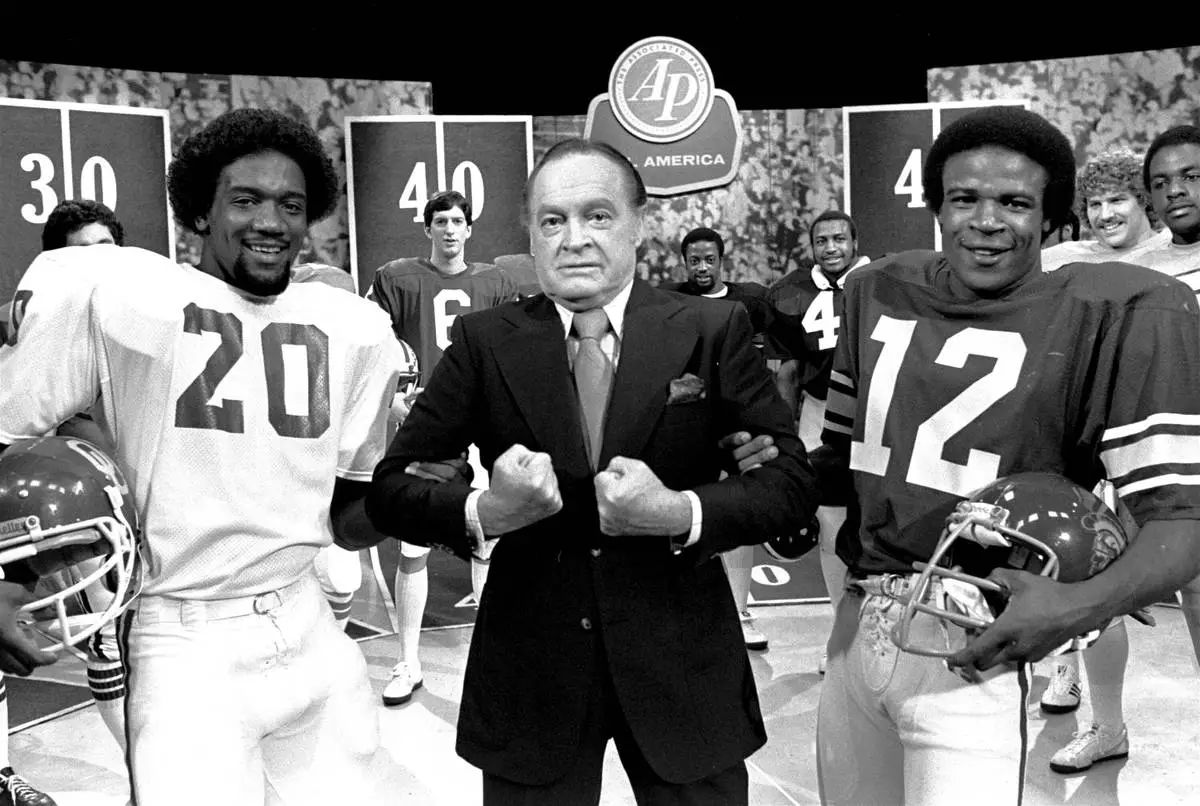
FILE - Comedian Bob Hope is pictured at a taping session Monday, Dec. 10, 1979, in NBC's Burbank Studios with members of the Associated Press All-America football team. With Hope are: Billy Sims of Oklahoma, left, and Charles White of USC, Heisman Trophy winner. Sims won the Heisman Trophy in 1978. (AP Photo/Wally Fong, File)
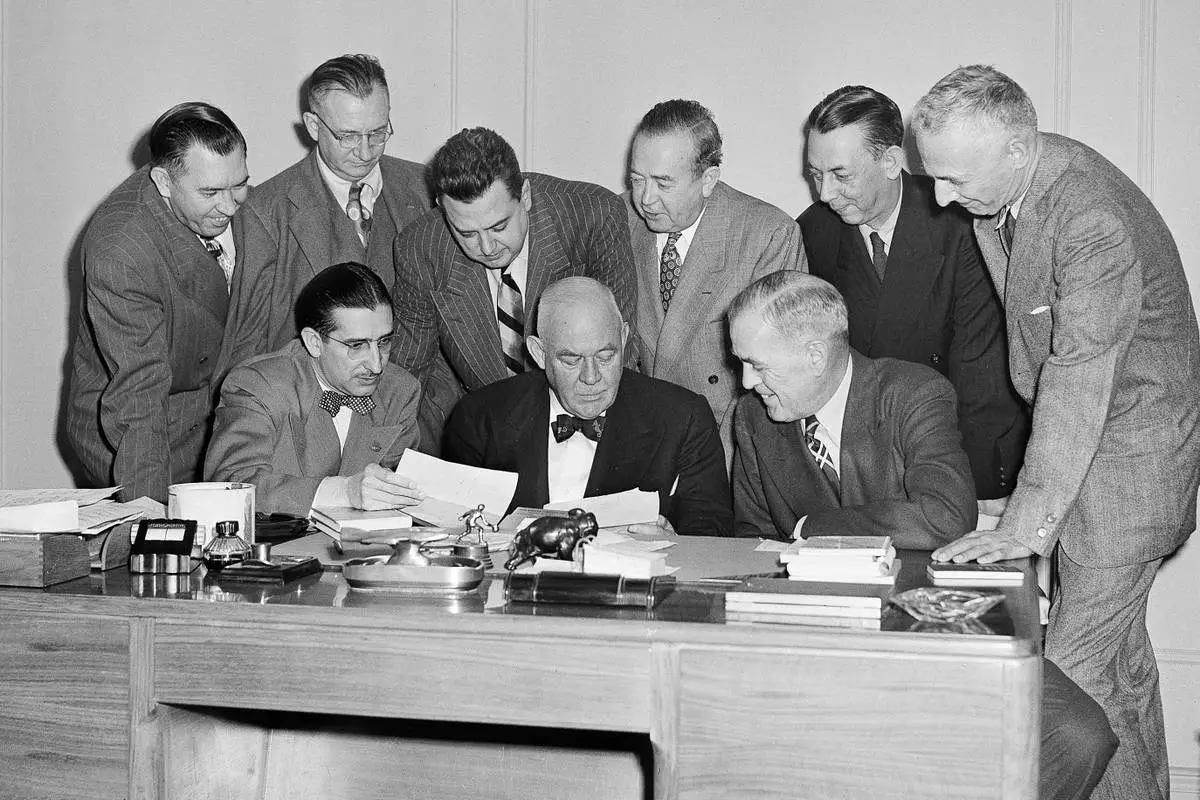
FILE - A group of sportswriters confer with Grantland Rice, noted sports authority, seated at center, in Chicago, Nov. 13, 1949, to select Look Magazine's All-America college football team. Seated, from left: Hal Middlesworth, Daily Oklahoman; Rice; and Bert McGrane, Des Moines Register. Standing from left: Raymond Johnson, Nashville Tennessean; Francis Powers, Chicago Daily News; Tim Cohane, Look Magazine; Charley Johnson, Minneapolis Star; Bill Leiser, San Francisco Chronicle, and HG. Salsinger, Detroit News. (AP Photo/Paul Cannon, File)
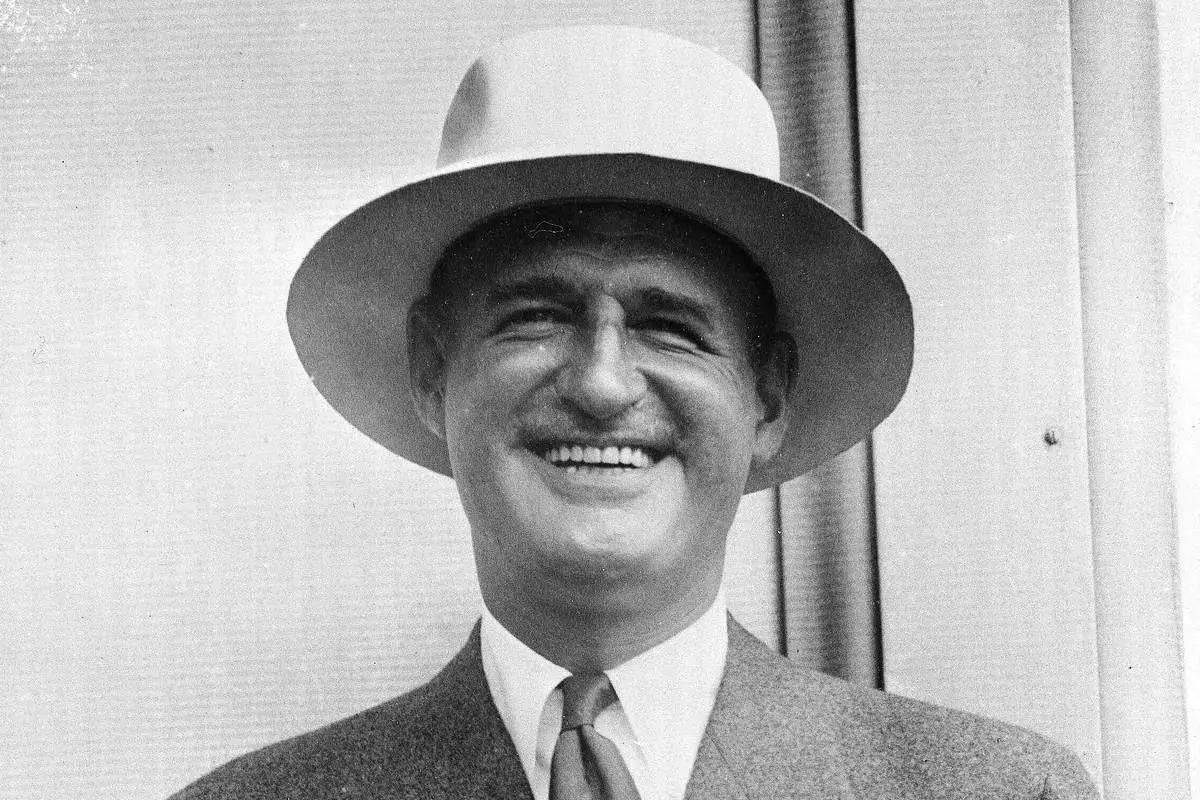
FILE - Former football player Walter Camp Jr., is shown at the Yale Club in New York, on Sept. 24, 1929. (AP Photo/File)
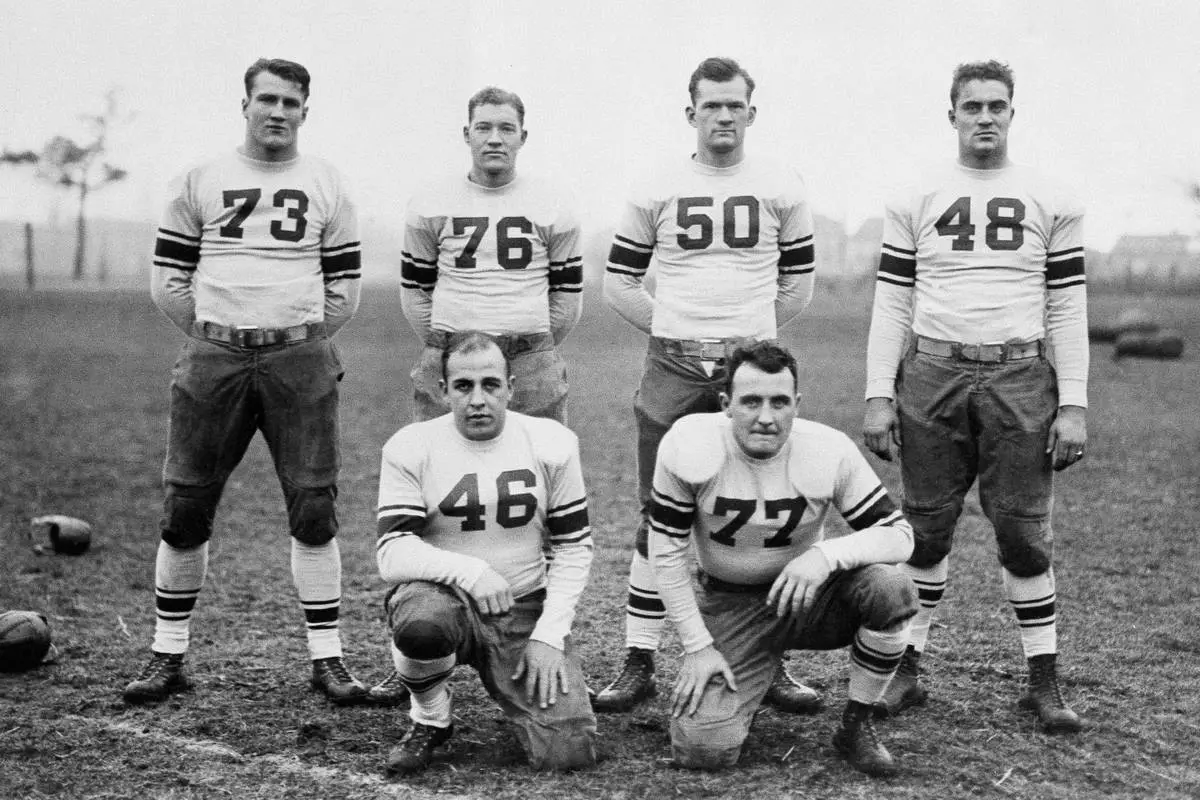
Six outstanding stars on Coach Hanley's squad that will represent the East in the East-West Game at San Francisco on New Year's Day pose Dec. 17, 1929. They are, standing from left, Bronko Nagurski, Minnesota; Tony Holm, Alabama; Elmer Sleight, Purdue, Ted Twomey, Notre Dame: kneeling from left, Willis Glasgow, Iowa; and Jack Cannon, Notre Dame. (AP Photo/File)
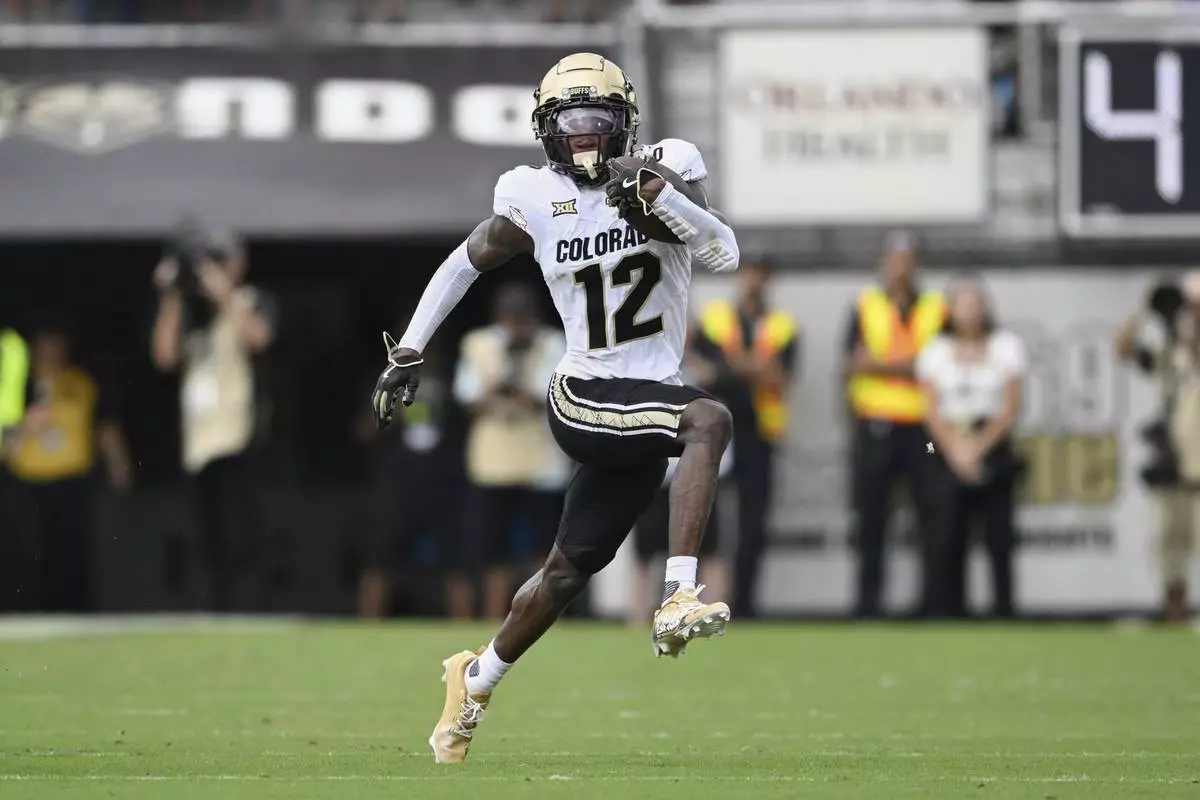
FILE - Colorado wide receiver Travis Hunter (12) runs after catching a pass during the first half of an NCAA college football game against Central Florida, Saturday, Sept. 28, 2024, in Orlando, Fla. (AP Photo/Phelan M. Ebenhack, File)
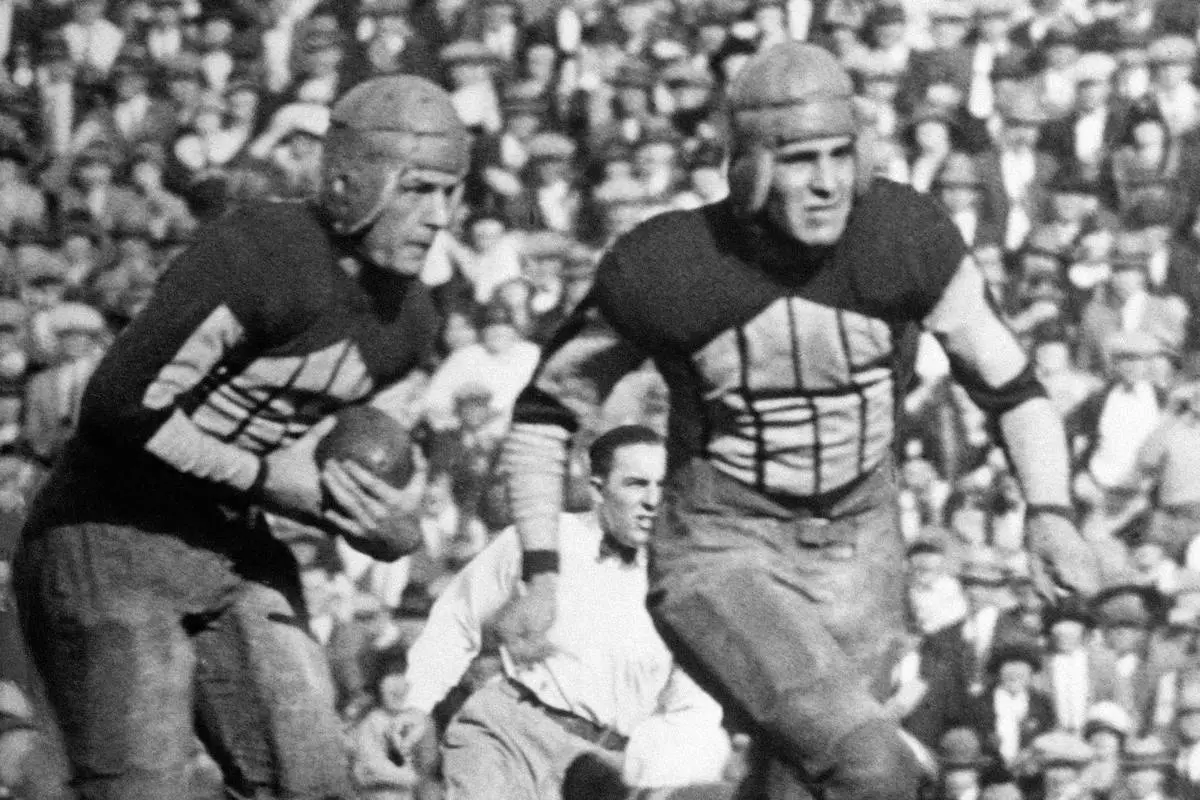
FILE - Illinois' Red Grange, left, follows a blocker on a 95-yard kickoff return for a touchdown against Michigan during a college football game on Oc.t 18, 1924, in Champaign, Ill. (AP Photo/File)