DUBAI, United Arab Emirates (AP) — Iran’s Supreme Leader Ayatollah Ali Khamenei on Saturday branded U.S. President Donald Trump a “criminal” for supporting protesters in Iran, and blamed demonstrators for causing thousands of deaths.
In a speech broadcast by state television, Khamenei said the protests had left “several thousand” people dead — the first indication from an Iranian leader of the extent of the casualties from the wave of protests that began Dec. 28 and led to a bloody crackdown.
“In this revolt, the U.S. president made remarks in person, encouraged seditious people to go ahead and said: ‘We do support you, we do support you militarily,'" said Khamenei, who has final say on all state matters. He reiterated an accusation that the U.S. seeks domination over Iran’s economic and political resources.
“We do consider the U.S. president a criminal, because of casualties and damages, because of accusations against the Iranian nation,” he said. He described the protesters as “foot soldiers” of the United States and said they had destroyed mosques and educational centers. “Through hurting people, they killed several thousand of them,” he said.
In response, Trump called for an end to Khamenei’s nearly 40-year reign.
“The man is a sick man who should run his country properly and stop killing people,” Trump told Politico in an interview Saturday. “His country is the worst place to live anywhere in the world because of poor leadership.”
“It’s time to look for new leadership in Iran," he added.
The back-and-forth rhetoric came a day after Trump sounded a conciliatory tone, saying that “Iran canceled the hanging of over 800 people,” and adding that “I greatly respect the fact that they canceled.” He did not clarify whom he spoke to in Iran to confirm the state of any planned executions. His comments were a sign he may be backing away from a military strike.
The official IRNA news agency reported that Tehran Prosecutor Gen. Ali Salehi, referring to Trump's remarks about the cancellation of the death sentence of 800 protesters, said: “Trump always makes futile and irrelevant statements. Our attitude is severe, preventive and fast.” He did not elaborate.
In recent days, Trump had told protesting Iranians that “ help is on the way ” and that his administration would “act accordingly” if the killing of demonstrators continued or if Iranian authorities executed detained protesters.
In his speech, Khamenei said rioters were armed with live ammunition that was imported from abroad, without naming any countries.
“We do not plan, we do not take the country toward war. But we do not release domestic offenders, worse than domestic offenders; there are international offenders. We do not let them alone either,” he said, and urged officials to pursue the cases.
Iran has returned to an uneasy calm after harsh repression of protests that began Dec. 28 over Iran’s ailing economy. The crackdown has left at least 3,308 people dead, according to the U.S.-based Human Rights Activists News Agency, exceeding that of any other round of protest or unrest in Iran in decades and recalling the chaos surrounding the 1979 revolution.
The agency has been accurate throughout the years of demonstrations, relying on a network of activists inside Iran that confirms all reported fatalities. The AP has been unable to independently confirm the toll.
Iranian officials have repeatedly accused the United States and Israel of fomenting unrest in the country. On Friday, Iran’s President Masoud Pezeshkian, in a phone conversation with Russian President Vladimir Putin, accused the U.S. and Israel of meddling in the unrest.
There have been no signs of protests for days in Tehran, where shopping and street life have returned to normal, and Iranian state media have not reported any new unrest.
During the protests, authorities blocked all internet access on Jan. 8. On Saturday, text messaging and very limited internet services began functioning again briefly in parts of Iran, witnesses said.
Cellphone text messaging began operating overnight, while users were able to access local websites through a domestic internet service. Some also reported limited access to international internet services via the use of a virtual private network, or VPN.
The extent of access and what was behind it wasn’t immediately clear. It's possible that officials were turning on some systems for the start of the Iranian working week, as the outage has affected businesses, particularly banks in the country, trying to handle transactions.
Internet traffic monitoring service Cloudflare and internet access advocacy group NetBlocks reported very slight increases in connectivity Saturday morning, while Iran’s semiofficial Mehr news agency also reported limited internet access. It did not offer an explanation.
A call by Iran’s exiled Crown Prince Reza Pahlavi for protesters to take to the streets again from Saturday to Monday did not appear to have been heeded by Saturday afternoon.
Pahlavi, whose father was overthrown by Iran’s 1979 Islamic Revolution, enjoys support from die-hard monarchists in the diaspora but has struggled to gain wider appeal within Iran. However, that has not stopped him from presenting himself as the transitional leader of Iran if the government were to fall.
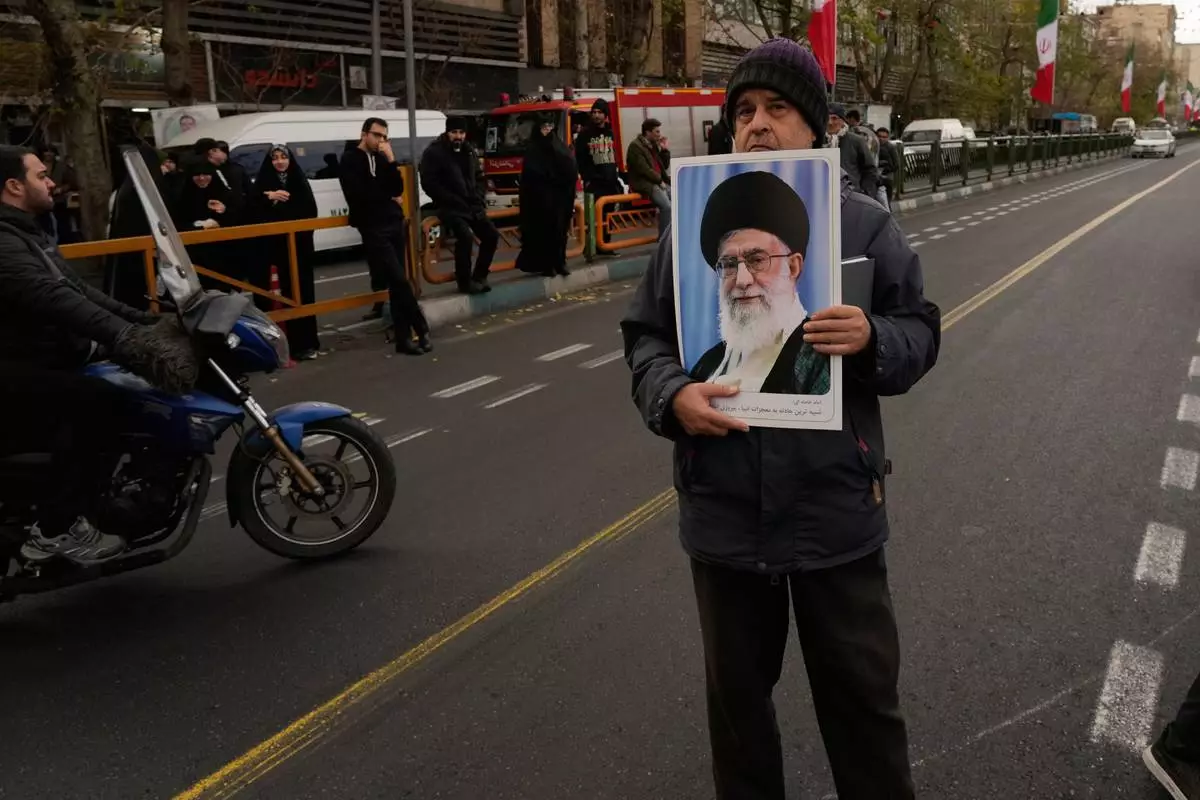
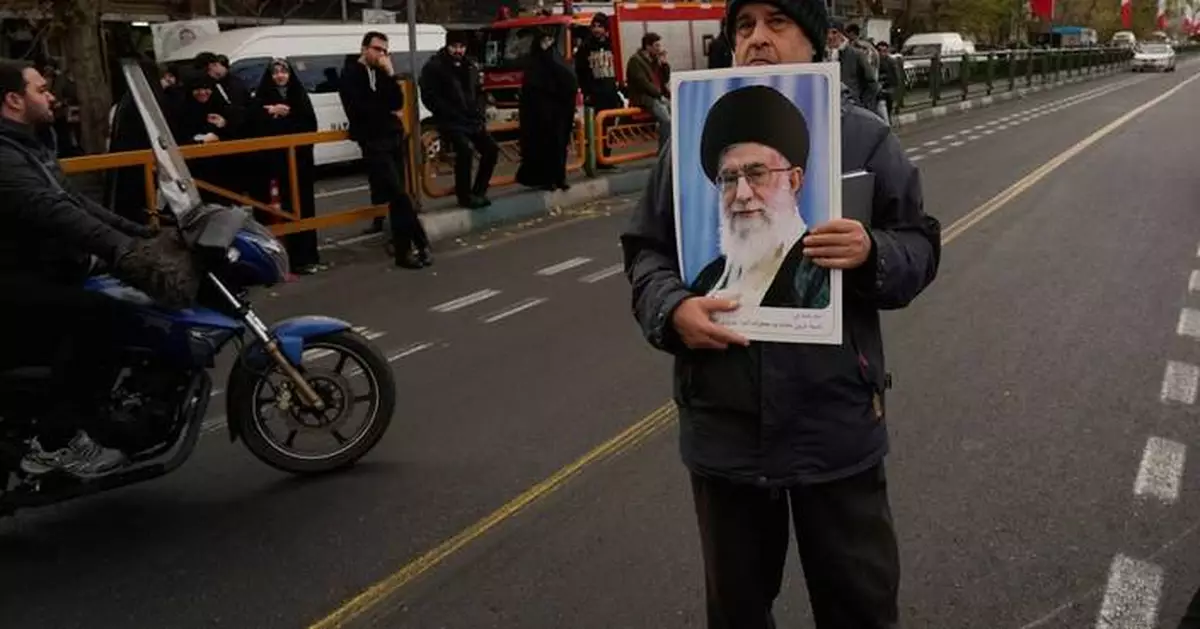
A man holds a poster of the Iranian Supreme Leader Ayatollah Ali Khamenei during a funeral ceremony for a group of security forces, who were killed during anti-government protests, in Tehran, Iran, Wednesday, Jan. 14, 2026. (AP Photo/Vahid Salemi)
WASHINGTON (AP) — Since starting a war with Iran caused oil and gasoline prices to spike, President Donald Trump has pivoted from a focus on keeping energy prices low to trying to paint high oil prices as a positive.
The about-face comes as Trump's team has struggled to offer a clear plan for opening up the critical Strait of Hormuz so that tankers full of oil and natural gas are no longer stranded — even as the administration took a series of decisions to try to quickly stabilize surging prices.
“The United States is the largest Oil Producer in the World, by far, so when oil prices go up, we make a lot of money,” Trump said Thursday on his social media site.
It was only last month, in his State of the Union address, that Trump had bragged about gas prices at $2.30 a gallon, a figure that has since soared more than 50% to a national average of $3.60 a gallon, according to AAA.
The flip-flop shows Trump's political interests at home are suddenly at odds with his desire to flex America’s muscles on the global stage. It comes at a precarious time for Trump's party, ahead of the November midterm elections. Trump has said that high gas prices helped him defeat his predecessor, Joe Biden. But he told reporters on Saturday that he had no worries about the rising costs that could influence voters this year, and create pressure for him to end the conflict prematurely.
The investment bank Goldman Sachs on Thursday said that based on its forecasts and historic experience, higher oil prices would cause inflation to be higher, growth to be slower and the unemployment rate to increase by the end of the year.
Normally, about 20 million barrels of oil pass through the Strait of Hormuz each day, but most tankers are now avoiding it. Benchmark oil prices have swung violently with the uncertainty, and on Thursday the global crude oil benchmark price jumped to $100 a barrel.
“The swings in Brent crude oil prices over the past several days are eye-catching and odds are volatility will remain because of the absence of a timeline for when the conflict will deescalate and when the Strait of Hormuz, which is effectively closed, will see traffic begin to recover,” analysts at the consultancy Oxford Economics concluded on Wednesday.
The president has given a series of contradictory messages about his plans to address this issue. He said in a Monday news conference that the Strait of Hormuz “is going to remain safe” well after it was identified as a danger zone, claiming that the presence of the U.S. Navy and insurance for tankers would keep things secure.
By Tuesday, he said on Truth Social that Iran would face “Military consequences” that would be “at a level never seen before” if it placed mines in the Strait of Hormuz, later stressing that the U.S. military was blowing up Iran’s mine-laying ships.
On Wednesday, Trump's Energy Secretary Chris Wright briefly posted that the U.S. Navy had escorted a tanker through the strait — later deleting the false claim.
Trump on Wednesday had said “the straits are in great shape” and said he thought oil companies should use them. But on Thursday, Wright could not provide a timeline on when the U.S. Navy might escort tankers through the strait. “It’ll happen relatively soon, but it can’t happen now,” Wright told CNBC. “We’re simply not ready. All of our military assets right now are focused on destroying Iran’s offensive capabilities.”
Wright acknowledged the conflict was causing “a significant disruption” in short-term gas prices, but sought to emphasize the long-term benefits of an Iran that no longer poses a threat to the U.S. and Middle Eastern nations.
Late on Thursday, the Treasury Department announced that it would take another step to free up Russian oil stranded on tankers at sea due to U.S. sanctions for its war on Ukraine, granting a license to waive those sanctions for a month. That builds on a move last week to give India temporary permission to buy Russian oil.
The move follows the Trump administration granting temporary permission for India to buy Russian oil. Last week, analysts estimated there were about 125 million barrels loaded on tankers at sea.
Treasury Secretary Scott Bessent posted on X that the expanded waiver was a “narrowly tailored, short-term measure” that would “not provide significant financial benefit to the Russian government, which derives the majority of its energy revenue from taxes assessed at the point of extraction.”
Earlier on Thursday, the White House said it was looking at waiving Jones Act requirements to use U.S.-flagged ships to move goods between U.S. ports, a temporary move that White House press secretary Karoline Leavitt said could “ensure vital energy products and agricultural necessities are flowing freely to U.S. ports.”
That followed a shift on Wednesday, when Trump said the U.S. would join with other countries and release oil to lower prices. He had initially downplayed the need to tap strategic reserves. The coordinated release among countries is unlikely to bring down oil prices, so much as stabilize the market.
“Such a move will slow rather than stop rising oil prices and offer a temporary salve to the searing burn of rising gasoline prices,” said Joe Brusuelas, chief U.S. economist at the consultancy RSM.
__
Associated Press writers Collin Binkley, Aamer Madhani and Fatima Hussein contributed to this report.
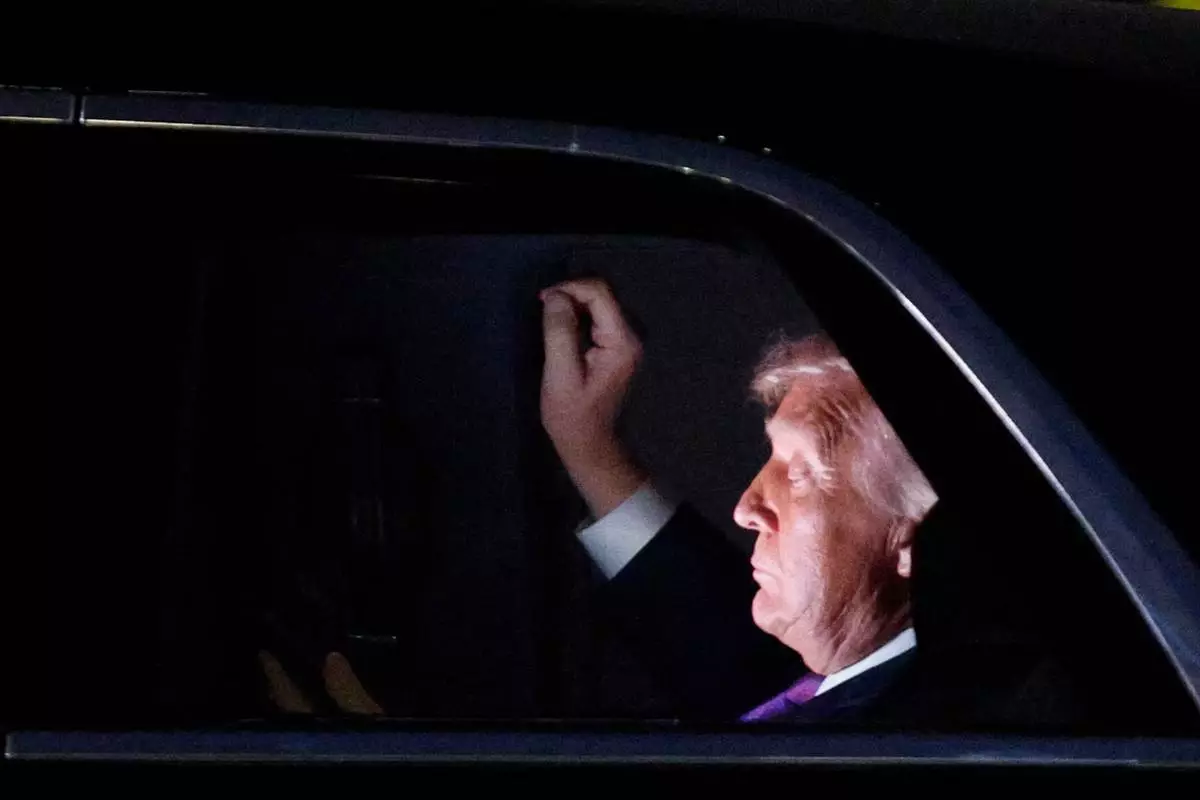
President Donald Trump is seen in his limousine, known as "The Beast," for the motorcade to the White House after his arrival on Air Force One at Joint Base Andrews, Md., Wednesday, March 11, 2026. (AP Photo/Luis M. Alvarez)
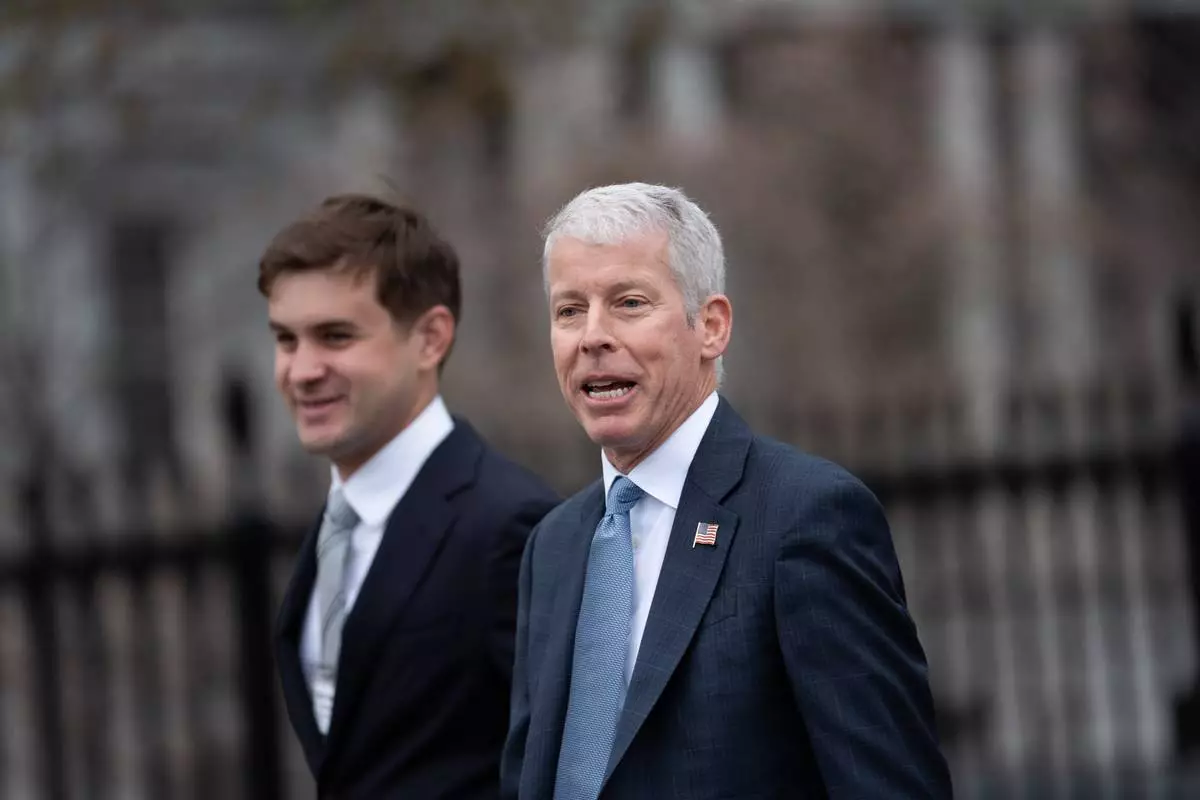
Energy Secretary Chris Wright walks to the White House following an interview with CNN, Thursday, March 12, 2026, in Washington. (AP Photo/Allison Robbert)