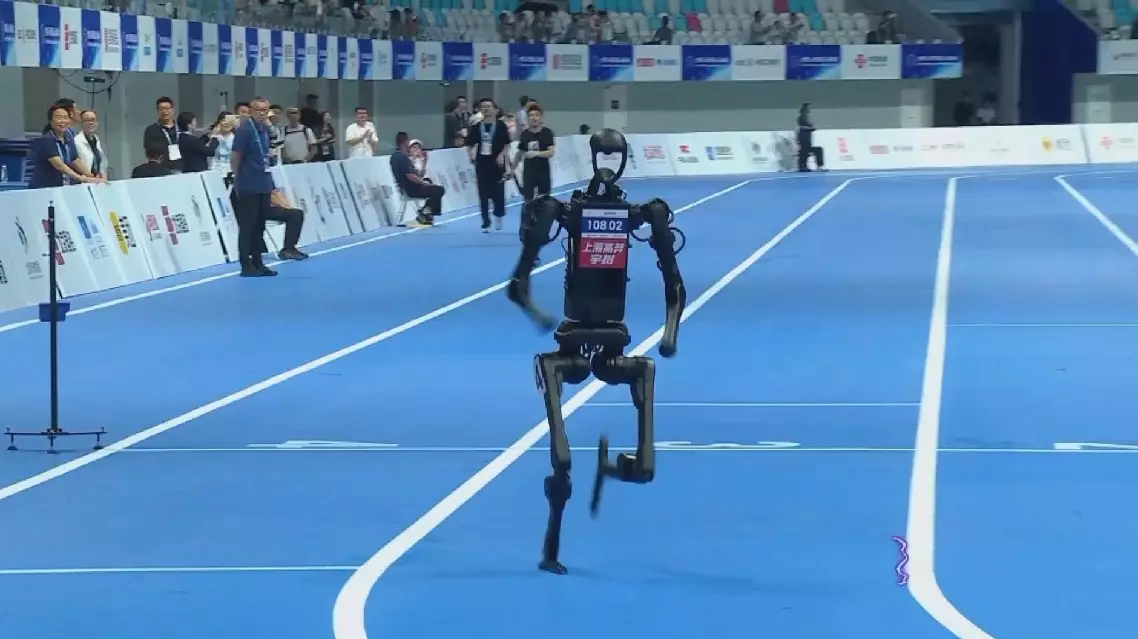
Unitree's H1 robot, a full-size, general-purpose humanoid robot, claimed the gold medal in the 400-meter race at the inaugural World Humanoid Robot Games in Beijing on Friday.
The historic competition took place at the National Speed Skating Oval, an Olympic venue known as the "Ice Ribbon."
Sixty-four teams competed across 16 preliminary heats, with 16 advancing to the second round and four ultimately qualifying for the final. Among the finalists, three were developed by the Beijing Innovation Center of Humanoid Robotics.
Notably, all three robots from the center completed the race using fully autonomous navigation, without any remote human control. They maintained stable gaits, followed precise running paths, and avoided stepping on lane lines -- demonstrating highly sophisticated and robust control systems.
"This is extremely challenging. A humanoid robot has more than 30 joints, so it is necessary to precisely control all of them, while having it to remain at a certain speed. Throughout the race, the robot must not fall, must strictly run along the set lane, and avoid stepping on lane lines or cutting across lanes. The fact that it did so shows the control algorithm is highly stable," said Tang Jian, chief technology officer of the innovation center.
The gold medal was secured by Shanghai Gaoyi Technology Company, a subsidiary of Hangzhou-based Unitree Robotics, which deployed the H1 robot to complete the race in 1 minute and 28.03 seconds.
Robots from the Beijing Innovation Center -- Tianzhuo, Tianxiao, and Tianjiao -- finished second, third, and fourth, with times of 1:35.92, 1:40.92, and 1:58.65, respectively.
"Our H1 robot actually still has much greater potential to unlock. For the next competition, I think the most important thing is to maintain continuous technological progress every month and every year," said Wang Xingxing, founder and CEO of Unitree Robotics.
The 2025 World Humanoid Robot Games marks a pivotal moment in the evolution of robotics, displaying rapid advancements in artificial intelligence, dynamic locomotion, and autonomous decision-making.
Running from Thursday to Sunday, the Games has attracted 280 teams from 16 countries, including the United States, Germany and Italy. Competitors will take part in 26 events, spanning running, long jump, free exercises and football, and skills-based tasks like moving materials, sorting drugs and cleaning across different scenarios.
Unitree's H1 robot wins 400m race at inaugural World Humanoid Robot Games

Hundreds of activists from Latin America, North America and Europe have arrived in Cuba as part of an international solidarity convoy, bringing over 20 tons of humanitarian aid for Cubans struggling with a severe economic and energy crisis.
The first members of the convoy arrived in Cuba by air while a second group is expected to come aboard a flotilla that sailed out of Mexico.
The first group was officially welcomed to Cuba during a ceremony in Havana, where Cuban President Miguel Diaz-Canel expressed appreciation for the solidarity at a critical time for the Cuban people.
The group brought humanitarian aid to local hospitals including medicines to treat cancer patients. The activists were briefed about the hardships currently being faced by Cubans.
Convoy organizers met with Cuban government officials and talked to the media about their initiative.
"There are deeply humanistic motivations for this convoy. That's why people are conducting these 'acopios,' these aid collections in their own communities, in their own plazas, in their own homes, packing suitcases full of basic medicines that the blockade seeks to prevent the Cuban people from accessing," said David Adler, a convoy coordinator.
Cubans have endured a deep economic crisis for the past few years, made worse by a U.S. embargo. A recent oil blockade against the country has caused a severe energy shortage.
"For us, it's a good opportunity because we are walking in the neighborhoods, we are talking to ordinary people, we are hearing people's stories. With no intermediaries, we are hearing how difficult life is right now, how it's been difficult over the last few years but how its gotten infinitely worse in the last three months because of the fuel blockade brought on by Trump," said Manolo De Los Santos, the executive director of The People's Forum.
The activists said their task is to shed light on what U.S. government policies are doing to Cuba. British Member of Parliament Jeremy Corbyn, who has joined other parliamentarians in the convoy, said that their presence in Cuba is sending a clear message.
"I think the images around the world of ordinary people coming to Cuba with the necessary equipment for children to be treated in hospital, to repair the damaged electricity system and all the rest of it is very important, and I think that will lead to pressure on governments all around the world," said Corbyn.
The 10th Summit of the Community of Latin American and Caribbean States (CELAC), which concluded in the Colombian capital Bogota on Saturday, adopted the Bogota Declaration, calling on relevant countries to abide by UN resolutions and end the economic, commercial and financial blockade against Cuba.
Cuban Foreign Minister Bruno Rodriguez said in his speech that Cuba is facing severe challenges and is engaged in a struggle for dignity and freedom. Cuba is willing to conduct serious and responsible dialogue with the United States on the basis of mutual respect, but the precondition is that neither side should interfere in each other's internal affairs or their respective political, economic and social systems.
Global activists arrive in Cuba with humanitarian aid