China has implemented a series of major ecological projects throughout Xizang Autonomous Region over the years to further strengthen its ecological security barriers and boost green development, fostering the harmonious coexistence between humans and nature on the snowy plateau.
In China's southwest region, a scientific expedition team has recently conducted routine protective experiments on the Kuqiong Gangri Glacier at an altitude of about 5,600 meters.
The team is part of China's second scientific expedition and research of the Qinghai-Xizang Plateau initiated in August 2017, aiming to reveal the mechanisms of environmental change and provide scientific support for the ecological security of the plateau.
Glaciers are the "white treasure" of the Qinghai-Xizang Plateau, playing an irreplaceable role in global climate regulation and biodiversity conservation, according to team members.
"From the lake you see up ahead, there are more lakes further down, then forming runoff that feeds into the Yarlung Zangbo River. In this way, glaciers, which begin with a single trickle, become the water resource on which billions of people depend. Glacier protection is imperative given their immense value," saig Yao Tandong, an academician of Chinese Academy of Sciences and also the team leader of the second comprehensive scientific expedition to Qinghai-Xizang Plateau.
In 2024, the Regulations of the Xizang Autonomous Region for Glacier Protection, China's first provincial-level special laws on glacier protection, came into effect.
This milestone marks a significant step in refining the core framework of Xizang's integrated ecological environment protection system, covering mountains, waters, forests, farmlands, lakes, grasslands, deserts, and glaciers.
In recent years, Xizang has vigorously pushed for a series of major ecological projects, including the afforestation project in the mountains north and south of Lhasa, protection and restoration of degraded wetlands, and the preservation of natural forests.
The comprehensive vegetation coverage of the grasslands in Xiang has increased to 48.07 percent, with the forest coverage stabilizing at 12.31 percent and the health index of rivers and lakes reaching 100 percent.
Meanwhile, Xizang has maintained excellent ambient air, water, and soil quality throughout, consolidating its position as one of the regions with the best ecological environments globally.
Xizang's development has extended far beyond preserving its clear waters and green mountains, with vigorous advancements in constructing clean energy bases such as solar and wind power. By the first half of 2025, clean energy sources accounted for over 99 percent of the region's total electricity generation.
A prime example is the clean energy industrial park in Nagqu's Seni District. Its photovoltaic power station greatly alleviates winter electricity shortages in Nagqu City while implementing a power generation-grazing integration model -- preserving pastures beneath the panels where yaks can graze.
"During the construction, we meticulously planned the routes. Initially, we removed the grass sod in advance and transferred it to our greenhouse for cultivation. Upon completion of the construction, we restored the grass sods to their original state," said Zhang Wenyu, head of the photovoltaic power station.
In addition, Xizang has also exemplified model practices in fostering harmonious coexistence between humans and nature.
At a national wetland park in Nagqu, over a million migratory birds arrive annually. Tashi Phuntsok, a wildlife ranger in the park, has devoted 23 years to safeguarding the birds' seasonal cycles -- overseeing their arrivals, rest periods, breeding activities, and subsequent migrations.
"In addition to these birds, I also take care of the fish in the lake and the yaks on the grasslands. We rely on each other, are closely interconnected, and cannot do without one another," he said.
Today, Xizang hosts habitats for 68 wildlife species under national first-class protection, including black-necked cranes and Tibetan antelopes, thanks to enhanced conservation efforts.
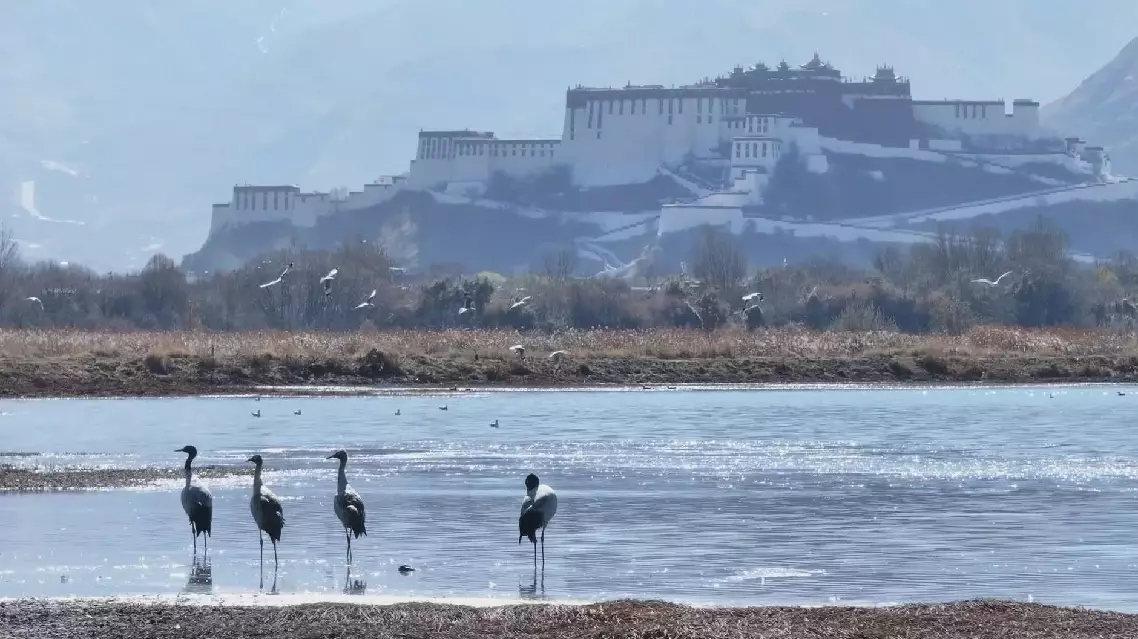
China bolsters Xizang's ecological security with major green projects