TORONTO (AP) — Air Canada and the union representing 10,000 flight attendants resumed talks late Monday for the first time since the strike began over the weekend. The strike is affecting about 130,000 travelers a day at the peak of the summer travel season.
It was the first time the two sides talked since early Saturday or late Friday. In an update to its members, the union said the airline reached out and the meeting occurred with the assistance of a mediator in Toronto.
Click to Gallery
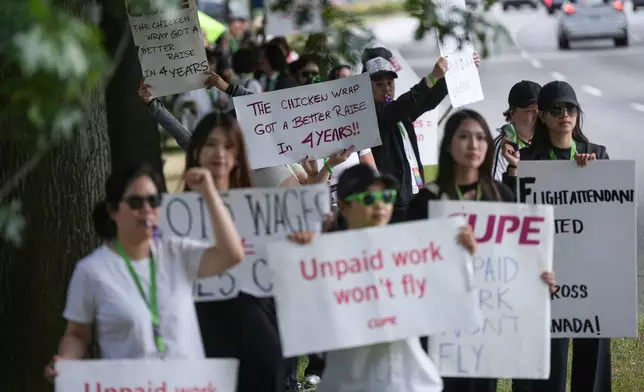
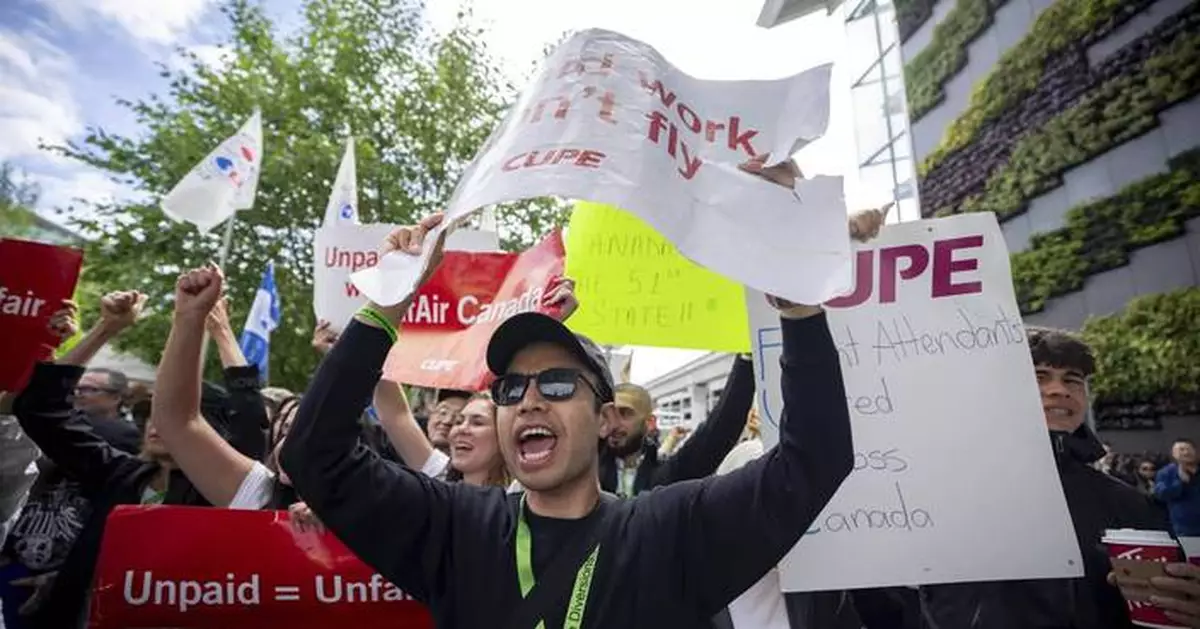
Striking Air Canada flight attendants rally at Vancouver International Airport, in Richmond, British Columbia, Monday, Aug. 18, 2025. (Darryl Dyck/The Canadian Press via AP)
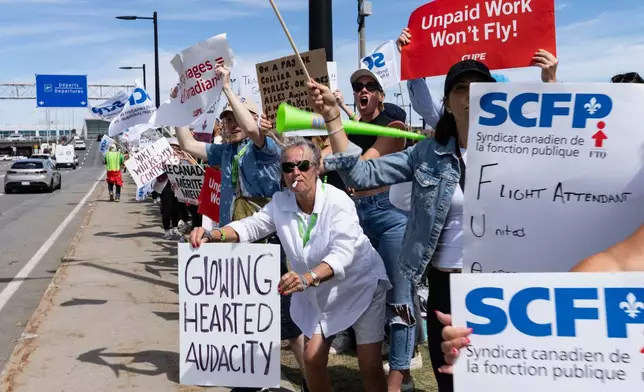
Air Canada flight attendants and supporters picket outside Montreal-Pierre Elliott Trudeau International Airport in Dorval, Quebec, Monday, Aug. 18, 2025. (Christinne Muschi/The Canadian Press via AP)
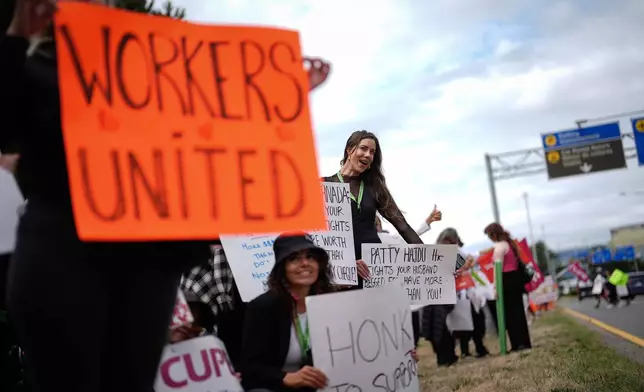
Striking Air Canada flight attendants rally at Vancouver International Airport, in Richmond, British Columbia, Monday, Aug. 18, 2025. (Darryl Dyck/The Canadian Press via AP)
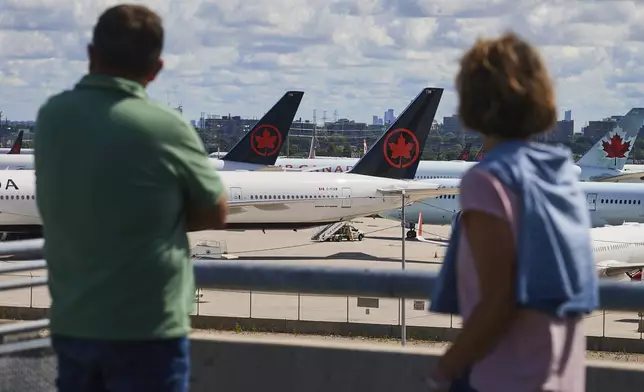
Travelers look out over grounded Air Canada planes as flight attendants picket at Pearson International Airport in Toronto, Monday, Aug. 18, 2025. (Sammy Kogan/The Canadian Press via AP)
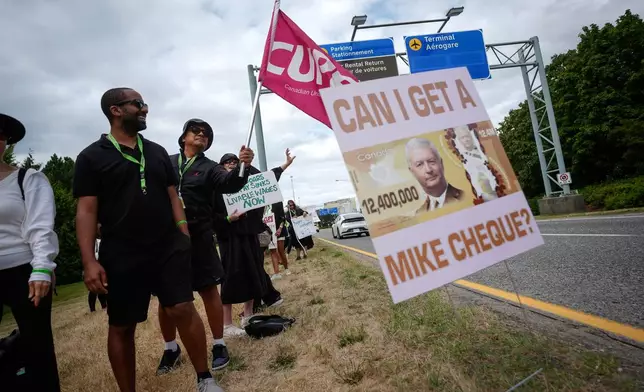
A sign with a photo of Air Canada CEO Michael Rousseau on it is seen as striking Air Canada flight attendants rally at Vancouver International Airport, in Richmond, British Columbia, Monday, Aug. 18, 2025. (/Darryl Dyck/The Canadian Press via AP)
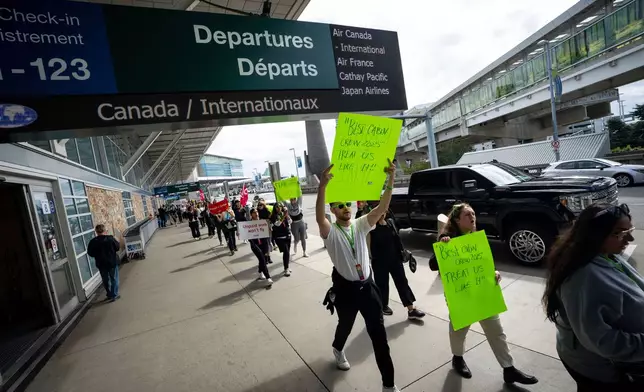
Picketers march around the departures level at the Vancouver International Airport in Richmond, British Columbia, Sunday, Aug. 17, 2025. (Ethan Cairns/The Canadian Press via AP)
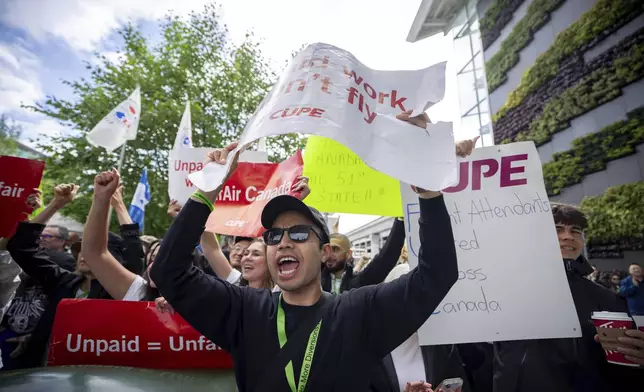
Picketers cheer as they hear news that Air Canada has halted a restart of operations at the Vancouver International Airport in Richmond, B.C., on Sunday, Aug. 17, 2025. (Ethan Cairns/The Canadian Press via AP)
It followed the union's declaration that the flight attendants won’t return to work even though the strike, now in its third day, has been declared illegal.
Earlier, Air Canada said rolling cancellations would now extend Tuesday afternoon after the union defied a second return-to-work order. The country's biggest airline had said earlier that operations would resume Monday evening but the union president said that won't happen.
“We will not be returning to the skies,” said Mark Hancock, national president for Canadian Union of Public Employees, or CUPE, which also represents some non-public sectors.
The Canada Industrial Relations Board had declared the strike illegal Monday and ordered the flight attendants back on the job. But the union said it would defy the directive. Union leaders also ignored a weekend order to submit to binding arbitration and end the strike by Sunday afternoon.
The board, an independent administrative tribunal that interprets and applies Canada’s labor laws, had said the union needed to provide written notice to all of its members by noon Monday that they must resume their duties.
“If it means folks like me going to jail, then so be it. If it means our union being fined, then so be it," Hancock said. "We’re looking for a solution here. Our members want a solution here, but solution has to be found at the bargaining table.”
It was not immediately clear what recourse the board or the government have if the union continues to refuse.
Labor leaders are objecting to the Canadian government’s repeated use of a law that cuts off workers' right to strike and forces them into arbitration, a step the government took in recent years with workers at ports, railways and elsewhere.
“We are in a situation where literally hundreds of thousands of Canadians and visitors to our country are being disrupted by this action,” Prime Minister Mark Carney said. “I urge both parties to resolve this as quickly as possible.”
Carney stressed it was important that flight attendants were compensated fairly at all times.
Jobs Minister Patty Hajdu said the federal government is launching a probe into the unions' allegations that flight attendants are not paid for work they do while airplanes are on the ground, and is considering introducing legislation to address the issue.
Air Canada operates around 700 flights per day. The airline estimated Monday that 500,000 customers would be affected by flight cancellations.
Aviation analytics firm Cirium said that as of Monday afternoon, Air Canada had called off at least 1,219 domestic flights and 1,339 international flights since last Thursday, when the carrier began gradually suspending its operations ahead of the strike and lockout.
Air Canada chief executive Michael Rousseau said he still was looking for a quick resolution.
“We’re obviously hoping we can go tomorrow, but we’ll make that decision later today,” Rousseau said on BNN Bloomberg shortly after the union announced it would continue with the strike.
Montreal resident Robert Brzymowski has been stranded in Prague along with his wife and their two children since Saturday, when Air Canada canceled their flight home from what was meant to be a two-week vacation visiting relatives.
Brzymowski, who consults businesses on energy-efficient practices, said he was set to start a new job Monday but lost out on the contract because he wasn’t back in Montreal in time.
“I wasn’t planning on losing my job over vacation,” he said.
Frustrated by what he described as a lack of communication from the airline, Brzymowski said he went to the airport in Prague on Monday morning and was able to get the airline to book them a new flight on Aug. 25 — more than a week after their original flight.
He said his children will also miss the first day of the new school year, and his wife won’t get paid for the week because she used the last of her paid time off for the year for this trip.
“I, for one, will never fly Air Canada again,” Brzymowski said. “I’ll take a boat if I have to.”
Flight attendants walked off the job early Saturday, after turning down the airline's request to enter into government-directed arbitration, which allows a third-party mediator to decide the terms of a new contract.
Air Canada and CUPE have been in contract talks for about eight months but remain far apart on the issue of pay and the unpaid work that flight attendants do when planes aren’t in the air.
The airline’s latest offer included a 38% increase in total compensation, including benefits and pensions, over four years, that it said “would have made our flight attendants the best compensated in Canada.”
But the union pushed back, saying the proposed 8% raise in the first year didn’t go far enough because of inflation.
Passengers whose flights are impacted will be eligible to request a full refund on the airline’s website or mobile app, according to Air Canada.
Airlines reporter Rio Yamat contributed to this report from Las Vegas.
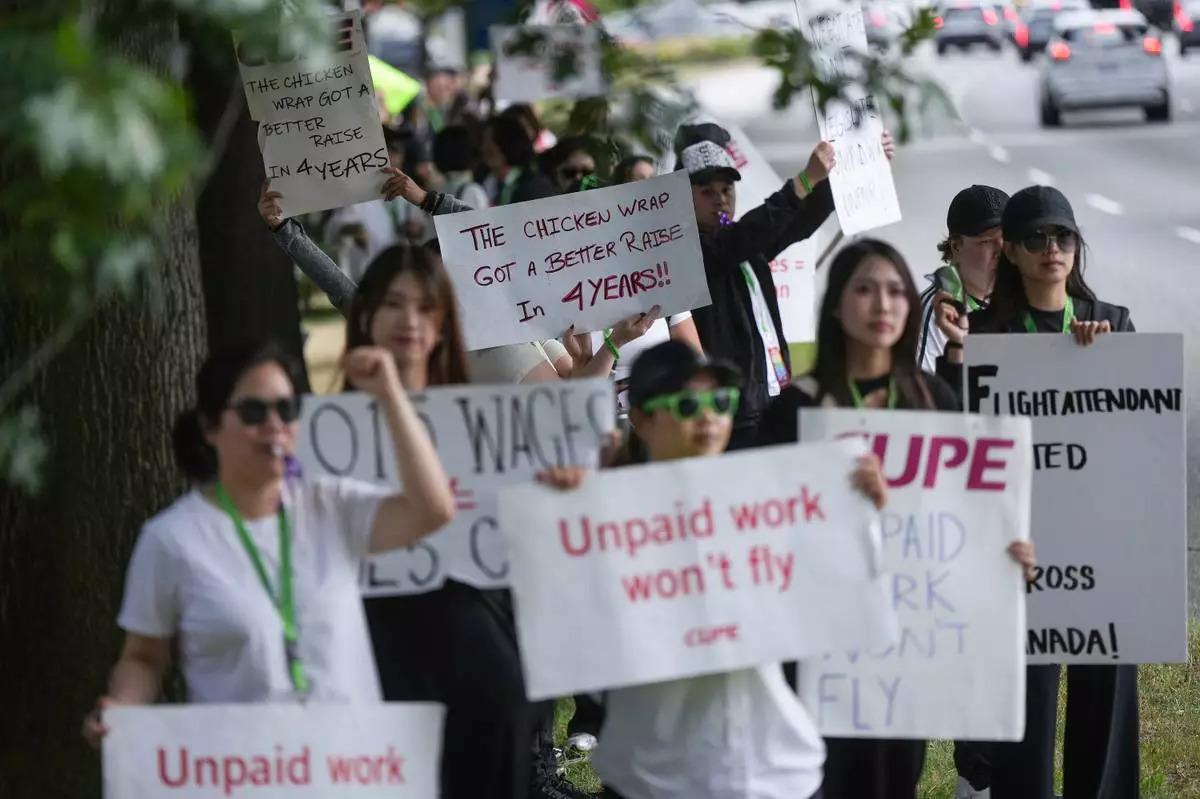
Striking Air Canada flight attendants rally at Vancouver International Airport, in Richmond, British Columbia, Monday, Aug. 18, 2025. (Darryl Dyck/The Canadian Press via AP)

Air Canada flight attendants and supporters picket outside Montreal-Pierre Elliott Trudeau International Airport in Dorval, Quebec, Monday, Aug. 18, 2025. (Christinne Muschi/The Canadian Press via AP)

Striking Air Canada flight attendants rally at Vancouver International Airport, in Richmond, British Columbia, Monday, Aug. 18, 2025. (Darryl Dyck/The Canadian Press via AP)
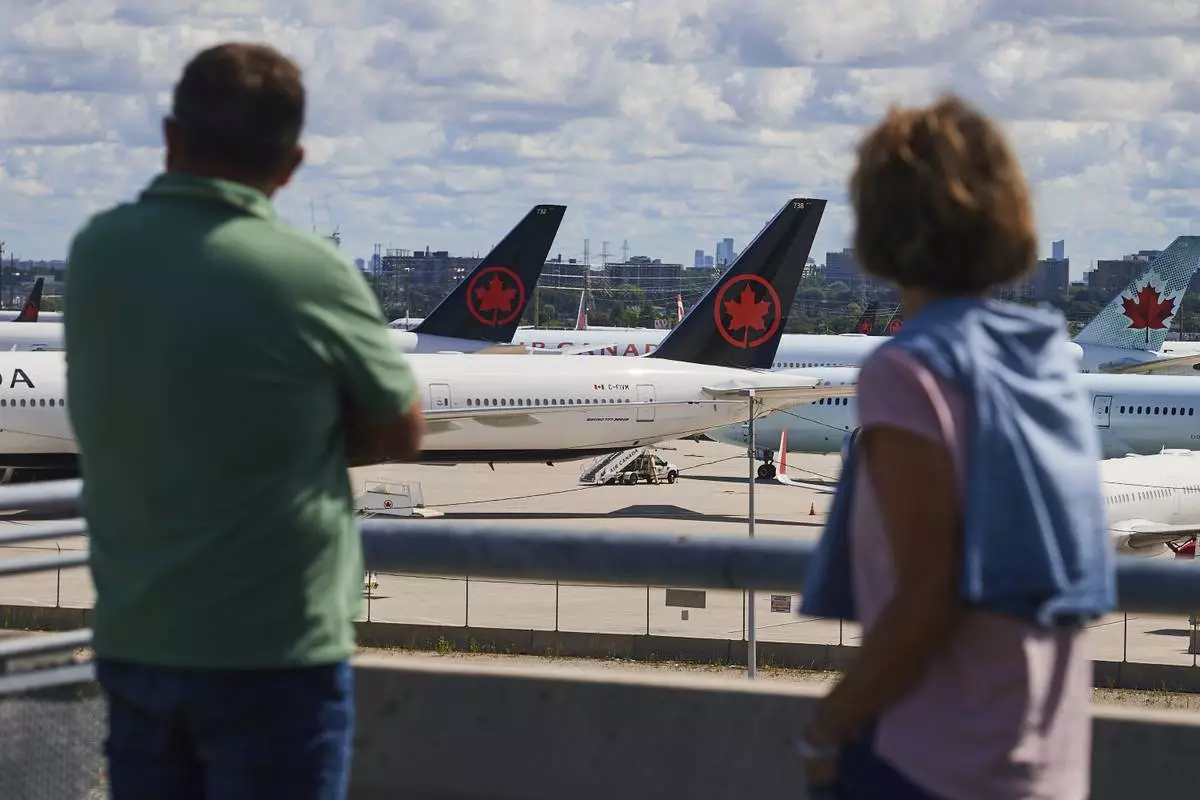
Travelers look out over grounded Air Canada planes as flight attendants picket at Pearson International Airport in Toronto, Monday, Aug. 18, 2025. (Sammy Kogan/The Canadian Press via AP)
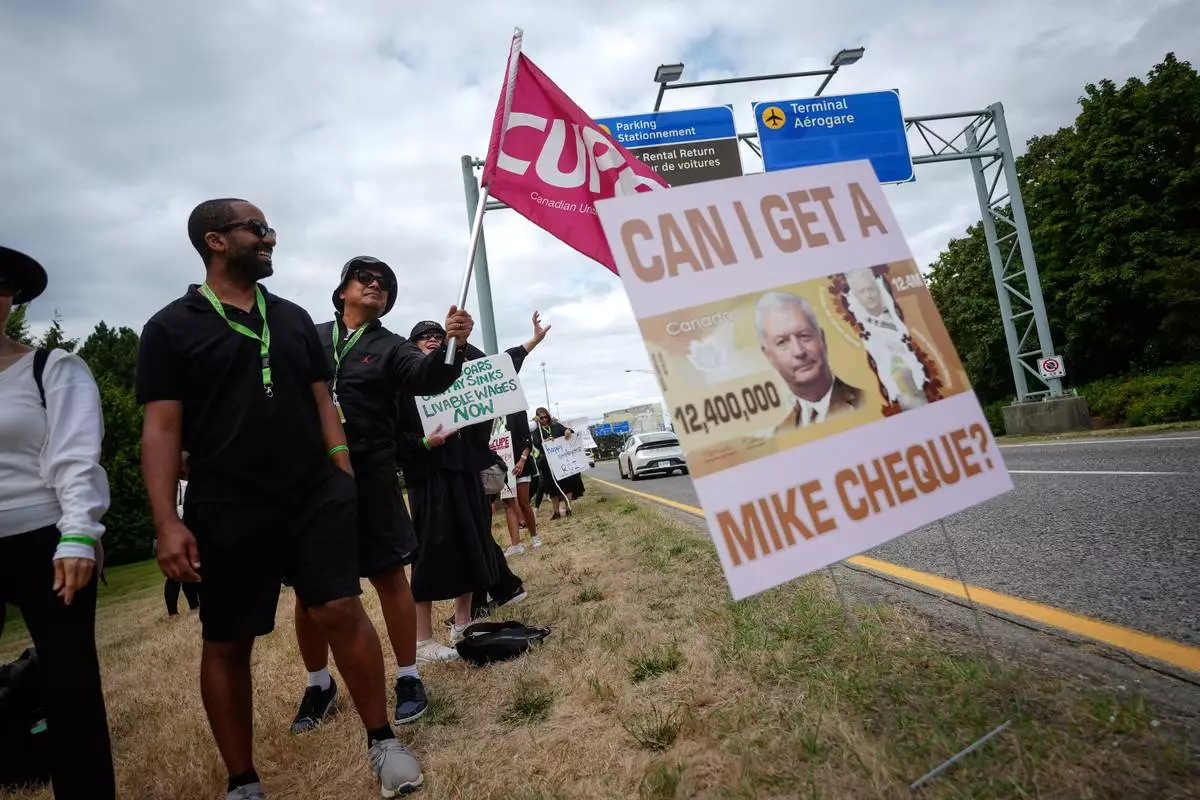
A sign with a photo of Air Canada CEO Michael Rousseau on it is seen as striking Air Canada flight attendants rally at Vancouver International Airport, in Richmond, British Columbia, Monday, Aug. 18, 2025. (/Darryl Dyck/The Canadian Press via AP)
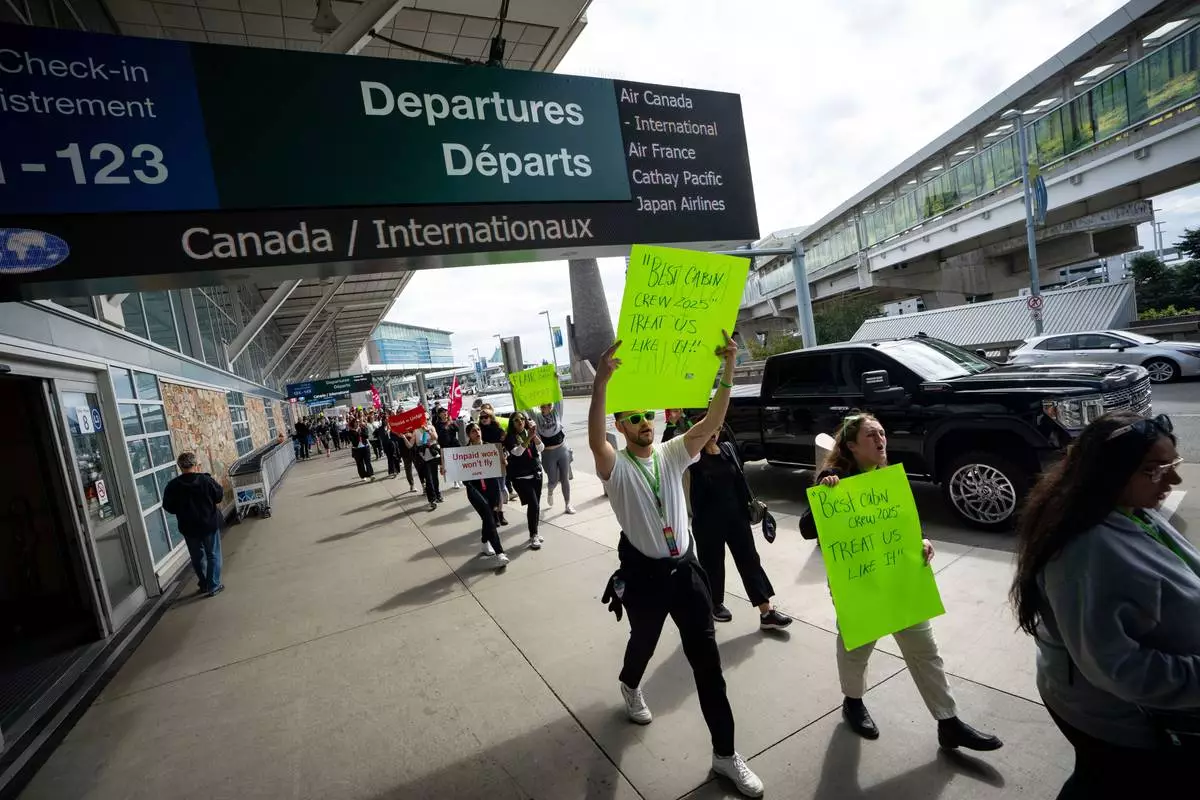
Picketers march around the departures level at the Vancouver International Airport in Richmond, British Columbia, Sunday, Aug. 17, 2025. (Ethan Cairns/The Canadian Press via AP)

Picketers cheer as they hear news that Air Canada has halted a restart of operations at the Vancouver International Airport in Richmond, B.C., on Sunday, Aug. 17, 2025. (Ethan Cairns/The Canadian Press via AP)