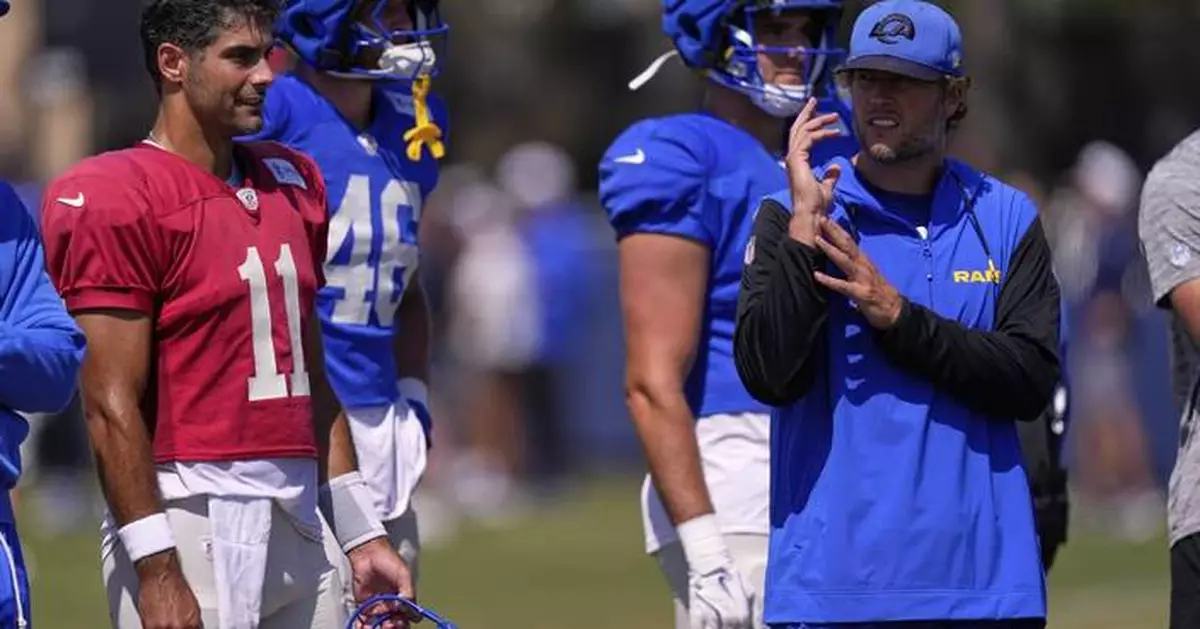
LOS ANGELES (AP) — Matthew Stafford went through his second practice of the summer with the Rams on Tuesday, and coach Sean McVay seemed encouraged by his starting quarterback’s progress in his recovery from an injured disk in his back.
“I thought he looked good,” McVay said. “I thought he looked better than yesterday. I thought it was a step in the right direction. And we’re going to continue to hope that he’s able to stack days and feel good, and it’s what’s happened so far.”
McVay remains cautiously optimistic about Stafford’s progress after missing all of the Rams’ two-week training camp at Loyola Marymount University and the past two weeks of preseason work at the team’s facility in the San Fernando Valley, while balancing it with an awareness any sort of twinge or soreness could reset the quarterback’s progress.
“Backs can be a volatile thing,” McVay said. “This is definitely positive progress. But what I think you want to be able to say is, hopefully after a few minutes, settle down, ‘Am I still feeling good? Do I wake up tomorrow still feeling good?’ And those are the steps that I think are the appropriate measures to be able to take. But it certainly is trending in a positive direction for us.”
McVay said Stafford did more in terms of challenging himself against a live pass rush, including moving in the pocket, working with the first-team offense against the starting defense. Stafford could share his assessment for the first time later this week as he is scheduled to meet with the media Thursday barring any setbacks.
McVay declined to answer if Stafford has received additional epidural injections to allow him to resume practicing, preferring to keep the matter internal.
McVay also said he has not decided if Stafford or other senior players will travel with the Rams for their last preseason game against the Cleveland Browns on Saturday.
AP NFL: https://apnews.com/hub/NFL
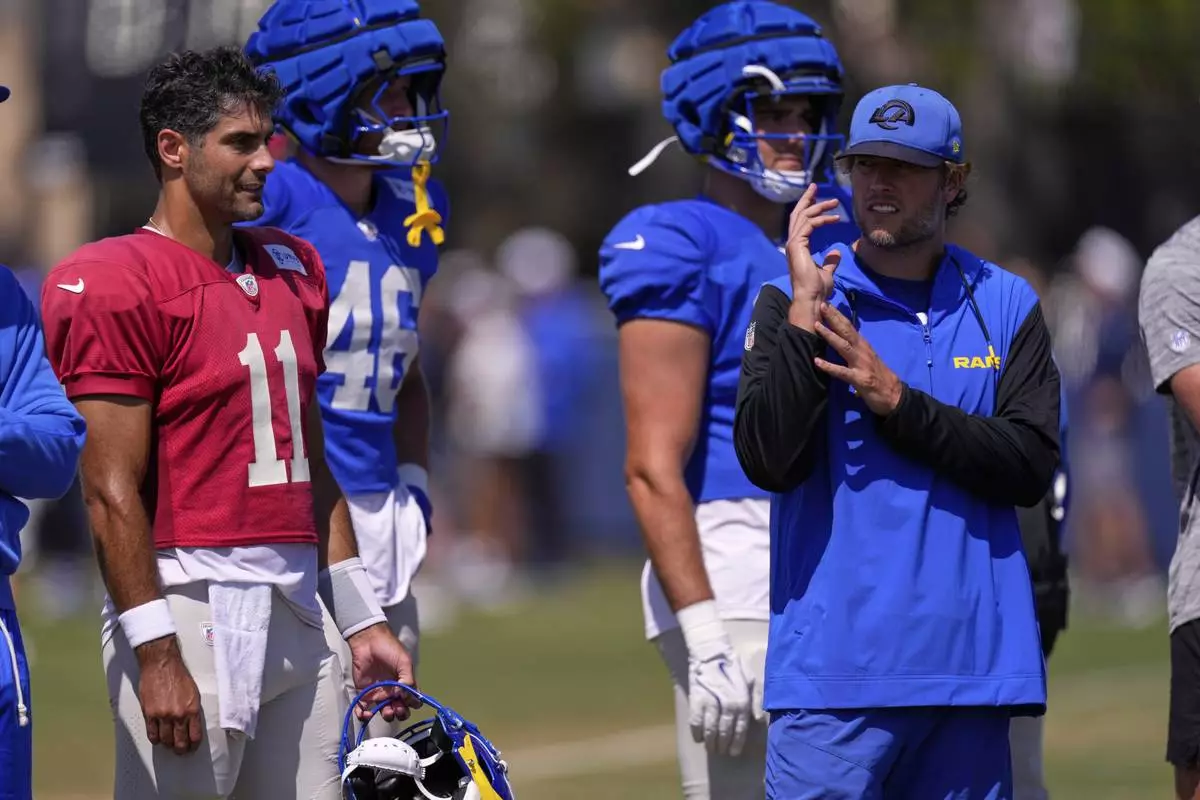
Los Angeles Rams quarterback Jimmy Garoppolo, left, talks with quarterback Matthew Stafford during a training camp scrimmage against the Dallas Cowboys, Tuesday, Aug. 5, 2025, in Oxnard, Calif. (AP Photo/Mark J. Terrill)
MIAMI (AP) — Some oil vessels are diverting away from Venezuela after U.S. President Donald Trump threatened a “blockade” of sanctioned oil tankers entering or leaving the South American country, a dramatic escalation in the White House’s pressure campaign on leader Nicolás Maduro.
Trump said Tuesday on social media, in all caps, that he is ordering a "total and complete blockade of all sanctioned oil tankers” into and out of Venezuela, a move that threatens to choke off revenue from the world's largest oil reserves that are key to Maduro's grip on power.
It’s not clear exactly what Trump meant by his threats. U.S. sanctions adopted during his first administration make it illegal for Americans to purchase Venezuela’s crude oil without a license from the Treasury Department.
Additionally, hundreds of ships themselves have been sanctioned — part of a massive shadow fleet of often aging vessels that has proliferated in recent years to transport oil on behalf of Iran, Russia, Venezuela and other U.S. adversaries under sanctions.
At least 30 vessels under sanctions are navigating near Venezuela, according to Windward, a maritime intelligence firm that helps U.S. officials target the shadow fleet. A few have started to change their course, perhaps fearing they could face the same fate as the Skipper, a sanctioned vessel seized by U.S. forces last week near Venezuela.
“It’s quite clear that this has disrupted energy flows to and from Venezuela,” said Michelle Wiese Bockmann, a senior analyst at Windward. "Every hour when we’re tracking these vessels, we are seeing tankers that are deviating, loitering or changing their behavior.”
Among those is the Hyperion, which had been sailing toward the Jose port in Venezuela before doing a 90-degree turn early Wednesday and starting to head north away from the South American mainland.
The vessel, previously part of Russia’s state-owned shipping fleet, was one of 173 sanctioned in the final days of the Biden administration for allegedly facilitating Russian oil sales in violation of sanctions over Moscow’s invasion of Ukraine.
Following the penalties, the vessel changed its flag from the Comoros to Gambia. But the West African nation deleted Hyperion — along with dozens of other vessels — from its privately run ship registry in November for allegedly using false certificates claiming to have been issued by its maritime authority.
The vessel’s ownership also is obfuscated under multiple layers of offshore companies, some of them listed in Dubai, United Arab Emirates.
“It’s just screaming that it’s in a position to be seized,” Wiese Bockmann said.
Since the first Trump administration imposed punishing oil sanctions on Venezuela in 2017, Maduro’s government has boosted its reliance on a network of rogue tankers to smuggle a growing share of the roughly 900,000 barrels of oil per day that the OPEC nation produces.
Sanctioned tankers carried about 18% of Venezuela’s international shipments during the second half of this year, up from 6% in the first half of the year, according to Jim Burkhard, global head of oil markets and mobility at S&P Global Energy.
Burkhard said that while supplies to China, the main destination for most Venezuelan oil, could be affected, he doesn't expect any major disruption to oil markets.
“Volatility or uncertainty around Venezuela is not new, it’s not a shock,” he said. Markets also react more when supplies of oil are scarce, and “the market today is not tight. There’s plenty of oil.”
Unaffected for now is the roughly 143,000 barrels per day of Venezuelan heavy crude sent to U.S. refineries along the Gulf coast, much of it transported by Chevron, which has a waiver to operate in Venezuela.
“Chevron’s operations in Venezuela continue without disruption and in full compliance with laws and regulations applicable to its business, as well as the sanctions frameworks provided for by the U.S. government," spokesman Bill Turenne said.
Still, for the industry's rogue actors, Trump's threat of a blockade represents a paradigm shift.
“There are already ships that have decided not to leave Venezuela for fear of being seized, and there are also ships headed to Venezuela to load crude oil that decided to turn back," said Francisco Monaldi, a Venezuelan oil expert at Rice University in Houston.
That's good news for the oceans, where hundreds of vessels, many without insurance and poorly maintained, were a constant menace.
"Many of these are no more than floating rust buckets," said Wiese Bockmann, the Windward analyst. "So irrespective of the sanctions and the geopolitical reasons for their being targeted, it is a good thing to have a strategy to deal with them and to remove them from trading.”
Associated Press writer Michael Biesecker and Michelle L. Price in Washington, Regina Garcia Cano in Caracas, Venezuela, and David McHugh in Frankfurt, Germany, contributed to this report.
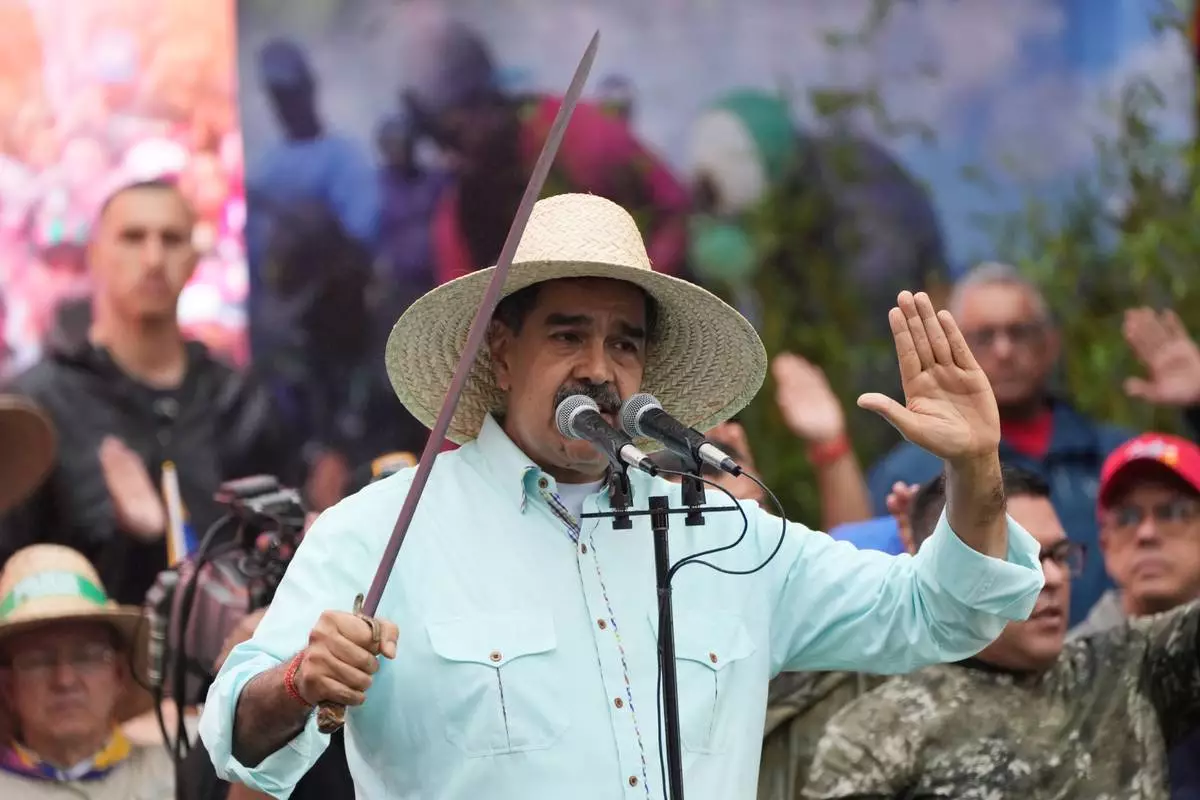
President Nicolas Maduro addresses supporters during a rally marking the anniversary of the Battle of Santa Ines, which took place during Venezuela's 19th-century Federal War, in Caracas, Venezuela, Wednesday, Dec. 10, 2025. (AP Photo/Ariana Cubillos)